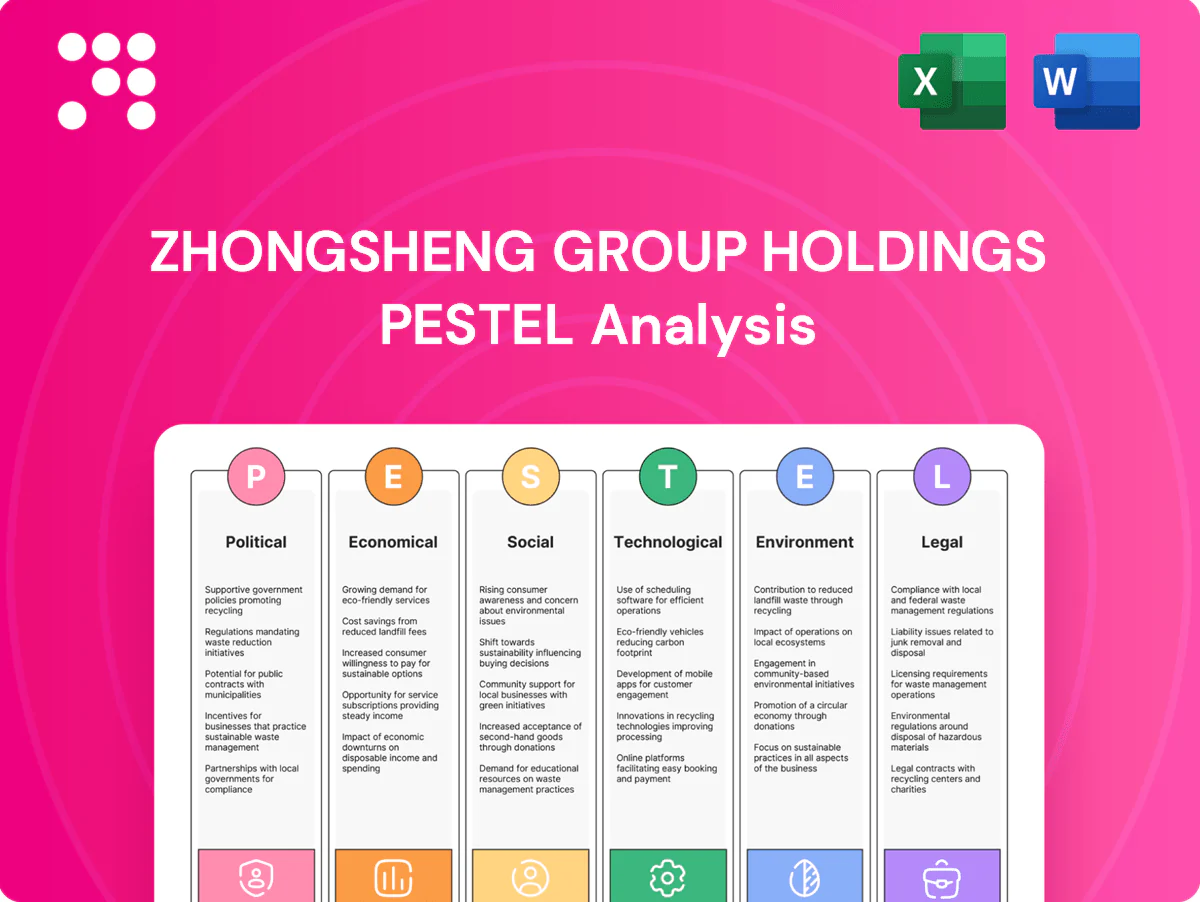
Zhongsheng Group Holdings PESTLE Analysis

Plan Smarter. Present Sharper. Compete Stronger.
Unlock strategic clarity with our concise PESTLE Analysis of Zhongsheng Group Holdings—highlighting political risks, economic drivers, social trends, tech disruptors, legal pressures, and environmental factors affecting its growth. Ideal for investors and strategists seeking actionable context; buy the full report for a complete, ready-to-use breakdown and immediate insights.
Political factors

NEV policy direction
China’s industrial policy prioritizes NEVs through tax breaks and purchase incentives, with NEV retail sales reaching about 9.5 million units and ~38% penetration in 2024, steering dealer mix toward EVs and PHEVs. Zhongsheng’s multi-brand portfolio must align with NEV credit/quota requirements to secure allocations and avoid penalties. Sudden policy shifts can rapidly change demand and inventory plans, so active engagement with OEMs is essential to synchronize supply with incentives.
License plate controls
Major cities maintain license plate lotteries/auctions for ICE vehicles (Beijing, Shanghai) while loosening NEV quotas, driving showroom traffic and model mix divergence across Tier‑1 versus Tier‑3/4 markets. NEV penetration rose to about 40% of passenger car sales in 2024, amplifying demand in quota‑friendly regions. Zhongsheng should channel marketing to NEV‑friendly locales and align stocking strategies with local registration rules and auction cycles.

Trade and tariff risks
Zhongsheng Group Holdings (HKEX: 0881) faces trade and tariff risks as geopolitical tensions can trigger additional duties or approvals on imported luxury models, compounding the baseline 15% import tariff on passenger cars and squeezing margins. Import delays or price hikes depress sales volumes and used-vehicle margins, while shifting mix toward locally produced premium models reduces exposure. Continuous monitoring of China Customs and policy notices is essential to respond to tariff or quota changes.

Local subsidies variability
Provincial and municipal incentives for car purchases and scrappage vary by locale and timing, creating short demand windows that affect volume and margins.
Zhongsheng, with over 1,100 sales and service outlets across ~260 cities, can reallocate inventory to subsidy-active markets and run coordinated campaigns to capture these short windows.
- Local incentives fluctuate by city and month
- Network scale enables inventory shifts
- Coordinated marketing targets subsidy windows
Government procurement stance
Official fleets in China are increasingly favoring NEVs and domestic brands, reflecting a NEV penetration in new vehicle registrations near 35% in 2024; while retail sales remain dominant, institutional orders offer volume anchors that can stabilize procurement cycles. Zhongsheng’s emphasis on compliant NEV models and tailored service packages improves tender win rates, and alignment with sustainability targets (carbon neutrality pledges across provinces) enhances eligibility for large public procurements.
- NEV penetration ~35% (2024)
- Institutional orders = volume anchor
- Compliant models + service packages = higher tender success
- Sustainability alignment increases eligibility
China NEV surge: 9.5m retail (38%) forces dealer network to optimize allocations
China NEV policy and city plate rules drove 2024 NEV retail ~9.5m units (~38% penetration); Zhongsheng must align allocations, pricing and inventory with NEV credits, tariffs and local incentives. Trade tariffs (15% baseline) and geopolitical risks pressure imported luxury margins. Large network enables rapid reallocation to subsidy hotspots and institutional NEV tenders.
| Metric | 2024 | Impact |
|---|---|---|
| NEV retail | 9.5m / 38% | Shift to EV/PHEV |
| Import tariff | 15% | Margin squeeze |
| Outlets | 1,100 / 260 cities | Inventory flexibility |
| Institutional NEV share | 35% | Stable demand |
What is included in the product
 Detailed Word Document
Examines how Political, Economic, Social, Technological, Environmental and Legal forces uniquely impact Zhongsheng Group Holdings, using data-driven insights and trend analysis to identify risks, opportunities and strategic responses for executives, investors and planners in the China auto retail and services market.

 Customizable Excel Spreadsheet
A concise, visually segmented PESTLE summary of Zhongsheng Group Holdings that distills regulatory, economic, social, technological, environmental and legal implications for quick decision-making; editable and presentation‑ready for slides, team alignment, and on‑the‑go review.
Economic factors

Consumer income trends
Luxury and mid-high auto demand for Zhongsheng closely follows disposable income and wealth effects; China's per capita disposable income rose about 5% in 2024 (NBS), supporting premium sales in 1H24. Property-market softness and slower GDP growth can curb big-ticket purchases, pressuring new-vehicle sales. Geographic tier diversification across Tier-1 to Tier-3 cities smooths regional volatility, while premium after-sales services stabilize revenue during downcycles.
Credit and rates
Auto financing uptake is highly rate-sensitive: with China’s 1-year LPR at 3.65% (2023–24 benchmark), PBOC easing in 2024 improved affordability and enabled upselling, while tightening would cut conversions. Zhongsheng’s captive and partner finance options cushion consumers from rate swings and supported a financing penetration near industry levels (~50–56% for new-car purchases in 2023). Robust risk controls and strict credit underwriting limit delinquency exposure.

Price wars and margins
Intense OEM discounting, especially in NEVs, has compressed dealer gross margins as BYD captured about 30% of China NEV retail in 2024, amplifying price competition. Agile pricing and value-added bundles help preserve unit economics while protecting ASP. After-sales and F&I increasingly drive profitability, often contributing 25–30% of dealer profits. Strict inventory discipline—targeting under 45 days—reduces exposure to rapid MSRP swings.

Used-car market growth
Policy support expanding trade-in channels boosts Zhongsheng’s used-car volumes, while healthy residual values facilitate equity transfers that support new-vehicle purchases; certified pre-owned programs enhance margins and customer retention, and data-driven appraisal tools cut valuation risk and return volatility.
- Trade-in expansion
- Residuals support new sales
- Certified pre-owned margins
- Data-driven valuation
Supply chain normalization
Chip and logistics constraints have eased, with semiconductor lead times down about 50% to roughly 14 weeks by 2024, but supply remains uneven across models, creating allocation volatility that can boost showroom wait times by as much as 4–6 weeks.
- Allocation volatility: +4–6 week wait
- Lead-time improvement: ~50% to ~14 weeks (2024)
- Balanced brand mix: reduces single-OEM risk
- Transparent communication: preserves ~20–25% conversion
China NEV surge: 9.5m retail (38%) forces dealer network to optimize allocations
China per-capita disposable income +5% in 2024 (NBS) supported premium sales; 1-yr LPR 3.65% eased financing; financing penetration ~52% (2023) aided conversions. BYD ~30% NEV retail (2024) intensified margin pressure; F&I/after-sales ~25–30% dealer profits. Inventory target <45 days; semiconductor lead times ~14 weeks (2024) causing 4–6 week allocation volatility.
| Metric | 2023–24 |
|---|---|
| Per-capita disposable income | +5% (2024) |
| 1-yr LPR | 3.65% |
| Financing penetration | ~52% |
| BYD NEV share | ~30% |
| Lead time (chips) | ~14 weeks |
Preview the Actual Deliverable
Zhongsheng Group Holdings PESTLE Analysis
The Zhongsheng Group Holdings PESTLE Analysis shown here is the exact document you’ll receive after purchase—fully formatted and ready to use. It contains the full political, economic, social, technological, legal, and environmental assessment as displayed. No placeholders or teasers; this is the final, downloadable file.

Original: $10.00
-65%$10.00
$3.50Product Information
Product Information
Shipping & Returns
Shipping & Returns
Description
Plan Smarter. Present Sharper. Compete Stronger.
Unlock strategic clarity with our concise PESTLE Analysis of Zhongsheng Group Holdings—highlighting political risks, economic drivers, social trends, tech disruptors, legal pressures, and environmental factors affecting its growth. Ideal for investors and strategists seeking actionable context; buy the full report for a complete, ready-to-use breakdown and immediate insights.
Political factors
NEV policy direction
China’s industrial policy prioritizes NEVs through tax breaks and purchase incentives, with NEV retail sales reaching about 9.5 million units and ~38% penetration in 2024, steering dealer mix toward EVs and PHEVs. Zhongsheng’s multi-brand portfolio must align with NEV credit/quota requirements to secure allocations and avoid penalties. Sudden policy shifts can rapidly change demand and inventory plans, so active engagement with OEMs is essential to synchronize supply with incentives.
License plate controls
Major cities maintain license plate lotteries/auctions for ICE vehicles (Beijing, Shanghai) while loosening NEV quotas, driving showroom traffic and model mix divergence across Tier‑1 versus Tier‑3/4 markets. NEV penetration rose to about 40% of passenger car sales in 2024, amplifying demand in quota‑friendly regions. Zhongsheng should channel marketing to NEV‑friendly locales and align stocking strategies with local registration rules and auction cycles.
Trade and tariff risks
Zhongsheng Group Holdings (HKEX: 0881) faces trade and tariff risks as geopolitical tensions can trigger additional duties or approvals on imported luxury models, compounding the baseline 15% import tariff on passenger cars and squeezing margins. Import delays or price hikes depress sales volumes and used-vehicle margins, while shifting mix toward locally produced premium models reduces exposure. Continuous monitoring of China Customs and policy notices is essential to respond to tariff or quota changes.
Local subsidies variability
Provincial and municipal incentives for car purchases and scrappage vary by locale and timing, creating short demand windows that affect volume and margins.
Zhongsheng, with over 1,100 sales and service outlets across ~260 cities, can reallocate inventory to subsidy-active markets and run coordinated campaigns to capture these short windows.
- Local incentives fluctuate by city and month
- Network scale enables inventory shifts
- Coordinated marketing targets subsidy windows
Government procurement stance
Official fleets in China are increasingly favoring NEVs and domestic brands, reflecting a NEV penetration in new vehicle registrations near 35% in 2024; while retail sales remain dominant, institutional orders offer volume anchors that can stabilize procurement cycles. Zhongsheng’s emphasis on compliant NEV models and tailored service packages improves tender win rates, and alignment with sustainability targets (carbon neutrality pledges across provinces) enhances eligibility for large public procurements.
- NEV penetration ~35% (2024)
- Institutional orders = volume anchor
- Compliant models + service packages = higher tender success
- Sustainability alignment increases eligibility
China NEV surge: 9.5m retail (38%) forces dealer network to optimize allocations
China NEV policy and city plate rules drove 2024 NEV retail ~9.5m units (~38% penetration); Zhongsheng must align allocations, pricing and inventory with NEV credits, tariffs and local incentives. Trade tariffs (15% baseline) and geopolitical risks pressure imported luxury margins. Large network enables rapid reallocation to subsidy hotspots and institutional NEV tenders.
| Metric | 2024 | Impact |
|---|---|---|
| NEV retail | 9.5m / 38% | Shift to EV/PHEV |
| Import tariff | 15% | Margin squeeze |
| Outlets | 1,100 / 260 cities | Inventory flexibility |
| Institutional NEV share | 35% | Stable demand |
What is included in the product
Detailed Word Document
Examines how Political, Economic, Social, Technological, Environmental and Legal forces uniquely impact Zhongsheng Group Holdings, using data-driven insights and trend analysis to identify risks, opportunities and strategic responses for executives, investors and planners in the China auto retail and services market.
Customizable Excel Spreadsheet
A concise, visually segmented PESTLE summary of Zhongsheng Group Holdings that distills regulatory, economic, social, technological, environmental and legal implications for quick decision-making; editable and presentation‑ready for slides, team alignment, and on‑the‑go review.
Economic factors
Consumer income trends
Luxury and mid-high auto demand for Zhongsheng closely follows disposable income and wealth effects; China's per capita disposable income rose about 5% in 2024 (NBS), supporting premium sales in 1H24. Property-market softness and slower GDP growth can curb big-ticket purchases, pressuring new-vehicle sales. Geographic tier diversification across Tier-1 to Tier-3 cities smooths regional volatility, while premium after-sales services stabilize revenue during downcycles.
Credit and rates
Auto financing uptake is highly rate-sensitive: with China’s 1-year LPR at 3.65% (2023–24 benchmark), PBOC easing in 2024 improved affordability and enabled upselling, while tightening would cut conversions. Zhongsheng’s captive and partner finance options cushion consumers from rate swings and supported a financing penetration near industry levels (~50–56% for new-car purchases in 2023). Robust risk controls and strict credit underwriting limit delinquency exposure.
Price wars and margins
Intense OEM discounting, especially in NEVs, has compressed dealer gross margins as BYD captured about 30% of China NEV retail in 2024, amplifying price competition. Agile pricing and value-added bundles help preserve unit economics while protecting ASP. After-sales and F&I increasingly drive profitability, often contributing 25–30% of dealer profits. Strict inventory discipline—targeting under 45 days—reduces exposure to rapid MSRP swings.
Used-car market growth
Policy support expanding trade-in channels boosts Zhongsheng’s used-car volumes, while healthy residual values facilitate equity transfers that support new-vehicle purchases; certified pre-owned programs enhance margins and customer retention, and data-driven appraisal tools cut valuation risk and return volatility.
- Trade-in expansion
- Residuals support new sales
- Certified pre-owned margins
- Data-driven valuation
Supply chain normalization
Chip and logistics constraints have eased, with semiconductor lead times down about 50% to roughly 14 weeks by 2024, but supply remains uneven across models, creating allocation volatility that can boost showroom wait times by as much as 4–6 weeks.
- Allocation volatility: +4–6 week wait
- Lead-time improvement: ~50% to ~14 weeks (2024)
- Balanced brand mix: reduces single-OEM risk
- Transparent communication: preserves ~20–25% conversion
China NEV surge: 9.5m retail (38%) forces dealer network to optimize allocations
China per-capita disposable income +5% in 2024 (NBS) supported premium sales; 1-yr LPR 3.65% eased financing; financing penetration ~52% (2023) aided conversions. BYD ~30% NEV retail (2024) intensified margin pressure; F&I/after-sales ~25–30% dealer profits. Inventory target <45 days; semiconductor lead times ~14 weeks (2024) causing 4–6 week allocation volatility.
| Metric | 2023–24 |
|---|---|
| Per-capita disposable income | +5% (2024) |
| 1-yr LPR | 3.65% |
| Financing penetration | ~52% |
| BYD NEV share | ~30% |
| Lead time (chips) | ~14 weeks |
Preview the Actual Deliverable
Zhongsheng Group Holdings PESTLE Analysis
The Zhongsheng Group Holdings PESTLE Analysis shown here is the exact document you’ll receive after purchase—fully formatted and ready to use. It contains the full political, economic, social, technological, legal, and environmental assessment as displayed. No placeholders or teasers; this is the final, downloadable file.