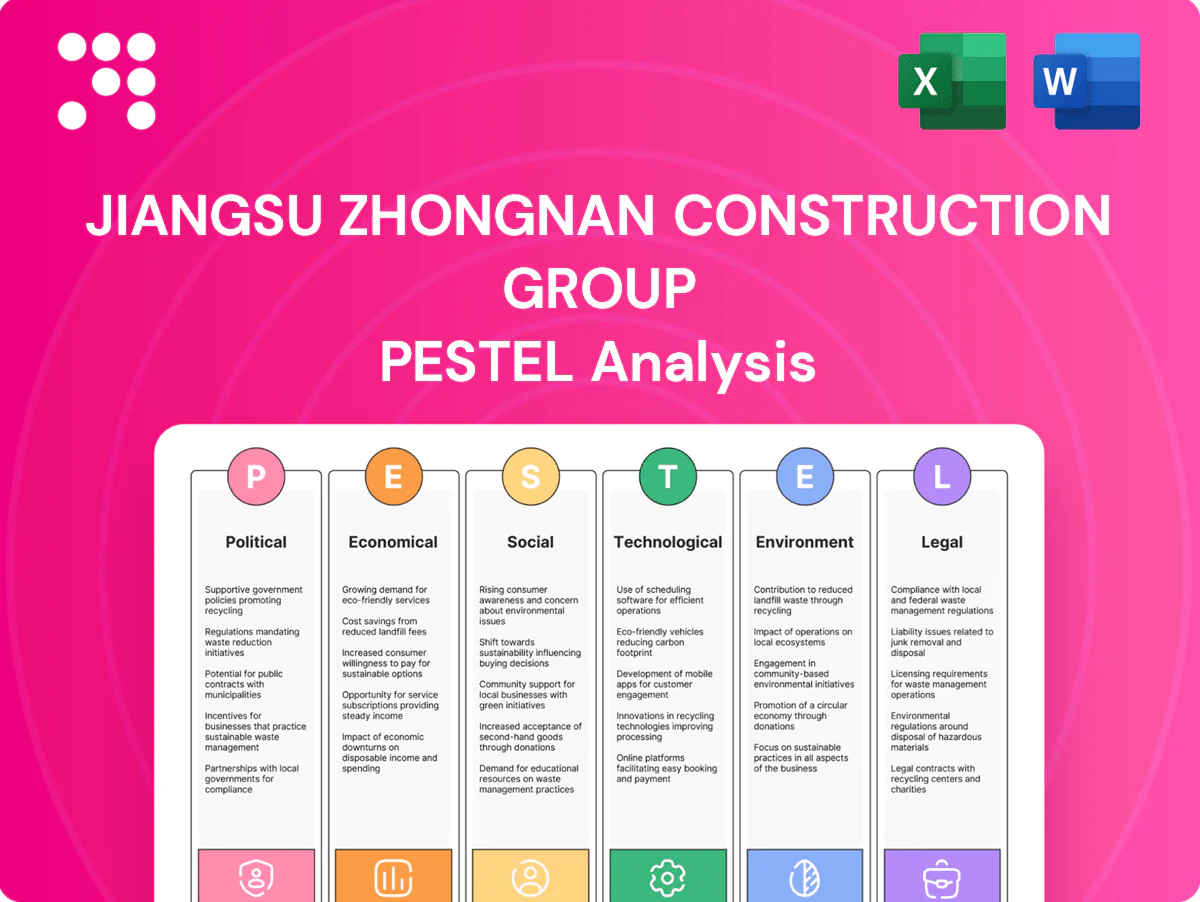
Jiangsu Zhongnan Construction Group PESTLE Analysis

Plan Smarter. Present Sharper. Compete Stronger.
Unlock how political shifts, economic cycles, and regulatory pressures shape Jiangsu Zhongnan Construction Group’s prospects—our concise PESTLE highlights key risks and opportunities across governance, markets, and technology. Ideal for investors and strategists seeking actionable insight; purchase the full report for the complete, editable analysis and practical recommendations.
Political factors

Central housing policy direction
Beijing’s housing-for-living policy, reinforced under the 2024 macro target of roughly 5% GDP growth, tightens pricing, sales pace and financing thresholds, directly pressuring margins. Tight/loose cycles drive pre-sales and cash flow volatility; pre-sales often provide over 50% of developers’ operating funds. Aligning projects to 保障房 and 安居工程 improves approval odds and access to local support, while misalignment risks curbs and slower permits.
Land supply and local government coordination
City-level land auctions in Jiangsu's 13 prefecture-level cities and proximity to four national tier-1 hubs mean floor-price rules and premium caps directly compress margins, so disciplined bid caps are essential. Relationships with municipal planners determine access to TOD and urban-renewal plots, where preferential redevelopment sites can offset shrinking greenfield supply as China’s urbanization reached 66.8% in 2023. Tailored bidding by city tier preserves EBITDA targets.

Infrastructure stimulus orientation
Counter-cyclical funding—notably around 4 trillion yuan of special local government bonds in 2024 and ongoing PPPs—has expanded engineering backlogs that benefit large builders. Prioritization of transport, municipal and shantytown upgrades in Jiangsu creates a steady project pipeline. PPP risk-sharing is under tighter central scrutiny after past excesses, raising contract diligence requirements. Execution capability, not price alone, secures politically important projects.

Financial oversight of developers
Financial oversight under the central "three red lines" sets explicit thresholds—liability-to-asset ratio below 70%, net gearing below 100%, and cash to short-term borrowings above 1—constraining Jiangsu Zhongnan's leverage and growth. Policy pilots for white-list financing and M&A loans (piloted since 2023) selectively restore credit to higher-quality developers, while access to state-backed guarantee schemes can lower funding costs. Failure to meet thresholds risks bank credit rationing and project delays, as seen across the sector since the 2021 deleveraging drive.
- Three red lines: liability/assets <70%
- Net gearing: <100%
- Cash/short-term borrowings: >1
- White-list/M&A pilots: support selective financing since 2023
- Non-compliance: leads to credit rationing and project delays
Regional policy heterogeneity
Regional policy heterogeneity forces Jiangsu Zhongnan to shift sales by city: select lower-tier markets saw relaxed purchase/mortgage rules while hotspots tightened, coinciding with a 1-year LPR at 3.45% in 2024 that eased financing costs.
Hukou reforms and talent-attraction programs redirected demand toward provincial hubs, requiring local land-quota and subsidy navigation to secure projects.
Balancing a portfolio across tiers mitigates revenue swings from sudden local policy shifts.
- Local mortgage easing vs hotspot limits
- Hukou/talent-driven geographic demand
- Provincial quotas/subsidies need local insight
- Tier diversification reduces policy risk
Jiangsu PPP edge: 4tn bonds, 3.45% LPR, three-red-lines
Central housing-for-living, three-red-lines and white-list pilots (since 2023) tighten leverage and favor projects aligned to 保障房/安居工程; LPR easing (1yr 3.45% in 2024) aids financing but city-level caps and floor-price rules compress margins. Jiangsu benefits from 4tn yuan special local bonds (2024) and 66.8% urbanization (2023), so municipal relations and execution win PPP/urban-renewal bids.
| Metric | Value |
|---|---|
| Three red lines | Liab/Asset<70% Gearing<100% Cash/STB>1 |
| LPR (1yr) | 3.45% (2024) |
| Local bonds | 4tn yuan (2024) |
| Urbanization | 66.8% (2023) |
What is included in the product
 Detailed Word Document
Explores how external macro-environmental factors uniquely affect the Jiangsu Zhongnan Construction Group across Political, Economic, Social, Technological, Environmental and Legal dimensions, with data-backed trends and region-specific regulatory context. Designed for executives and investors, the analysis highlights threats, opportunities and forward-looking insights for strategic planning.

 Customizable Excel Spreadsheet
A concise, visually segmented PESTLE summary for Jiangsu Zhongnan Construction Group that clarifies regulatory, economic, social and environmental risks, is editable for region- or line-specific notes, and is formatted for easy inclusion in slides, reports and team alignment across devices.
Economic factors

Property cycle and demand elasticity
Prolonged property downturn through 2024–mid‑2025 has compressed ASPs and sell‑through for Jiangsu Zhongnan, forcing slower inventory digestion and delayed pre‑sale launches tied to buyer confidence.
Management increasingly balances price incentives with margin protection, reducing heavy discounts but accepting longer holding periods to protect cash flow.
Diversification into construction contracting and investment businesses has provided more stable revenue streams and mitigated exposure to cyclical sales weakness.
Credit conditions and liquidity
Recent LPR cuts—1Y at 3.45% and 5Y around 4.20%—have nudged mortgage uptake but developers report that targeted financing windows still drive project starts rather than base rates. Banks remain selective, lending to higher-rated borrowers and first-tier city projects while avoiding lower-tier, high-leverage developers. Onshore bond access is tightly tied to ratings and guarantees; unsecured issuance is rare. Working capital discipline is vital as pre-sales have weakened, with some lower-tier cities seeing declines exceeding 20%.

Infrastructure and urbanization tailwinds
Urban renewal, old-community retrofits and Yangtze River Delta city-cluster expansion underpin steady engineering volumes as China’s urbanization reached 64.7% in 2023. Government-led infrastructure capex has offset private housing softness, with 2023 fixed-asset investment in infrastructure up 3.8% year-on-year. Winning EPC/GC contracts smooths cyclicality, and Jiangsu Zhongnan’s scale benefits from Jiangsu province’s 12.74 trillion RMB GDP (2023), improving bid competitiveness.

Input costs and supply chain
Steel, cement and labor—often accounting for around 50% of project material and direct costs—drive margin variability for Jiangsu Zhongnan; China rebar and cement price swings have materially affected margins in 2023–24. Bulk procurement, design optimization and prefabrication reduce exposure, while contractor solvency must be managed through strict payment terms and performance bonds. Logistics efficiency directly impacts delivery schedules and working capital.
- Steel/cement ≈50% of direct costs
- Mitigate: bulk buy, prefabrication, design opt
- Manage: payment terms, bonding, credit checks
- Logistics: on-time delivery drives cashflow
Macro growth and employment
Household income trends drive affordability and upgrade demand; China GDP grew about 5% in 2024, supporting consumption recovery. Weak employment—urban unemployment ~5% while youth unemployment around 20%—suppresses first-time buyer formation; targeted stimulus (mortgage cuts, subsidies) can revive sentiment. Rental and affordable housing act as counter-cyclical niches; Jiangsu exposure should mirror regional macro dispersion between coastal cities and inland counties.
- Household income sensitivity: high
- Employment drag: urban 5% / youth ~20%
- Policy levers: mortgage cuts, subsidies
- Strategy: diversify coastal vs inland exposure
Jiangsu PPP edge: 4tn bonds, 3.45% LPR, three-red-lines
Prolonged property downturn through mid‑2025 compresses ASPs and delays sales; Jiangsu Zhongnan relies on contracting/investment to stabilize revenue. LPR cuts (1Y 3.45%, 5Y 4.20%) modestly aid mortgages while banks favor high‑rated projects. Input costs (steel/cement ≈50% direct costs) and Jiangsu GDP RMB12.74tn (2023) shape margins and bidding strength.
| Metric | Value |
|---|---|
| 1Y LPR | 3.45% |
| 5Y LPR | 4.20% |
| Steel/Cement share | ≈50% |
| Urbanization | 64.7% (2023) |
| Jiangsu GDP | RMB 12.74tn (2023) |
Same Document Delivered
Jiangsu Zhongnan Construction Group PESTLE Analysis
The preview shown here is the exact document you’ll receive after purchase—fully formatted and ready to use. This Jiangsu Zhongnan Construction Group PESTLE Analysis provides concise political, economic, social, technological, legal and environmental insights to support strategic and investment decisions. The layout, content, and structure visible here are exactly what you’ll download immediately after buying.

Original: $10.00
-65%$10.00
$3.50Product Information
Product Information
Shipping & Returns
Shipping & Returns
Description
Plan Smarter. Present Sharper. Compete Stronger.
Unlock how political shifts, economic cycles, and regulatory pressures shape Jiangsu Zhongnan Construction Group’s prospects—our concise PESTLE highlights key risks and opportunities across governance, markets, and technology. Ideal for investors and strategists seeking actionable insight; purchase the full report for the complete, editable analysis and practical recommendations.
Political factors
Central housing policy direction
Beijing’s housing-for-living policy, reinforced under the 2024 macro target of roughly 5% GDP growth, tightens pricing, sales pace and financing thresholds, directly pressuring margins. Tight/loose cycles drive pre-sales and cash flow volatility; pre-sales often provide over 50% of developers’ operating funds. Aligning projects to 保障房 and 安居工程 improves approval odds and access to local support, while misalignment risks curbs and slower permits.
Land supply and local government coordination
City-level land auctions in Jiangsu's 13 prefecture-level cities and proximity to four national tier-1 hubs mean floor-price rules and premium caps directly compress margins, so disciplined bid caps are essential. Relationships with municipal planners determine access to TOD and urban-renewal plots, where preferential redevelopment sites can offset shrinking greenfield supply as China’s urbanization reached 66.8% in 2023. Tailored bidding by city tier preserves EBITDA targets.
Infrastructure stimulus orientation
Counter-cyclical funding—notably around 4 trillion yuan of special local government bonds in 2024 and ongoing PPPs—has expanded engineering backlogs that benefit large builders. Prioritization of transport, municipal and shantytown upgrades in Jiangsu creates a steady project pipeline. PPP risk-sharing is under tighter central scrutiny after past excesses, raising contract diligence requirements. Execution capability, not price alone, secures politically important projects.
Financial oversight of developers
Financial oversight under the central "three red lines" sets explicit thresholds—liability-to-asset ratio below 70%, net gearing below 100%, and cash to short-term borrowings above 1—constraining Jiangsu Zhongnan's leverage and growth. Policy pilots for white-list financing and M&A loans (piloted since 2023) selectively restore credit to higher-quality developers, while access to state-backed guarantee schemes can lower funding costs. Failure to meet thresholds risks bank credit rationing and project delays, as seen across the sector since the 2021 deleveraging drive.
- Three red lines: liability/assets <70%
- Net gearing: <100%
- Cash/short-term borrowings: >1
- White-list/M&A pilots: support selective financing since 2023
- Non-compliance: leads to credit rationing and project delays
Regional policy heterogeneity
Regional policy heterogeneity forces Jiangsu Zhongnan to shift sales by city: select lower-tier markets saw relaxed purchase/mortgage rules while hotspots tightened, coinciding with a 1-year LPR at 3.45% in 2024 that eased financing costs.
Hukou reforms and talent-attraction programs redirected demand toward provincial hubs, requiring local land-quota and subsidy navigation to secure projects.
Balancing a portfolio across tiers mitigates revenue swings from sudden local policy shifts.
- Local mortgage easing vs hotspot limits
- Hukou/talent-driven geographic demand
- Provincial quotas/subsidies need local insight
- Tier diversification reduces policy risk
Jiangsu PPP edge: 4tn bonds, 3.45% LPR, three-red-lines
Central housing-for-living, three-red-lines and white-list pilots (since 2023) tighten leverage and favor projects aligned to 保障房/安居工程; LPR easing (1yr 3.45% in 2024) aids financing but city-level caps and floor-price rules compress margins. Jiangsu benefits from 4tn yuan special local bonds (2024) and 66.8% urbanization (2023), so municipal relations and execution win PPP/urban-renewal bids.
| Metric | Value |
|---|---|
| Three red lines | Liab/Asset<70% Gearing<100% Cash/STB>1 |
| LPR (1yr) | 3.45% (2024) |
| Local bonds | 4tn yuan (2024) |
| Urbanization | 66.8% (2023) |
What is included in the product
Detailed Word Document
Explores how external macro-environmental factors uniquely affect the Jiangsu Zhongnan Construction Group across Political, Economic, Social, Technological, Environmental and Legal dimensions, with data-backed trends and region-specific regulatory context. Designed for executives and investors, the analysis highlights threats, opportunities and forward-looking insights for strategic planning.
Customizable Excel Spreadsheet
A concise, visually segmented PESTLE summary for Jiangsu Zhongnan Construction Group that clarifies regulatory, economic, social and environmental risks, is editable for region- or line-specific notes, and is formatted for easy inclusion in slides, reports and team alignment across devices.
Economic factors
Property cycle and demand elasticity
Prolonged property downturn through 2024–mid‑2025 has compressed ASPs and sell‑through for Jiangsu Zhongnan, forcing slower inventory digestion and delayed pre‑sale launches tied to buyer confidence.
Management increasingly balances price incentives with margin protection, reducing heavy discounts but accepting longer holding periods to protect cash flow.
Diversification into construction contracting and investment businesses has provided more stable revenue streams and mitigated exposure to cyclical sales weakness.
Credit conditions and liquidity
Recent LPR cuts—1Y at 3.45% and 5Y around 4.20%—have nudged mortgage uptake but developers report that targeted financing windows still drive project starts rather than base rates. Banks remain selective, lending to higher-rated borrowers and first-tier city projects while avoiding lower-tier, high-leverage developers. Onshore bond access is tightly tied to ratings and guarantees; unsecured issuance is rare. Working capital discipline is vital as pre-sales have weakened, with some lower-tier cities seeing declines exceeding 20%.
Infrastructure and urbanization tailwinds
Urban renewal, old-community retrofits and Yangtze River Delta city-cluster expansion underpin steady engineering volumes as China’s urbanization reached 64.7% in 2023. Government-led infrastructure capex has offset private housing softness, with 2023 fixed-asset investment in infrastructure up 3.8% year-on-year. Winning EPC/GC contracts smooths cyclicality, and Jiangsu Zhongnan’s scale benefits from Jiangsu province’s 12.74 trillion RMB GDP (2023), improving bid competitiveness.
Input costs and supply chain
Steel, cement and labor—often accounting for around 50% of project material and direct costs—drive margin variability for Jiangsu Zhongnan; China rebar and cement price swings have materially affected margins in 2023–24. Bulk procurement, design optimization and prefabrication reduce exposure, while contractor solvency must be managed through strict payment terms and performance bonds. Logistics efficiency directly impacts delivery schedules and working capital.
- Steel/cement ≈50% of direct costs
- Mitigate: bulk buy, prefabrication, design opt
- Manage: payment terms, bonding, credit checks
- Logistics: on-time delivery drives cashflow
Macro growth and employment
Household income trends drive affordability and upgrade demand; China GDP grew about 5% in 2024, supporting consumption recovery. Weak employment—urban unemployment ~5% while youth unemployment around 20%—suppresses first-time buyer formation; targeted stimulus (mortgage cuts, subsidies) can revive sentiment. Rental and affordable housing act as counter-cyclical niches; Jiangsu exposure should mirror regional macro dispersion between coastal cities and inland counties.
- Household income sensitivity: high
- Employment drag: urban 5% / youth ~20%
- Policy levers: mortgage cuts, subsidies
- Strategy: diversify coastal vs inland exposure
Jiangsu PPP edge: 4tn bonds, 3.45% LPR, three-red-lines
Prolonged property downturn through mid‑2025 compresses ASPs and delays sales; Jiangsu Zhongnan relies on contracting/investment to stabilize revenue. LPR cuts (1Y 3.45%, 5Y 4.20%) modestly aid mortgages while banks favor high‑rated projects. Input costs (steel/cement ≈50% direct costs) and Jiangsu GDP RMB12.74tn (2023) shape margins and bidding strength.
| Metric | Value |
|---|---|
| 1Y LPR | 3.45% |
| 5Y LPR | 4.20% |
| Steel/Cement share | ≈50% |
| Urbanization | 64.7% (2023) |
| Jiangsu GDP | RMB 12.74tn (2023) |
Same Document Delivered
Jiangsu Zhongnan Construction Group PESTLE Analysis
The preview shown here is the exact document you’ll receive after purchase—fully formatted and ready to use. This Jiangsu Zhongnan Construction Group PESTLE Analysis provides concise political, economic, social, technological, legal and environmental insights to support strategic and investment decisions. The layout, content, and structure visible here are exactly what you’ll download immediately after buying.