Zenvia SWOT Analysis

Your Strategic Toolkit Starts Here
Zenvia shows strong regional leadership in CPaaS and diversified product offerings, but faces competition, regulatory risks, and execution challenges as it scales. Our full SWOT unpacks market positioning, financial context, and strategic moves in detail. Purchase the complete, editable report to inform investment or strategic decisions.
Strengths

Omnichannel CX platform
Zenvia unifies SMS, WhatsApp and other digital channels into a single platform, reducing fragmentation for clients. The cohesive hub simplifies journey design and measurement across touchpoints, supporting 10,000+ customers and processing billions of messages annually. This creates stickiness, lowers switching costs and enables consistent brand experiences at scale.
Deep WhatsApp and SMS capabilities
Zenvia’s deep WhatsApp and SMS capabilities are a core differentiator in regions where WhatsApp reaches ~2.7 billion users (Meta, 2023) and SMS retains ~98% open rates within minutes, making high-volume delivery, compliance, and template management critical for outcomes. Robust routing and cost controls boost ROI by lowering failed-delivery and retransmit costs, while platform reliability supports time-sensitive use cases such as authentication and service alerts.

Automation and personalization engine
Workflow builders, chatbots and granular segmentation enable Zenvia to deliver personalized, automated interactions that cut manual workload and boost conversion and CSAT; Gartner notes 70% of customer interactions will involve emerging tech by 2025. Data-driven triggers power timely outreach and predictive touchpoints, while orchestration tools manage complex multi-channel customer journeys end-to-end.

Sales, service, and marketing use-case breadth
Sales, service, and marketing use-case breadth lets Zenvia capture wallet share across acquisition, engagement, and support, enabling multi-department relevance and deeper account penetration. Cross-functional analytics tie campaigns to support outcomes, clarifying ROI and supporting end-to-end lifecycle management. As of 2024 Zenvia serves thousands of customers across Latin America.
- Omnichannel reach across acquisition–support
- Multi-department account penetration
- Cross-functional analytics = clearer impact
- Supports end-to-end customer lifecycle
Strong LATAM presence and relationships
Strong LATAM presence and relationships give Zenvia faster go-to-market through brand recognition and local partnerships across Brazil, Mexico, Colombia and Argentina, and its B3 listing (ZENV3) reinforces corporate credibility. Local regulatory and pricing knowledge improves execution and margins, while on-the-ground support boosts client trust and creates a defensible foothold versus global competitors.
- Regional footprint: Brazil, Mexico, Colombia, Argentina
- B3-listed: ZENV3
- Local partnerships accelerate launches
- On-the-ground support increases client retention
Omnichannel: 10,000+ clients, billions messages, WhatsApp reach, 98% SMS
Zenvia’s unified omnichannel platform serves 10,000+ customers and processes billions of messages annually, creating high retention and scalable brand experiences. Deep WhatsApp and SMS capabilities leverage ~2.7 billion WhatsApp users (Meta 2023) and ~98% SMS open rates for time-sensitive delivery and compliance. Strong LATAM footprint across Brazil, Mexico, Colombia and Argentina plus B3 listing (ZENV3) accelerates GTM and trust.
| Metric | Value |
|---|---|
| Customers | 10,000+ |
| Messages/year | Billions |
| WhatsApp reach | ~2.7B users (Meta, 2023) |
| SMS open rate | ~98% |
| Key markets | Brazil, Mexico, Colombia, Argentina |
| Listing | B3: ZENV3 |
What is included in the product
 Detailed Word Document
Delivers a strategic overview of Zenvia’s internal and external business factors, outlining strengths, weaknesses, opportunities and threats to assess competitive position, growth drivers, operational gaps and market risks shaping its future.

 Customizable Excel Spreadsheet
Provides a concise Zenvia SWOT matrix for fast strategy alignment and targeted pain-point resolution, highlighting messaging, platform, and regulatory risks. Editable format enables rapid updates to reflect product, channel, and market shifts for quick stakeholder decisions.
Weaknesses

Dependence on third-party channels
Dependence on third-party channels like Meta, carriers and device OEMs leaves Zenvia exposed to abrupt policy and pricing changes that can force repricing or feature rollbacks. API rate limits and template restrictions (e.g., WhatsApp template rules) can disrupt client workflows and SLA adherence. Fee adjustments by partners drive margin volatility and constrain Zenvia’s product roadmap autonomy and monetization flexibility.
Price pressure and commoditization
Zenvia faces intense price pressure and commoditization in CPaaS and messaging as buyers aggressively benchmark unit costs against global players like Twilio and Sinch. Without clear differentiation through value-added software, analytics or vertical workflows, reliance on transport alone risks margin compression. Sustained competitiveness requires shifting revenue mix toward higher-margin SaaS features and platform services.

Integration and onboarding complexity
Connecting CRMs, ERPs and disparate data sources often requires significant engineering time and can extend integrations to 3–6 months, delaying time-to-value and lengthening sales cycles. SMEs frequently lack in-house technical capacity, with many reporting limited IT resources for integrations, raising onboarding burden. Poor onboarding correlates with higher early churn risk, sometimes increasing churn in the first 90 days.

Limited global scale vs hyperscalers
Zenvia’s regional focus faces pressure from hyperscalers that, per Synergy Research, commanded roughly 65% of global cloud market share in 2024, enabling outsized R&D budgets, global network reach, and enterprise SLAs that can restrict Zenvia’s ability to win multinational mandates; feature velocity and breadth may lag leaders and large procurement teams often prefer incumbent hyperscalers.
- Smaller R&D spend vs hyperscalers (~65% market share top 3)
- Limited global network/SLAs impeding multinational deals
- Slower feature velocity; procurement bias toward larger vendors
Churn and ARPU constraints in SME base
Smaller SME customers are highly price- and ROI-sensitive, driving higher churn and limiting ARPU expansion; volume volatility from seasonal or campaign-driven usage further depresses per-customer revenue. Upsell success hinges on clear value cases and customer education, while elevated support costs for SMEs erode unit economics and margin recovery.
- High churn risk among price-sensitive SMEs
- Volume volatility lowers ARPU
- Upsell needs strong value/education
- Support costs pressure unit margins
Third-party channel reliance and 3–6 month integrations squeeze margins and deal wins
Dependence on third-party channels and partners (e.g., WhatsApp templates, carriers) creates exposure to abrupt policy/pricing shifts that compress margins and force product trade-offs. Integration timelines of 3–6 months delay time-to-value and raise early churn risk in the first 90 days. Regional scale and smaller R&D vs hyperscalers (top 3 ~65% cloud share in 2024) limit multinational deal wins.
| Weakness | Data |
|---|---|
| Hyperscaler dominance | Top 3 ~65% global cloud share (2024) |
| Integration time | 3–6 months |
Preview the Actual Deliverable
Zenvia SWOT Analysis
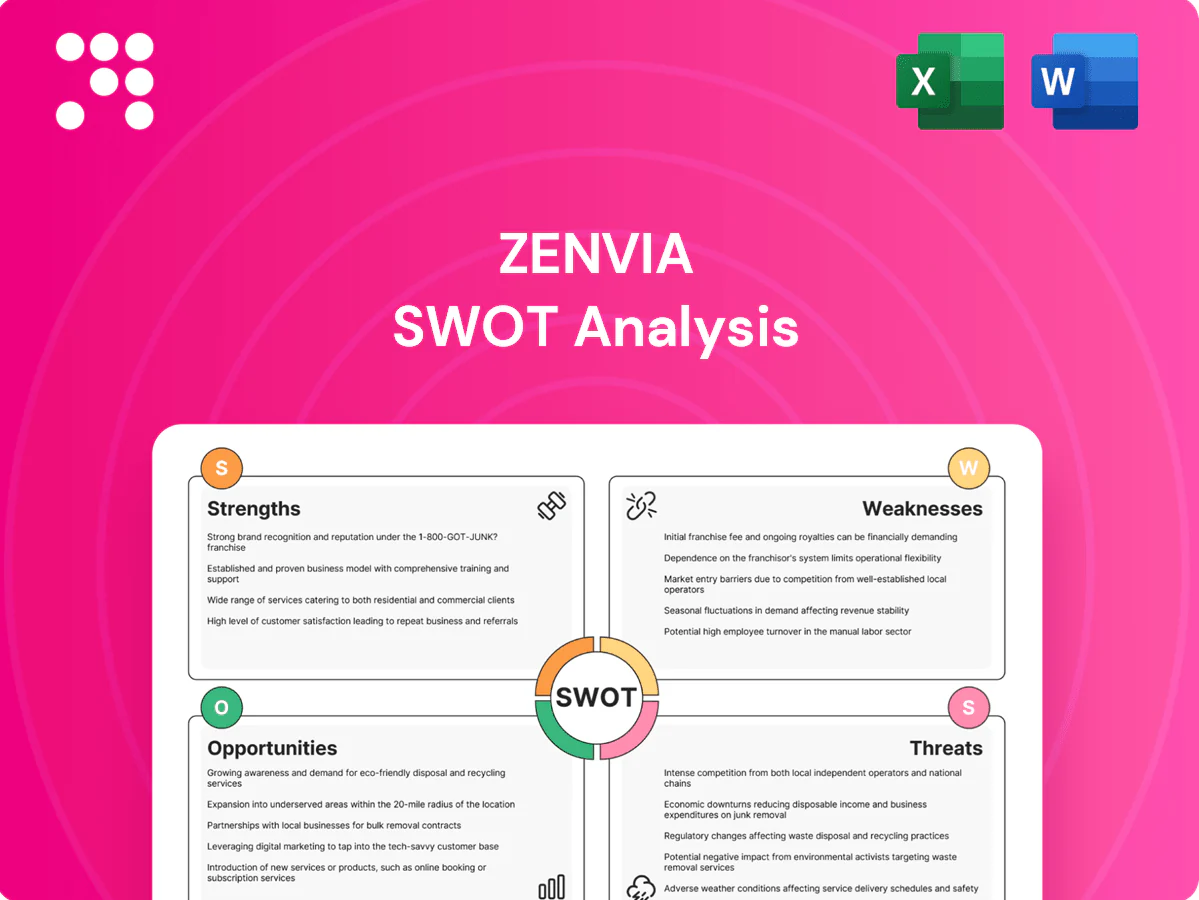
This is the actual SWOT analysis document you’ll receive upon purchase—no surprises, just professional quality. The preview below is taken directly from the full SWOT report you'll get; purchase unlocks the entire in-depth version. Once bought, you'll receive the full, editable file ready for download and use.

Product Information
Product Information
Shipping & Returns
Shipping & Returns
Description
Your Strategic Toolkit Starts Here
Zenvia shows strong regional leadership in CPaaS and diversified product offerings, but faces competition, regulatory risks, and execution challenges as it scales. Our full SWOT unpacks market positioning, financial context, and strategic moves in detail. Purchase the complete, editable report to inform investment or strategic decisions.
Strengths
Omnichannel CX platform
Zenvia unifies SMS, WhatsApp and other digital channels into a single platform, reducing fragmentation for clients. The cohesive hub simplifies journey design and measurement across touchpoints, supporting 10,000+ customers and processing billions of messages annually. This creates stickiness, lowers switching costs and enables consistent brand experiences at scale.
Deep WhatsApp and SMS capabilities
Zenvia’s deep WhatsApp and SMS capabilities are a core differentiator in regions where WhatsApp reaches ~2.7 billion users (Meta, 2023) and SMS retains ~98% open rates within minutes, making high-volume delivery, compliance, and template management critical for outcomes. Robust routing and cost controls boost ROI by lowering failed-delivery and retransmit costs, while platform reliability supports time-sensitive use cases such as authentication and service alerts.
Automation and personalization engine
Workflow builders, chatbots and granular segmentation enable Zenvia to deliver personalized, automated interactions that cut manual workload and boost conversion and CSAT; Gartner notes 70% of customer interactions will involve emerging tech by 2025. Data-driven triggers power timely outreach and predictive touchpoints, while orchestration tools manage complex multi-channel customer journeys end-to-end.
Sales, service, and marketing use-case breadth
Sales, service, and marketing use-case breadth lets Zenvia capture wallet share across acquisition, engagement, and support, enabling multi-department relevance and deeper account penetration. Cross-functional analytics tie campaigns to support outcomes, clarifying ROI and supporting end-to-end lifecycle management. As of 2024 Zenvia serves thousands of customers across Latin America.
- Omnichannel reach across acquisition–support
- Multi-department account penetration
- Cross-functional analytics = clearer impact
- Supports end-to-end customer lifecycle
Strong LATAM presence and relationships
Strong LATAM presence and relationships give Zenvia faster go-to-market through brand recognition and local partnerships across Brazil, Mexico, Colombia and Argentina, and its B3 listing (ZENV3) reinforces corporate credibility. Local regulatory and pricing knowledge improves execution and margins, while on-the-ground support boosts client trust and creates a defensible foothold versus global competitors.
- Regional footprint: Brazil, Mexico, Colombia, Argentina
- B3-listed: ZENV3
- Local partnerships accelerate launches
- On-the-ground support increases client retention
Omnichannel: 10,000+ clients, billions messages, WhatsApp reach, 98% SMS
Zenvia’s unified omnichannel platform serves 10,000+ customers and processes billions of messages annually, creating high retention and scalable brand experiences. Deep WhatsApp and SMS capabilities leverage ~2.7 billion WhatsApp users (Meta 2023) and ~98% SMS open rates for time-sensitive delivery and compliance. Strong LATAM footprint across Brazil, Mexico, Colombia and Argentina plus B3 listing (ZENV3) accelerates GTM and trust.
| Metric | Value |
|---|---|
| Customers | 10,000+ |
| Messages/year | Billions |
| WhatsApp reach | ~2.7B users (Meta, 2023) |
| SMS open rate | ~98% |
| Key markets | Brazil, Mexico, Colombia, Argentina |
| Listing | B3: ZENV3 |
What is included in the product
Detailed Word Document
Delivers a strategic overview of Zenvia’s internal and external business factors, outlining strengths, weaknesses, opportunities and threats to assess competitive position, growth drivers, operational gaps and market risks shaping its future.
Customizable Excel Spreadsheet
Provides a concise Zenvia SWOT matrix for fast strategy alignment and targeted pain-point resolution, highlighting messaging, platform, and regulatory risks. Editable format enables rapid updates to reflect product, channel, and market shifts for quick stakeholder decisions.
Weaknesses
Dependence on third-party channels
Dependence on third-party channels like Meta, carriers and device OEMs leaves Zenvia exposed to abrupt policy and pricing changes that can force repricing or feature rollbacks. API rate limits and template restrictions (e.g., WhatsApp template rules) can disrupt client workflows and SLA adherence. Fee adjustments by partners drive margin volatility and constrain Zenvia’s product roadmap autonomy and monetization flexibility.
Price pressure and commoditization
Zenvia faces intense price pressure and commoditization in CPaaS and messaging as buyers aggressively benchmark unit costs against global players like Twilio and Sinch. Without clear differentiation through value-added software, analytics or vertical workflows, reliance on transport alone risks margin compression. Sustained competitiveness requires shifting revenue mix toward higher-margin SaaS features and platform services.
Integration and onboarding complexity
Connecting CRMs, ERPs and disparate data sources often requires significant engineering time and can extend integrations to 3–6 months, delaying time-to-value and lengthening sales cycles. SMEs frequently lack in-house technical capacity, with many reporting limited IT resources for integrations, raising onboarding burden. Poor onboarding correlates with higher early churn risk, sometimes increasing churn in the first 90 days.
Limited global scale vs hyperscalers
Zenvia’s regional focus faces pressure from hyperscalers that, per Synergy Research, commanded roughly 65% of global cloud market share in 2024, enabling outsized R&D budgets, global network reach, and enterprise SLAs that can restrict Zenvia’s ability to win multinational mandates; feature velocity and breadth may lag leaders and large procurement teams often prefer incumbent hyperscalers.
- Smaller R&D spend vs hyperscalers (~65% market share top 3)
- Limited global network/SLAs impeding multinational deals
- Slower feature velocity; procurement bias toward larger vendors
Churn and ARPU constraints in SME base
Smaller SME customers are highly price- and ROI-sensitive, driving higher churn and limiting ARPU expansion; volume volatility from seasonal or campaign-driven usage further depresses per-customer revenue. Upsell success hinges on clear value cases and customer education, while elevated support costs for SMEs erode unit economics and margin recovery.
- High churn risk among price-sensitive SMEs
- Volume volatility lowers ARPU
- Upsell needs strong value/education
- Support costs pressure unit margins
Third-party channel reliance and 3–6 month integrations squeeze margins and deal wins
Dependence on third-party channels and partners (e.g., WhatsApp templates, carriers) creates exposure to abrupt policy/pricing shifts that compress margins and force product trade-offs. Integration timelines of 3–6 months delay time-to-value and raise early churn risk in the first 90 days. Regional scale and smaller R&D vs hyperscalers (top 3 ~65% cloud share in 2024) limit multinational deal wins.
| Weakness | Data |
|---|---|
| Hyperscaler dominance | Top 3 ~65% global cloud share (2024) |
| Integration time | 3–6 months |
Preview the Actual Deliverable
Zenvia SWOT Analysis
This is the actual SWOT analysis document you’ll receive upon purchase—no surprises, just professional quality. The preview below is taken directly from the full SWOT report you'll get; purchase unlocks the entire in-depth version. Once bought, you'll receive the full, editable file ready for download and use.