Inner Mongolia Yili PESTLE Analysis

Plan Smarter. Present Sharper. Compete Stronger.
Our PESTLE Analysis of Inner Mongolia Yili reveals how political regulation, shifting consumer incomes, technological innovation, and environmental pressures shape its growth trajectory. Ideal for investors and strategists, it translates trends into tactical implications. Purchase the full report to access the complete, actionable breakdown immediately.
Political factors

State support for dairy
China’s agricultural policies prioritize domestic dairy self-sufficiency and quality upgrading, supporting major players like Yili, which held about 22% domestic market share in 2023. Yili can access grants, tax incentives and rural revitalization programs that modernize farms and boost raw milk quality. Support is conditional on meeting government-set standards and production targets. Policy shifts could reallocate subsidies across regions or product categories, altering Yili’s subsidy mix.
Food security priorities
Beijing’s food security agenda under the 14th Five-Year Plan (2021–2025) and the 95% staple self-sufficiency aim pushes resilient supply chains and safe nutrition; as China’s largest dairy producer, Yili may be nudged toward upstream integration and building milk-powder strategic reserves, stabilizing inputs but raising capital needs and regulatory reporting; price/supply oversight during shocks is likely to tighten.

Trade policy and tariffs
Import tariffs and quotas on dairy inputs—China’s applied tariff on whole milk powder is 4%—directly raise Yili’s cost base, while New Zealand supplies roughly 32% of China’s milk powder imports, creating concentration risk. Geopolitical tensions could restrict access to NZ/EU/Australia inputs or increase compliance costs. Export ambitions face destination-country tariffs and strict standards, so Yili must diversify suppliers and markets to reduce policy volatility.

Regional development in Inner Mongolia
Regional authorities under the 14th Five-Year Plan (2021–2025) promote dairy clusters, infrastructure and cold-chain upgrades, easing Yili’s access to nearby pastureland with targeted local policy backing. Environmental caps and stricter land-use controls, however, can limit herd expansion and new farm approvals. Coordination with local SOEs and cooperatives is frequently required for land, logistics and subsidy access.
- 14th Five-Year Plan (2021–2025) drives dairy cluster and cold-chain buildout
- Proximity to pastureland reduces raw-milk logistics costs
- Environmental and land-use caps constrain expansion
- Coordination with SOEs/cooperatives necessary for permits and logistics
International market access
Government diplomacy and Belt and Road access to 140+ partner markets can materially expand Yili exports; regulatory equivalence for dairy safety can cut foreign product registration timelines from typical 12–18 months to as low as 3–6 months in aligned markets. Political shifts abroad often prompt new testing, labeling or localization rules, so Yili needs adaptive compliance teams and active engagement with embassies and industry bodies.
- BRI coverage: 140+ countries
- Registration time: 12–18m → 3–6m (with equivalence)
- Risk: new testing/label rules after political shifts
- Action: adaptive compliance + embassy/industry engagement
State dairy support raises capex; 22% market share and 4% tariff
State support for dairy (Yili ~22% domestic share in 2023) brings subsidies, tax breaks and cluster funding but is conditional on standards and targets. Food-security rules (14th FYP) push upstream integration and reserves, increasing capex and reporting. Import tariffs (whole milk powder 4%) and NZ reliance (~32% imports) raise supply risk; BRI (140+ countries) eases export registration (12–18m → 3–6m with equivalence).
| Metric | Value |
|---|---|
| Yili market share (2023) | 22% |
| WMP tariff | 4% |
| NZ share of imports | 32% |
| BRI markets | 140+ |
What is included in the product
 Detailed Word Document
Comprehensive PESTLE analysis of Inner Mongolia Yili examining Political, Economic, Social, Technological, Environmental and Legal drivers with data-backed trends and region-specific examples; designed for executives and investors to identify risks, opportunities and forward-looking scenarios ready for inclusion in reports, plans or pitches.

 Customizable Excel Spreadsheet
A concise, PESTLE-segmented summary of Inner Mongolia Yili that simplifies regulatory, economic, social, technological, environmental and legal risks for quick use in meetings, presentations, and cross-team alignment.
Economic factors

Consumer income trends
Rising urban disposable income—up 6.1% nationwide in 2024 per NBS—fuels premium dairy demand for Inner Mongolia Yili, while elevated youth unemployment (~19% for ages 16–24 in 2024) and slower consumption growth pressure discretionary lines like ice cream. Mass-market fluid milk stays resilient but remains price-sensitive, so Yili must shift portfolio mix between premium and value tiers across macro cycles.
Input cost volatility
Feed, energy and packaging costs move with global commodities: CBOT corn futures traded roughly between 5 and 7 USD/bu in 2024–H1 2025 while Brent averaged about 75–85 USD/bbl, driving raw-cost swings for Yili.
Spikes compress margins in fresh milk and yogurt where pricing power is limited, forcing tighter gross-margin control and occasional SKU rationalization.
Hedging and multi‑year supply contracts (commonly 6–18 months) plus productivity gains in farming and processing are critical to stabilize costs and protect profitability.

FX and interest rates
RMB volatility (USD/CNY ~6.7–7.3 in 2023–24) raises import costs for powders and equipment and can compress overseas margins as Yili’s exports account for about 10% of sales. PBOC lending rates (1Y LPR 3.45%, 5Y ~4.2%) and global rate shifts alter financing costs for farms, plants and cold-chain investments. Balancing debt duration and currency mix and using export receipts as a natural hedge reduces FX and rate exposure.

E-commerce and channel mix
Rapid expansion of online grocery and quick-commerce boosts Yili’s reach but compresses margins due to platform commissions often in the 10–25% range; DTC channels grew materially in 2024, enabling first-party data and upselling of premium SKUs while modern offline trade still controls chilled dairy requiring cold‑chain excellence.
- Online reach vs margin: commissions 10–25%
- DTC value: better data, higher premium ASPs
- Offline: chilled dominated—logistics critical
- Omnichannel pricing/promo optimization protects margins
Competitive intensity
Domestic rivals and multinationals compete on quality, safety and product innovation while Yili holds roughly 20–25% market share, with Yili and Mengniu together accounting for about 40% of branded dairy sales; private labels and regional brands undercut prices as private-label penetration remains below 10% in many categories. Ongoing consolidation among processors and farms raises retailer bargaining power, and Yili’s shift to functional-nutrition products supports higher margins and premium pricing.
- market-share: Yili ~20–25%
- top-2 share: ~40%
- private-label penetration: <10%
- differentiation: functional nutrition → higher margins
State dairy support raises capex; 22% market share and 4% tariff
Rising urban disposable income (+6.1% in 2024 per NBS) supports premium dairy while high youth unemployment (~19% in 2024) and slower consumption pressure value SKUs; Yili balances premium/value mix. Commodity swings (CBOT corn ~5–7 USD/bu; Brent ~75–85 USD/bbl in 2024–H1 2025) and RMB 6.7–7.3 FX range tighten margins. Online commissions (10–25%) and exports (~10% of sales) shape pricing, hedging and channel mix.
| Metric | Value |
|---|---|
| Urban income growth (2024) | +6.1% |
| Youth unemployment (2024) | ~19% |
| Yili market share | 20–25% |
| Exports of sales | ~10% |
| CBOT corn (2024–H1 2025) | $5–7/bu |
| Brent (2024–H1 2025) | $75–85/bbl |
| USD/CNY (2023–24) | ~6.7–7.3 |
| Online commissions | 10–25% |
| 1Y / 5Y LPR | 3.45% / ~4.2% |
What You See Is What You Get
Inner Mongolia Yili PESTLE Analysis
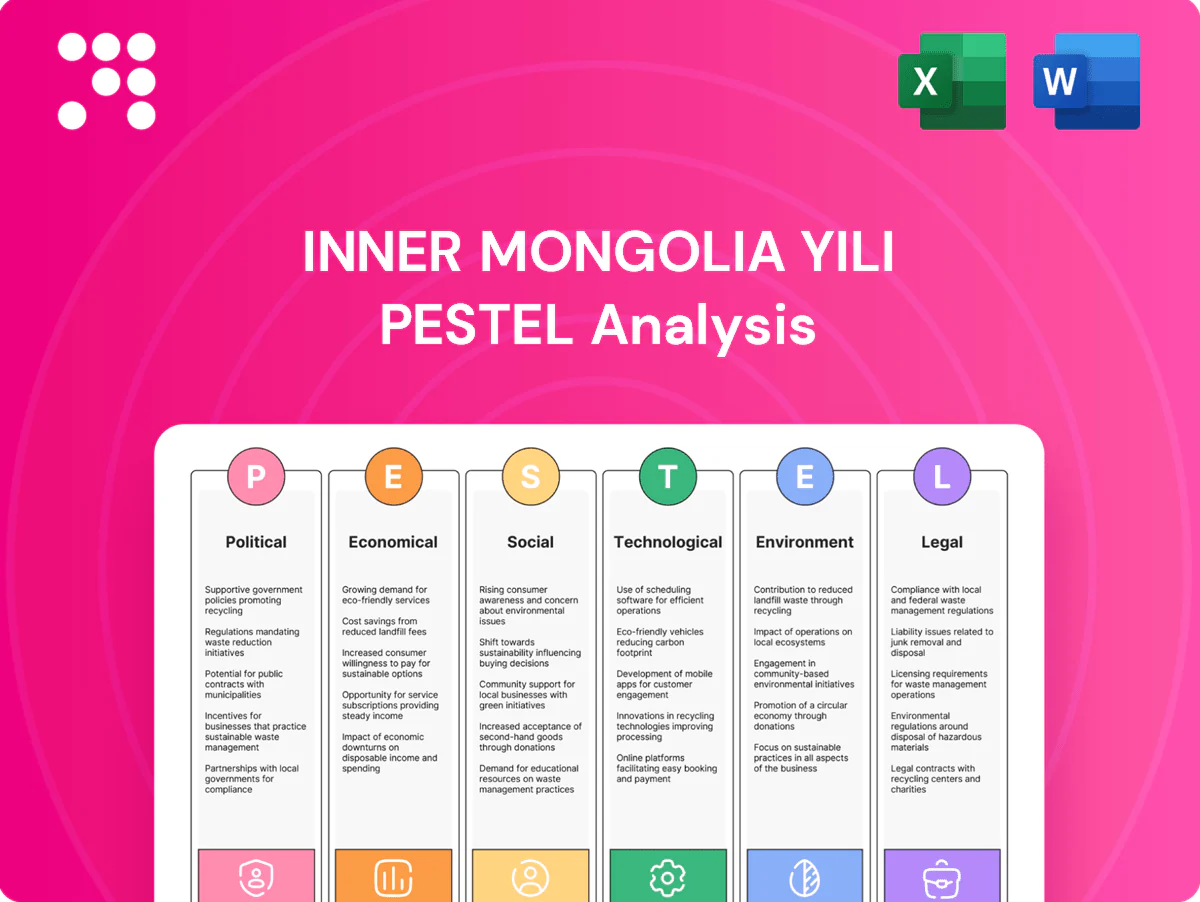
This Inner Mongolia Yili PESTLE Analysis concisely examines political, economic, social, technological, legal and environmental factors shaping Yili's strategic outlook. The preview shown here is the exact document you’ll receive after purchase—fully formatted and ready to use. No placeholders or edits are needed; the file is the final, downloadable report.

Product Information
Product Information
Shipping & Returns
Shipping & Returns
Description
Plan Smarter. Present Sharper. Compete Stronger.
Our PESTLE Analysis of Inner Mongolia Yili reveals how political regulation, shifting consumer incomes, technological innovation, and environmental pressures shape its growth trajectory. Ideal for investors and strategists, it translates trends into tactical implications. Purchase the full report to access the complete, actionable breakdown immediately.
Political factors
State support for dairy
China’s agricultural policies prioritize domestic dairy self-sufficiency and quality upgrading, supporting major players like Yili, which held about 22% domestic market share in 2023. Yili can access grants, tax incentives and rural revitalization programs that modernize farms and boost raw milk quality. Support is conditional on meeting government-set standards and production targets. Policy shifts could reallocate subsidies across regions or product categories, altering Yili’s subsidy mix.
Food security priorities
Beijing’s food security agenda under the 14th Five-Year Plan (2021–2025) and the 95% staple self-sufficiency aim pushes resilient supply chains and safe nutrition; as China’s largest dairy producer, Yili may be nudged toward upstream integration and building milk-powder strategic reserves, stabilizing inputs but raising capital needs and regulatory reporting; price/supply oversight during shocks is likely to tighten.
Trade policy and tariffs
Import tariffs and quotas on dairy inputs—China’s applied tariff on whole milk powder is 4%—directly raise Yili’s cost base, while New Zealand supplies roughly 32% of China’s milk powder imports, creating concentration risk. Geopolitical tensions could restrict access to NZ/EU/Australia inputs or increase compliance costs. Export ambitions face destination-country tariffs and strict standards, so Yili must diversify suppliers and markets to reduce policy volatility.
Regional development in Inner Mongolia
Regional authorities under the 14th Five-Year Plan (2021–2025) promote dairy clusters, infrastructure and cold-chain upgrades, easing Yili’s access to nearby pastureland with targeted local policy backing. Environmental caps and stricter land-use controls, however, can limit herd expansion and new farm approvals. Coordination with local SOEs and cooperatives is frequently required for land, logistics and subsidy access.
- 14th Five-Year Plan (2021–2025) drives dairy cluster and cold-chain buildout
- Proximity to pastureland reduces raw-milk logistics costs
- Environmental and land-use caps constrain expansion
- Coordination with SOEs/cooperatives necessary for permits and logistics
International market access
Government diplomacy and Belt and Road access to 140+ partner markets can materially expand Yili exports; regulatory equivalence for dairy safety can cut foreign product registration timelines from typical 12–18 months to as low as 3–6 months in aligned markets. Political shifts abroad often prompt new testing, labeling or localization rules, so Yili needs adaptive compliance teams and active engagement with embassies and industry bodies.
- BRI coverage: 140+ countries
- Registration time: 12–18m → 3–6m (with equivalence)
- Risk: new testing/label rules after political shifts
- Action: adaptive compliance + embassy/industry engagement
State dairy support raises capex; 22% market share and 4% tariff
State support for dairy (Yili ~22% domestic share in 2023) brings subsidies, tax breaks and cluster funding but is conditional on standards and targets. Food-security rules (14th FYP) push upstream integration and reserves, increasing capex and reporting. Import tariffs (whole milk powder 4%) and NZ reliance (~32% imports) raise supply risk; BRI (140+ countries) eases export registration (12–18m → 3–6m with equivalence).
| Metric | Value |
|---|---|
| Yili market share (2023) | 22% |
| WMP tariff | 4% |
| NZ share of imports | 32% |
| BRI markets | 140+ |
What is included in the product
Detailed Word Document
Comprehensive PESTLE analysis of Inner Mongolia Yili examining Political, Economic, Social, Technological, Environmental and Legal drivers with data-backed trends and region-specific examples; designed for executives and investors to identify risks, opportunities and forward-looking scenarios ready for inclusion in reports, plans or pitches.
Customizable Excel Spreadsheet
A concise, PESTLE-segmented summary of Inner Mongolia Yili that simplifies regulatory, economic, social, technological, environmental and legal risks for quick use in meetings, presentations, and cross-team alignment.
Economic factors
Consumer income trends
Rising urban disposable income—up 6.1% nationwide in 2024 per NBS—fuels premium dairy demand for Inner Mongolia Yili, while elevated youth unemployment (~19% for ages 16–24 in 2024) and slower consumption growth pressure discretionary lines like ice cream. Mass-market fluid milk stays resilient but remains price-sensitive, so Yili must shift portfolio mix between premium and value tiers across macro cycles.
Input cost volatility
Feed, energy and packaging costs move with global commodities: CBOT corn futures traded roughly between 5 and 7 USD/bu in 2024–H1 2025 while Brent averaged about 75–85 USD/bbl, driving raw-cost swings for Yili.
Spikes compress margins in fresh milk and yogurt where pricing power is limited, forcing tighter gross-margin control and occasional SKU rationalization.
Hedging and multi‑year supply contracts (commonly 6–18 months) plus productivity gains in farming and processing are critical to stabilize costs and protect profitability.
FX and interest rates
RMB volatility (USD/CNY ~6.7–7.3 in 2023–24) raises import costs for powders and equipment and can compress overseas margins as Yili’s exports account for about 10% of sales. PBOC lending rates (1Y LPR 3.45%, 5Y ~4.2%) and global rate shifts alter financing costs for farms, plants and cold-chain investments. Balancing debt duration and currency mix and using export receipts as a natural hedge reduces FX and rate exposure.
E-commerce and channel mix
Rapid expansion of online grocery and quick-commerce boosts Yili’s reach but compresses margins due to platform commissions often in the 10–25% range; DTC channels grew materially in 2024, enabling first-party data and upselling of premium SKUs while modern offline trade still controls chilled dairy requiring cold‑chain excellence.
- Online reach vs margin: commissions 10–25%
- DTC value: better data, higher premium ASPs
- Offline: chilled dominated—logistics critical
- Omnichannel pricing/promo optimization protects margins
Competitive intensity
Domestic rivals and multinationals compete on quality, safety and product innovation while Yili holds roughly 20–25% market share, with Yili and Mengniu together accounting for about 40% of branded dairy sales; private labels and regional brands undercut prices as private-label penetration remains below 10% in many categories. Ongoing consolidation among processors and farms raises retailer bargaining power, and Yili’s shift to functional-nutrition products supports higher margins and premium pricing.
- market-share: Yili ~20–25%
- top-2 share: ~40%
- private-label penetration: <10%
- differentiation: functional nutrition → higher margins
State dairy support raises capex; 22% market share and 4% tariff
Rising urban disposable income (+6.1% in 2024 per NBS) supports premium dairy while high youth unemployment (~19% in 2024) and slower consumption pressure value SKUs; Yili balances premium/value mix. Commodity swings (CBOT corn ~5–7 USD/bu; Brent ~75–85 USD/bbl in 2024–H1 2025) and RMB 6.7–7.3 FX range tighten margins. Online commissions (10–25%) and exports (~10% of sales) shape pricing, hedging and channel mix.
| Metric | Value |
|---|---|
| Urban income growth (2024) | +6.1% |
| Youth unemployment (2024) | ~19% |
| Yili market share | 20–25% |
| Exports of sales | ~10% |
| CBOT corn (2024–H1 2025) | $5–7/bu |
| Brent (2024–H1 2025) | $75–85/bbl |
| USD/CNY (2023–24) | ~6.7–7.3 |
| Online commissions | 10–25% |
| 1Y / 5Y LPR | 3.45% / ~4.2% |
What You See Is What You Get
Inner Mongolia Yili PESTLE Analysis
This Inner Mongolia Yili PESTLE Analysis concisely examines political, economic, social, technological, legal and environmental factors shaping Yili's strategic outlook. The preview shown here is the exact document you’ll receive after purchase—fully formatted and ready to use. No placeholders or edits are needed; the file is the final, downloadable report.