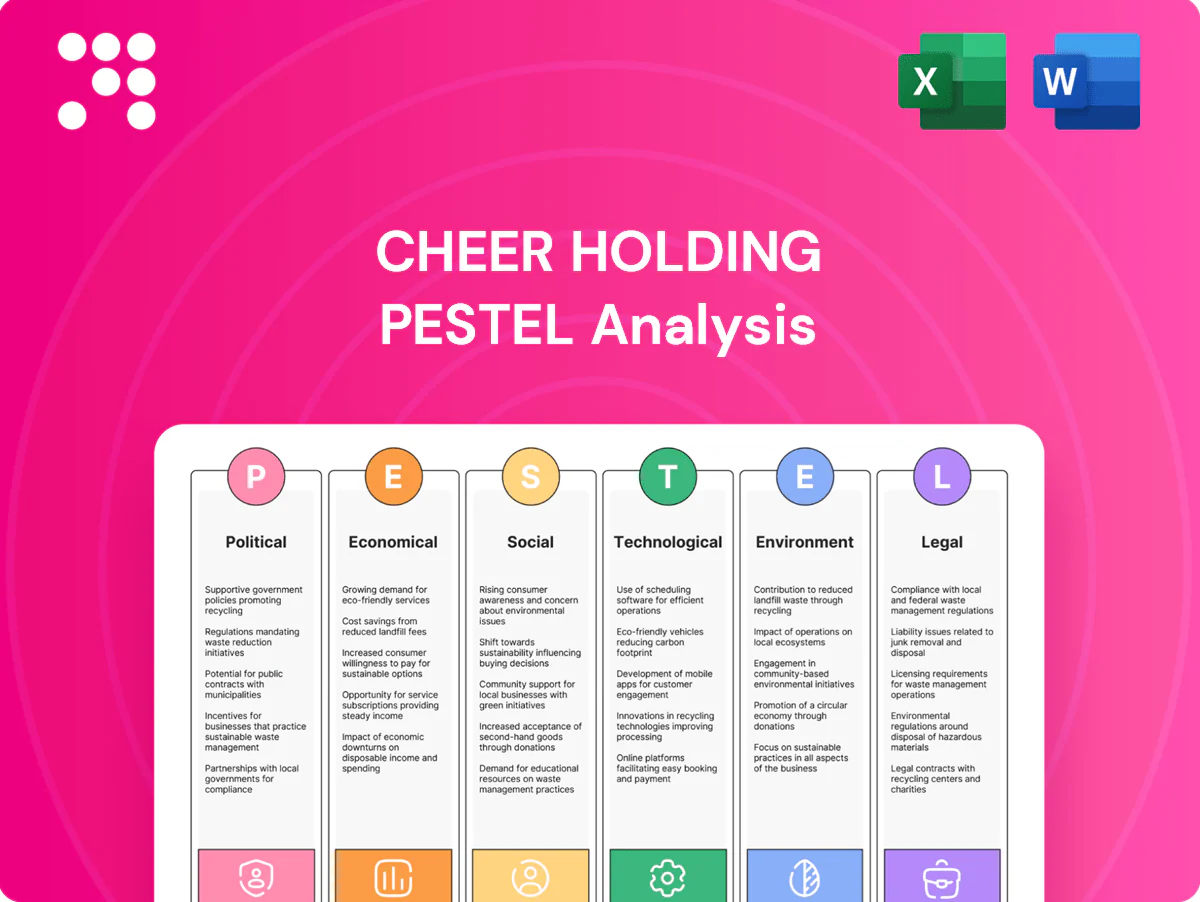
Cheer Holding PESTLE Analysis

Your Shortcut to Market Insight Starts Here
Unlock how political shifts, economic trends, social dynamics, and technology developments are reshaping Cheer Holding’s prospects with our concise PESTLE snapshot. This expert analysis highlights key risks and opportunities to sharpen your strategy. Purchase the full report for actionable, ready-to-use insights and downloadable tables.
Political factors

State oversight of digital media
China’s centralized governance prioritizes control over online content and platforms, affecting 1.05 billion internet users (2024). Policy shifts can occur rapidly, altering ad formats, campaign approvals and publisher access, while alignment with propaganda and positive energy is often required. Tightened governance raises compliance costs but tends to protect incumbents: top five platforms capture over 70% of digital ad spend.
Content censorship and moderation
Strict censorship rules increasingly constrain short-video and social creative, with platforms and regulators driving millions of annual removals; major platforms' transparency reports show combined removals in the tens of millions in recent years. Sensitive topics, keywords and depictions can trigger takedowns or fines, so robust pre-screening and moderation workflows are essential. Compliance workflows add review latency, often slowing time-to-market and reducing creative throughput.

Industrial policy and digital economy support
Beijing’s push for the digital economy—estimated around 50 trillion yuan in recent years—boosts martech, AI and SME digitization through subsidies, tax incentives and national pilot zones that lower adoption costs. Policy-driven support can accelerate Cheer Holding’s martech uptake and revenue from AI services. However, preference for domestic ecosystems and walled gardens restricts foreign integrations, while certified access to state-backed data exchanges can unlock new data-driven product lines.

Geopolitical tensions and cross-border risk
Rising US–China tensions since US export controls on advanced semiconductors and AI chips began in October 2022 constrain capital access, vendor selection, and cross-border data flows, and can limit certain ad-tech tools via sanctions updated through 2023–2024; foreign client demand may waver amid perceived risk. Cheer mitigates this by diversifying revenue across domestic sectors.
- Impact: restricted chip/ad-tech access
- Timing: export controls since Oct 2022, expanded 2023–24
- Client risk: potential demand drop
- Mitigation: domestic sector diversification
Local government enforcement variability
Local government enforcement variability means Cheer faces uneven application of central rules across 31 provincial-level regions, causing campaign execution and platform approvals to differ materially by area. Regional approval processes often add weeks to months to go-to-market timelines, making local relationships and complete compliance documentation critical for speed. Fragmentation raises operational complexity and increases per-campaign costs through duplicated approvals and localized legal fees.
- Tag: provincial-variance
- Tag: approval-delays
- Tag: local-compliance
- Tag: higher-ops-cost
China controls hit 1.05B; top5 > 70% ad share
China’s centralized content control affects 1.05 billion internet users (2024) and drives rapid policy shifts that favor incumbents—top five platforms grab >70% of digital ad spend. Strict censorship and millions of annual removals raise compliance costs and slow campaigns. State support for a ~50 trillion yuan digital economy and export controls (since Oct 2022) shape vendor access and client risk.
| Tag | Metric | Value |
|---|---|---|
| Users | Internet users | 1.05B (2024) |
| Concentration | Top5 ad share | >70% |
| Economy | Digital economy | ~50T yuan |
What is included in the product
 Detailed Word Document
Explores how external macro-environmental factors uniquely affect Cheer Holding across Political, Economic, Social, Technological, Environmental, and Legal dimensions, with each section backed by current data and trends to identify threats and opportunities for executives, consultants, and investors.

 Customizable Excel Spreadsheet
Clean, visually segmented PESTLE summary of Cheer Holding that streamlines meetings and presentations, allows quick annotation for regional or business-line specifics, and is easily dropped into slides or shared across teams for fast alignment on external risks and market positioning.
Economic factors

Ad spend cyclicality
Marketing budgets track GDP, retail sales and business confidence, making ad spend cyclical; China’s growth normalized to about 5.2% in 2024, which has compressed CPMs and volumes in key quarters. Performance-driven formats (CPA, performance video) gain share during weak cycles, while diversification into resilient verticals such as FMCG and essential services stabilizes revenue.
SME health and digital adoption
Cheer’s revenue is tied to SMEs’ willingness to spend on mobile and short-video ads; global SMEs comprise about 90% of businesses and 50% of employment (World Bank), so their demand matters. Cash-flow pressures and credit tightness—IFC estimates a $5.2 trillion SME financing gap—can curtail campaigns, though government SME support programs can offset weakness. Simple, ROI-transparent offerings accelerate uptake in lower-tier cities where digital adoption is rising.

Pricing power and platform take-rates
Walled gardens such as Google and Meta captured roughly half of global digital ad revenue in 2024, heavily influencing CPMs and bid floors. Rising platform take-rates have compressed intermediary margins, squeezing pure media-reselling models. Offering analytics, audience insights and value-added services enables Cheer Holding to charge premiums and protect margins. Scale and exclusive inventory enhance bargaining power vs dominant platforms.

Currency and cost structure
RMB volatility (around 7.2 CNY/USD in mid-2025) lifts costs for imported tech, cloud credits and chips—China imported roughly $400B of semiconductors in 2023—while pricing services in RMB stabilizes revenues for domestic clients. Shifting to local hosting cuts FX exposure but concentrates vendor risk; hedging and local-sourcing strategies are used to mitigate swings and protect margins.
- RMB level: ~7.2 CNY/USD (mid-2025)
- Semiconductor imports: ≈$400B (2023)
- Domestic pricing: stabilizes RMB revenue
- Trade-off: lower FX risk vs higher vendor concentration
Competition and consolidation
The ad-tech market remains highly fragmented with intense price competition; global digital ad spend was about $520B in 2023 with programmatic ~70% of display, amplifying price pressure on independents. Larger platforms and agency groups are pursuing consolidation, squeezing margins and client access. Niche specialization and proprietary first-party data raise defensibility, while M&A adds capabilities and client scale.
- Fragmentation: many small vendors
- Consolidation: platforms/agencies expanding
- Defensibility: niche + proprietary data
- M&A: capability and scale gains
China controls hit 1.05B; top5 > 70% ad share
Marketing and SME ad budgets follow GDP; China grew ≈5.2% in 2024, shifting spend to performance formats and FMCG. SMEs (≈90% of firms) drive mobile short-video demand but a $5.2T SME financing gap can curb campaigns; ROI-transparent products aid uptake. RMB ≈7.2 CNY/USD (mid-2025) raises imported tech costs; local pricing/hosting cut FX risk but increase vendor concentration.
| Metric | Value |
|---|---|
| China GDP (2024) | ≈5.2% |
| Global digital ad spend (2023) | $520B |
| RMB level (mid-2025) | ≈7.2 CNY/USD |
| SME financing gap | $5.2T (IFC) |
What You See Is What You Get
Cheer Holding PESTLE Analysis
The preview shown here is the exact Cheer Holding PESTLE Analysis you’ll receive after purchase—fully formatted and ready to use. The layout, content, and structure visible are exactly what you’ll download immediately after buying. No placeholders, no surprises.

Product Information
Product Information
Shipping & Returns
Shipping & Returns
Description
Your Shortcut to Market Insight Starts Here
Unlock how political shifts, economic trends, social dynamics, and technology developments are reshaping Cheer Holding’s prospects with our concise PESTLE snapshot. This expert analysis highlights key risks and opportunities to sharpen your strategy. Purchase the full report for actionable, ready-to-use insights and downloadable tables.
Political factors
State oversight of digital media
China’s centralized governance prioritizes control over online content and platforms, affecting 1.05 billion internet users (2024). Policy shifts can occur rapidly, altering ad formats, campaign approvals and publisher access, while alignment with propaganda and positive energy is often required. Tightened governance raises compliance costs but tends to protect incumbents: top five platforms capture over 70% of digital ad spend.
Content censorship and moderation
Strict censorship rules increasingly constrain short-video and social creative, with platforms and regulators driving millions of annual removals; major platforms' transparency reports show combined removals in the tens of millions in recent years. Sensitive topics, keywords and depictions can trigger takedowns or fines, so robust pre-screening and moderation workflows are essential. Compliance workflows add review latency, often slowing time-to-market and reducing creative throughput.
Industrial policy and digital economy support
Beijing’s push for the digital economy—estimated around 50 trillion yuan in recent years—boosts martech, AI and SME digitization through subsidies, tax incentives and national pilot zones that lower adoption costs. Policy-driven support can accelerate Cheer Holding’s martech uptake and revenue from AI services. However, preference for domestic ecosystems and walled gardens restricts foreign integrations, while certified access to state-backed data exchanges can unlock new data-driven product lines.
Geopolitical tensions and cross-border risk
Rising US–China tensions since US export controls on advanced semiconductors and AI chips began in October 2022 constrain capital access, vendor selection, and cross-border data flows, and can limit certain ad-tech tools via sanctions updated through 2023–2024; foreign client demand may waver amid perceived risk. Cheer mitigates this by diversifying revenue across domestic sectors.
- Impact: restricted chip/ad-tech access
- Timing: export controls since Oct 2022, expanded 2023–24
- Client risk: potential demand drop
- Mitigation: domestic sector diversification
Local government enforcement variability
Local government enforcement variability means Cheer faces uneven application of central rules across 31 provincial-level regions, causing campaign execution and platform approvals to differ materially by area. Regional approval processes often add weeks to months to go-to-market timelines, making local relationships and complete compliance documentation critical for speed. Fragmentation raises operational complexity and increases per-campaign costs through duplicated approvals and localized legal fees.
- Tag: provincial-variance
- Tag: approval-delays
- Tag: local-compliance
- Tag: higher-ops-cost
China controls hit 1.05B; top5 > 70% ad share
China’s centralized content control affects 1.05 billion internet users (2024) and drives rapid policy shifts that favor incumbents—top five platforms grab >70% of digital ad spend. Strict censorship and millions of annual removals raise compliance costs and slow campaigns. State support for a ~50 trillion yuan digital economy and export controls (since Oct 2022) shape vendor access and client risk.
| Tag | Metric | Value |
|---|---|---|
| Users | Internet users | 1.05B (2024) |
| Concentration | Top5 ad share | >70% |
| Economy | Digital economy | ~50T yuan |
What is included in the product
Detailed Word Document
Explores how external macro-environmental factors uniquely affect Cheer Holding across Political, Economic, Social, Technological, Environmental, and Legal dimensions, with each section backed by current data and trends to identify threats and opportunities for executives, consultants, and investors.
Customizable Excel Spreadsheet
Clean, visually segmented PESTLE summary of Cheer Holding that streamlines meetings and presentations, allows quick annotation for regional or business-line specifics, and is easily dropped into slides or shared across teams for fast alignment on external risks and market positioning.
Economic factors
Ad spend cyclicality
Marketing budgets track GDP, retail sales and business confidence, making ad spend cyclical; China’s growth normalized to about 5.2% in 2024, which has compressed CPMs and volumes in key quarters. Performance-driven formats (CPA, performance video) gain share during weak cycles, while diversification into resilient verticals such as FMCG and essential services stabilizes revenue.
SME health and digital adoption
Cheer’s revenue is tied to SMEs’ willingness to spend on mobile and short-video ads; global SMEs comprise about 90% of businesses and 50% of employment (World Bank), so their demand matters. Cash-flow pressures and credit tightness—IFC estimates a $5.2 trillion SME financing gap—can curtail campaigns, though government SME support programs can offset weakness. Simple, ROI-transparent offerings accelerate uptake in lower-tier cities where digital adoption is rising.
Pricing power and platform take-rates
Walled gardens such as Google and Meta captured roughly half of global digital ad revenue in 2024, heavily influencing CPMs and bid floors. Rising platform take-rates have compressed intermediary margins, squeezing pure media-reselling models. Offering analytics, audience insights and value-added services enables Cheer Holding to charge premiums and protect margins. Scale and exclusive inventory enhance bargaining power vs dominant platforms.
Currency and cost structure
RMB volatility (around 7.2 CNY/USD in mid-2025) lifts costs for imported tech, cloud credits and chips—China imported roughly $400B of semiconductors in 2023—while pricing services in RMB stabilizes revenues for domestic clients. Shifting to local hosting cuts FX exposure but concentrates vendor risk; hedging and local-sourcing strategies are used to mitigate swings and protect margins.
- RMB level: ~7.2 CNY/USD (mid-2025)
- Semiconductor imports: ≈$400B (2023)
- Domestic pricing: stabilizes RMB revenue
- Trade-off: lower FX risk vs higher vendor concentration
Competition and consolidation
The ad-tech market remains highly fragmented with intense price competition; global digital ad spend was about $520B in 2023 with programmatic ~70% of display, amplifying price pressure on independents. Larger platforms and agency groups are pursuing consolidation, squeezing margins and client access. Niche specialization and proprietary first-party data raise defensibility, while M&A adds capabilities and client scale.
- Fragmentation: many small vendors
- Consolidation: platforms/agencies expanding
- Defensibility: niche + proprietary data
- M&A: capability and scale gains
China controls hit 1.05B; top5 > 70% ad share
Marketing and SME ad budgets follow GDP; China grew ≈5.2% in 2024, shifting spend to performance formats and FMCG. SMEs (≈90% of firms) drive mobile short-video demand but a $5.2T SME financing gap can curb campaigns; ROI-transparent products aid uptake. RMB ≈7.2 CNY/USD (mid-2025) raises imported tech costs; local pricing/hosting cut FX risk but increase vendor concentration.
| Metric | Value |
|---|---|
| China GDP (2024) | ≈5.2% |
| Global digital ad spend (2023) | $520B |
| RMB level (mid-2025) | ≈7.2 CNY/USD |
| SME financing gap | $5.2T (IFC) |
What You See Is What You Get
Cheer Holding PESTLE Analysis
The preview shown here is the exact Cheer Holding PESTLE Analysis you’ll receive after purchase—fully formatted and ready to use. The layout, content, and structure visible are exactly what you’ll download immediately after buying. No placeholders, no surprises.











