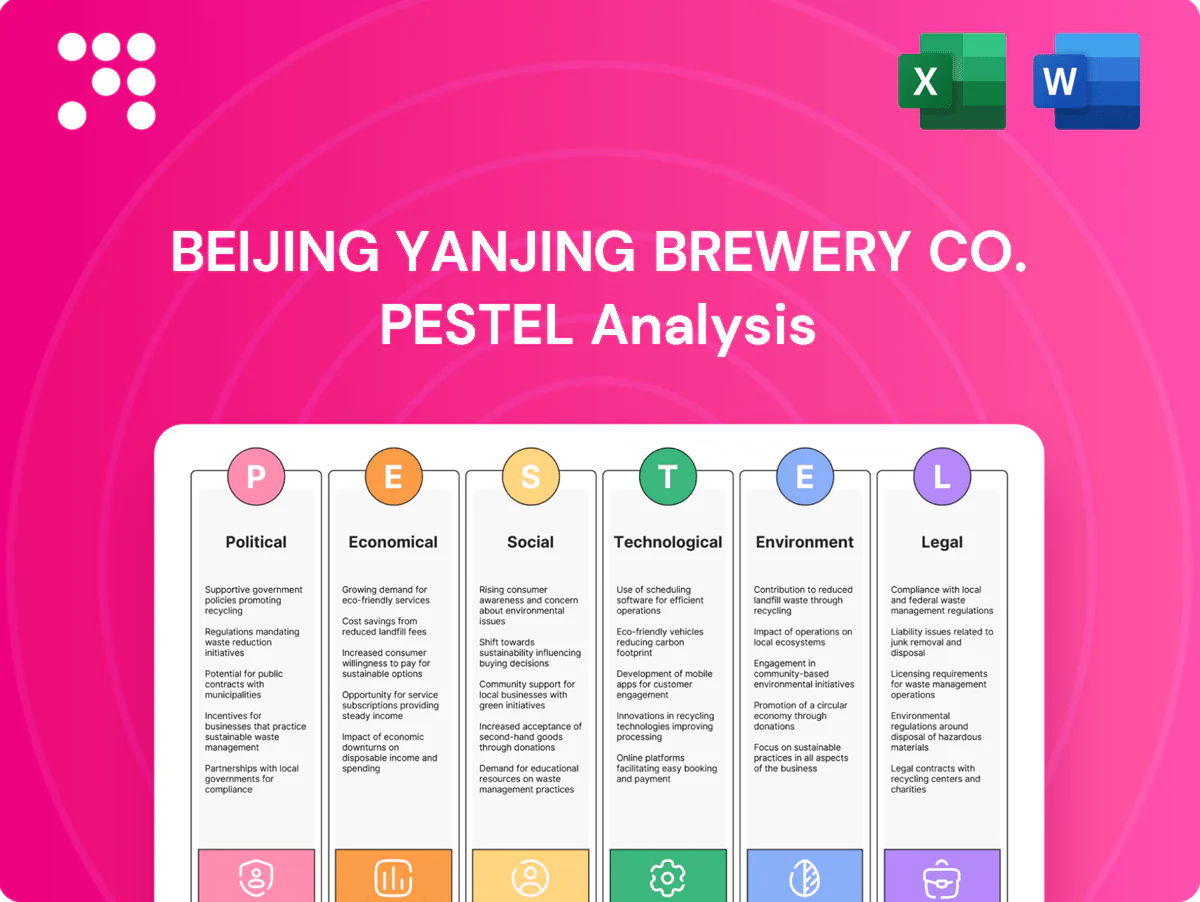
Beijing Yanjing Brewery Co. PESTLE Analysis

Your Shortcut to Market Insight Starts Here
Quickly understand how political, economic, social, technological, legal and environmental forces shape Beijing Yanjing Brewery Co.'s prospects with our concise PESTLE snapshot. Ideal for investors and strategists, it highlights risks and growth levers. Purchase the full analysis to access detailed, actionable insights and editable charts for immediate use.
Political factors

Industrial policy alignment
China's industrial policy (eg, Made in China 2025 and dual‑circulation priorities) favors leading domestic FMCG and modern manufacturing, benefiting national brewers; Beijing Yanjing is a state‑owned, top‑5 Chinese brewer by volume. Local government ties can unlock land, utilities and distribution advantages, while shifts in subsidies or procurement can redirect support. Yanjing must align with Beijing's regional goals (Beijing GDP ~RMB 4.3 trillion in 2023) to sustain preferential access.
Alcohol regulation intensity
Regulatory authorities control production licenses, quality standards and marketing of alcoholic beverages, and tighter measures—seen in several 2023–24 local ordinances limiting sales hours and point-of-sale promotions—can curb volume growth by low single digits. Stronger public-health focus and stepped-up drunk-driving enforcement in 2024 amplify anti-excess campaigns, pressuring premium high-ABV SKUs. Beijing Yanjing must rebalance its portfolio toward lower-ABV and non-alcoholic lines to protect revenue and market share.

Provincial protectionism
Provincial protectionism in China keeps regional brands dominant, with the national beer market at about 34 billion liters in 2023 and strong local patronage favoring homegrown labels. Provincial procurement preferences and distribution barriers slow cross-province expansion, so Yanjing—a top-5 national brewer—leverages its multi-brand footprint to hold local footholds but still faces entrenched rivals. Strategic alliances and joint-venture partnerships help mitigate access frictions and improve market penetration.

Trade and import dynamics
Geopolitical frictions raise risks for Yanjing’s imported barley, hops and brewing equipment as tariff shifts and tighter customs scrutiny can increase input costs and cause delays. Diversifying origins and strengthening domestic supplier networks reduces supply vulnerability. Currency policy and cross-border settlement rules materially affect procurement economics and hedging costs.
- Geopolitical risk: higher tariffs/customs
- Mitigation: diversify suppliers, build domestic sourcing
- FX/settlement: impacts cost and hedging
Government procurement and visibility
Association with official events boosts Yanjing's brand prestige and on-premise visibility, while policy-driven banquet austerity cycles periodically depress demand for premium channels; maintaining strict compliance and reputational integrity is essential to preserve access and avoid sanctions; diversifying into retail and e-commerce helps buffer sales against policy swings.
- Brand prestige from official events
- Banquet austerity reduces premium on-premise demand
- Compliance and reputation protect market access
- Retail and e-commerce diversification buffers policy risk
Policy favors big domestic brewers; regulatory limits and tariffs squeeze premium volumes
Political forces—state industrial policy, local government ties and provincial protectionism—favor large domestic brewers like Beijing Yanjing (top‑5 by volume) but require alignment with regional goals (Beijing GDP RMB 4.3 trillion in 2023). Regulatory tightening (2023–24 local sales/ads limits) and banquet austerity cut premium on‑premise volumes low single digits; geopolitical tariffs and customs raise input cost risk.
| Indicator | Value | Impact |
|---|---|---|
| China beer market (2023) | 34 bn L | Scale opportunity |
| Beijing GDP (2023) | RMB 4.3 tn | Preferential access |
| Regulatory tightening (2023–24) | Sales/ads limits | −low single‑digit vol. |
What is included in the product
 Detailed Word Document
Explores how Political, Economic, Social, Technological, Environmental and Legal forces uniquely affect Beijing Yanjing Brewery, combining data-driven trends and regulatory context to identify risks and opportunities. Tailored for executives and investors, it delivers forward-looking insights ready for strategic planning and funding materials.

 Customizable Excel Spreadsheet
A concise PESTLE snapshot of Beijing Yanjing Brewery that’s visually segmented for quick meeting reference, easily editable for local context and drop‑in to slides—helping teams align on regulatory, economic, social and competitive risks during planning.
Economic factors

Consumer spending trends
Slower macro momentum—China GDP grew 5.2% in 2023—alongside uneven household income gains (per‑capita disposable income up ~5% in 2023) can temper overall beer demand. Premiumization persists but consumers are increasingly value‑conscious, boosting mid‑premium segments. Yanjing must segment pricing and pack sizes to defend volumes and mitigate trade‑down risk. Efficient cost structures and clear value propositions are critical to retain share.
Input cost volatility
Barley (~$260–$300/ton in 2024), hops (~$10–$15/kg), sugar (~$450–$520/ton) and aluminium (LME ~ $2,200/ton mid‑2024) drive Yanjing’s gross‑margin sensitivity; weather shocks and 2023–24 logistics constraints spiked costs. Hedging, long‑term contracts and localized sourcing help stabilise margins, while packaging lightweighting (can weight cuts ~5–10%) offsets aluminium exposure.

Channel mix shifts
On-premise recovery into 2024 lifted gross margins as bars and restaurants—key higher-margin channels—rebounded; Yanjing benefits from this mix shift while modern trade and convenience stores expand geographic reach. E-commerce and instant-delivery platforms, backed by China's online retail of physical goods exceeding 13 trillion yuan in 2023 (NBS), heighten price transparency and accelerate promo cadence. Optimizing RTM, DSD and digital-shelf visibility improves share capture, but revenue management must calibrate promo depth to protect brand equity and long-term ASPs.

Competitive intensity
China's beer market is top‑heavy, with the top five brewers holding about 65% of volume in 2024, forcing Beijing Yanjing to defend regional strongholds amid fierce local rivalry. Price wars frequently erupt in lower‑tier cities and traditional trade channels, compressing margins. Differentiation, scale efficiencies and a faster innovation cadence with localized activation are essential to retain and rotate shelf space.
- Top5 ~65% (2024)
- Yanjing share ~8–9% (2024)
- Lower‑tier price wars compress margins
Capex and productivity
Automation and energy-efficient upgrades can materially lift ROIC at Beijing Yanjing Brewery by lowering unit production costs and reducing energy spend, while brewery network optimization cuts logistics and fixed costs through consolidation of underperforming sites.
Capital discipline remains essential amid demand uncertainty; phased investments tied to proven volume corridors help mitigate deployment risk and preserve cash flow.
- Capex: prioritize automation and EE retrofits
- Productivity: network optimization to cut logistics
- Risk: phased, volume‑validated rollouts
Policy favors big domestic brewers; regulatory limits and tariffs squeeze premium volumes
Slower GDP (5.2% in 2023) and modest per‑capita income growth (~+5% 2023) constrain volume upside; premiumisation meets value sensitivity, pushing mid‑premium. Input cost volatility (barley $260–300/t, Al ~$2,200/t in 2024) pressures margins; hedging and local sourcing reduce risk. On‑premise recovery and e‑commerce raise premium mix but heighten promo intensity.
| Indicator | Value |
|---|---|
| China GDP (2023) | 5.2% |
| Per‑capita dispo. income (2023) | +≈5% |
| Yanjing share (2024) | 8–9% |
| Barley (2024) | $260–300/t |
| Aluminium (mid‑2024) | ~$2,200/t |
Preview the Actual Deliverable
Beijing Yanjing Brewery Co. PESTLE Analysis
The preview shown here is the exact Beijing Yanjing Brewery PESTLE analysis you’ll receive after purchase—fully formatted and ready to use. It covers political, economic, social, technological, legal, and environmental factors affecting the brewery, with actionable insights and concise summaries. No placeholders or teasers—this is the final, professionally structured file you’ll download immediately after payment.

Original: $10.00
-65%$10.00
$3.50Product Information
Product Information
Shipping & Returns
Shipping & Returns
Description
Your Shortcut to Market Insight Starts Here
Quickly understand how political, economic, social, technological, legal and environmental forces shape Beijing Yanjing Brewery Co.'s prospects with our concise PESTLE snapshot. Ideal for investors and strategists, it highlights risks and growth levers. Purchase the full analysis to access detailed, actionable insights and editable charts for immediate use.
Political factors
Industrial policy alignment
China's industrial policy (eg, Made in China 2025 and dual‑circulation priorities) favors leading domestic FMCG and modern manufacturing, benefiting national brewers; Beijing Yanjing is a state‑owned, top‑5 Chinese brewer by volume. Local government ties can unlock land, utilities and distribution advantages, while shifts in subsidies or procurement can redirect support. Yanjing must align with Beijing's regional goals (Beijing GDP ~RMB 4.3 trillion in 2023) to sustain preferential access.
Alcohol regulation intensity
Regulatory authorities control production licenses, quality standards and marketing of alcoholic beverages, and tighter measures—seen in several 2023–24 local ordinances limiting sales hours and point-of-sale promotions—can curb volume growth by low single digits. Stronger public-health focus and stepped-up drunk-driving enforcement in 2024 amplify anti-excess campaigns, pressuring premium high-ABV SKUs. Beijing Yanjing must rebalance its portfolio toward lower-ABV and non-alcoholic lines to protect revenue and market share.
Provincial protectionism
Provincial protectionism in China keeps regional brands dominant, with the national beer market at about 34 billion liters in 2023 and strong local patronage favoring homegrown labels. Provincial procurement preferences and distribution barriers slow cross-province expansion, so Yanjing—a top-5 national brewer—leverages its multi-brand footprint to hold local footholds but still faces entrenched rivals. Strategic alliances and joint-venture partnerships help mitigate access frictions and improve market penetration.
Trade and import dynamics
Geopolitical frictions raise risks for Yanjing’s imported barley, hops and brewing equipment as tariff shifts and tighter customs scrutiny can increase input costs and cause delays. Diversifying origins and strengthening domestic supplier networks reduces supply vulnerability. Currency policy and cross-border settlement rules materially affect procurement economics and hedging costs.
- Geopolitical risk: higher tariffs/customs
- Mitigation: diversify suppliers, build domestic sourcing
- FX/settlement: impacts cost and hedging
Government procurement and visibility
Association with official events boosts Yanjing's brand prestige and on-premise visibility, while policy-driven banquet austerity cycles periodically depress demand for premium channels; maintaining strict compliance and reputational integrity is essential to preserve access and avoid sanctions; diversifying into retail and e-commerce helps buffer sales against policy swings.
- Brand prestige from official events
- Banquet austerity reduces premium on-premise demand
- Compliance and reputation protect market access
- Retail and e-commerce diversification buffers policy risk
Policy favors big domestic brewers; regulatory limits and tariffs squeeze premium volumes
Political forces—state industrial policy, local government ties and provincial protectionism—favor large domestic brewers like Beijing Yanjing (top‑5 by volume) but require alignment with regional goals (Beijing GDP RMB 4.3 trillion in 2023). Regulatory tightening (2023–24 local sales/ads limits) and banquet austerity cut premium on‑premise volumes low single digits; geopolitical tariffs and customs raise input cost risk.
| Indicator | Value | Impact |
|---|---|---|
| China beer market (2023) | 34 bn L | Scale opportunity |
| Beijing GDP (2023) | RMB 4.3 tn | Preferential access |
| Regulatory tightening (2023–24) | Sales/ads limits | −low single‑digit vol. |
What is included in the product
Detailed Word Document
Explores how Political, Economic, Social, Technological, Environmental and Legal forces uniquely affect Beijing Yanjing Brewery, combining data-driven trends and regulatory context to identify risks and opportunities. Tailored for executives and investors, it delivers forward-looking insights ready for strategic planning and funding materials.
Customizable Excel Spreadsheet
A concise PESTLE snapshot of Beijing Yanjing Brewery that’s visually segmented for quick meeting reference, easily editable for local context and drop‑in to slides—helping teams align on regulatory, economic, social and competitive risks during planning.
Economic factors
Consumer spending trends
Slower macro momentum—China GDP grew 5.2% in 2023—alongside uneven household income gains (per‑capita disposable income up ~5% in 2023) can temper overall beer demand. Premiumization persists but consumers are increasingly value‑conscious, boosting mid‑premium segments. Yanjing must segment pricing and pack sizes to defend volumes and mitigate trade‑down risk. Efficient cost structures and clear value propositions are critical to retain share.
Input cost volatility
Barley (~$260–$300/ton in 2024), hops (~$10–$15/kg), sugar (~$450–$520/ton) and aluminium (LME ~ $2,200/ton mid‑2024) drive Yanjing’s gross‑margin sensitivity; weather shocks and 2023–24 logistics constraints spiked costs. Hedging, long‑term contracts and localized sourcing help stabilise margins, while packaging lightweighting (can weight cuts ~5–10%) offsets aluminium exposure.
Channel mix shifts
On-premise recovery into 2024 lifted gross margins as bars and restaurants—key higher-margin channels—rebounded; Yanjing benefits from this mix shift while modern trade and convenience stores expand geographic reach. E-commerce and instant-delivery platforms, backed by China's online retail of physical goods exceeding 13 trillion yuan in 2023 (NBS), heighten price transparency and accelerate promo cadence. Optimizing RTM, DSD and digital-shelf visibility improves share capture, but revenue management must calibrate promo depth to protect brand equity and long-term ASPs.
Competitive intensity
China's beer market is top‑heavy, with the top five brewers holding about 65% of volume in 2024, forcing Beijing Yanjing to defend regional strongholds amid fierce local rivalry. Price wars frequently erupt in lower‑tier cities and traditional trade channels, compressing margins. Differentiation, scale efficiencies and a faster innovation cadence with localized activation are essential to retain and rotate shelf space.
- Top5 ~65% (2024)
- Yanjing share ~8–9% (2024)
- Lower‑tier price wars compress margins
Capex and productivity
Automation and energy-efficient upgrades can materially lift ROIC at Beijing Yanjing Brewery by lowering unit production costs and reducing energy spend, while brewery network optimization cuts logistics and fixed costs through consolidation of underperforming sites.
Capital discipline remains essential amid demand uncertainty; phased investments tied to proven volume corridors help mitigate deployment risk and preserve cash flow.
- Capex: prioritize automation and EE retrofits
- Productivity: network optimization to cut logistics
- Risk: phased, volume‑validated rollouts
Policy favors big domestic brewers; regulatory limits and tariffs squeeze premium volumes
Slower GDP (5.2% in 2023) and modest per‑capita income growth (~+5% 2023) constrain volume upside; premiumisation meets value sensitivity, pushing mid‑premium. Input cost volatility (barley $260–300/t, Al ~$2,200/t in 2024) pressures margins; hedging and local sourcing reduce risk. On‑premise recovery and e‑commerce raise premium mix but heighten promo intensity.
| Indicator | Value |
|---|---|
| China GDP (2023) | 5.2% |
| Per‑capita dispo. income (2023) | +≈5% |
| Yanjing share (2024) | 8–9% |
| Barley (2024) | $260–300/t |
| Aluminium (mid‑2024) | ~$2,200/t |
Preview the Actual Deliverable
Beijing Yanjing Brewery Co. PESTLE Analysis
The preview shown here is the exact Beijing Yanjing Brewery PESTLE analysis you’ll receive after purchase—fully formatted and ready to use. It covers political, economic, social, technological, legal, and environmental factors affecting the brewery, with actionable insights and concise summaries. No placeholders or teasers—this is the final, professionally structured file you’ll download immediately after payment.