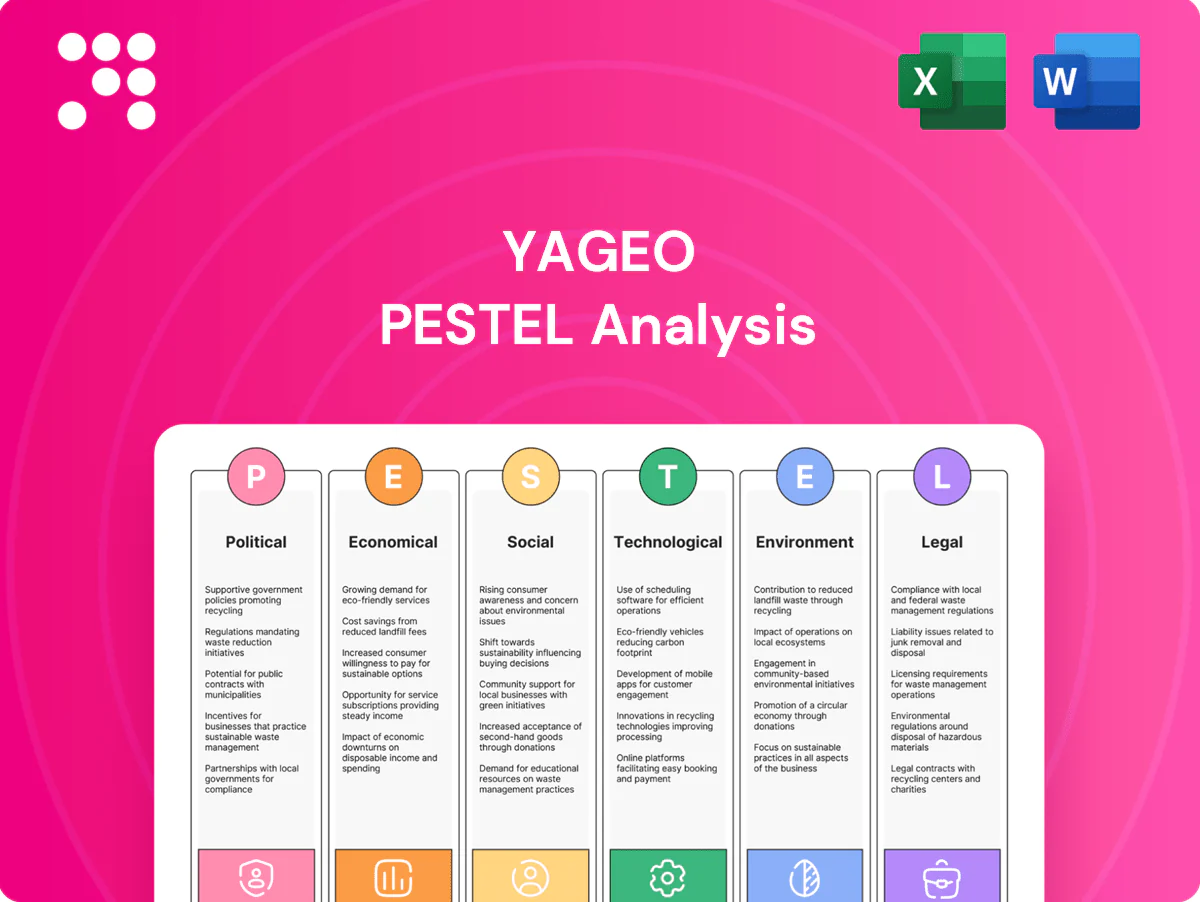
Yageo PESTLE Analysis

Your Shortcut to Market Insight Starts Here
Unlock how political shifts, supply-chain economics, and rapid tech advances are reshaping Yageo’s competitive edge in our concise PESTLE snapshot—ideal for investors and strategists. See where regulatory risk and sustainability trends could hit margins or open new markets. Buy the full PESTLE for a complete, actionable breakdown ready for immediate use.
Political factors

US–China tech tensions
US–China export controls announced from October 2022 and tightened August 2023, plus US tariffs on Chinese goods up to 25%, can constrain Yageo sales into China and complicate sourcing for its global customers. Restrictions on advanced electronics can ripple into passive component demand, while friend‑shoring and relocations may force Yageo to adjust its plant footprint. Policy volatility raises planning and inventory risks for the supply chain.
Taiwan geopolitical risk
Taiwan geopolitical risk threatens supply-chain continuity and raises insurance premiums after increased cross-strait incidents; Yageo, Taiwan-based passive-component leader, reported NT$143.6 billion revenue in 2024, exposing material geographic concentration. Customers are diversifying suppliers, pressuring pricing and market share, so Yageo must keep contingency plans and multisite redundancy. Political instability can delay capex and raise capital costs, affecting investment timing and WACC.

Industrial policy subsidies
US CHIPS Act ($52B), the EU Chips Act (≈€43B mobilized) and Asian packages (Japan ≈¥2.2T/~$16B) push reshoring of semiconductors and electronics, making local manufacturing incentives material for Yageo. Tying passives into subsidized regional supply chains can unlock grants and tax credits but local‑content rules force regionalization of production. Competitors will chase the same incentives, compressing first‑mover gains.

Trade policy and tariffs
Tariff shifts on electronic components—including lingering US Section 301 duties (7.5% on many Chinese-origin tech goods) and varying MFN rates—raise Yageo’s landed costs and squeeze channel margins; RCEP (in force 2022) and regional tariff cuts can create pricing headroom for Asia-centric sourcing. Rules of origin under trade deals and USMCA logistics can redirect where Yageo assembles or ships, while multi-country value chains increase compliance complexity and administrative costs.
- Tariff impact: US Section 301 at 7.5%
- Preferential relief: RCEP active since 2022
- Rules of origin steer manufacturing footprint
- Higher compliance burden across multiple jurisdictions
Public procurement and standards
Government telecom, defense and infrastructure specs (e.g., standards for 5G radio modules and military-grade parts) steer Yageo's component selection; compliance helps secure multi-year contracts while policy-led 5G and EV rollouts—with ~1.8 billion 5G connections and ~14 million EVs globally by 2024—improve volume visibility; sudden funding shifts in defense or infrastructure can abruptly reverse demand trajectories.
- Standards-driven procurement → long-term contracts
- 5G/EV scale (2024) → clearer volume outlook
- Funding shifts → demand volatility risk
Export controls, Taiwan tensions and tariffs lift costs; NT$143.6B exposure
Political risks—US–China export controls, Taiwan tensions and tariffs—raise supply‑chain, insurance and capital costs; Yageo’s NT$143.6 billion 2024 revenue concentrates exposure. Subsidies (US CHIPS $52B, EU ≈€43B, Japan ≈¥2.2T) and RCEP (2022) reshape footprint; US Section 301 duties (7.5%) lift landed costs.
| Metric | Value |
|---|---|
| Yageo revenue (2024) | NT$143.6B |
| US CHIPS | $52B |
| EU mobilized | ≈€43B |
| Japan package | ≈¥2.2T |
| Section 301 duties | 7.5% |
| RCEP | In force 2022 |
What is included in the product
 Detailed Word Document
Explores how external macro-environmental factors uniquely affect Yageo across Political, Economic, Social, Technological, Environmental, and Legal dimensions, using data-backed examples tied to its passive components, sensors and global supply chains. Designed for executives, consultants and investors, it delivers forward-looking insights, scenario implications and clean, presentation-ready formatting for plans or decks.

 Customizable Excel Spreadsheet
A concise, visually segmented PESTLE summary of Yageo that’s editable and shareable for quick alignment in meetings, presentations, and planning sessions, helping teams assess external risks and strategic positioning at a glance.
Economic factors

Electronics cycle sensitivity
Passive components face pronounced inventory cycles across consumer, industrial and telecom; the global passive market was about USD 60bn in 2024 and Yageo reported roughly USD 3.1bn revenue that year, exposing it to utilization swings (downcycles pushing utilization toward ~55% in 2023, upturns >90%), compressed pricing and lead times stretching past 20 weeks; forecast accuracy and channel health are therefore critical while Yageo balances capacity discipline with service levels.
Automotive and EV growth
Rising electronic content per vehicle expands MLCC, resistor, and inductor demand as EVs and ADAS add sensors, power electronics and high-frequency passives; EVs exceeded 10% of global new car sales by 2023, underpinning faster content growth. AEC-qualified parts command premium margins but require stringent testing and traceability. EV adoption and ADAS shift mix toward high-reliability SKUs, while automotive production volatility can still whipsaw orders and inventory planning.

FX and input costs
Yageo invoices and sources in TWD, USD, EUR and CNY, creating translation and transaction exposure across its global footprint; FX moves weighed on margins in 2024 as USD/TWD volatility persisted. Metals and ceramics—notably copper (~$9,500/ton LME in 2024), nickel (~$23,000/ton) and palladium (~$1,200/oz)—directly raise COGS when prices climb. Hedging programs smooth short-term swings but cannot fully offset structural price moves (historical swings >30%). Supplier diversification and regional sourcing mitigate but do not eliminate cost pressure.

Inflation and rates
- Rate: Fed 5.25–5.50% (mid‑2025)
- CPI: US ~3.3% (Jun 2025)
- Pricing power: mix & supply tightness
- Defense: automation improves unit economics
Customer concentration and ASPs
Large OEMs and EMS customers exert pricing pressure and demand high service levels; Yageo’s design-win stickiness underpins recurring revenue but requires sustained R&D and field engineering to retain wins. Mix shifts toward high-capacitance and specialty passives have lifted ASPs, while channel inventory policies and OEM safety stock continue to cloud order visibility into 2024–2025.
- Customer concentration: top OEMs drive pricing/service demands
- Design-win stickiness: supports recurring revenue but needs ongoing engineering
- ASPs: rising from mix upgrades to specialty/high-capacitance passives
- Channel inventory: policies materially affect order visibility
Export controls, Taiwan tensions and tariffs lift costs; NT$143.6B exposure
Global passive market ~$60bn (2024) with Yageo revenue ~$3.1bn exposes it to utilization swings (~55% in 2023 to >90% in upcycles), stretched lead times >20 weeks and margin pressure. EVs (>10% new car sales in 2023) lift automotive passives demand and ASPs. Fed funds 5.25–5.50% (mid‑2025) and US CPI ~3.3% (Jun 2025) damp capex and raise costs.
| Metric | Value |
|---|---|
| Market (2024) | $60bn |
| Yageo revenue (2024) | $3.1bn |
| Utilization range | ~55%–>90% |
| Fed funds | 5.25–5.50% |
| US CPI (Jun 2025) | ~3.3% |
Preview Before You Purchase
Yageo PESTLE Analysis
This Yageo PESTLE Analysis preview is the exact document you’ll receive after purchase—fully formatted and ready to use. The layout, content, and structure shown are identical to the downloadable file. No placeholders or teasers; this is the final, professionally structured report.

Original: $10.00
-65%$10.00
$3.50Product Information
Product Information
Shipping & Returns
Shipping & Returns
Description
Your Shortcut to Market Insight Starts Here
Unlock how political shifts, supply-chain economics, and rapid tech advances are reshaping Yageo’s competitive edge in our concise PESTLE snapshot—ideal for investors and strategists. See where regulatory risk and sustainability trends could hit margins or open new markets. Buy the full PESTLE for a complete, actionable breakdown ready for immediate use.
Political factors
US–China tech tensions
US–China export controls announced from October 2022 and tightened August 2023, plus US tariffs on Chinese goods up to 25%, can constrain Yageo sales into China and complicate sourcing for its global customers. Restrictions on advanced electronics can ripple into passive component demand, while friend‑shoring and relocations may force Yageo to adjust its plant footprint. Policy volatility raises planning and inventory risks for the supply chain.
Taiwan geopolitical risk
Taiwan geopolitical risk threatens supply-chain continuity and raises insurance premiums after increased cross-strait incidents; Yageo, Taiwan-based passive-component leader, reported NT$143.6 billion revenue in 2024, exposing material geographic concentration. Customers are diversifying suppliers, pressuring pricing and market share, so Yageo must keep contingency plans and multisite redundancy. Political instability can delay capex and raise capital costs, affecting investment timing and WACC.
Industrial policy subsidies
US CHIPS Act ($52B), the EU Chips Act (≈€43B mobilized) and Asian packages (Japan ≈¥2.2T/~$16B) push reshoring of semiconductors and electronics, making local manufacturing incentives material for Yageo. Tying passives into subsidized regional supply chains can unlock grants and tax credits but local‑content rules force regionalization of production. Competitors will chase the same incentives, compressing first‑mover gains.
Trade policy and tariffs
Tariff shifts on electronic components—including lingering US Section 301 duties (7.5% on many Chinese-origin tech goods) and varying MFN rates—raise Yageo’s landed costs and squeeze channel margins; RCEP (in force 2022) and regional tariff cuts can create pricing headroom for Asia-centric sourcing. Rules of origin under trade deals and USMCA logistics can redirect where Yageo assembles or ships, while multi-country value chains increase compliance complexity and administrative costs.
- Tariff impact: US Section 301 at 7.5%
- Preferential relief: RCEP active since 2022
- Rules of origin steer manufacturing footprint
- Higher compliance burden across multiple jurisdictions
Public procurement and standards
Government telecom, defense and infrastructure specs (e.g., standards for 5G radio modules and military-grade parts) steer Yageo's component selection; compliance helps secure multi-year contracts while policy-led 5G and EV rollouts—with ~1.8 billion 5G connections and ~14 million EVs globally by 2024—improve volume visibility; sudden funding shifts in defense or infrastructure can abruptly reverse demand trajectories.
- Standards-driven procurement → long-term contracts
- 5G/EV scale (2024) → clearer volume outlook
- Funding shifts → demand volatility risk
Export controls, Taiwan tensions and tariffs lift costs; NT$143.6B exposure
Political risks—US–China export controls, Taiwan tensions and tariffs—raise supply‑chain, insurance and capital costs; Yageo’s NT$143.6 billion 2024 revenue concentrates exposure. Subsidies (US CHIPS $52B, EU ≈€43B, Japan ≈¥2.2T) and RCEP (2022) reshape footprint; US Section 301 duties (7.5%) lift landed costs.
| Metric | Value |
|---|---|
| Yageo revenue (2024) | NT$143.6B |
| US CHIPS | $52B |
| EU mobilized | ≈€43B |
| Japan package | ≈¥2.2T |
| Section 301 duties | 7.5% |
| RCEP | In force 2022 |
What is included in the product
Detailed Word Document
Explores how external macro-environmental factors uniquely affect Yageo across Political, Economic, Social, Technological, Environmental, and Legal dimensions, using data-backed examples tied to its passive components, sensors and global supply chains. Designed for executives, consultants and investors, it delivers forward-looking insights, scenario implications and clean, presentation-ready formatting for plans or decks.
Customizable Excel Spreadsheet
A concise, visually segmented PESTLE summary of Yageo that’s editable and shareable for quick alignment in meetings, presentations, and planning sessions, helping teams assess external risks and strategic positioning at a glance.
Economic factors
Electronics cycle sensitivity
Passive components face pronounced inventory cycles across consumer, industrial and telecom; the global passive market was about USD 60bn in 2024 and Yageo reported roughly USD 3.1bn revenue that year, exposing it to utilization swings (downcycles pushing utilization toward ~55% in 2023, upturns >90%), compressed pricing and lead times stretching past 20 weeks; forecast accuracy and channel health are therefore critical while Yageo balances capacity discipline with service levels.
Automotive and EV growth
Rising electronic content per vehicle expands MLCC, resistor, and inductor demand as EVs and ADAS add sensors, power electronics and high-frequency passives; EVs exceeded 10% of global new car sales by 2023, underpinning faster content growth. AEC-qualified parts command premium margins but require stringent testing and traceability. EV adoption and ADAS shift mix toward high-reliability SKUs, while automotive production volatility can still whipsaw orders and inventory planning.
FX and input costs
Yageo invoices and sources in TWD, USD, EUR and CNY, creating translation and transaction exposure across its global footprint; FX moves weighed on margins in 2024 as USD/TWD volatility persisted. Metals and ceramics—notably copper (~$9,500/ton LME in 2024), nickel (~$23,000/ton) and palladium (~$1,200/oz)—directly raise COGS when prices climb. Hedging programs smooth short-term swings but cannot fully offset structural price moves (historical swings >30%). Supplier diversification and regional sourcing mitigate but do not eliminate cost pressure.
Inflation and rates
- Rate: Fed 5.25–5.50% (mid‑2025)
- CPI: US ~3.3% (Jun 2025)
- Pricing power: mix & supply tightness
- Defense: automation improves unit economics
Customer concentration and ASPs
Large OEMs and EMS customers exert pricing pressure and demand high service levels; Yageo’s design-win stickiness underpins recurring revenue but requires sustained R&D and field engineering to retain wins. Mix shifts toward high-capacitance and specialty passives have lifted ASPs, while channel inventory policies and OEM safety stock continue to cloud order visibility into 2024–2025.
- Customer concentration: top OEMs drive pricing/service demands
- Design-win stickiness: supports recurring revenue but needs ongoing engineering
- ASPs: rising from mix upgrades to specialty/high-capacitance passives
- Channel inventory: policies materially affect order visibility
Export controls, Taiwan tensions and tariffs lift costs; NT$143.6B exposure
Global passive market ~$60bn (2024) with Yageo revenue ~$3.1bn exposes it to utilization swings (~55% in 2023 to >90% in upcycles), stretched lead times >20 weeks and margin pressure. EVs (>10% new car sales in 2023) lift automotive passives demand and ASPs. Fed funds 5.25–5.50% (mid‑2025) and US CPI ~3.3% (Jun 2025) damp capex and raise costs.
| Metric | Value |
|---|---|
| Market (2024) | $60bn |
| Yageo revenue (2024) | $3.1bn |
| Utilization range | ~55%–>90% |
| Fed funds | 5.25–5.50% |
| US CPI (Jun 2025) | ~3.3% |
Preview Before You Purchase
Yageo PESTLE Analysis
This Yageo PESTLE Analysis preview is the exact document you’ll receive after purchase—fully formatted and ready to use. The layout, content, and structure shown are identical to the downloadable file. No placeholders or teasers; this is the final, professionally structured report.











