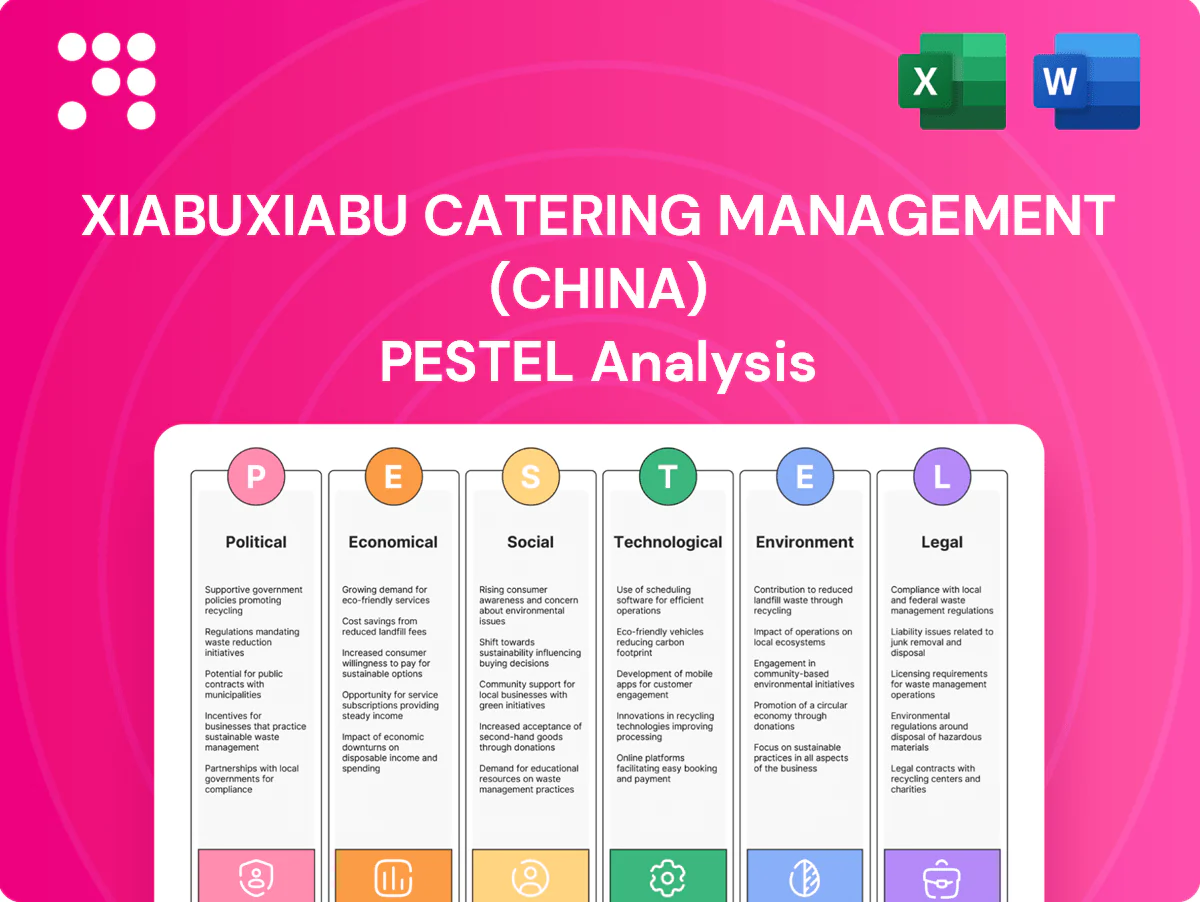
Xiabuxiabu Catering Management (China) PESTLE Analysis

Make Smarter Strategic Decisions with a Complete PESTEL View
Discover how political shifts, consumer trends, and regulatory changes are reshaping Xiabuxiabu Catering Management (China)'s growth prospects. This concise PESTLE snapshot highlights risks and opportunities for investors and strategists. Purchase the full analysis to access detailed insights, forecasts, and strategic recommendations ready for immediate use.
Political factors

Food-safety oversight and inspections
China enforces stringent food-safety oversight under the Food Safety Law (2015) with routine local inspections and zero-tolerance enforcement that can trigger fines or closures; consistent compliance eases licensing and reduces operational disruptions. Xiabuxiabu must maintain end-to-end traceability and standardized processes across both brands so strong governance serves as a competitive differentiator in a tightly scrutinized market.
Consumption stimulus and local subsidies
Provincial and city-level consumption vouchers and night-economy campaigns—launched in over 30 prefecture-level cities by 2024—can lift dine-in traffic; municipal voucher pools often range from tens to hundreds of millions of RMB, creating measurable short-term demand spikes. Xiabuxiabu can align time-limited promotions with these programs and prioritize malls and transport hubs in incentivized zones to amplify uptake, but rapid execution is critical to capture transient boosts.

Supply-chain self-reliance and agri policy
Policies boosting domestic livestock and condiments—China produced about 7 million tonnes of beef and 4 million tonnes of mutton in 2023—reduce cost volatility and strengthen supply stability for Xiabuxiabu. Partnering with government-approved local suppliers cuts geopolitical and import risk as imports still meet roughly 20% of beef demand. Multi-year contracts can secure beef, mutton and chili supply and prices; strict origin and traceability rules require full compliance.

Platform regulation and fair-competition rules
Regulators since 2021 have curtailed platform exclusivity and pushed fee-transparency, improving chain bargaining power; Meituan ~63% and Ele.me ~29% of food delivery share in 2023 (iResearch), with average commissions 15–25% industry-wide (2023 reports), so diversifying beyond a single aggregator can cut costs and risk.
- Optimize across Meituan/Ele.me/private traffic
- Target 10–30% private-order growth to lower commission spend
- Monitor SAMR/CAC guidance to avoid channel disruption
Macropolitical stability and geopolitics
Stable domestic policy supports Xiabuxiabu's network planning and capex visibility, aided by China's 2024 GDP growth of 5.2% (NBS), while geopolitical tensions push commodity costs and investor sentiment—Brent averaged about $86/bbl in 2024, raising input-price volatility. Hedging and diversified sourcing reduce margin swings, and clear stakeholder communication sustains capital access and financing terms.
- Domestic growth: 2024 GDP +5.2%
- Commodity marker: Brent ~ $86/bbl (2024 avg)
- Risk mitigant: hedging + diversified suppliers
- Finance: proactive stakeholder communications maintain capital lines
Tight food-safety rules and dine-in spikes force omnichannel shift; commissions 15–25%
Stringent food-safety enforcement (Food Safety Law) requires end-to-end traceability and standardized ops to avoid fines or closures. Municipal consumption vouchers and night-economy drives (30+ cities by 2024) create short-term dine-in spikes needing rapid execution. Delivery-market regulation plus Meituan ~63%/Ele.me ~29% (2023) and 15–25% commissions force omnichannel and private-order growth (target 10–30%).
| Indicator | Value |
|---|---|
| China GDP 2024 | +5.2% (NBS) |
| Meituan / Ele.me (2023) | ~63% / ~29% (iResearch) |
| Brent 2024 avg | ~$86/bbl |
| Beef / Mutton 2023 | ~7M t / ~4M t |
What is included in the product
 Detailed Word Document
Explores how Political, Economic, Social, Technological, Environmental, and Legal forces uniquely affect Xiabuxiabu Catering Management (China), with data-backed trends, actionable risks and opportunities; designed to support executives, investors and strategists with forward-looking insights for scenario planning and competitive positioning.

 Customizable Excel Spreadsheet
A clean, summarized PESTLE for Xiabuxiabu Catering Management (China) that highlights regulatory, economic, social, technological, environmental and legal risks to streamline meetings, support quick decision-making and reduce external uncertainty in strategy sessions.
Economic factors

Weak consumer sentiment and downtrading
Prolonged caution in discretionary spend has driven downtrading, with NBS and industry reports showing retail sales growth moderating to low single digits in 2024 and elevated household savings supporting value-seeking behavior. Xiabuxiabu can defend the mass brand via combo pricing, weekday promos and bundle economics to protect traffic. Coucou can sustain premium positioning through experiential differentiation, while disciplined menu engineering must protect margin even as promotions keep covers stable.
Food input price volatility
Meat and vegetable prices in China show seasonal swings often reaching 10–25% intra-year volatility, so Xiabuxiabu uses contracting and hedging plus seasonal menus to smooth margins; central kitchens improve yield and standardization, cutting ingredient waste by around 15–20%, while real-time procurement and POS dashboards flag cost variance within 24 hours to protect gross margins.

Urbanization and tier-city mix
China’s urbanization reached 64.7% in 2023, concentrating spending and footfall in higher-tier cities and premium malls. Store productivity varies markedly by tier, mall quality and footfall, with higher-tier malls supporting Coucou’s premium checks while lower tiers favor value hotpot formats. Portfolio allocation and aggressive rent negotiations drive ROI, and disciplined store closures preserve cash.

Delivery and takeaway economics
Xiabuxiabu’s off-premise expands reach but compresses margins via platform commissions typically 15–25% plus packaging; unit economics improve when private-domain traffic and self-pickup cut commission/fulfillment costs by ~5–10 ppt and 10–15% respectively. Hotpot travelability forces delivery-tailored SKUs and heat-retention packaging to avoid quality loss; cross-selling retail sauces can lift AOV ~5–8%.
- Commissions: 15–25%
- Private-domain/self-pickup: −5–10 ppt commission
- Fulfillment cost saving: 10–15%
- Cross-sell AOV lift: 5–8%
Labor costs and productivity
Minimum wage adjustments and staffing tightness in 2023–24 pushed hourly frontline labor costs higher, with regional monthly minima roughly 1,500–2,500 CNY across major Chinese cities, squeezing margins for Xiabuxiabu.
Standardized SOPs, focused training and partial automation have documented productivity gains—faster table turns and lower labor per cover—while incentive alignment cuts turnover and flexible rostering matches peak demand.
- labor-cost-range: 1,500–2,500 CNY/month
- productivity-drivers: SOPs, training, automation
- retention: incentives reduce turnover
- rostering: flexible schedules for peak match
Tight food-safety rules and dine-in spikes force omnichannel shift; commissions 15–25%
Slowing retail sales growth to low single digits in 2024 and high household savings drive value-seeking and downtrading; Xiabuxiabu defends traffic via combo pricing and bundles. Input volatility (seasonal 10–25%) and labor rises (minima 1,500–2,500 CNY/month) pressure margins; central kitchens cut waste ~15–20% and private-domain/self-pickup trims commission 5–10 ppt.
| Metric | 2023/24 |
|---|---|
| Urbanization | 64.7% |
| Retail sales growth | Low single digits (2024) |
| Platform commission | 15–25% |
| Wage range | 1,500–2,500 CNY/mo |
Preview Before You Purchase
Xiabuxiabu Catering Management (China) PESTLE Analysis
This Xiabuxiabu Catering Management (China) PESTLE Analysis provides concise insights into political, economic, social, technological, legal, and environmental factors affecting the business. The preview shown here is the exact document you’ll receive after purchase—fully formatted and ready to use. No placeholders or teasers; what you see is the final, downloadable file.

Original: $10.00
-65%$10.00
$3.50Product Information
Product Information
Shipping & Returns
Shipping & Returns
Description
Make Smarter Strategic Decisions with a Complete PESTEL View
Discover how political shifts, consumer trends, and regulatory changes are reshaping Xiabuxiabu Catering Management (China)'s growth prospects. This concise PESTLE snapshot highlights risks and opportunities for investors and strategists. Purchase the full analysis to access detailed insights, forecasts, and strategic recommendations ready for immediate use.
Political factors
Food-safety oversight and inspections
China enforces stringent food-safety oversight under the Food Safety Law (2015) with routine local inspections and zero-tolerance enforcement that can trigger fines or closures; consistent compliance eases licensing and reduces operational disruptions. Xiabuxiabu must maintain end-to-end traceability and standardized processes across both brands so strong governance serves as a competitive differentiator in a tightly scrutinized market.
Consumption stimulus and local subsidies
Provincial and city-level consumption vouchers and night-economy campaigns—launched in over 30 prefecture-level cities by 2024—can lift dine-in traffic; municipal voucher pools often range from tens to hundreds of millions of RMB, creating measurable short-term demand spikes. Xiabuxiabu can align time-limited promotions with these programs and prioritize malls and transport hubs in incentivized zones to amplify uptake, but rapid execution is critical to capture transient boosts.
Supply-chain self-reliance and agri policy
Policies boosting domestic livestock and condiments—China produced about 7 million tonnes of beef and 4 million tonnes of mutton in 2023—reduce cost volatility and strengthen supply stability for Xiabuxiabu. Partnering with government-approved local suppliers cuts geopolitical and import risk as imports still meet roughly 20% of beef demand. Multi-year contracts can secure beef, mutton and chili supply and prices; strict origin and traceability rules require full compliance.
Platform regulation and fair-competition rules
Regulators since 2021 have curtailed platform exclusivity and pushed fee-transparency, improving chain bargaining power; Meituan ~63% and Ele.me ~29% of food delivery share in 2023 (iResearch), with average commissions 15–25% industry-wide (2023 reports), so diversifying beyond a single aggregator can cut costs and risk.
- Optimize across Meituan/Ele.me/private traffic
- Target 10–30% private-order growth to lower commission spend
- Monitor SAMR/CAC guidance to avoid channel disruption
Macropolitical stability and geopolitics
Stable domestic policy supports Xiabuxiabu's network planning and capex visibility, aided by China's 2024 GDP growth of 5.2% (NBS), while geopolitical tensions push commodity costs and investor sentiment—Brent averaged about $86/bbl in 2024, raising input-price volatility. Hedging and diversified sourcing reduce margin swings, and clear stakeholder communication sustains capital access and financing terms.
- Domestic growth: 2024 GDP +5.2%
- Commodity marker: Brent ~ $86/bbl (2024 avg)
- Risk mitigant: hedging + diversified suppliers
- Finance: proactive stakeholder communications maintain capital lines
Tight food-safety rules and dine-in spikes force omnichannel shift; commissions 15–25%
Stringent food-safety enforcement (Food Safety Law) requires end-to-end traceability and standardized ops to avoid fines or closures. Municipal consumption vouchers and night-economy drives (30+ cities by 2024) create short-term dine-in spikes needing rapid execution. Delivery-market regulation plus Meituan ~63%/Ele.me ~29% (2023) and 15–25% commissions force omnichannel and private-order growth (target 10–30%).
| Indicator | Value |
|---|---|
| China GDP 2024 | +5.2% (NBS) |
| Meituan / Ele.me (2023) | ~63% / ~29% (iResearch) |
| Brent 2024 avg | ~$86/bbl |
| Beef / Mutton 2023 | ~7M t / ~4M t |
What is included in the product
Detailed Word Document
Explores how Political, Economic, Social, Technological, Environmental, and Legal forces uniquely affect Xiabuxiabu Catering Management (China), with data-backed trends, actionable risks and opportunities; designed to support executives, investors and strategists with forward-looking insights for scenario planning and competitive positioning.
Customizable Excel Spreadsheet
A clean, summarized PESTLE for Xiabuxiabu Catering Management (China) that highlights regulatory, economic, social, technological, environmental and legal risks to streamline meetings, support quick decision-making and reduce external uncertainty in strategy sessions.
Economic factors
Weak consumer sentiment and downtrading
Prolonged caution in discretionary spend has driven downtrading, with NBS and industry reports showing retail sales growth moderating to low single digits in 2024 and elevated household savings supporting value-seeking behavior. Xiabuxiabu can defend the mass brand via combo pricing, weekday promos and bundle economics to protect traffic. Coucou can sustain premium positioning through experiential differentiation, while disciplined menu engineering must protect margin even as promotions keep covers stable.
Food input price volatility
Meat and vegetable prices in China show seasonal swings often reaching 10–25% intra-year volatility, so Xiabuxiabu uses contracting and hedging plus seasonal menus to smooth margins; central kitchens improve yield and standardization, cutting ingredient waste by around 15–20%, while real-time procurement and POS dashboards flag cost variance within 24 hours to protect gross margins.
Urbanization and tier-city mix
China’s urbanization reached 64.7% in 2023, concentrating spending and footfall in higher-tier cities and premium malls. Store productivity varies markedly by tier, mall quality and footfall, with higher-tier malls supporting Coucou’s premium checks while lower tiers favor value hotpot formats. Portfolio allocation and aggressive rent negotiations drive ROI, and disciplined store closures preserve cash.
Delivery and takeaway economics
Xiabuxiabu’s off-premise expands reach but compresses margins via platform commissions typically 15–25% plus packaging; unit economics improve when private-domain traffic and self-pickup cut commission/fulfillment costs by ~5–10 ppt and 10–15% respectively. Hotpot travelability forces delivery-tailored SKUs and heat-retention packaging to avoid quality loss; cross-selling retail sauces can lift AOV ~5–8%.
- Commissions: 15–25%
- Private-domain/self-pickup: −5–10 ppt commission
- Fulfillment cost saving: 10–15%
- Cross-sell AOV lift: 5–8%
Labor costs and productivity
Minimum wage adjustments and staffing tightness in 2023–24 pushed hourly frontline labor costs higher, with regional monthly minima roughly 1,500–2,500 CNY across major Chinese cities, squeezing margins for Xiabuxiabu.
Standardized SOPs, focused training and partial automation have documented productivity gains—faster table turns and lower labor per cover—while incentive alignment cuts turnover and flexible rostering matches peak demand.
- labor-cost-range: 1,500–2,500 CNY/month
- productivity-drivers: SOPs, training, automation
- retention: incentives reduce turnover
- rostering: flexible schedules for peak match
Tight food-safety rules and dine-in spikes force omnichannel shift; commissions 15–25%
Slowing retail sales growth to low single digits in 2024 and high household savings drive value-seeking and downtrading; Xiabuxiabu defends traffic via combo pricing and bundles. Input volatility (seasonal 10–25%) and labor rises (minima 1,500–2,500 CNY/month) pressure margins; central kitchens cut waste ~15–20% and private-domain/self-pickup trims commission 5–10 ppt.
| Metric | 2023/24 |
|---|---|
| Urbanization | 64.7% |
| Retail sales growth | Low single digits (2024) |
| Platform commission | 15–25% |
| Wage range | 1,500–2,500 CNY/mo |
Preview Before You Purchase
Xiabuxiabu Catering Management (China) PESTLE Analysis
This Xiabuxiabu Catering Management (China) PESTLE Analysis provides concise insights into political, economic, social, technological, legal, and environmental factors affecting the business. The preview shown here is the exact document you’ll receive after purchase—fully formatted and ready to use. No placeholders or teasers; what you see is the final, downloadable file.