Whitehaven Coal PESTLE Analysis

Your Shortcut to Market Insight Starts Here
Explore how political pressures, commodity cycles, and environmental regulation converge to shape Whitehaven Coal’s strategy and risk profile in this targeted PESTLE snapshot. Our analysis highlights supply-chain, social license, and tech risks you can’t ignore. Ideal for investors and strategists, the full PESTLE delivers actionable, sourced insights. Purchase the complete report to download and apply immediately.
Political factors

Australian energy policy
Changes in federal and NSW energy and climate policy directly shape approvals, operating limits and demand signals for coal, with Australia committing to a 43% reduction in emissions by 2030 and net zero by 2050. A faster shift to decarbonisation can compress mine lives and raise compliance costs, while support for an orderly transition increasingly ties approvals to stricter offsets and rehabilitation. Policy stability reduces project risk and financing spreads for coal miners in a market where Australia supplies about 40% of seaborne coal.
Approvals and permitting
State planning decisions and ministerial call‑ins in New South Wales directly determine timing and certainty for Whitehaven Coal’s new pits, extensions and expansions, often overriding local approvals. Lengthy environmental assessments and appeals routinely defer project start‑up and can push cash flows into later years. Growing political scrutiny of cumulative impacts—water, biodiversity and dust—raises the evidentiary bar for approvals. Early stakeholder alignment reduces escalation risk and shortens approval timelines.

Trade and export relations
Bilateral ties with key Asian buyers such as Japan and Korea underpin Whitehaven Coal’s long‑term sales contracts and pricing formulas; Austrade data through 2023 show Japan and Korea remain among Australia’s largest coal purchasers. Diplomatic strain, tariffs or informal restrictions can divert volumes or compress margins, while government‑led trade missions and agreements in 2024 opened logistics windows for expanded shipments. Sanctions on competitor nations, notably the EU/UK ban on Russian seaborne coal since 2022, have shifted relative advantage in Asian markets.

Indigenous engagement policy
Commonwealth and NSW frameworks for Indigenous land use agreements materially shape access, timelines and benefit sharing for Whitehaven; Indigenous peoples comprise 3.8% of Australia (2021 census), concentrating land rights impacts in NSW mining regions. Political momentum for stronger cultural‑heritage protections can force mine redesigns or added conditions. Constructive partnerships reduce political risk and protests; transparent benefit flows build durable local support.
- Frameworks: ILUAs and state protocols
- Risk: heritage protections → redesign
- Mitigation: partnerships lower protest risk
- Trust: transparent benefit flows sustain consent
Infrastructure and royalties
Government stances on rail and port investment, access pricing and royalty regimes directly affect Whitehaven Coal’s delivered costs; recent NSW and federal infrastructure reviews have prioritized export supply chains, while access pricing reforms raise unit transport risk. Unexpected royalty hikes materially amplify earnings sensitivity to coal prices and volumes, and election cycles in Australia periodically trigger policy resets. Stable, predictable settings enable long‑term contracts and capex planning.
- Policy risk: election-driven resets
- Access pricing: alters delivered cost
- Royalties: direct earnings sensitivity
- Stability: supports long-term capex
Australia coal sector pressured by 2030/2050 climate targets, export shifts and land access risks
Federal NSW energy/climate targets (43% emissions cut by 2030; net zero 2050) and state planning decisions drive approvals, compliance costs and mine lives for Whitehaven; Australia supplies about 40% of seaborne coal. Diplomatic shifts (EU/UK 2022 ban on Russian coal) and Indigenous land rights (3.8% of population) add access and market risk.
| Metric | Value |
|---|---|
| 2030 emissions target | 43% |
| Net zero | 2050 |
| Seaborne coal share | ~40% |
| Indigenous pop (2021) | 3.8% |
What is included in the product
 Detailed Word Document
Explores how Political, Economic, Social, Technological, Environmental and Legal forces uniquely affect Whitehaven Coal, with data-backed trends, forward-looking insights and detailed sub-points to help executives, investors and strategists identify risks, opportunities and actionable responses.

 Customizable Excel Spreadsheet
A concise, visually segmented Whitehaven Coal PESTLE summary that eases stakeholder alignment by highlighting key external risks and opportunities for meetings, presentations and planning sessions, while remaining editable for region- or project-specific notes and quick inclusion in slide decks or reports.
Economic factors

Coal price cycles
Metallurgical and thermal coal price cycles drive Whitehaven’s revenue volatility and investment timing, with spot moves often exceeding 50% year‑on‑year and met coal premiums in Asia running roughly 30–40% above thermal amid strong steel demand; power demand and gas price swings are primary drivers of thermal pricing. High-price periods have enabled deleveraging and A$200–400m buybacks, while downturns force strict cost discipline; hedging and contract mix smooth cash flows.
Currency and inflation
AUD/USD around 0.65 in mid‑2025 improves USD export realizations versus AUD‑denominated costs, so a weaker AUD materially boosts Whitehaven margins. Australian CPI was about 3.4% YoY (Q1 2025), lifting wages, explosives, diesel and contractor rates and pressuring unit costs during commodity upcycles. Ongoing procurement and productivity programs are key to mitigating that margin squeeze.

Logistics and shipping
Rail availability and port queue times (Port of Newcastle throughput ~160 Mtpa) directly influence demurrage and FOB costs and customer reliability; spikes in vessel queues have deferred exports despite strong demand. Global freight and insurance premia (reflected in volatile Baltic indices) affect landed competitiveness in Asia. Bottlenecks can defer revenue; long‑term haulage and port contracts reduce cost and delivery volatility.

Capital access and rates
Higher interest rates and tighter lender ESG screens are reducing available financing for new coal projects and increasing cost of capital, which compresses NPV and lengthens payback periods for expansions and methane abatement schemes. Whitehaven’s strong cash generation supports self‑funding of projects and dividends, while diversified banking relationships and bond market access lower refinancing risk.
- Higher rates & ESG filters tighten project finance
- Cost of capital directly reduces NPV/payback on abatement
- Operating cashflow enables self‑funding/dividends
- Diversified banks & bond access cut refinancing risk
Competitive landscape
Indonesia, which supplies roughly 35% of seaborne thermal coal, plus swing volumes from the US, Russia, Canada and Mozambique, drive short-term price and market-share moves; quality spreads (ash, sulfur, HCC versus PCI) command premiums, and outages at peers can lift Whitehaven realizations temporarily while customers stick to reliable, consistent specs to secure offtake.
- Supply concentration: Indonesia ~35% seaborne share
- Quality premia: HCC/low-ash, low-sulfur receive price uplifts
- Disruption impact: peer outages => temporary price spikes
- Customer demand: reliability sustains contractual offtake
Australia coal sector pressured by 2030/2050 climate targets, export shifts and land access risks
Met and thermal coal price cycles drive >50% y/y revenue swings; met premiums ~30–40% over thermal. AUD/USD ~0.65 (mid‑2025) lifts USD export realizations while Australian CPI ~3.4% (Q1 2025) pushes input costs. Port of Newcastle throughput ~160 Mtpa and Indonesia ~35% seaborne share create supply/price sensitivity; higher rates (~4.35% RBA) raise project CAPEX.
| Metric | Value |
|---|---|
| Coal price volatility | >50% y/y |
| Met premium | 30–40% |
| AUD/USD | ~0.65 (mid‑2025) |
| Aus CPI | 3.4% Q1 2025 |
| Port Newcastle | ~160 Mtpa |
| Indonesia seaborne | ~35% |
| RBA cash rate | ~4.35% |
Preview the Actual Deliverable
Whitehaven Coal PESTLE Analysis
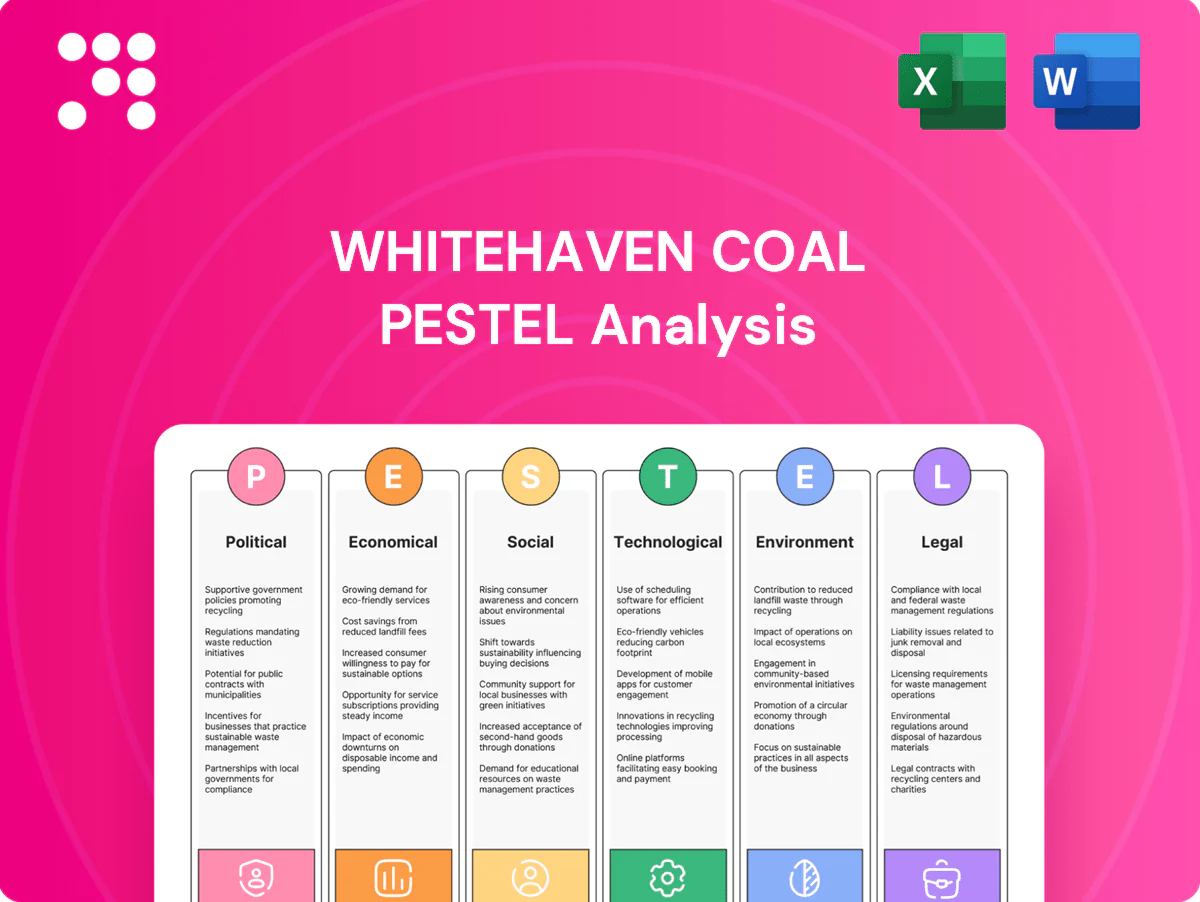
The preview shown here is the exact Whitehaven Coal PESTLE Analysis report you’ll receive after purchase—fully formatted and ready to use. It includes comprehensive Political, Economic, Social, Technological, Legal and Environmental insights with professional structure and no placeholders. After checkout you’ll instantly download this same finished document, exactly as displayed.

Product Information
Product Information
Shipping & Returns
Shipping & Returns
Description
Your Shortcut to Market Insight Starts Here
Explore how political pressures, commodity cycles, and environmental regulation converge to shape Whitehaven Coal’s strategy and risk profile in this targeted PESTLE snapshot. Our analysis highlights supply-chain, social license, and tech risks you can’t ignore. Ideal for investors and strategists, the full PESTLE delivers actionable, sourced insights. Purchase the complete report to download and apply immediately.
Political factors
Australian energy policy
Changes in federal and NSW energy and climate policy directly shape approvals, operating limits and demand signals for coal, with Australia committing to a 43% reduction in emissions by 2030 and net zero by 2050. A faster shift to decarbonisation can compress mine lives and raise compliance costs, while support for an orderly transition increasingly ties approvals to stricter offsets and rehabilitation. Policy stability reduces project risk and financing spreads for coal miners in a market where Australia supplies about 40% of seaborne coal.
Approvals and permitting
State planning decisions and ministerial call‑ins in New South Wales directly determine timing and certainty for Whitehaven Coal’s new pits, extensions and expansions, often overriding local approvals. Lengthy environmental assessments and appeals routinely defer project start‑up and can push cash flows into later years. Growing political scrutiny of cumulative impacts—water, biodiversity and dust—raises the evidentiary bar for approvals. Early stakeholder alignment reduces escalation risk and shortens approval timelines.
Trade and export relations
Bilateral ties with key Asian buyers such as Japan and Korea underpin Whitehaven Coal’s long‑term sales contracts and pricing formulas; Austrade data through 2023 show Japan and Korea remain among Australia’s largest coal purchasers. Diplomatic strain, tariffs or informal restrictions can divert volumes or compress margins, while government‑led trade missions and agreements in 2024 opened logistics windows for expanded shipments. Sanctions on competitor nations, notably the EU/UK ban on Russian seaborne coal since 2022, have shifted relative advantage in Asian markets.
Indigenous engagement policy
Commonwealth and NSW frameworks for Indigenous land use agreements materially shape access, timelines and benefit sharing for Whitehaven; Indigenous peoples comprise 3.8% of Australia (2021 census), concentrating land rights impacts in NSW mining regions. Political momentum for stronger cultural‑heritage protections can force mine redesigns or added conditions. Constructive partnerships reduce political risk and protests; transparent benefit flows build durable local support.
- Frameworks: ILUAs and state protocols
- Risk: heritage protections → redesign
- Mitigation: partnerships lower protest risk
- Trust: transparent benefit flows sustain consent
Infrastructure and royalties
Government stances on rail and port investment, access pricing and royalty regimes directly affect Whitehaven Coal’s delivered costs; recent NSW and federal infrastructure reviews have prioritized export supply chains, while access pricing reforms raise unit transport risk. Unexpected royalty hikes materially amplify earnings sensitivity to coal prices and volumes, and election cycles in Australia periodically trigger policy resets. Stable, predictable settings enable long‑term contracts and capex planning.
- Policy risk: election-driven resets
- Access pricing: alters delivered cost
- Royalties: direct earnings sensitivity
- Stability: supports long-term capex
Australia coal sector pressured by 2030/2050 climate targets, export shifts and land access risks
Federal NSW energy/climate targets (43% emissions cut by 2030; net zero 2050) and state planning decisions drive approvals, compliance costs and mine lives for Whitehaven; Australia supplies about 40% of seaborne coal. Diplomatic shifts (EU/UK 2022 ban on Russian coal) and Indigenous land rights (3.8% of population) add access and market risk.
| Metric | Value |
|---|---|
| 2030 emissions target | 43% |
| Net zero | 2050 |
| Seaborne coal share | ~40% |
| Indigenous pop (2021) | 3.8% |
What is included in the product
Detailed Word Document
Explores how Political, Economic, Social, Technological, Environmental and Legal forces uniquely affect Whitehaven Coal, with data-backed trends, forward-looking insights and detailed sub-points to help executives, investors and strategists identify risks, opportunities and actionable responses.
Customizable Excel Spreadsheet
A concise, visually segmented Whitehaven Coal PESTLE summary that eases stakeholder alignment by highlighting key external risks and opportunities for meetings, presentations and planning sessions, while remaining editable for region- or project-specific notes and quick inclusion in slide decks or reports.
Economic factors
Coal price cycles
Metallurgical and thermal coal price cycles drive Whitehaven’s revenue volatility and investment timing, with spot moves often exceeding 50% year‑on‑year and met coal premiums in Asia running roughly 30–40% above thermal amid strong steel demand; power demand and gas price swings are primary drivers of thermal pricing. High-price periods have enabled deleveraging and A$200–400m buybacks, while downturns force strict cost discipline; hedging and contract mix smooth cash flows.
Currency and inflation
AUD/USD around 0.65 in mid‑2025 improves USD export realizations versus AUD‑denominated costs, so a weaker AUD materially boosts Whitehaven margins. Australian CPI was about 3.4% YoY (Q1 2025), lifting wages, explosives, diesel and contractor rates and pressuring unit costs during commodity upcycles. Ongoing procurement and productivity programs are key to mitigating that margin squeeze.
Logistics and shipping
Rail availability and port queue times (Port of Newcastle throughput ~160 Mtpa) directly influence demurrage and FOB costs and customer reliability; spikes in vessel queues have deferred exports despite strong demand. Global freight and insurance premia (reflected in volatile Baltic indices) affect landed competitiveness in Asia. Bottlenecks can defer revenue; long‑term haulage and port contracts reduce cost and delivery volatility.
Capital access and rates
Higher interest rates and tighter lender ESG screens are reducing available financing for new coal projects and increasing cost of capital, which compresses NPV and lengthens payback periods for expansions and methane abatement schemes. Whitehaven’s strong cash generation supports self‑funding of projects and dividends, while diversified banking relationships and bond market access lower refinancing risk.
- Higher rates & ESG filters tighten project finance
- Cost of capital directly reduces NPV/payback on abatement
- Operating cashflow enables self‑funding/dividends
- Diversified banks & bond access cut refinancing risk
Competitive landscape
Indonesia, which supplies roughly 35% of seaborne thermal coal, plus swing volumes from the US, Russia, Canada and Mozambique, drive short-term price and market-share moves; quality spreads (ash, sulfur, HCC versus PCI) command premiums, and outages at peers can lift Whitehaven realizations temporarily while customers stick to reliable, consistent specs to secure offtake.
- Supply concentration: Indonesia ~35% seaborne share
- Quality premia: HCC/low-ash, low-sulfur receive price uplifts
- Disruption impact: peer outages => temporary price spikes
- Customer demand: reliability sustains contractual offtake
Australia coal sector pressured by 2030/2050 climate targets, export shifts and land access risks
Met and thermal coal price cycles drive >50% y/y revenue swings; met premiums ~30–40% over thermal. AUD/USD ~0.65 (mid‑2025) lifts USD export realizations while Australian CPI ~3.4% (Q1 2025) pushes input costs. Port of Newcastle throughput ~160 Mtpa and Indonesia ~35% seaborne share create supply/price sensitivity; higher rates (~4.35% RBA) raise project CAPEX.
| Metric | Value |
|---|---|
| Coal price volatility | >50% y/y |
| Met premium | 30–40% |
| AUD/USD | ~0.65 (mid‑2025) |
| Aus CPI | 3.4% Q1 2025 |
| Port Newcastle | ~160 Mtpa |
| Indonesia seaborne | ~35% |
| RBA cash rate | ~4.35% |
Preview the Actual Deliverable
Whitehaven Coal PESTLE Analysis
The preview shown here is the exact Whitehaven Coal PESTLE Analysis report you’ll receive after purchase—fully formatted and ready to use. It includes comprehensive Political, Economic, Social, Technological, Legal and Environmental insights with professional structure and no placeholders. After checkout you’ll instantly download this same finished document, exactly as displayed.