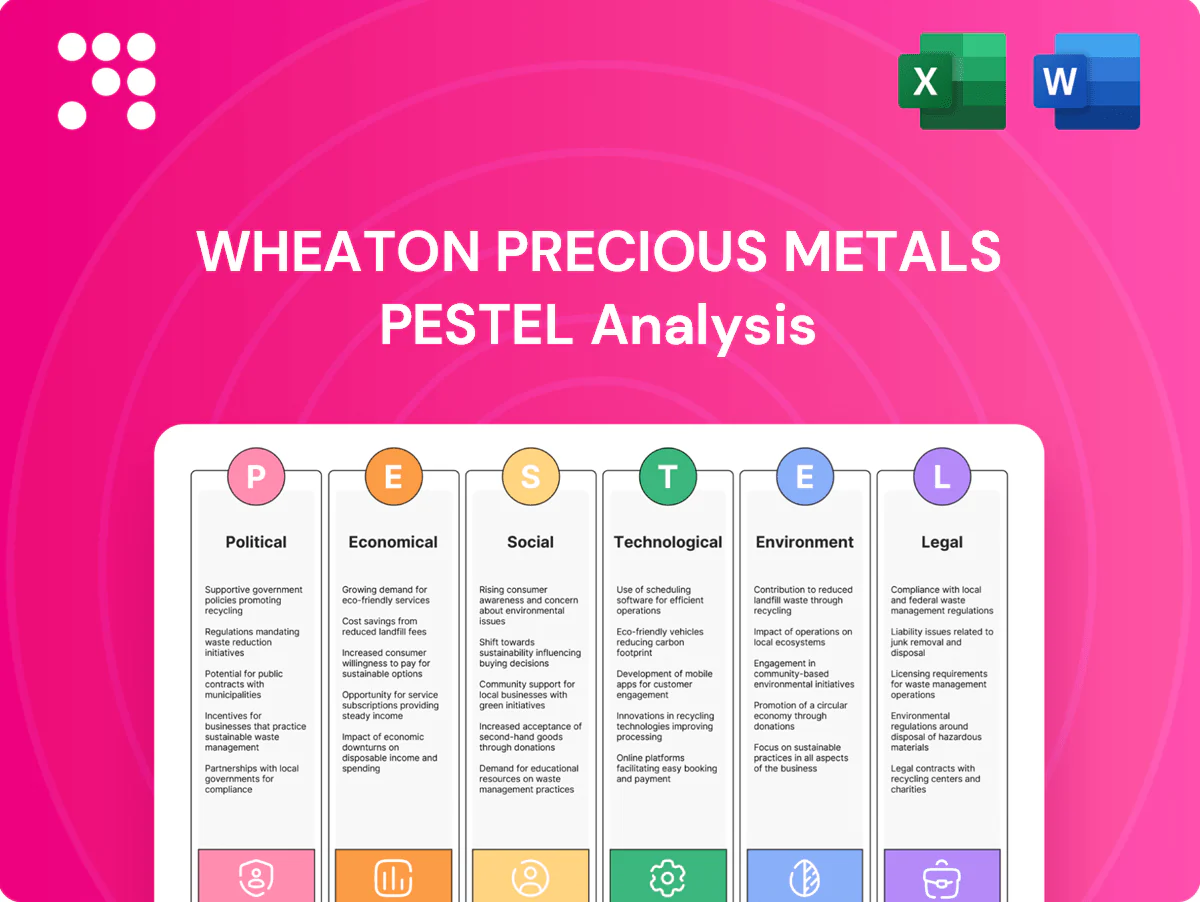
Wheaton Precious Metals PESTLE Analysis

Make Smarter Strategic Decisions with a Complete PESTEL View
Our PESTLE analysis pinpoints how regulatory shifts, commodity cycles, ESG pressures and technological advances are reshaping Wheaton Precious Metals’ outlook. Packed with actionable insights for investors and strategists, it reveals key risks and opportunities. Purchase the full report to access the complete, editable breakdown and make informed decisions today.
Political factors

Geopolitical stability of host nations
Wheaton’s streaming revenue depends on counterparties operating mines across over 10 jurisdictions, exposing deliveries to coups, elections and sudden policy swings that can halt operations or complicate logistics. Management must price political risk into contracts and diversify across countries to limit concentration. Scenario planning and country caps are used to maintain continuity of deliveries and protect cash flow.
Resource nationalism and fiscal regimes
Shifts in royalties, export duties or windfall taxes—recently seen across multiple jurisdictions—directly compress mine margins and can raise operating costs by several percentage points, squeezing sponsors' cash flow. Wheaton’s fixed purchase price is contractually set, but strained counterparties may delay expansions or cut throughput, reducing payable volumes. Continuous monitoring of fiscal changes is required to protect volume assumptions and NAV models.

Permitting and community approvals
Local and national permitting timelines for mining projects are often lengthy and politicized, and delays can stall first metal delivery under Wheaton Precious Metals streams. Wheaton’s due diligence must rigorously assess permit status and the political will of host jurisdictions. The quality of operator engagement with communities and regulators is a leading indicator of timing risk and likely cash-flow impacts.

Trade policy, tariffs, and logistics
Trade-rule shifts affect concentrate and doré shipments, with customs changes and port slowdowns increasing transit times; as of 2024 Wheaton held 31 streams across 11 jurisdictions, exposing deliveries to cross-border friction. Sanctions or tariffs can reroute supply chains or raise costs, so Wheaton relies on operators’ compliance and alternative logistics routes and flexible delivery clauses to limit disruption.
- 31 streams (2024)
- Exposure across 11 countries
- Contract flexibility for delivery locations
- Reliance on operators’ compliance and alternative routes
Government stability and contract enforceability
Legal predictability underpins long-term streaming contracts for Wheaton Precious Metals (WPM, founded 2004; listed on NYSE/TSX), as clear governing law and enforceable judgments protect royalty cash flows. Regime changes in producer countries can reopen legacy agreements or trigger renegotiation, raising recovery and timing risk. Selecting neutral arbitration venues and robust governing law reduces enforceability risk, while political risk insurance can hedge country-specific payment interruptions.
- WPM listed NYSE/TSX
- Neutral arbitration mitigates enforcement gaps
- Political risk insurance protects revenue streams
Revenue exposure across 31 streams in 11 jurisdictions forces political-risk pricing and caps
Wheaton’s revenue hinges on deliveries from 31 streams across 11 jurisdictions (2024), exposing cash flow to coups, elections and fiscal-policy swings that can halt operations. Contractual fixed pricing forces Wheaton to price political risk and rely on operator compliance, neutral arbitration and political-risk insurance to preserve enforceability. Active country caps and scenario planning limit concentration and delivery interruptions.
| Metric | Value |
|---|---|
| Streams (2024) | 31 |
| Jurisdictions | 11 |
| Country caps | Active |
| Risk mitigants | Arbitration, insurance |
What is included in the product
 Detailed Word Document
Explores how macro-environmental factors uniquely affect Wheaton Precious Metals across Political, Economic, Social, Technological, Environmental, and Legal dimensions, with each section backed by current data and trends to highlight risks and opportunities.

 Customizable Excel Spreadsheet
Concise PESTLE summary for Wheaton Precious Metals, visually segmented for quick interpretation and easily dropped into presentations or planning sessions; editable for regional or business-line notes to support risk discussions and team alignment.
Economic factors

Precious metal price volatility
Wheaton’s revenue moves with gold and silver prices while unit costs from streaming contracts are largely fixed, so rising metal prices expand margins and cash flow and declines compress them. Diversification across gold, silver and palladium helps smooth cycles. Hedging can be calibrated to protect covenant metrics without fully capping upside.
Interest rates and discount rates
Higher interest rates (US federal funds 5.25–5.50% in mid‑2025) raise required returns and compress NPV on precious‑metal streams, reducing deal valuations; they also increase operators’ financing costs and can delay projects as capex is reprioritized. Lower rates improve streaming competitiveness versus debt financing. Capital allocation should adjust hurdle rates and stress‑test stream economics for rate sensitivity.

USD strength and FX dynamics
USD strength matters because Wheaton sells metal streams priced in dollars while many mine partners incur local‑currency costs; with the US Dollar Index near 104.5 (July 2025) and gold ≈ $2,300/oz, dollar appreciation compresses counterparties’ margins and can elevate default risk. Wheaton records translation effects on G&A and taxes (CAD reporting) that shift reported EPS; FX stress testing (scenario-driven DXY moves) is used to quantify counterparty and volumetric risk across agreements.

Counterparty credit and solvency
Operator balance sheets directly affect project execution and delivery reliability for Wheaton Precious Metals, since weak operator liquidity can delay mine development and concentrate operational risk.
Commodity downturns have prompted industry restructurings that shift payment and delivery timelines, increasing counterparty credit risk for streaming contracts.
Robust covenants and security packages in Wheaton’s streaming agreements reduce loss given default, while portfolio diversity across multiple operators lowers single-asset dependency and mitigates concentrated counterparty exposure.
- operator-balance-sheet
- commodity-downturns
- covenants-security
- portfolio-diversity
Capital market access and deal pipeline
Wheaton Precious Metals (TSX, NYSE: WPM) benefits when scarce capital drives miners toward streaming, expanding its deal pipeline at preferential terms and preserving equity for operators.
In strong markets competition for royalties and streams tightens valuations, so Wheaton’s disciplined return thresholds are critical to sustaining long-run value creation.
- streaming favored when debt/equity scarce
- hot markets compress yields
- WPM discipline protects long-term returns
Revenue exposure across 31 streams in 11 jurisdictions forces political-risk pricing and caps
Wheaton’s revenues and margins track gold/silver prices while streaming unit costs are fixed, so higher metals expand cashflow and declines compress it. Mid‑2025 rates (Fed 5.25–5.50%) raise discount rates and compress stream NPVs. USD strength (DXY ~104.5) and gold ≈ $2,300/oz elevate operator stress and FX translation risk.
| Metric | Mid‑2025 |
|---|---|
| Fed funds | 5.25–5.50% |
| DXY | 104.5 |
| Gold | $2,300/oz |
Same Document Delivered
Wheaton Precious Metals PESTLE Analysis
The preview shown here is the exact document you’ll receive after purchase—fully formatted and ready to use. It contains the complete Wheaton Precious Metals PESTLE analysis with political, economic, social, technological, legal and environmental insights. No placeholders or teasers—this is the final file you’ll download immediately after checkout.

Original: $10.00
-65%$10.00
$3.50Product Information
Product Information
Shipping & Returns
Shipping & Returns
Description
Make Smarter Strategic Decisions with a Complete PESTEL View
Our PESTLE analysis pinpoints how regulatory shifts, commodity cycles, ESG pressures and technological advances are reshaping Wheaton Precious Metals’ outlook. Packed with actionable insights for investors and strategists, it reveals key risks and opportunities. Purchase the full report to access the complete, editable breakdown and make informed decisions today.
Political factors
Geopolitical stability of host nations
Wheaton’s streaming revenue depends on counterparties operating mines across over 10 jurisdictions, exposing deliveries to coups, elections and sudden policy swings that can halt operations or complicate logistics. Management must price political risk into contracts and diversify across countries to limit concentration. Scenario planning and country caps are used to maintain continuity of deliveries and protect cash flow.
Resource nationalism and fiscal regimes
Shifts in royalties, export duties or windfall taxes—recently seen across multiple jurisdictions—directly compress mine margins and can raise operating costs by several percentage points, squeezing sponsors' cash flow. Wheaton’s fixed purchase price is contractually set, but strained counterparties may delay expansions or cut throughput, reducing payable volumes. Continuous monitoring of fiscal changes is required to protect volume assumptions and NAV models.
Permitting and community approvals
Local and national permitting timelines for mining projects are often lengthy and politicized, and delays can stall first metal delivery under Wheaton Precious Metals streams. Wheaton’s due diligence must rigorously assess permit status and the political will of host jurisdictions. The quality of operator engagement with communities and regulators is a leading indicator of timing risk and likely cash-flow impacts.
Trade policy, tariffs, and logistics
Trade-rule shifts affect concentrate and doré shipments, with customs changes and port slowdowns increasing transit times; as of 2024 Wheaton held 31 streams across 11 jurisdictions, exposing deliveries to cross-border friction. Sanctions or tariffs can reroute supply chains or raise costs, so Wheaton relies on operators’ compliance and alternative logistics routes and flexible delivery clauses to limit disruption.
- 31 streams (2024)
- Exposure across 11 countries
- Contract flexibility for delivery locations
- Reliance on operators’ compliance and alternative routes
Government stability and contract enforceability
Legal predictability underpins long-term streaming contracts for Wheaton Precious Metals (WPM, founded 2004; listed on NYSE/TSX), as clear governing law and enforceable judgments protect royalty cash flows. Regime changes in producer countries can reopen legacy agreements or trigger renegotiation, raising recovery and timing risk. Selecting neutral arbitration venues and robust governing law reduces enforceability risk, while political risk insurance can hedge country-specific payment interruptions.
- WPM listed NYSE/TSX
- Neutral arbitration mitigates enforcement gaps
- Political risk insurance protects revenue streams
Revenue exposure across 31 streams in 11 jurisdictions forces political-risk pricing and caps
Wheaton’s revenue hinges on deliveries from 31 streams across 11 jurisdictions (2024), exposing cash flow to coups, elections and fiscal-policy swings that can halt operations. Contractual fixed pricing forces Wheaton to price political risk and rely on operator compliance, neutral arbitration and political-risk insurance to preserve enforceability. Active country caps and scenario planning limit concentration and delivery interruptions.
| Metric | Value |
|---|---|
| Streams (2024) | 31 |
| Jurisdictions | 11 |
| Country caps | Active |
| Risk mitigants | Arbitration, insurance |
What is included in the product
Detailed Word Document
Explores how macro-environmental factors uniquely affect Wheaton Precious Metals across Political, Economic, Social, Technological, Environmental, and Legal dimensions, with each section backed by current data and trends to highlight risks and opportunities.
Customizable Excel Spreadsheet
Concise PESTLE summary for Wheaton Precious Metals, visually segmented for quick interpretation and easily dropped into presentations or planning sessions; editable for regional or business-line notes to support risk discussions and team alignment.
Economic factors
Precious metal price volatility
Wheaton’s revenue moves with gold and silver prices while unit costs from streaming contracts are largely fixed, so rising metal prices expand margins and cash flow and declines compress them. Diversification across gold, silver and palladium helps smooth cycles. Hedging can be calibrated to protect covenant metrics without fully capping upside.
Interest rates and discount rates
Higher interest rates (US federal funds 5.25–5.50% in mid‑2025) raise required returns and compress NPV on precious‑metal streams, reducing deal valuations; they also increase operators’ financing costs and can delay projects as capex is reprioritized. Lower rates improve streaming competitiveness versus debt financing. Capital allocation should adjust hurdle rates and stress‑test stream economics for rate sensitivity.
USD strength and FX dynamics
USD strength matters because Wheaton sells metal streams priced in dollars while many mine partners incur local‑currency costs; with the US Dollar Index near 104.5 (July 2025) and gold ≈ $2,300/oz, dollar appreciation compresses counterparties’ margins and can elevate default risk. Wheaton records translation effects on G&A and taxes (CAD reporting) that shift reported EPS; FX stress testing (scenario-driven DXY moves) is used to quantify counterparty and volumetric risk across agreements.
Counterparty credit and solvency
Operator balance sheets directly affect project execution and delivery reliability for Wheaton Precious Metals, since weak operator liquidity can delay mine development and concentrate operational risk.
Commodity downturns have prompted industry restructurings that shift payment and delivery timelines, increasing counterparty credit risk for streaming contracts.
Robust covenants and security packages in Wheaton’s streaming agreements reduce loss given default, while portfolio diversity across multiple operators lowers single-asset dependency and mitigates concentrated counterparty exposure.
- operator-balance-sheet
- commodity-downturns
- covenants-security
- portfolio-diversity
Capital market access and deal pipeline
Wheaton Precious Metals (TSX, NYSE: WPM) benefits when scarce capital drives miners toward streaming, expanding its deal pipeline at preferential terms and preserving equity for operators.
In strong markets competition for royalties and streams tightens valuations, so Wheaton’s disciplined return thresholds are critical to sustaining long-run value creation.
- streaming favored when debt/equity scarce
- hot markets compress yields
- WPM discipline protects long-term returns
Revenue exposure across 31 streams in 11 jurisdictions forces political-risk pricing and caps
Wheaton’s revenues and margins track gold/silver prices while streaming unit costs are fixed, so higher metals expand cashflow and declines compress it. Mid‑2025 rates (Fed 5.25–5.50%) raise discount rates and compress stream NPVs. USD strength (DXY ~104.5) and gold ≈ $2,300/oz elevate operator stress and FX translation risk.
| Metric | Mid‑2025 |
|---|---|
| Fed funds | 5.25–5.50% |
| DXY | 104.5 |
| Gold | $2,300/oz |
Same Document Delivered
Wheaton Precious Metals PESTLE Analysis
The preview shown here is the exact document you’ll receive after purchase—fully formatted and ready to use. It contains the complete Wheaton Precious Metals PESTLE analysis with political, economic, social, technological, legal and environmental insights. No placeholders or teasers—this is the final file you’ll download immediately after checkout.