Wendy's SWOT Analysis

Dive Deeper Into the Company’s Strategic Blueprint
Wendy’s strong brand recognition, menu innovation, and digital ordering capabilities contrast with franchise quality variability and limited international scale, while opportunities include delivery growth and menu diversification against threats from intense quick‑service rivals and commodity cost pressure. Want the full story behind the company’s strengths, risks, and growth drivers? Purchase the complete SWOT analysis to gain a professionally written, editable report ideal for investors and strategists.
Strengths

Distinct fresh-beef positioning
Fresh never frozen differentiates Wendy's in a crowded QSR burger market, supporting a quality narrative against value-led rivals. That claim helps sustain premium pricing and a higher average check mix, reflected across Wendy's roughly 7,000 restaurants worldwide (2024). The simple, repeatable message boosts brand recall and marketing efficiency.
Menu innovation and customization
Wendy’s rotates limited-time offers and enables easy customization via its app and in-store, keeping the menu relevant and driving repeat visits and higher average checks. Innovation spans chicken lines, premium salads and seasonal Frosty flavors, supporting broader appeal. These tactics help defend market share against trend-driven competitors by rapidly testing and scaling popular items.

Franchise-led, scalable model
Wendy's predominantly franchised base (over 95% of ~7,000+ restaurants) supports asset-light growth and stable royalty-driven cash flows. This structure reduces capital intensity and enables rapid market entry through local operators. Aligned incentives with franchisees can accelerate remodels and new formats. System scale enhances procurement and national marketing efficiency.

Strong drive-thru and digital channels
Wendy's robust drive-thru network drives throughput and convenience, supporting peak-hour volume while off-premise sales exceed 60% of systemwide mix. Digital ordering, delivery and a loyalty program with over 20 million members extend reach and strengthen first-party data capture. These channels boost repeat visits through targeted promotions and provide a hedge against dine-in volatility.
- Drive-thru: high throughput, convenience
- Off-premise: >60% of sales
- Loyalty: >20M members
- Benefit: repeat visits, targeted promos, dine-in hedge
Memorable brand and value platforms
Wendy’s distinctive brand voice and value bundles, like budget combos, drive steady traffic while a sharp social media strategy boosts engagement at low cost and strengthens brand recall. Value platforms help smooth sales in softer macro periods and complement premium menu items to balance ticket mix and margins.
- Brand-led traffic
- Low-cost digital engagement
- Demand smoothing
- Balanced value/premium mix
Fresh-never-frozen positioning fuels premium pricing, loyalty >20M and >60% off-premise
Wendy's fresh-never-frozen positioning and bold brand voice support premium pricing across ~7,000 restaurants (2024). Menu innovation, digital ordering and loyalty (>20M members) drive repeat visits while off-premise sales exceed 60%. An asset-light model (over 95% franchised) produces royalty-driven cash flow and scalable marketing/procurement advantages.
| Metric | Value |
|---|---|
| Restaurants (2024) | ~7,000 |
| Franchised | >95% |
| Off-premise mix | >60% |
| Loyalty members | >20M |
What is included in the product
 Detailed Word Document
Delivers a strategic overview of Wendy's internal and external business factors, outlining strengths, weaknesses, opportunities, and threats to its competitive position in fast food—covering brand equity, menu innovation, franchise model, operational challenges, and market risks.

 Customizable Excel Spreadsheet
Relieves strategic pain points by providing a concise SWOT matrix that highlights Wendy's brand strengths, menu innovation opportunities, competitive threats, and operational weaknesses for rapid stakeholder alignment and faster decision-making.
Weaknesses

Smaller scale than top rivals
Wendy’s operates roughly 7,000 restaurants worldwide versus McDonald’s ~40,000, leaving it smaller in unit count and purchasing heft; this scale gap can translate into higher per-unit procurement and franchise costs and weaker national marketing reach. Limited scale has historically slowed Wendy’s international expansion compared with larger rivals. Weaker volume reduces bargaining power with suppliers and delivery/aggregator platforms, pressuring margins.
High exposure to North America
Wendy's derives over 90% of its systemwide sales from the U.S. and Canada, concentrating revenue and elevating regional risk. A U.S. macro downturn or intensified local competition could disproportionately hit margins and same-store sales. This footprint limits diversification benefits and leaves substantial international whitespace underexploited relative to peers.

Fresh supply chain complexity
Fresh, never-frozen beef and fresh produce elevate cold-chain and logistics demands, increasing cost volatility and operational risk versus frozen inputs; Wendy’s network of roughly 7,000 restaurants in 2024 amplifies exposure. Supply disruptions can hit consistency and availability, and franchisees may face tighter margins during price spikes and delivery interruptions.

Menu breadth can slow throughput
Wendy's broad customization and menu variety complicate kitchen flow, increasing average prep time and risking slower service during peak periods at the chain’s roughly 7,000 global restaurants (2024 estimate). Operational complexity strains labor efficiency and can dilute Wendy's perception of simplicity versus streamlined rivals, pressuring throughput and labor margins.
- Customization slows assembly
- Peaks raise wait times
- Higher labor strain
- Perceived complexity vs rivals
Brand perception tethered to burgers
Heavy association with burgers limits appeal to health-seeking diners and could cap average check outside core categories; Wendy's operated over 7,000 restaurants globally in 2024, so shifts toward bowls, wraps or plant-forward items require careful brand fit. Repositioning risks confusing loyal guests and diluting pricing power beyond core sandwiches.
- Health-perception risk
- Pricing power constrained
- Repositioning may alienate core
Limited scale, fresh-beef cold chain and US concentration raise costs; menu complexity slows service
Wendy’s ~7,000 restaurants (2024) limit purchasing scale vs McDonald’s ~40,000, raising per-unit costs and national marketing disadvantage. Over 90% of systemwide sales come from the U.S. and Canada, concentrating regional risk. Fresh, never-frozen beef increases cold-chain costs and supply volatility. Menu complexity slows service, raising labor and throughput pressure.
| Metric | Value (2024) |
|---|---|
| Restaurants | ~7,000 |
| US/Canada sales | >90% |
| McDonald’s units (peer) | ~40,000 |
| Fresh-beef supply risk | High |
Full Version Awaits
Wendy's SWOT Analysis
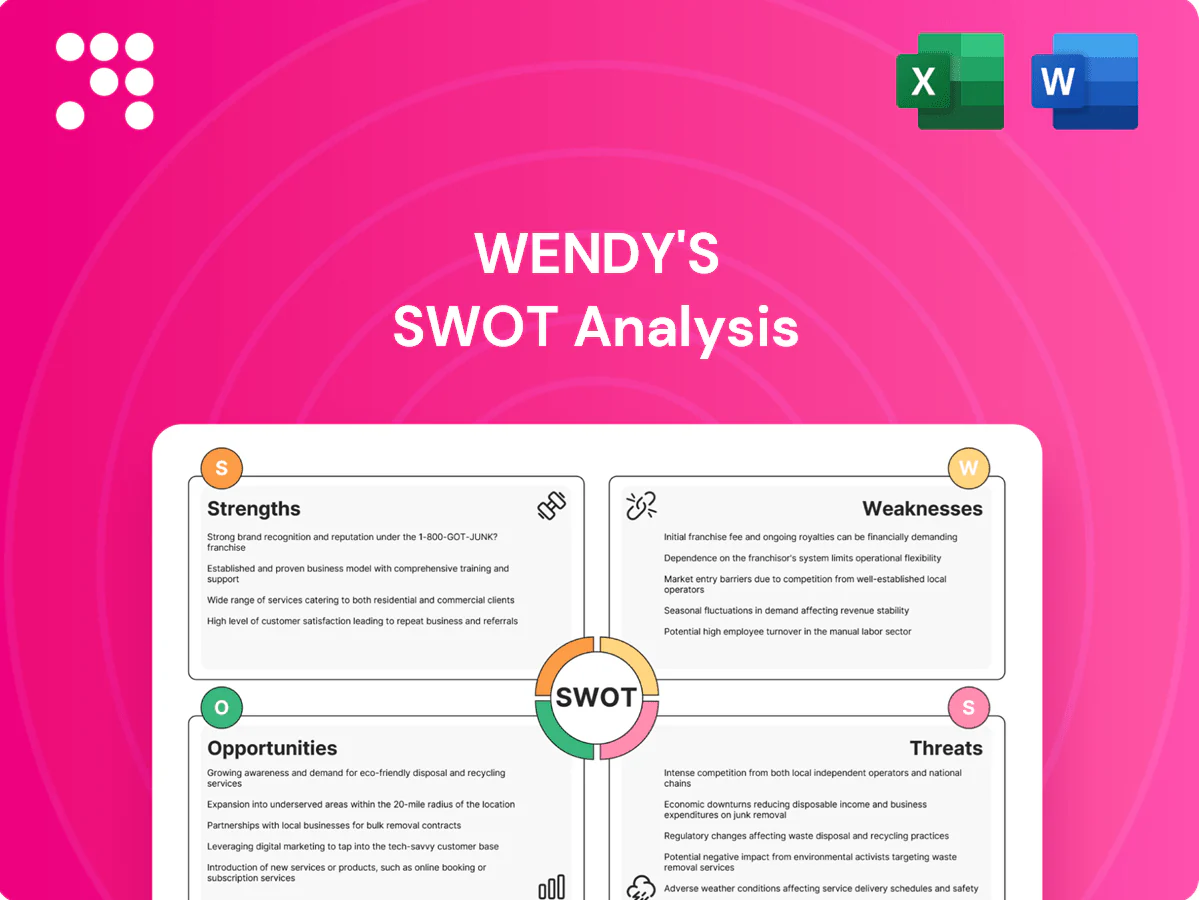
This Wendy's SWOT analysis delivers concise strengths, weaknesses, opportunities, and threats with actionable insights for investors and strategists. The preview below is taken directly from the full SWOT report you'll get—no surprises, just professional quality. Purchase unlocks the complete, editable document ready for immediate use in research, presentations, or strategic planning.

Product Information
Product Information
Shipping & Returns
Shipping & Returns
Description
Dive Deeper Into the Company’s Strategic Blueprint
Wendy’s strong brand recognition, menu innovation, and digital ordering capabilities contrast with franchise quality variability and limited international scale, while opportunities include delivery growth and menu diversification against threats from intense quick‑service rivals and commodity cost pressure. Want the full story behind the company’s strengths, risks, and growth drivers? Purchase the complete SWOT analysis to gain a professionally written, editable report ideal for investors and strategists.
Strengths
Distinct fresh-beef positioning
Fresh never frozen differentiates Wendy's in a crowded QSR burger market, supporting a quality narrative against value-led rivals. That claim helps sustain premium pricing and a higher average check mix, reflected across Wendy's roughly 7,000 restaurants worldwide (2024). The simple, repeatable message boosts brand recall and marketing efficiency.
Menu innovation and customization
Wendy’s rotates limited-time offers and enables easy customization via its app and in-store, keeping the menu relevant and driving repeat visits and higher average checks. Innovation spans chicken lines, premium salads and seasonal Frosty flavors, supporting broader appeal. These tactics help defend market share against trend-driven competitors by rapidly testing and scaling popular items.
Franchise-led, scalable model
Wendy's predominantly franchised base (over 95% of ~7,000+ restaurants) supports asset-light growth and stable royalty-driven cash flows. This structure reduces capital intensity and enables rapid market entry through local operators. Aligned incentives with franchisees can accelerate remodels and new formats. System scale enhances procurement and national marketing efficiency.
Strong drive-thru and digital channels
Wendy's robust drive-thru network drives throughput and convenience, supporting peak-hour volume while off-premise sales exceed 60% of systemwide mix. Digital ordering, delivery and a loyalty program with over 20 million members extend reach and strengthen first-party data capture. These channels boost repeat visits through targeted promotions and provide a hedge against dine-in volatility.
- Drive-thru: high throughput, convenience
- Off-premise: >60% of sales
- Loyalty: >20M members
- Benefit: repeat visits, targeted promos, dine-in hedge
Memorable brand and value platforms
Wendy’s distinctive brand voice and value bundles, like budget combos, drive steady traffic while a sharp social media strategy boosts engagement at low cost and strengthens brand recall. Value platforms help smooth sales in softer macro periods and complement premium menu items to balance ticket mix and margins.
- Brand-led traffic
- Low-cost digital engagement
- Demand smoothing
- Balanced value/premium mix
Fresh-never-frozen positioning fuels premium pricing, loyalty >20M and >60% off-premise
Wendy's fresh-never-frozen positioning and bold brand voice support premium pricing across ~7,000 restaurants (2024). Menu innovation, digital ordering and loyalty (>20M members) drive repeat visits while off-premise sales exceed 60%. An asset-light model (over 95% franchised) produces royalty-driven cash flow and scalable marketing/procurement advantages.
| Metric | Value |
|---|---|
| Restaurants (2024) | ~7,000 |
| Franchised | >95% |
| Off-premise mix | >60% |
| Loyalty members | >20M |
What is included in the product
Detailed Word Document
Delivers a strategic overview of Wendy's internal and external business factors, outlining strengths, weaknesses, opportunities, and threats to its competitive position in fast food—covering brand equity, menu innovation, franchise model, operational challenges, and market risks.
Customizable Excel Spreadsheet
Relieves strategic pain points by providing a concise SWOT matrix that highlights Wendy's brand strengths, menu innovation opportunities, competitive threats, and operational weaknesses for rapid stakeholder alignment and faster decision-making.
Weaknesses
Smaller scale than top rivals
Wendy’s operates roughly 7,000 restaurants worldwide versus McDonald’s ~40,000, leaving it smaller in unit count and purchasing heft; this scale gap can translate into higher per-unit procurement and franchise costs and weaker national marketing reach. Limited scale has historically slowed Wendy’s international expansion compared with larger rivals. Weaker volume reduces bargaining power with suppliers and delivery/aggregator platforms, pressuring margins.
High exposure to North America
Wendy's derives over 90% of its systemwide sales from the U.S. and Canada, concentrating revenue and elevating regional risk. A U.S. macro downturn or intensified local competition could disproportionately hit margins and same-store sales. This footprint limits diversification benefits and leaves substantial international whitespace underexploited relative to peers.
Fresh supply chain complexity
Fresh, never-frozen beef and fresh produce elevate cold-chain and logistics demands, increasing cost volatility and operational risk versus frozen inputs; Wendy’s network of roughly 7,000 restaurants in 2024 amplifies exposure. Supply disruptions can hit consistency and availability, and franchisees may face tighter margins during price spikes and delivery interruptions.
Menu breadth can slow throughput
Wendy's broad customization and menu variety complicate kitchen flow, increasing average prep time and risking slower service during peak periods at the chain’s roughly 7,000 global restaurants (2024 estimate). Operational complexity strains labor efficiency and can dilute Wendy's perception of simplicity versus streamlined rivals, pressuring throughput and labor margins.
- Customization slows assembly
- Peaks raise wait times
- Higher labor strain
- Perceived complexity vs rivals
Brand perception tethered to burgers
Heavy association with burgers limits appeal to health-seeking diners and could cap average check outside core categories; Wendy's operated over 7,000 restaurants globally in 2024, so shifts toward bowls, wraps or plant-forward items require careful brand fit. Repositioning risks confusing loyal guests and diluting pricing power beyond core sandwiches.
- Health-perception risk
- Pricing power constrained
- Repositioning may alienate core
Limited scale, fresh-beef cold chain and US concentration raise costs; menu complexity slows service
Wendy’s ~7,000 restaurants (2024) limit purchasing scale vs McDonald’s ~40,000, raising per-unit costs and national marketing disadvantage. Over 90% of systemwide sales come from the U.S. and Canada, concentrating regional risk. Fresh, never-frozen beef increases cold-chain costs and supply volatility. Menu complexity slows service, raising labor and throughput pressure.
| Metric | Value (2024) |
|---|---|
| Restaurants | ~7,000 |
| US/Canada sales | >90% |
| McDonald’s units (peer) | ~40,000 |
| Fresh-beef supply risk | High |
Full Version Awaits
Wendy's SWOT Analysis
This Wendy's SWOT analysis delivers concise strengths, weaknesses, opportunities, and threats with actionable insights for investors and strategists. The preview below is taken directly from the full SWOT report you'll get—no surprises, just professional quality. Purchase unlocks the complete, editable document ready for immediate use in research, presentations, or strategic planning.