Voestalpine PESTLE Analysis

Make Smarter Strategic Decisions with a Complete PESTEL View
Unlock strategic clarity with our Voestalpine PESTLE Analysis—concise, data-driven insight into the political, economic, social, technological, legal, and environmental forces shaping the company. Ideal for investors and strategists, it highlights risks and growth levers you need to act on. Save research time and boost decision confidence with our expert report. Purchase the full PESTLE now for the complete, editable download.
Political factors

EU industrial policy shifts
The EU Green Deal and industrial strategy steer funding and priorities toward low‑carbon steel, with Fit for 55 targeting a 55% GHG cut by 2030 and the CBAM rollout (phased 2023–2026) altering cost dynamics. Policy support can accelerate Voestalpine’s greentec roadmap. Shifts in subsidies and state‑aid rules, alongside NextGenerationEU (€800bn) and the 2021–27 EU budget (€1.074trn), affect investment timing and locations.
Trade tariffs and CBAM
EU anti‑dumping duties on various steel products and the Carbon Border Adjustment Mechanism reshape import costs for steelmakers and consumers. CBAM entered a transitional reporting phase in October 2023 (covering 11 sectors including steel) with full carbon pricing from 1 January 2026, creating administrative and data‑reporting burdens. Voestalpine may gain protection versus high‑emission competitors as embedded‑carbon costs rise. Compliance raises pricing complexity and potential margin volatility.

Geopolitical supply risks
War, sanctions and trade tensions since 2022 have disrupted raw material and energy flows critical to Voestalpine, making supplies of iron ore, coking coal and specialty alloys less predictable. Sourcing volatility raises input-cost and production-risk exposure for the steel group. Diversification and regionalization of supply chains are increasingly strategic. EU gas imports from Russia fell from about 40% pre-2022 to roughly 9% in 2024.

Energy security priorities
National policies to secure gas, power and hydrogen shape Voestalpine plant economics: EU ETS carbon prices near €95/t in 2024–25 and TTF gas around €25–35/MWh materially change fuel-switch and abatement costs, while capacity markets and price caps (used in several EU states) affect EAF competitiveness versus BF-BOF.
Public procurement and rail
Public procurement and infrastructure budgets directly drive demand for Voestalpine’s rail products; EU instruments such as Connecting Europe Facility 2021–2027 (33.7 billion EUR) and NextGenerationEU (806.9 billion EUR) boost order visibility and can smooth cyclicality through policy-led modernization cycles, supporting margins during downturns.
- Procurement-led demand
- CEF2 33.7bn EUR
- NextGenerationEU 806.9bn EUR
- Improves order visibility & margins
EU CBAM, Fit for 55 and ~€95 ETS accelerate demand for low-carbon steel investments
EU climate and trade policy (Fit for 55; CBAM full carbon pricing from 1 Jan 2026) shifts costs toward low‑carbon steel, aiding Voestalpine’s greentec investments. EU ETS near €95/t (2024–25) and TTF gas €25–35/MWh raise abatement and energy costs. Supply risks from war/sanctions force sourcing diversification while EU procurement (NextGenerationEU €806.9bn; CEF €33.7bn) boosts demand visibility.
| Indicator | Value |
|---|---|
| EU ETS | ~€95/t (2024–25) |
| TTF gas | €25–35/MWh |
| CBAM | full pricing 01‑01‑2026 |
| NextGenerationEU | €806.9bn |
| CEF | €33.7bn |
What is included in the product
 Detailed Word Document
Examines how Political, Economic, Social, Technological, Environmental and Legal forces shape Voestalpine’s strategy and operations, using data-driven trends and region-specific dynamics to identify threats, opportunities and forward-looking scenarios for executives, investors and strategists.

 Customizable Excel Spreadsheet
Provides a concise, visually segmented PESTLE snapshot of Voestalpine that’s easily dropped into presentations or shared across teams, helping unblock strategy meetings and focus discussions on external risks and market positioning.
Economic factors

Industrial demand cycles
Voestalpine faces pronounced order volatility as automotive, aerospace, energy and rail sectors drive cyclical swings; automotive OEM production fluctuations and aircraft delivery backlogs reshape steel and component demand. Inventory swings and shifting OEM production schedules compress volumes and change product mix, affecting margins and lead times. Counter‑cyclical service revenues—maintenance, rail infrastructure and tooling—help partly buffer downturns; Voestalpine reported group revenue of about EUR 15.2bn in 2023/24.
Energy and electricity costs
Power prices decide EAF vs blast furnace economics: at 400 kWh/t an electricity price of 80 EUR/MWh implies ~32 EUR/t energy cost, versus ~80 EUR/t at 200 EUR/MWh, swinging margins materially. European wholesale power spiked to ~300 EUR/MWh in 2022 and averaged c.70–100 EUR/MWh in 2023–24, pressuring margins and capex cases. Long‑term PPAs and hedging are therefore critical levers to stabilize costs and secure project IRRs.

Raw material and scrap markets
Scrap availability and variable quality constrain voestalpine’s low‑carbon steel output, with the group recycling roughly 2 million tonnes of scrap annually to reduce emission intensity. Volatility in iron ore, metallurgical coal and alloy prices drives raw‑material cost swings that squeezed margins in 2023–24. Strategic sourcing, long‑term supply contracts and recycling partnerships have been scaled up to mitigate price and availability risk.

FX and global footprint
Euro moves materially affect voestalpine: a stronger euro in 2024 (EUR/USD ~1.09 average) reduced export competitiveness and compressed euro‑priced steel margins, while a weaker euro raised EUR‑priced input costs for imported ore and energy. Multi‑currency operations across >50 countries and ~48,000 employees (2024) necessitate active hedging and net‑exposure management. Location choices balance lower production costs, market access, and geopolitical/logistics risk.
- FX impact: EUR/USD ~1.09 (2024)
- Operations: >50 countries, ~48,000 employees (2024)
- Response: active hedging, local sourcing, plant placement for market access
Capital intensity and financing
Hydrogen-ready DRI and EAF transitions require very large capex, often hundreds of millions to low billions per plant; Voestalpine’s shift hinges on multi-year investments and tight execution. EU carbon prices averaged about €80/tCO2 in 2024, increasing the incentive to decarbonize and improving project economics. Green financing, tax credits and grants lower WACC, so disciplined phasing and execution are essential to protect returns.
- Capex scale: hundreds of millions–low billions per plant
- EU carbon price (2024): ~€80/tCO2
- Key enablers: green finance, tax credits, grants; execution discipline
EU CBAM, Fit for 55 and ~€95 ETS accelerate demand for low-carbon steel investments
Voestalpine faces cyclical demand from automotive, aerospace, energy and rail, with group revenue ~EUR 15.2bn (2023/24) and inventory/production swings compressing margins. Electricity and carbon costs drive margins: EU ETS ~€80/tCO2 (2024) and EUR/USD ~1.09 (2024) tightened competitiveness. Large capex for hydrogen‑ready DRI/EAF and limited scrap (~2 Mt recycled p.a.) shape investment timing and cost exposure.
| Metric | Value |
|---|---|
| Revenue | EUR 15.2bn (2023/24) |
| EU ETS | €80/tCO2 (2024) |
| EUR/USD | ~1.09 (2024) |
| Employees | ~48,000 (2024) |
| Scrap recycled | ~2 Mt p.a. |
Same Document Delivered
Voestalpine PESTLE Analysis
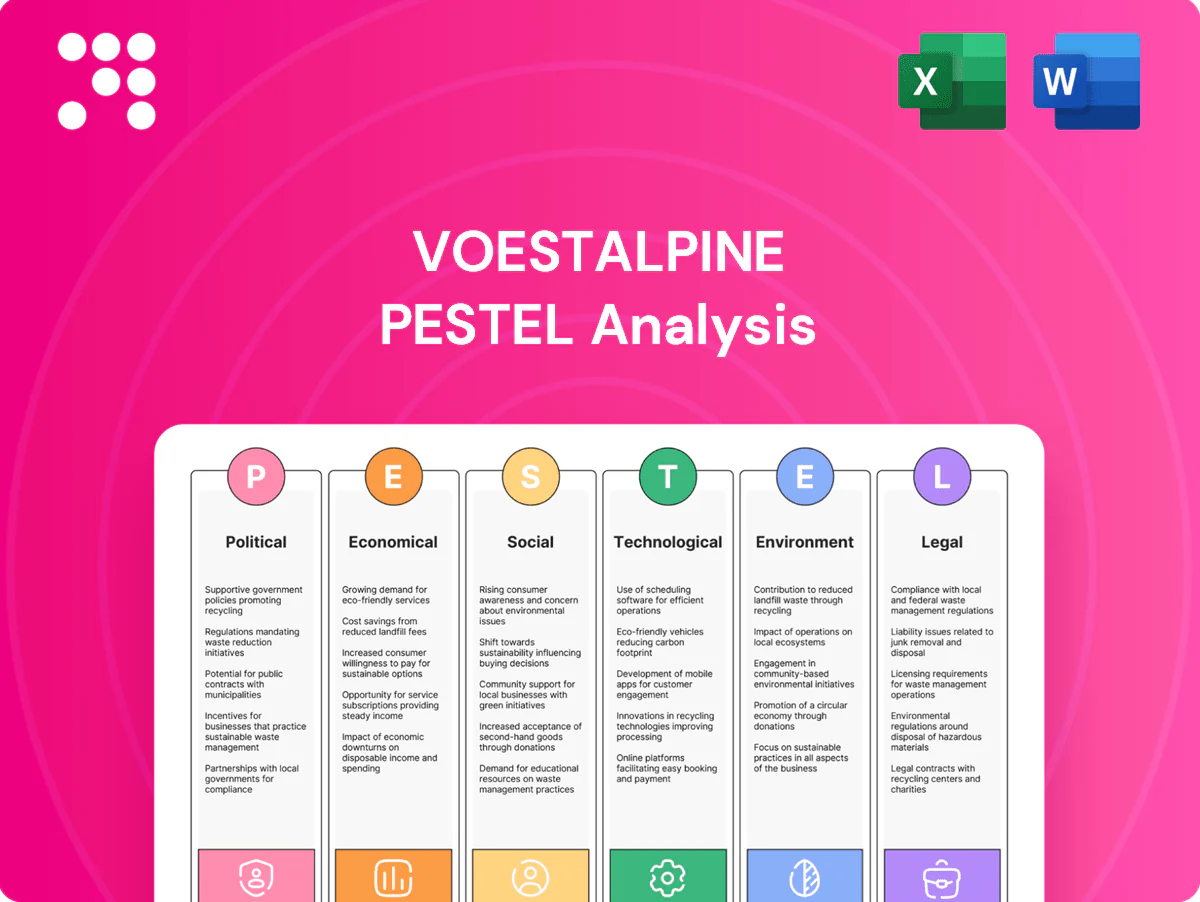
The Voestalpine PESTLE Analysis preview shown here is the exact document you’ll receive after purchase—fully formatted and ready to use. The content and structure visible are identical to the downloadable file, with no placeholders or teasers. After payment you’ll instantly get this final, professionally structured report.

Original: $10.00
-65%$10.00
$3.50Product Information
Product Information
Shipping & Returns
Shipping & Returns
Description
Make Smarter Strategic Decisions with a Complete PESTEL View
Unlock strategic clarity with our Voestalpine PESTLE Analysis—concise, data-driven insight into the political, economic, social, technological, legal, and environmental forces shaping the company. Ideal for investors and strategists, it highlights risks and growth levers you need to act on. Save research time and boost decision confidence with our expert report. Purchase the full PESTLE now for the complete, editable download.
Political factors
EU industrial policy shifts
The EU Green Deal and industrial strategy steer funding and priorities toward low‑carbon steel, with Fit for 55 targeting a 55% GHG cut by 2030 and the CBAM rollout (phased 2023–2026) altering cost dynamics. Policy support can accelerate Voestalpine’s greentec roadmap. Shifts in subsidies and state‑aid rules, alongside NextGenerationEU (€800bn) and the 2021–27 EU budget (€1.074trn), affect investment timing and locations.
Trade tariffs and CBAM
EU anti‑dumping duties on various steel products and the Carbon Border Adjustment Mechanism reshape import costs for steelmakers and consumers. CBAM entered a transitional reporting phase in October 2023 (covering 11 sectors including steel) with full carbon pricing from 1 January 2026, creating administrative and data‑reporting burdens. Voestalpine may gain protection versus high‑emission competitors as embedded‑carbon costs rise. Compliance raises pricing complexity and potential margin volatility.
Geopolitical supply risks
War, sanctions and trade tensions since 2022 have disrupted raw material and energy flows critical to Voestalpine, making supplies of iron ore, coking coal and specialty alloys less predictable. Sourcing volatility raises input-cost and production-risk exposure for the steel group. Diversification and regionalization of supply chains are increasingly strategic. EU gas imports from Russia fell from about 40% pre-2022 to roughly 9% in 2024.
Energy security priorities
National policies to secure gas, power and hydrogen shape Voestalpine plant economics: EU ETS carbon prices near €95/t in 2024–25 and TTF gas around €25–35/MWh materially change fuel-switch and abatement costs, while capacity markets and price caps (used in several EU states) affect EAF competitiveness versus BF-BOF.
Public procurement and rail
Public procurement and infrastructure budgets directly drive demand for Voestalpine’s rail products; EU instruments such as Connecting Europe Facility 2021–2027 (33.7 billion EUR) and NextGenerationEU (806.9 billion EUR) boost order visibility and can smooth cyclicality through policy-led modernization cycles, supporting margins during downturns.
- Procurement-led demand
- CEF2 33.7bn EUR
- NextGenerationEU 806.9bn EUR
- Improves order visibility & margins
EU CBAM, Fit for 55 and ~€95 ETS accelerate demand for low-carbon steel investments
EU climate and trade policy (Fit for 55; CBAM full carbon pricing from 1 Jan 2026) shifts costs toward low‑carbon steel, aiding Voestalpine’s greentec investments. EU ETS near €95/t (2024–25) and TTF gas €25–35/MWh raise abatement and energy costs. Supply risks from war/sanctions force sourcing diversification while EU procurement (NextGenerationEU €806.9bn; CEF €33.7bn) boosts demand visibility.
| Indicator | Value |
|---|---|
| EU ETS | ~€95/t (2024–25) |
| TTF gas | €25–35/MWh |
| CBAM | full pricing 01‑01‑2026 |
| NextGenerationEU | €806.9bn |
| CEF | €33.7bn |
What is included in the product
Detailed Word Document
Examines how Political, Economic, Social, Technological, Environmental and Legal forces shape Voestalpine’s strategy and operations, using data-driven trends and region-specific dynamics to identify threats, opportunities and forward-looking scenarios for executives, investors and strategists.
Customizable Excel Spreadsheet
Provides a concise, visually segmented PESTLE snapshot of Voestalpine that’s easily dropped into presentations or shared across teams, helping unblock strategy meetings and focus discussions on external risks and market positioning.
Economic factors
Industrial demand cycles
Voestalpine faces pronounced order volatility as automotive, aerospace, energy and rail sectors drive cyclical swings; automotive OEM production fluctuations and aircraft delivery backlogs reshape steel and component demand. Inventory swings and shifting OEM production schedules compress volumes and change product mix, affecting margins and lead times. Counter‑cyclical service revenues—maintenance, rail infrastructure and tooling—help partly buffer downturns; Voestalpine reported group revenue of about EUR 15.2bn in 2023/24.
Energy and electricity costs
Power prices decide EAF vs blast furnace economics: at 400 kWh/t an electricity price of 80 EUR/MWh implies ~32 EUR/t energy cost, versus ~80 EUR/t at 200 EUR/MWh, swinging margins materially. European wholesale power spiked to ~300 EUR/MWh in 2022 and averaged c.70–100 EUR/MWh in 2023–24, pressuring margins and capex cases. Long‑term PPAs and hedging are therefore critical levers to stabilize costs and secure project IRRs.
Raw material and scrap markets
Scrap availability and variable quality constrain voestalpine’s low‑carbon steel output, with the group recycling roughly 2 million tonnes of scrap annually to reduce emission intensity. Volatility in iron ore, metallurgical coal and alloy prices drives raw‑material cost swings that squeezed margins in 2023–24. Strategic sourcing, long‑term supply contracts and recycling partnerships have been scaled up to mitigate price and availability risk.
FX and global footprint
Euro moves materially affect voestalpine: a stronger euro in 2024 (EUR/USD ~1.09 average) reduced export competitiveness and compressed euro‑priced steel margins, while a weaker euro raised EUR‑priced input costs for imported ore and energy. Multi‑currency operations across >50 countries and ~48,000 employees (2024) necessitate active hedging and net‑exposure management. Location choices balance lower production costs, market access, and geopolitical/logistics risk.
- FX impact: EUR/USD ~1.09 (2024)
- Operations: >50 countries, ~48,000 employees (2024)
- Response: active hedging, local sourcing, plant placement for market access
Capital intensity and financing
Hydrogen-ready DRI and EAF transitions require very large capex, often hundreds of millions to low billions per plant; Voestalpine’s shift hinges on multi-year investments and tight execution. EU carbon prices averaged about €80/tCO2 in 2024, increasing the incentive to decarbonize and improving project economics. Green financing, tax credits and grants lower WACC, so disciplined phasing and execution are essential to protect returns.
- Capex scale: hundreds of millions–low billions per plant
- EU carbon price (2024): ~€80/tCO2
- Key enablers: green finance, tax credits, grants; execution discipline
EU CBAM, Fit for 55 and ~€95 ETS accelerate demand for low-carbon steel investments
Voestalpine faces cyclical demand from automotive, aerospace, energy and rail, with group revenue ~EUR 15.2bn (2023/24) and inventory/production swings compressing margins. Electricity and carbon costs drive margins: EU ETS ~€80/tCO2 (2024) and EUR/USD ~1.09 (2024) tightened competitiveness. Large capex for hydrogen‑ready DRI/EAF and limited scrap (~2 Mt recycled p.a.) shape investment timing and cost exposure.
| Metric | Value |
|---|---|
| Revenue | EUR 15.2bn (2023/24) |
| EU ETS | €80/tCO2 (2024) |
| EUR/USD | ~1.09 (2024) |
| Employees | ~48,000 (2024) |
| Scrap recycled | ~2 Mt p.a. |
Same Document Delivered
Voestalpine PESTLE Analysis
The Voestalpine PESTLE Analysis preview shown here is the exact document you’ll receive after purchase—fully formatted and ready to use. The content and structure visible are identical to the downloadable file, with no placeholders or teasers. After payment you’ll instantly get this final, professionally structured report.