Vitrolife SWOT Analysis

Dive Deeper Into the Company’s Strategic Blueprint
Vitrolife’s SWOT analysis highlights its leading IVF technologies, strong clinical partnerships, and exposure to regulatory and pricing pressures in reproductive medicine. We unpack competitive advantages, operational risks, and growth levers across R&D and international markets. Want the full story behind the company’s strengths, risks, and growth drivers? Purchase the complete SWOT analysis to gain access to a professionally written, fully editable report designed to support planning, pitches, and research.
Strengths

Global IVF footprint
Strong presence across more than 120 countries gives Vitrolife scale, brand familiarity and close clinic relationships; geographic diversification smooths demand volatility between regions; proximity to key markets accelerates feedback loops and product refinement; and it strengthens distributor and KOL networks in reproductive medicine.
Comprehensive IVF portfolio
Vitrolifes end-to-end IVF portfolio—media, cryopreservation and instruments—raises share-of-wallet and switching costs while bundled solutions simplify procurement and standardize clinical workflows. Cross-selling across this suite boosts margins and customer stickiness, supporting consistent clinical outcomes across IVF stages. The group, listed on Nasdaq Stockholm and operating in over 120 countries, leverages 31 years of sector experience.

Quality and clinical credibility
Vitrolife's ISO 13485-certified manufacturing and strict quality control deliver high product consistency crucial for embryo viability and patient outcomes; the company supplies clinics in over 100 countries. Strong clinical validations and peer-reviewed studies have supported broad adoption, reinforcing embryologists' trust. Regulatory-compliant production and a Nasdaq Stockholm-listed track record further reduce perceived risk for clinics.

Innovation in reproductive technologies
Vitrolife's focused R&D in culture formulations and cryo technologies consistently improves embryo viability and lab throughput, with incremental innovations delivering measurable efficiency gains for IVF clinics.
Close collaboration with clinics accelerates translational development, while a strong patent portfolio and proprietary know-how create high barriers to entry in this specialized market.
- R&D-driven performance gains
- Incremental lab efficiency
- Clinic partnerships for translation
- IP-protected niche moat
Mission-driven brand
Vitrolife's purpose of helping people conceive resonates with clinicians and patients, strengthening trust and enabling premium product positioning. Purpose alignment supports loyalty and long-term clinic agreements. As a Nasdaq Stockholm-listed company (VITR) with FY2023 revenue ~SEK 3.6bn, the employer brand attracts embryology and medtech talent.
- Clinician/patient trust
- Premium positioning & loyalty
- Attracts specialized talent
- Supports long-term partnerships
Global IVF leader: 31 years, 120+ countries, ~SEK 3.6bn revenue
Vitrolife operates in 120+ countries with 31 years of sector experience and FY2023 revenue ~SEK 3.6bn (Nasdaq Stockholm: VITR). Its end-to-end IVF portfolio (media, cryo, instruments) and ISO 13485 manufacturing drive clinic stickiness, cross-sell margins and consistent clinical outcomes. Strong clinical evidence, patents and clinic partnerships create a high barrier to entry and support premium pricing.
| Metric | Value |
|---|---|
| Geographic reach | 120+ countries |
| Experience | 31 years |
| FY2023 Revenue | ~SEK 3.6bn |
What is included in the product
 Detailed Word Document
Provides a concise SWOT analysis of Vitrolife, highlighting its technological strengths, operational weaknesses, market expansion opportunities, and competitive and regulatory threats shaping the company’s strategic outlook.

 Customizable Excel Spreadsheet
Provides a concise, Vitrolife-specific SWOT matrix for rapid strategic alignment and stakeholder updates; editable layout lets teams quickly reflect changes in product pipeline, regulatory shifts, and market expansion priorities.
Weaknesses

Dependence on IVF cycle volumes
Revenue closely tracks IVF procedure counts, leaving Vitrolife exposed to macro and demographic swings; US cycles are roughly 300,000/year (CDC) and global cycles number in the low millions, so volume shifts materially impact sales. Economic downturns often cut elective treatment demand, reimbursement changes can delay or cancel cycles, and seasonality plus clinic capacity constraints add quarter-to-quarter variability.
Narrow therapeutic focus
Concentration in assisted reproduction leaves Vitrolife exposed to limited diversification benefits, as the bulk of its operations target IVF clinics and labs. Adjacent women’s health and genetic testing revenue streams appear underrepresented in the company’s portfolio. Category-specific shocks—regulatory changes, reimbursement cuts or demand shifts—could materially dent top-line performance. Investors often penalize single-vertical exposure with higher perceived risk and valuation discounts.

Premium pricing sensitivity
High-quality media and instruments command premiums that some clinics resist, especially as cost-sensitive markets often shift to lower-priced alternatives; purchasing groups and tenders increasingly compress margins and force vendors to match aggressive pricing. Price elasticity tends to rise as incremental success-rate gains plateau, weakening willingness to pay for premium consumables and capital equipment.

Regulatory and validation burden
IVF consumables face rigorous biocompatibility and clinical testing that commonly adds 12–36 months to time-to-market, slowing Vitrolife’s product rollout.
Country-specific approvals and divergent standards (EU IVDR since 2022) fragment launch timelines, requiring sequential submissions and local clinical data.
Post-market surveillance and documentation increase ongoing OPEX—typically adding several percent of product costs—and strain smaller regional rollouts.
- Regulatory delay: 12–36 months
- IVDR impact: increased conformity requirements since 2022
- Ongoing costs: surveillance/documentation add to OPEX
- Fragmented launches: sequential country approvals
Complex supply and cold chain
Media require tight controls (typically 2–8°C) and cryopreservation relies on liquid nitrogen at −196°C, making logistics complex and costly; temperature excursions can cause complete product loss and spoilage. Disruptions to cold chain or transport can impair clinic operations and harm customer relationships, forcing difficult inventory trade-offs between shelf life and availability.
- Temperature-critical: 2–8°C and −196°C
- High spoilage risk on excursion
- Inventory vs availability trade-off
IVF risk: volume-driven sales, price pressure, 12–36 months delays, cold chain 2–8°C/−196°C
Revenue tied to IVF volumes (US ~300,000 cycles/year; global ~1–2M) makes sales sensitive to macro/demographic swings. Regulatory timelines (12–36 months) and fragmented approvals (IVDR since 2022) slow launches and raise OPEX. Price pressure from tenders and cost-sensitive clinics compress margins. Cold chain needs (2–8°C; −196°C) increase logistics risk and spoilage.
| Metric | Value |
|---|---|
| US cycles | ~300,000/yr (CDC) |
| Global cycles | ~1–2M/yr |
| Regulatory delay | 12–36 months |
| Cold chain | 2–8°C; −196°C |
Preview Before You Purchase
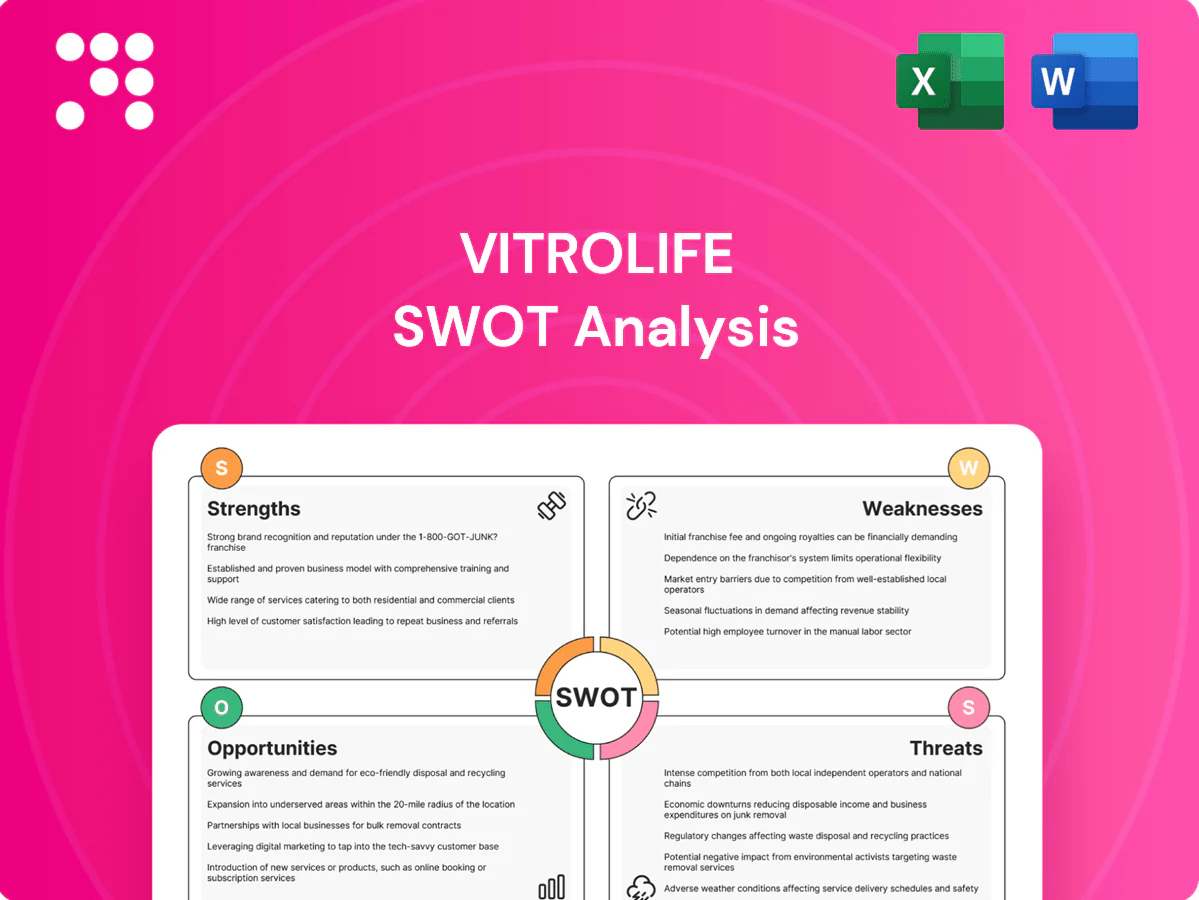
Vitrolife SWOT Analysis
This is the actual Vitrolife SWOT analysis document you’ll receive upon purchase—no surprises, just professional quality. The preview below is pulled directly from the full report, so buying unlocks the complete, editable version with in-depth strengths, weaknesses, opportunities and threats. Download provides the full, ready-to-use file immediately after checkout.

Original: $10.00
-65%$10.00
$3.50Product Information
Product Information
Shipping & Returns
Shipping & Returns
Description
Dive Deeper Into the Company’s Strategic Blueprint
Vitrolife’s SWOT analysis highlights its leading IVF technologies, strong clinical partnerships, and exposure to regulatory and pricing pressures in reproductive medicine. We unpack competitive advantages, operational risks, and growth levers across R&D and international markets. Want the full story behind the company’s strengths, risks, and growth drivers? Purchase the complete SWOT analysis to gain access to a professionally written, fully editable report designed to support planning, pitches, and research.
Strengths
Global IVF footprint
Strong presence across more than 120 countries gives Vitrolife scale, brand familiarity and close clinic relationships; geographic diversification smooths demand volatility between regions; proximity to key markets accelerates feedback loops and product refinement; and it strengthens distributor and KOL networks in reproductive medicine.
Comprehensive IVF portfolio
Vitrolifes end-to-end IVF portfolio—media, cryopreservation and instruments—raises share-of-wallet and switching costs while bundled solutions simplify procurement and standardize clinical workflows. Cross-selling across this suite boosts margins and customer stickiness, supporting consistent clinical outcomes across IVF stages. The group, listed on Nasdaq Stockholm and operating in over 120 countries, leverages 31 years of sector experience.
Quality and clinical credibility
Vitrolife's ISO 13485-certified manufacturing and strict quality control deliver high product consistency crucial for embryo viability and patient outcomes; the company supplies clinics in over 100 countries. Strong clinical validations and peer-reviewed studies have supported broad adoption, reinforcing embryologists' trust. Regulatory-compliant production and a Nasdaq Stockholm-listed track record further reduce perceived risk for clinics.
Innovation in reproductive technologies
Vitrolife's focused R&D in culture formulations and cryo technologies consistently improves embryo viability and lab throughput, with incremental innovations delivering measurable efficiency gains for IVF clinics.
Close collaboration with clinics accelerates translational development, while a strong patent portfolio and proprietary know-how create high barriers to entry in this specialized market.
- R&D-driven performance gains
- Incremental lab efficiency
- Clinic partnerships for translation
- IP-protected niche moat
Mission-driven brand
Vitrolife's purpose of helping people conceive resonates with clinicians and patients, strengthening trust and enabling premium product positioning. Purpose alignment supports loyalty and long-term clinic agreements. As a Nasdaq Stockholm-listed company (VITR) with FY2023 revenue ~SEK 3.6bn, the employer brand attracts embryology and medtech talent.
- Clinician/patient trust
- Premium positioning & loyalty
- Attracts specialized talent
- Supports long-term partnerships
Global IVF leader: 31 years, 120+ countries, ~SEK 3.6bn revenue
Vitrolife operates in 120+ countries with 31 years of sector experience and FY2023 revenue ~SEK 3.6bn (Nasdaq Stockholm: VITR). Its end-to-end IVF portfolio (media, cryo, instruments) and ISO 13485 manufacturing drive clinic stickiness, cross-sell margins and consistent clinical outcomes. Strong clinical evidence, patents and clinic partnerships create a high barrier to entry and support premium pricing.
| Metric | Value |
|---|---|
| Geographic reach | 120+ countries |
| Experience | 31 years |
| FY2023 Revenue | ~SEK 3.6bn |
What is included in the product
Detailed Word Document
Provides a concise SWOT analysis of Vitrolife, highlighting its technological strengths, operational weaknesses, market expansion opportunities, and competitive and regulatory threats shaping the company’s strategic outlook.
Customizable Excel Spreadsheet
Provides a concise, Vitrolife-specific SWOT matrix for rapid strategic alignment and stakeholder updates; editable layout lets teams quickly reflect changes in product pipeline, regulatory shifts, and market expansion priorities.
Weaknesses
Dependence on IVF cycle volumes
Revenue closely tracks IVF procedure counts, leaving Vitrolife exposed to macro and demographic swings; US cycles are roughly 300,000/year (CDC) and global cycles number in the low millions, so volume shifts materially impact sales. Economic downturns often cut elective treatment demand, reimbursement changes can delay or cancel cycles, and seasonality plus clinic capacity constraints add quarter-to-quarter variability.
Narrow therapeutic focus
Concentration in assisted reproduction leaves Vitrolife exposed to limited diversification benefits, as the bulk of its operations target IVF clinics and labs. Adjacent women’s health and genetic testing revenue streams appear underrepresented in the company’s portfolio. Category-specific shocks—regulatory changes, reimbursement cuts or demand shifts—could materially dent top-line performance. Investors often penalize single-vertical exposure with higher perceived risk and valuation discounts.
Premium pricing sensitivity
High-quality media and instruments command premiums that some clinics resist, especially as cost-sensitive markets often shift to lower-priced alternatives; purchasing groups and tenders increasingly compress margins and force vendors to match aggressive pricing. Price elasticity tends to rise as incremental success-rate gains plateau, weakening willingness to pay for premium consumables and capital equipment.
Regulatory and validation burden
IVF consumables face rigorous biocompatibility and clinical testing that commonly adds 12–36 months to time-to-market, slowing Vitrolife’s product rollout.
Country-specific approvals and divergent standards (EU IVDR since 2022) fragment launch timelines, requiring sequential submissions and local clinical data.
Post-market surveillance and documentation increase ongoing OPEX—typically adding several percent of product costs—and strain smaller regional rollouts.
- Regulatory delay: 12–36 months
- IVDR impact: increased conformity requirements since 2022
- Ongoing costs: surveillance/documentation add to OPEX
- Fragmented launches: sequential country approvals
Complex supply and cold chain
Media require tight controls (typically 2–8°C) and cryopreservation relies on liquid nitrogen at −196°C, making logistics complex and costly; temperature excursions can cause complete product loss and spoilage. Disruptions to cold chain or transport can impair clinic operations and harm customer relationships, forcing difficult inventory trade-offs between shelf life and availability.
- Temperature-critical: 2–8°C and −196°C
- High spoilage risk on excursion
- Inventory vs availability trade-off
IVF risk: volume-driven sales, price pressure, 12–36 months delays, cold chain 2–8°C/−196°C
Revenue tied to IVF volumes (US ~300,000 cycles/year; global ~1–2M) makes sales sensitive to macro/demographic swings. Regulatory timelines (12–36 months) and fragmented approvals (IVDR since 2022) slow launches and raise OPEX. Price pressure from tenders and cost-sensitive clinics compress margins. Cold chain needs (2–8°C; −196°C) increase logistics risk and spoilage.
| Metric | Value |
|---|---|
| US cycles | ~300,000/yr (CDC) |
| Global cycles | ~1–2M/yr |
| Regulatory delay | 12–36 months |
| Cold chain | 2–8°C; −196°C |
Preview Before You Purchase
Vitrolife SWOT Analysis
This is the actual Vitrolife SWOT analysis document you’ll receive upon purchase—no surprises, just professional quality. The preview below is pulled directly from the full report, so buying unlocks the complete, editable version with in-depth strengths, weaknesses, opportunities and threats. Download provides the full, ready-to-use file immediately after checkout.