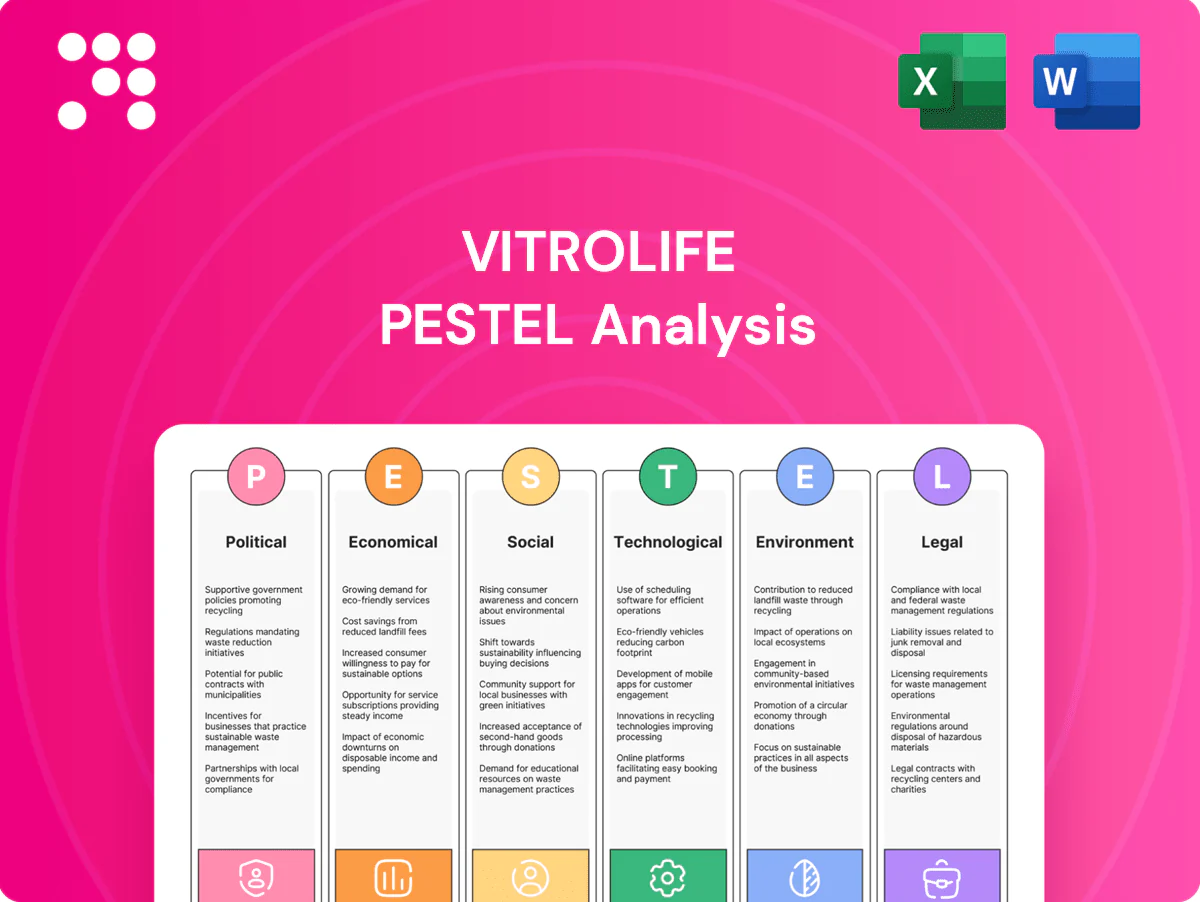
Vitrolife PESTLE Analysis

Plan Smarter. Present Sharper. Compete Stronger.
Gain a competitive edge with our PESTLE analysis of Vitrolife, revealing how political, economic, social, technological, legal and environmental forces shape its prospects. Ideal for investors and strategists, it's fully researched and ready-to-use. Download the full report now for actionable insights.
Political factors

ART regulation variability by country
IVF and assisted reproduction are regulated unevenly across regions, with about 3 million ART cycles performed worldwide annually and a global IVF market ~USD 21.5 billion in 2023, creating divergent product approval and clinical-use paths. Restrictive policies in some countries limit market access or procedures, while liberal frameworks expand demand. Vitrolife must localize its portfolio and training to align with national guidelines. Ongoing policy debates can rapidly shift addressable markets.
Public healthcare priorities and reimbursement
Government funding for fertility treatments varies widely and affects clinic volumes and product mix; infertility affects about 1 in 6 couples globally and the assisted reproductive technology market was roughly USD 25 billion in 2024.
Where IVF cycles are reimbursed, demand is more stable and price elasticity lower, reducing revenue volatility for suppliers.
Policy changes in reimbursement caps or inclusion of add-ons can quickly reshape revenue trajectories for manufacturers and clinics.
Vitrolife benefits from aligning clinical evidence with payer requirements to increase uptake in reimbursed markets and protect margins.

Trade policy, tariffs, and customs
Cross-border shipments of media, instruments and consumables face varied tariff regimes and customs delays that, per WTO, coincided with global merchandise trade growth of about 1.7% in 2024; some markets still levy over 5% duties on medical consumables, raising landed costs. Political tensions have forced rerouting and higher logistics spend; local warehousing and diversified suppliers reduce exposure. Precise compliance paperwork and product documentation are essential to avoid customs hold-ups.

Geopolitical stability and supply security
Geopolitical conflicts and sanctions since 2022 have disrupted market access and raw-material flows for life‑science suppliers, raising sourcing risk for Vitrolife; energy and transport shocks increase distribution costs and strain cold‑chain reliability. Vitrolife must maintain contingency plans for critical inputs and flexible regional production, backed by insurance and risk‑pooling to protect service levels.
- Supply disruption: diversify suppliers
- Cold chain: regional manufacturing
- Cost shocks: hedge energy/transport
- Risk management: insurance pools
Public policy on family formation
Pro-natalist policies and demographic strategies in key markets increase demand for fertility support, driving higher utilization of assisted reproductive technologies and benefiting Vitrolife’s consumables and equipment sales. Tax incentives or public subsidies for IVF correlate with higher clinic throughput and equipment turnover, while restrictions on donor gametes or surrogacy constrain service mix and reduce procedure volumes. Continuous monitoring of policy changes across EU, Asia and North America is essential for accurate demand forecasting and supply planning.
- Pro-natalist policies: boost ART demand
- Tax/subsidy presence: raises clinic throughput
- Donor/surrogacy limits: narrows procedure types
- Ongoing policy monitoring: critical for forecasting
Global IVF: regulation, tariffs and reimbursement reshape ~3M cycles, USD25B market
IVF regulation varies by country; ~3M ART cycles/year and a global IVF market ≈USD25B (2024), creating divergent approval and access. Reimbursement stability lowers price elasticity and raises volumes. Tariffs >5% in some markets and post‑2022 geopolitical shocks increased logistics costs. Vitrolife must localize products, diversify suppliers and align evidence to payers.
| Metric | Value |
|---|---|
| ART cycles (annual) | ~3M |
| Market size | ~USD25B (2024) |
What is included in the product
 Detailed Word Document
Provides a concise PESTLE assessment of Vitrolife, examining Political, Economic, Social, Technological, Environmental and Legal forces with data-backed trends and region-specific regulatory context. Designed for executives and investors to identify strategic risks, opportunities and forward-looking scenarios.

 Customizable Excel Spreadsheet
A concise, visually segmented PESTLE summary of Vitrolife that eases team alignment and strategic discussions by being presentation-ready and drop-in compatible; editable notes allow users to localize risks and opportunities for their region or business line.
Economic factors

Macroeconomic cycles and clinic spending
IVF demand shows resilience with an estimated >3 million ART cycles globally per year and a fertility services market ~28 billion USD in 2024, yet elective add-ons are cyclical; recessions compress out-of-pocket spending and lower uptake of premium products. Strong economies drive private clinic expansion and capital upgrades, so Vitrolife should calibrate product lines and pricing across tiers to protect mix and margin.
Healthcare inflation and input costs
Rising costs for lab consumables, energy and logistics are squeezing margins for embryology labs, driving clinics to prioritize reliable culture media and automation that reduce failed cycles and staff time. Price negotiations and value-based positioning are increasingly critical as purchasers demand measurable cycle success per euro. Cost volatility forces active procurement strategies and hedging of key inputs to protect gross margins.

Currency fluctuations and global revenues
Vitrolife is headquartered in Sweden and reports in SEK, so currency fluctuations in EUR, USD and CNY materially affect reported sales and profitability across reporting periods.
Mismatches between production costs incurred in SEK and sales billed in foreign currencies increase translational and transactional risk for margins.
Use of pricing corridors, regional pricing strategies and natural hedges from balanced sourcing mitigate short-term FX swings, while clear FX-policy disclosure strengthens investor confidence.

Market consolidation among IVF networks
Market consolidation among IVF networks gives large clinic groups greater purchasing power and centralized procurement, shifting supplier sales toward tenders, framework agreements and service‑level KPIs; the global IVF market was roughly USD 30bn in 2024, increasing buyer leverage. Vitrolife must compete on total cost of ownership and robust outcomes data to win long‑term contracts, which enhance revenue predictability and reduce sales volatility.
- Centralized procurement → tender-driven sales
- Emphasis on TCO and outcomes data
- Long-term contracts improve predictability
Emerging market growth
Rising middle classes in Asia, LATAM and MENA drive demand for IVF as affordability and insurance coverage improve; Asia-Pacific IVF market is forecast to grow ~10% CAGR to 2030, and India’s middle class is projected near 600 million by 2030, expanding addressable patients.
- Affordability: out-of-pocket sensitivity
- Infrastructure: clinics per capita limit uptake
- Product strategy: tiered portfolios + training
- Distribution: local partnerships ease regs
Global IVF: regulation, tariffs and reimbursement reshape ~3M cycles, USD25B market
IVF demand resilient (>3M ART cycles; ~USD 30bn market 2024) but discretionary add‑ons and recessions compress out‑of‑pocket spend and premium uptake. Rising lab consumable, energy and logistics costs squeeze margins, pushing clinics toward automation and value‑based buying. SEK reporting + FX exposure and clinic consolidation increase pricing and tender pressure; tiered pricing, hedging and TCO focus protect margins.
| Metric | Value |
|---|---|
| Global ART cycles (2024) | >3M |
| Market size (2024) | ~USD 30bn |
| APAC CAGR to 2030 | ~10% |
| India middle class (2030) | ~600M |
Preview Before You Purchase
Vitrolife PESTLE Analysis
The Vitrolife PESTLE Analysis provides a concise evaluation of political, economic, social, technological, legal and environmental factors affecting the company, with actionable implications for strategy and risk. The content and structure shown in the preview is the same document you’ll download after payment. Insights are fully formatted and ready to use for investment or strategic planning.

Product Information
Product Information
Shipping & Returns
Shipping & Returns
Description
Plan Smarter. Present Sharper. Compete Stronger.
Gain a competitive edge with our PESTLE analysis of Vitrolife, revealing how political, economic, social, technological, legal and environmental forces shape its prospects. Ideal for investors and strategists, it's fully researched and ready-to-use. Download the full report now for actionable insights.
Political factors
ART regulation variability by country
IVF and assisted reproduction are regulated unevenly across regions, with about 3 million ART cycles performed worldwide annually and a global IVF market ~USD 21.5 billion in 2023, creating divergent product approval and clinical-use paths. Restrictive policies in some countries limit market access or procedures, while liberal frameworks expand demand. Vitrolife must localize its portfolio and training to align with national guidelines. Ongoing policy debates can rapidly shift addressable markets.
Public healthcare priorities and reimbursement
Government funding for fertility treatments varies widely and affects clinic volumes and product mix; infertility affects about 1 in 6 couples globally and the assisted reproductive technology market was roughly USD 25 billion in 2024.
Where IVF cycles are reimbursed, demand is more stable and price elasticity lower, reducing revenue volatility for suppliers.
Policy changes in reimbursement caps or inclusion of add-ons can quickly reshape revenue trajectories for manufacturers and clinics.
Vitrolife benefits from aligning clinical evidence with payer requirements to increase uptake in reimbursed markets and protect margins.
Trade policy, tariffs, and customs
Cross-border shipments of media, instruments and consumables face varied tariff regimes and customs delays that, per WTO, coincided with global merchandise trade growth of about 1.7% in 2024; some markets still levy over 5% duties on medical consumables, raising landed costs. Political tensions have forced rerouting and higher logistics spend; local warehousing and diversified suppliers reduce exposure. Precise compliance paperwork and product documentation are essential to avoid customs hold-ups.
Geopolitical stability and supply security
Geopolitical conflicts and sanctions since 2022 have disrupted market access and raw-material flows for life‑science suppliers, raising sourcing risk for Vitrolife; energy and transport shocks increase distribution costs and strain cold‑chain reliability. Vitrolife must maintain contingency plans for critical inputs and flexible regional production, backed by insurance and risk‑pooling to protect service levels.
- Supply disruption: diversify suppliers
- Cold chain: regional manufacturing
- Cost shocks: hedge energy/transport
- Risk management: insurance pools
Public policy on family formation
Pro-natalist policies and demographic strategies in key markets increase demand for fertility support, driving higher utilization of assisted reproductive technologies and benefiting Vitrolife’s consumables and equipment sales. Tax incentives or public subsidies for IVF correlate with higher clinic throughput and equipment turnover, while restrictions on donor gametes or surrogacy constrain service mix and reduce procedure volumes. Continuous monitoring of policy changes across EU, Asia and North America is essential for accurate demand forecasting and supply planning.
- Pro-natalist policies: boost ART demand
- Tax/subsidy presence: raises clinic throughput
- Donor/surrogacy limits: narrows procedure types
- Ongoing policy monitoring: critical for forecasting
Global IVF: regulation, tariffs and reimbursement reshape ~3M cycles, USD25B market
IVF regulation varies by country; ~3M ART cycles/year and a global IVF market ≈USD25B (2024), creating divergent approval and access. Reimbursement stability lowers price elasticity and raises volumes. Tariffs >5% in some markets and post‑2022 geopolitical shocks increased logistics costs. Vitrolife must localize products, diversify suppliers and align evidence to payers.
| Metric | Value |
|---|---|
| ART cycles (annual) | ~3M |
| Market size | ~USD25B (2024) |
What is included in the product
Detailed Word Document
Provides a concise PESTLE assessment of Vitrolife, examining Political, Economic, Social, Technological, Environmental and Legal forces with data-backed trends and region-specific regulatory context. Designed for executives and investors to identify strategic risks, opportunities and forward-looking scenarios.
Customizable Excel Spreadsheet
A concise, visually segmented PESTLE summary of Vitrolife that eases team alignment and strategic discussions by being presentation-ready and drop-in compatible; editable notes allow users to localize risks and opportunities for their region or business line.
Economic factors
Macroeconomic cycles and clinic spending
IVF demand shows resilience with an estimated >3 million ART cycles globally per year and a fertility services market ~28 billion USD in 2024, yet elective add-ons are cyclical; recessions compress out-of-pocket spending and lower uptake of premium products. Strong economies drive private clinic expansion and capital upgrades, so Vitrolife should calibrate product lines and pricing across tiers to protect mix and margin.
Healthcare inflation and input costs
Rising costs for lab consumables, energy and logistics are squeezing margins for embryology labs, driving clinics to prioritize reliable culture media and automation that reduce failed cycles and staff time. Price negotiations and value-based positioning are increasingly critical as purchasers demand measurable cycle success per euro. Cost volatility forces active procurement strategies and hedging of key inputs to protect gross margins.
Currency fluctuations and global revenues
Vitrolife is headquartered in Sweden and reports in SEK, so currency fluctuations in EUR, USD and CNY materially affect reported sales and profitability across reporting periods.
Mismatches between production costs incurred in SEK and sales billed in foreign currencies increase translational and transactional risk for margins.
Use of pricing corridors, regional pricing strategies and natural hedges from balanced sourcing mitigate short-term FX swings, while clear FX-policy disclosure strengthens investor confidence.
Market consolidation among IVF networks
Market consolidation among IVF networks gives large clinic groups greater purchasing power and centralized procurement, shifting supplier sales toward tenders, framework agreements and service‑level KPIs; the global IVF market was roughly USD 30bn in 2024, increasing buyer leverage. Vitrolife must compete on total cost of ownership and robust outcomes data to win long‑term contracts, which enhance revenue predictability and reduce sales volatility.
- Centralized procurement → tender-driven sales
- Emphasis on TCO and outcomes data
- Long-term contracts improve predictability
Emerging market growth
Rising middle classes in Asia, LATAM and MENA drive demand for IVF as affordability and insurance coverage improve; Asia-Pacific IVF market is forecast to grow ~10% CAGR to 2030, and India’s middle class is projected near 600 million by 2030, expanding addressable patients.
- Affordability: out-of-pocket sensitivity
- Infrastructure: clinics per capita limit uptake
- Product strategy: tiered portfolios + training
- Distribution: local partnerships ease regs
Global IVF: regulation, tariffs and reimbursement reshape ~3M cycles, USD25B market
IVF demand resilient (>3M ART cycles; ~USD 30bn market 2024) but discretionary add‑ons and recessions compress out‑of‑pocket spend and premium uptake. Rising lab consumable, energy and logistics costs squeeze margins, pushing clinics toward automation and value‑based buying. SEK reporting + FX exposure and clinic consolidation increase pricing and tender pressure; tiered pricing, hedging and TCO focus protect margins.
| Metric | Value |
|---|---|
| Global ART cycles (2024) | >3M |
| Market size (2024) | ~USD 30bn |
| APAC CAGR to 2030 | ~10% |
| India middle class (2030) | ~600M |
Preview Before You Purchase
Vitrolife PESTLE Analysis
The Vitrolife PESTLE Analysis provides a concise evaluation of political, economic, social, technological, legal and environmental factors affecting the company, with actionable implications for strategy and risk. The content and structure shown in the preview is the same document you’ll download after payment. Insights are fully formatted and ready to use for investment or strategic planning.











