Visiativ SWOT Analysis

Make Insightful Decisions Backed by Expert Research
Explore Visiativ’s strategic position with our concise SWOT preview—highlighting core strengths in digital transformation, market-facing weaknesses, competitive threats, and growth opportunities across SaaS and services. Want the full picture? Purchase the complete SWOT for an editable, research-backed report and Excel tools to plan, pitch, or invest with confidence.
Strengths

Dassault ecosystem mastery
Visiativ's deep specialization in Dassault Systèmes solutions, notably SOLIDWORKS, delivers differentiated technical credibility that boosts win rates in PLM/CAD/CAE transformation deals. Close alignment with Dassault Systèmes (FY2024 revenue ~€6.3bn) provides roadmap visibility and co‑selling leverage, accelerating deal cycles. That partnership enables premium pricing on high‑complexity integrations and recurring services, improving margin expansion.
End‑to‑end digital transformation
Combining consulting, systems integration and custom development, Visiativ offers a one-stop digital transformation model that reduces vendor fragmentation and shortens time-to-value from months to weeks for many clients. The integrated approach drives larger, stickier deals and supports outcome-based engagements tied to operational KPIs. As an Euronext-listed provider, this model underpins scalable revenue growth and higher client retention.

SME-centric platforms
Visiativs SME-centric platforms lower adoption barriers and budget constraints for small and mid-sized firms, supporting a customer base of over 40,000 SMEs and accelerating digital uptake.
Packaged accelerators shorten deployment and standardize best practices, driving faster time-to-value and higher implementation efficiency.
This product-led model boosts gross margins versus pure resale/services and converts more business into recurring subscription and support revenue, which grew materially in recent years.

Sector know‑how and installed base
Visiativ leverages deep sector know‑how across manufacturing verticals, converting domain IP and reusable templates into faster deployments; the group reported about €162m revenue and serves over 27,000 clients (FY 2024), enabling repeatable cross‑sell of add‑ons and services. Strong references shorten sales cycles in similar industries and community effects boost brand within targeted clusters.
- FY2024 revenue ≈ €162m
- Installed base >27,000 clients
- High reuse of domain IP
- Shorter sales cycles via references
Partner network and support
Visiativ leverages a broad partner network of ISVs and technology partners to extend solution breadth, enabling faster integration and tailored offerings for industry clients. Access to partner training, certifications and co‑marketing funds strengthens delivery capacity and sales readiness. Joint go‑to‑market programs and clear escalation pathways boost account penetration, delivery quality and customer satisfaction.
- Alliances extend solution breadth
- Training & certifications enhance capacity
- Co‑marketing funds accelerate demand
- Joint GTM improves reach
- Escalation pathways raise service quality
CAD partnership and integrated services fuel premium pricing, faster deals and recurring revenue
Visiativ's SOLIDWORKS focus and Dassault tie boost win rates, premium pricing and faster deal cycles. Its combined consulting, systems‑integration and development model converts customers into recurring revenue, improving margins. SME platforms and accelerators enable rapid adoption across a large installed base.
| Metric | Value |
|---|---|
| FY2024 revenue | ≈ €162m |
| Installed base | >27,000 clients |
| SME reach | >40,000 firms |
What is included in the product
 Detailed Word Document
Provides a concise SWOT analysis of Visiativ, highlighting internal capabilities in digital transformation, R&D and recurring revenue while noting operational weaknesses and integration risks; identifies market opportunities in software, services and international expansion and potential threats from intensified competition, regulatory change and economic slowdown.

 Customizable Excel Spreadsheet
Provides a concise, visual SWOT matrix tailored to Visiativ for rapid strategy alignment and pain-point resolution; editable format enables quick updates to reflect shifting priorities and supports clear stakeholder communication.
Weaknesses

Vendor concentration risk
Heavy reliance on Dassault/SOLIDWORKS exposes Visiativ to partner pricing and roadmap changes, a material risk given SOLIDWORKS serves over 7 million users globally (company disclosures). Any channel policy shift by Dassault can compress Visiativ margins and constrain customer diversification, eroding cross-sell potential. This dependence limits bargaining power in large negotiations and accentuates revenue concentration risk for Visiativ.
Brand scale vs global integrators
Awareness remains lower than Tier‑1 SIs and hyperscalers, which together held roughly 69% of the 2024 cloud IaaS/PaaS market, limiting Visiativ’s visibility in mega‑deals and multinational rollouts. Procurement teams may perceive higher execution risk versus established integrators, increasing due‑diligence and contract barriers. To win business, Visiativ can face pricing pressure and margin compression to offset brand gap.

Project complexity and delivery risk
PLM and CAD integrations are high‑touch and error‑prone, contributing to the broader risk that about 70% of digital transformation projects fail to meet objectives (McKinsey); scope creep and data migration commonly cause multi‑month timeline overruns. Resource bottlenecks depress utilization and client satisfaction, while warranty and rework can materially erode project margins.

Geographic and scalability limits
If Visiativ's operations remain concentrated in select regions, growth is capped by local demand; Eurostat 2022 reports about 17% of EU firms sell abroad, underscoring limited cross-border reach. Scaling multilingual 24/7 support and handling international compliance and localization raise costs and complexity, reducing margins and deterring SMEs from scaling internationally. These constraints shrink the addressable market and slow revenue diversification.
- Regional concentration — limited TAM
- Support scalability — costly multilingual 24/7 ops
- Compliance & localization — added capex/OPEX
- SME deterrent — fewer clients scaling abroad
Talent attraction and retention
Competition for PLM, CAD, cloud and AI talent is intense, with specialist hiring costs and market premiums rising—attrition on long programs often exceeds 20% annually, threatening knowledge continuity. Utilization swings of ±15–25% drive burnout or bench time, while ongoing certification upkeep increases training costs and margins pressure.
- High hiring premiums for niche PLM/CAD/cloud/AI roles
- Attrition >20% risks knowledge loss on long projects
- Utilization volatility ±15–25% causes burnout/bench
- Certification upkeep raises training expenses
CAD/PLM reliance; hyperscalers hold 69% cloud; DT failure ~70%
Visiativ depends heavily on Dassault/SOLIDWORKS (7m users), exposing margins to partner policy shifts and concentration risk; hyperscalers/ Tier‑1 SIs held ~69% of 2024 cloud IaaS/PaaS, limiting mega‑deal access. PLM/CAD project failures and scope creep mirror McKinsey’s ~70% DT failure rate, while attrition >20% and ±15–25% utilization swing stress margins.
| Metric | Value |
|---|---|
| SOLIDWORKS users | 7,000,000 |
| 2024 cloud share (hyperscalers/Tier‑1) | 69% |
| DT projects failing (McKinsey) | ~70% |
| Attrition | >20% |
| Utilization variance | ±15–25% |
Same Document Delivered
Visiativ SWOT Analysis
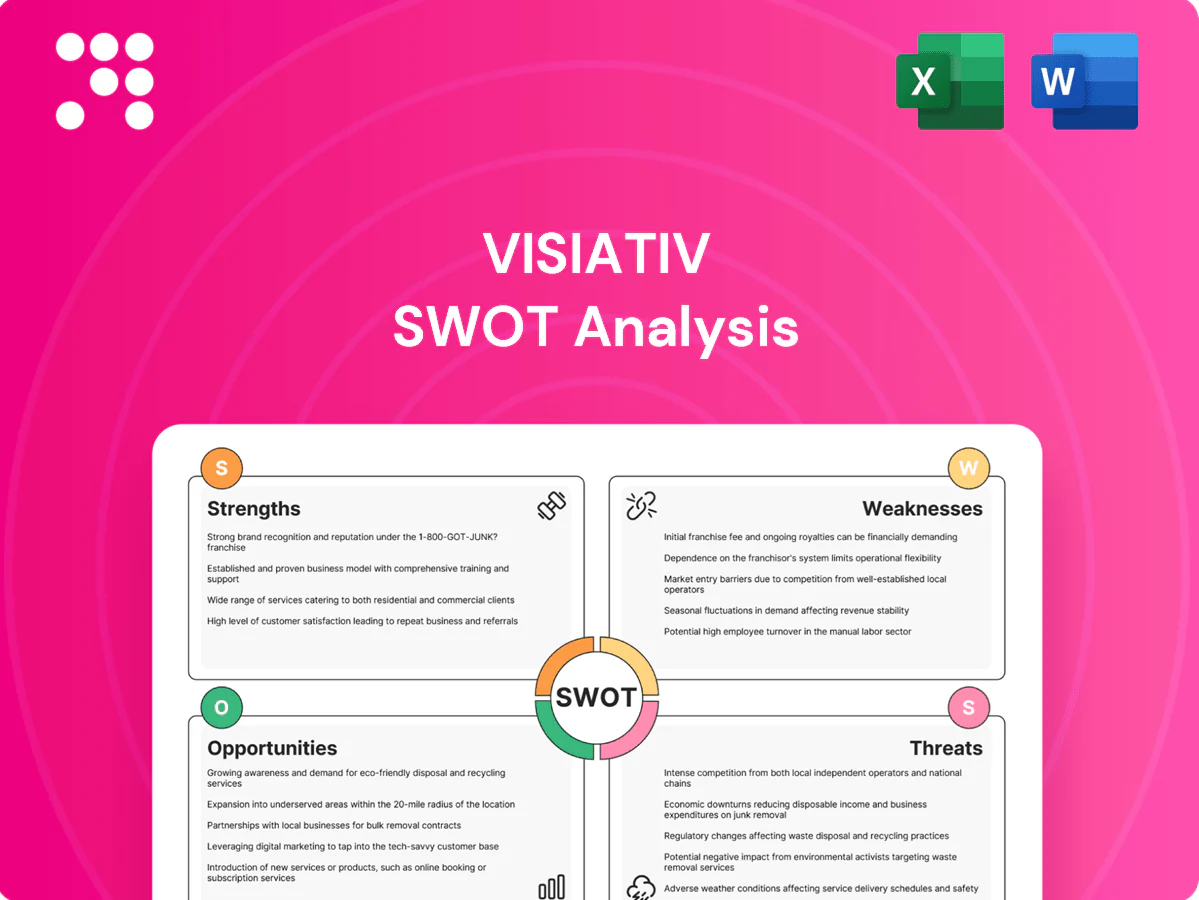
This is the actual Visiativ SWOT analysis document you’ll receive upon purchase—no surprises, just professional quality. The preview below is taken directly from the full report, so what you see is what you’ll download after checkout. Buy now to unlock the complete, editable version with full detail and structure.

Original: $10.00
-65%$10.00
$3.50Product Information
Product Information
Shipping & Returns
Shipping & Returns
Description
Make Insightful Decisions Backed by Expert Research
Explore Visiativ’s strategic position with our concise SWOT preview—highlighting core strengths in digital transformation, market-facing weaknesses, competitive threats, and growth opportunities across SaaS and services. Want the full picture? Purchase the complete SWOT for an editable, research-backed report and Excel tools to plan, pitch, or invest with confidence.
Strengths
Dassault ecosystem mastery
Visiativ's deep specialization in Dassault Systèmes solutions, notably SOLIDWORKS, delivers differentiated technical credibility that boosts win rates in PLM/CAD/CAE transformation deals. Close alignment with Dassault Systèmes (FY2024 revenue ~€6.3bn) provides roadmap visibility and co‑selling leverage, accelerating deal cycles. That partnership enables premium pricing on high‑complexity integrations and recurring services, improving margin expansion.
End‑to‑end digital transformation
Combining consulting, systems integration and custom development, Visiativ offers a one-stop digital transformation model that reduces vendor fragmentation and shortens time-to-value from months to weeks for many clients. The integrated approach drives larger, stickier deals and supports outcome-based engagements tied to operational KPIs. As an Euronext-listed provider, this model underpins scalable revenue growth and higher client retention.
SME-centric platforms
Visiativs SME-centric platforms lower adoption barriers and budget constraints for small and mid-sized firms, supporting a customer base of over 40,000 SMEs and accelerating digital uptake.
Packaged accelerators shorten deployment and standardize best practices, driving faster time-to-value and higher implementation efficiency.
This product-led model boosts gross margins versus pure resale/services and converts more business into recurring subscription and support revenue, which grew materially in recent years.
Sector know‑how and installed base
Visiativ leverages deep sector know‑how across manufacturing verticals, converting domain IP and reusable templates into faster deployments; the group reported about €162m revenue and serves over 27,000 clients (FY 2024), enabling repeatable cross‑sell of add‑ons and services. Strong references shorten sales cycles in similar industries and community effects boost brand within targeted clusters.
- FY2024 revenue ≈ €162m
- Installed base >27,000 clients
- High reuse of domain IP
- Shorter sales cycles via references
Partner network and support
Visiativ leverages a broad partner network of ISVs and technology partners to extend solution breadth, enabling faster integration and tailored offerings for industry clients. Access to partner training, certifications and co‑marketing funds strengthens delivery capacity and sales readiness. Joint go‑to‑market programs and clear escalation pathways boost account penetration, delivery quality and customer satisfaction.
- Alliances extend solution breadth
- Training & certifications enhance capacity
- Co‑marketing funds accelerate demand
- Joint GTM improves reach
- Escalation pathways raise service quality
CAD partnership and integrated services fuel premium pricing, faster deals and recurring revenue
Visiativ's SOLIDWORKS focus and Dassault tie boost win rates, premium pricing and faster deal cycles. Its combined consulting, systems‑integration and development model converts customers into recurring revenue, improving margins. SME platforms and accelerators enable rapid adoption across a large installed base.
| Metric | Value |
|---|---|
| FY2024 revenue | ≈ €162m |
| Installed base | >27,000 clients |
| SME reach | >40,000 firms |
What is included in the product
Detailed Word Document
Provides a concise SWOT analysis of Visiativ, highlighting internal capabilities in digital transformation, R&D and recurring revenue while noting operational weaknesses and integration risks; identifies market opportunities in software, services and international expansion and potential threats from intensified competition, regulatory change and economic slowdown.
Customizable Excel Spreadsheet
Provides a concise, visual SWOT matrix tailored to Visiativ for rapid strategy alignment and pain-point resolution; editable format enables quick updates to reflect shifting priorities and supports clear stakeholder communication.
Weaknesses
Vendor concentration risk
Heavy reliance on Dassault/SOLIDWORKS exposes Visiativ to partner pricing and roadmap changes, a material risk given SOLIDWORKS serves over 7 million users globally (company disclosures). Any channel policy shift by Dassault can compress Visiativ margins and constrain customer diversification, eroding cross-sell potential. This dependence limits bargaining power in large negotiations and accentuates revenue concentration risk for Visiativ.
Brand scale vs global integrators
Awareness remains lower than Tier‑1 SIs and hyperscalers, which together held roughly 69% of the 2024 cloud IaaS/PaaS market, limiting Visiativ’s visibility in mega‑deals and multinational rollouts. Procurement teams may perceive higher execution risk versus established integrators, increasing due‑diligence and contract barriers. To win business, Visiativ can face pricing pressure and margin compression to offset brand gap.
Project complexity and delivery risk
PLM and CAD integrations are high‑touch and error‑prone, contributing to the broader risk that about 70% of digital transformation projects fail to meet objectives (McKinsey); scope creep and data migration commonly cause multi‑month timeline overruns. Resource bottlenecks depress utilization and client satisfaction, while warranty and rework can materially erode project margins.
Geographic and scalability limits
If Visiativ's operations remain concentrated in select regions, growth is capped by local demand; Eurostat 2022 reports about 17% of EU firms sell abroad, underscoring limited cross-border reach. Scaling multilingual 24/7 support and handling international compliance and localization raise costs and complexity, reducing margins and deterring SMEs from scaling internationally. These constraints shrink the addressable market and slow revenue diversification.
- Regional concentration — limited TAM
- Support scalability — costly multilingual 24/7 ops
- Compliance & localization — added capex/OPEX
- SME deterrent — fewer clients scaling abroad
Talent attraction and retention
Competition for PLM, CAD, cloud and AI talent is intense, with specialist hiring costs and market premiums rising—attrition on long programs often exceeds 20% annually, threatening knowledge continuity. Utilization swings of ±15–25% drive burnout or bench time, while ongoing certification upkeep increases training costs and margins pressure.
- High hiring premiums for niche PLM/CAD/cloud/AI roles
- Attrition >20% risks knowledge loss on long projects
- Utilization volatility ±15–25% causes burnout/bench
- Certification upkeep raises training expenses
CAD/PLM reliance; hyperscalers hold 69% cloud; DT failure ~70%
Visiativ depends heavily on Dassault/SOLIDWORKS (7m users), exposing margins to partner policy shifts and concentration risk; hyperscalers/ Tier‑1 SIs held ~69% of 2024 cloud IaaS/PaaS, limiting mega‑deal access. PLM/CAD project failures and scope creep mirror McKinsey’s ~70% DT failure rate, while attrition >20% and ±15–25% utilization swing stress margins.
| Metric | Value |
|---|---|
| SOLIDWORKS users | 7,000,000 |
| 2024 cloud share (hyperscalers/Tier‑1) | 69% |
| DT projects failing (McKinsey) | ~70% |
| Attrition | >20% |
| Utilization variance | ±15–25% |
Same Document Delivered
Visiativ SWOT Analysis
This is the actual Visiativ SWOT analysis document you’ll receive upon purchase—no surprises, just professional quality. The preview below is taken directly from the full report, so what you see is what you’ll download after checkout. Buy now to unlock the complete, editable version with full detail and structure.