Viatris PESTLE Analysis

Your Shortcut to Market Insight Starts Here
Discover how political, economic, social, technological, legal, and environmental forces are reshaping Viatris’s strategy and risk profile in our concise PESTLE snapshot; perfect for investors and strategists. Dive deeper—purchase the full, editable PESTLE analysis to unlock actionable insights and immediate downloads for your next decision or presentation.
Political factors

Drug pricing reforms
Many countries are intensifying price controls, external reference pricing and tendering—U.S. Medicare negotiation under the Inflation Reduction Act will set prices for an initial cohort of drugs with negotiated prices taking effect in 2026, and the EU has expanded joint procurement frameworks since 2021 to cover high-cost medicines.
For Viatris this trend can compress generics and biosimilar margins while expanding volume through broader access; tender losses and reference-price cuts have driven double-digit margin erosion in generic peers during past procurement rounds.
Scenario-plan for sustained price cuts (eg negotiated benchmarks in 2026), potential tender loss and adverse mix shifts, and model impacts on revenue and gross margin under downside, base and upside cases.
Regulatory policy shifts
Regulatory shifts at FDA, EMA, WHO PQ and national agencies change approvals, interchangeability and pharmacovigilance burdens; FDA standard review is 10 months (priority 6 months), so faster approvals can accelerate launches while stricter rules raise time‑to‑market and compliance cost. For Viatris (2023 revenue $11.4B) monitor biosimilar substitution/interchangeability guidance and align CMC, real‑world evidence and quality systems proactively. Proactive alignment reduces launch risk and protects margins.

Geopolitics and trade
Tariffs, export controls, and geopolitical tensions can disrupt APIs, intermediates and logistics; China and India supply over 60% of global generic API capacity, concentrating risk. Diversification and nearshoring reduce single‑country exposure and are increasingly adopted across pharma supply chains. Maintain dual sourcing and inventory buffers to absorb shocks. Engage in trade compliance and duty optimization to limit cost volatility.

Public procurement dynamics
Government tenders drive pricing and access in many markets; WHO estimates public procurement supplies roughly 50–60% of medicines in low‑ and middle‑income countries. Single‑winner tenders compress prices but concentrate volume risk; multi‑winner models dilute risk. Viatris must build bidding intelligence, pursue cost leadership and deepen ties with health ministries and payers.
- tenders: 50–60% public supply
- single‑winner: lower price, higher volume risk
- multi‑winner: risk spread
- actions: bidding intelligence, cost leadership, ministry/payer relations
Healthcare funding priorities
Policy emphasis on universal health coverage—about half the world lacks essential health services and 100 million were pushed into poverty by health costs (WHO)—favours affordable medicines, boosting demand for generics and biosimilars; budget constraints, however, can force formulary exclusions or delayed reimbursements, squeezing margins.
- Position value dossiers showing cost offsets from generics/biosimilars
- Advocate access programs
- Pursue local manufacturing incentives
Medicare negotiation and price controls compress generics/biosimilars prices, increase volume risk
Intensifying price controls and the U.S. Medicare negotiation (effective 2026) will compress generics/biosimilar pricing while expanding volume via access.
Regulatory shifts (FDA 10/6‑month reviews) and biosimilar interchangeability guidance set launch risk and compliance costs.
Concentrated API supply (China+India >60%) and tenders (WHO: 50–60% public procurement) raise supply and volume‑risk.
| Metric | Value |
|---|---|
| Viatris 2023 revenue | $11.4B |
| API share (China+India) | >60% |
| Public procurement | 50–60% |
| People pushed into poverty (WHO) | 100M |
What is included in the product
 Detailed Word Document
Explores how macro-environmental factors uniquely affect Viatris across Political, Economic, Social, Technological, Environmental and Legal dimensions, with data-driven subpoints and region-specific examples. Designed for executives and investors, it offers forward-looking insights for scenario planning and strategic decision-making.

 Customizable Excel Spreadsheet
Viatris PESTLE: a concise, PESTLE-segmented brief that relieves meeting prep by enabling quick interpretation, editable local notes, seamless insertion into presentations, and rapid team alignment on external risks.
Economic factors

FX and inflation volatility
Viatris faces FX/inflation volatility as a large share of sales is in emerging markets while key inputs and debt are USD/EUR‑denominated, creating mismatch risk; US CPI was 3.4% in 2023, showing persistent inflation headwinds. Inflation raises wages, utilities and logistics, pressuring COGS. Mitigants include hedging, contractual pricing clauses and productivity programs, plus localizing sourcing and optimizing plant footprints.
Payer budget cycles
Economic slowdowns (IMF projects 3.2% global GDP growth in 2024) tighten public and private payer budgets, forcing stricter formulary controls and procurement cycles.
That accelerates generic substitution—generics account for about 90% of U.S. prescriptions by volume—while intensifying price erosion across molecules.
Viatris should deploy tiered offerings and varied pack sizes and emphasize pharmacoeconomic value propositions in hospital and retail channels to protect share and margin.

Biosimilar adoption economics
Biosimilar adoption hinges on price discounts, switching incentives and procurement rules; US launches average 15–35% discounts while EU tendering drives 20–70% cuts, with steeper discounts (30–50%) unlocking share but compressing unit margins. Model total lifetime value across molecules and indications—global biosimilars market was about $15–16bn in 2023, forecast ~12% CAGR to 2030—capturing portfolio-level net present value is critical. Invest in physician education and patient support, which real-world programs lift prescribing rates by roughly 10–25% and accelerate uptake.

Supply chain costs
Supply chain costs — volatile API prices (select APIs swung 30–50% in 2020–23), container freight rates (Drewry WCI fell from ~10,000/FEU in 2021 to ~1,800–2,500 in 2023–24) and rising energy bills materially pressure Viatris margins; build‑should‑cost models and long‑term supplier contracts to hedge risk, improve yield/OEE and use regional DCs to cut lead times.
- API swings: 30–50%
- Freight: WCI ~1,800–2,500 (2023–24)
- Actions: should‑cost, LTAs, OEE+, regional DCs
Emerging market growth
Rising incomes and expanding insurance in emerging markets—IMF projects EM growth around 4% in 2025—are increasing demand for essential medicines, but currency volatility and tighter local credit terms can offset revenue gains; Viatris should tailor portfolios to national EMLs and disease burdens and deploy access pricing plus risk‑sharing contracts.
- EM growth: IMF ~4% (2025)
- Risk: currency & credit squeeze
- Strategy: align to local EMLs/disease burden
- Pricing: access pricing & risk‑sharing
Medicare negotiation and price controls compress generics/biosimilars prices, increase volume risk
Viatris faces FX/inflation mismatch—large EM sales vs USD/EUR costs; US CPI 2023 3.4% and core inflation ~3.5% in 2024. IMF global GDP 2024 3.2%, EM growth ~4% (2025) boosting demand but raising currency/credit risk. Biosimilar discounts 15–50% and API swings 30–50% compress margins; mitigate with hedges, LTAs, should‑cost and value‑based contracts.
| Metric | Value | Implication |
|---|---|---|
| US CPI 2023 | 3.4% | cost pressure |
| Global GDP 2024 (IMF) | 3.2% | tighter payers |
| Biosimilar discount | 15–50% | margin erosion |
| API volatility | ±30–50% | COGS risk |
Preview Before You Purchase
Viatris PESTLE Analysis
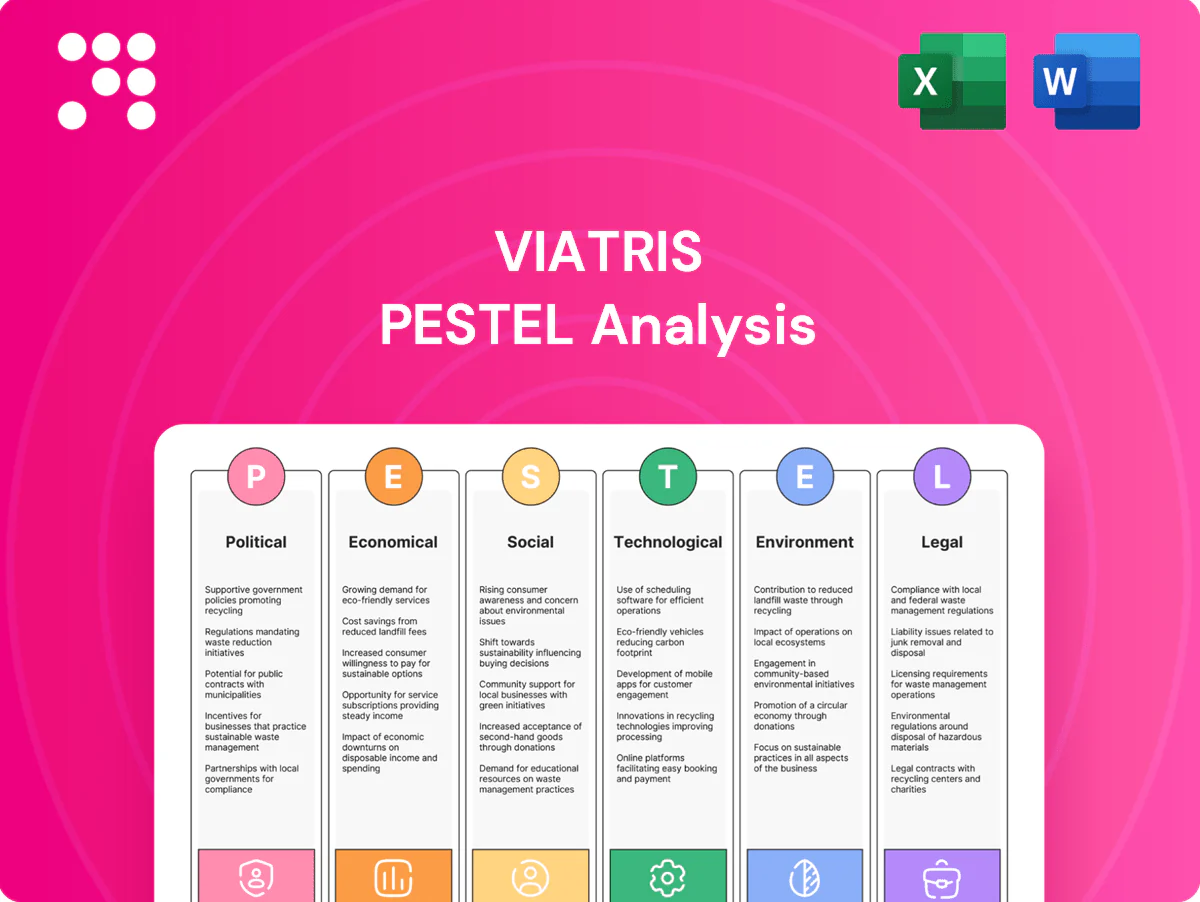
The Viatris PESTLE Analysis delivers a concise, actionable evaluation of political, economic, sociocultural, technological, legal, and environmental factors affecting Viatris. The preview shown here is the exact document you’ll receive after purchase—fully formatted and ready to use. Use it for investment screening, strategic planning, or competitive review.

Original: $10.00
-65%$10.00
$3.50Product Information
Product Information
Shipping & Returns
Shipping & Returns
Description
Your Shortcut to Market Insight Starts Here
Discover how political, economic, social, technological, legal, and environmental forces are reshaping Viatris’s strategy and risk profile in our concise PESTLE snapshot; perfect for investors and strategists. Dive deeper—purchase the full, editable PESTLE analysis to unlock actionable insights and immediate downloads for your next decision or presentation.
Political factors
Drug pricing reforms
Many countries are intensifying price controls, external reference pricing and tendering—U.S. Medicare negotiation under the Inflation Reduction Act will set prices for an initial cohort of drugs with negotiated prices taking effect in 2026, and the EU has expanded joint procurement frameworks since 2021 to cover high-cost medicines.
For Viatris this trend can compress generics and biosimilar margins while expanding volume through broader access; tender losses and reference-price cuts have driven double-digit margin erosion in generic peers during past procurement rounds.
Scenario-plan for sustained price cuts (eg negotiated benchmarks in 2026), potential tender loss and adverse mix shifts, and model impacts on revenue and gross margin under downside, base and upside cases.
Regulatory policy shifts
Regulatory shifts at FDA, EMA, WHO PQ and national agencies change approvals, interchangeability and pharmacovigilance burdens; FDA standard review is 10 months (priority 6 months), so faster approvals can accelerate launches while stricter rules raise time‑to‑market and compliance cost. For Viatris (2023 revenue $11.4B) monitor biosimilar substitution/interchangeability guidance and align CMC, real‑world evidence and quality systems proactively. Proactive alignment reduces launch risk and protects margins.
Geopolitics and trade
Tariffs, export controls, and geopolitical tensions can disrupt APIs, intermediates and logistics; China and India supply over 60% of global generic API capacity, concentrating risk. Diversification and nearshoring reduce single‑country exposure and are increasingly adopted across pharma supply chains. Maintain dual sourcing and inventory buffers to absorb shocks. Engage in trade compliance and duty optimization to limit cost volatility.
Public procurement dynamics
Government tenders drive pricing and access in many markets; WHO estimates public procurement supplies roughly 50–60% of medicines in low‑ and middle‑income countries. Single‑winner tenders compress prices but concentrate volume risk; multi‑winner models dilute risk. Viatris must build bidding intelligence, pursue cost leadership and deepen ties with health ministries and payers.
- tenders: 50–60% public supply
- single‑winner: lower price, higher volume risk
- multi‑winner: risk spread
- actions: bidding intelligence, cost leadership, ministry/payer relations
Healthcare funding priorities
Policy emphasis on universal health coverage—about half the world lacks essential health services and 100 million were pushed into poverty by health costs (WHO)—favours affordable medicines, boosting demand for generics and biosimilars; budget constraints, however, can force formulary exclusions or delayed reimbursements, squeezing margins.
- Position value dossiers showing cost offsets from generics/biosimilars
- Advocate access programs
- Pursue local manufacturing incentives
Medicare negotiation and price controls compress generics/biosimilars prices, increase volume risk
Intensifying price controls and the U.S. Medicare negotiation (effective 2026) will compress generics/biosimilar pricing while expanding volume via access.
Regulatory shifts (FDA 10/6‑month reviews) and biosimilar interchangeability guidance set launch risk and compliance costs.
Concentrated API supply (China+India >60%) and tenders (WHO: 50–60% public procurement) raise supply and volume‑risk.
| Metric | Value |
|---|---|
| Viatris 2023 revenue | $11.4B |
| API share (China+India) | >60% |
| Public procurement | 50–60% |
| People pushed into poverty (WHO) | 100M |
What is included in the product
Detailed Word Document
Explores how macro-environmental factors uniquely affect Viatris across Political, Economic, Social, Technological, Environmental and Legal dimensions, with data-driven subpoints and region-specific examples. Designed for executives and investors, it offers forward-looking insights for scenario planning and strategic decision-making.
Customizable Excel Spreadsheet
Viatris PESTLE: a concise, PESTLE-segmented brief that relieves meeting prep by enabling quick interpretation, editable local notes, seamless insertion into presentations, and rapid team alignment on external risks.
Economic factors
FX and inflation volatility
Viatris faces FX/inflation volatility as a large share of sales is in emerging markets while key inputs and debt are USD/EUR‑denominated, creating mismatch risk; US CPI was 3.4% in 2023, showing persistent inflation headwinds. Inflation raises wages, utilities and logistics, pressuring COGS. Mitigants include hedging, contractual pricing clauses and productivity programs, plus localizing sourcing and optimizing plant footprints.
Payer budget cycles
Economic slowdowns (IMF projects 3.2% global GDP growth in 2024) tighten public and private payer budgets, forcing stricter formulary controls and procurement cycles.
That accelerates generic substitution—generics account for about 90% of U.S. prescriptions by volume—while intensifying price erosion across molecules.
Viatris should deploy tiered offerings and varied pack sizes and emphasize pharmacoeconomic value propositions in hospital and retail channels to protect share and margin.
Biosimilar adoption economics
Biosimilar adoption hinges on price discounts, switching incentives and procurement rules; US launches average 15–35% discounts while EU tendering drives 20–70% cuts, with steeper discounts (30–50%) unlocking share but compressing unit margins. Model total lifetime value across molecules and indications—global biosimilars market was about $15–16bn in 2023, forecast ~12% CAGR to 2030—capturing portfolio-level net present value is critical. Invest in physician education and patient support, which real-world programs lift prescribing rates by roughly 10–25% and accelerate uptake.
Supply chain costs
Supply chain costs — volatile API prices (select APIs swung 30–50% in 2020–23), container freight rates (Drewry WCI fell from ~10,000/FEU in 2021 to ~1,800–2,500 in 2023–24) and rising energy bills materially pressure Viatris margins; build‑should‑cost models and long‑term supplier contracts to hedge risk, improve yield/OEE and use regional DCs to cut lead times.
- API swings: 30–50%
- Freight: WCI ~1,800–2,500 (2023–24)
- Actions: should‑cost, LTAs, OEE+, regional DCs
Emerging market growth
Rising incomes and expanding insurance in emerging markets—IMF projects EM growth around 4% in 2025—are increasing demand for essential medicines, but currency volatility and tighter local credit terms can offset revenue gains; Viatris should tailor portfolios to national EMLs and disease burdens and deploy access pricing plus risk‑sharing contracts.
- EM growth: IMF ~4% (2025)
- Risk: currency & credit squeeze
- Strategy: align to local EMLs/disease burden
- Pricing: access pricing & risk‑sharing
Medicare negotiation and price controls compress generics/biosimilars prices, increase volume risk
Viatris faces FX/inflation mismatch—large EM sales vs USD/EUR costs; US CPI 2023 3.4% and core inflation ~3.5% in 2024. IMF global GDP 2024 3.2%, EM growth ~4% (2025) boosting demand but raising currency/credit risk. Biosimilar discounts 15–50% and API swings 30–50% compress margins; mitigate with hedges, LTAs, should‑cost and value‑based contracts.
| Metric | Value | Implication |
|---|---|---|
| US CPI 2023 | 3.4% | cost pressure |
| Global GDP 2024 (IMF) | 3.2% | tighter payers |
| Biosimilar discount | 15–50% | margin erosion |
| API volatility | ±30–50% | COGS risk |
Preview Before You Purchase
Viatris PESTLE Analysis
The Viatris PESTLE Analysis delivers a concise, actionable evaluation of political, economic, sociocultural, technological, legal, and environmental factors affecting Viatris. The preview shown here is the exact document you’ll receive after purchase—fully formatted and ready to use. Use it for investment screening, strategic planning, or competitive review.