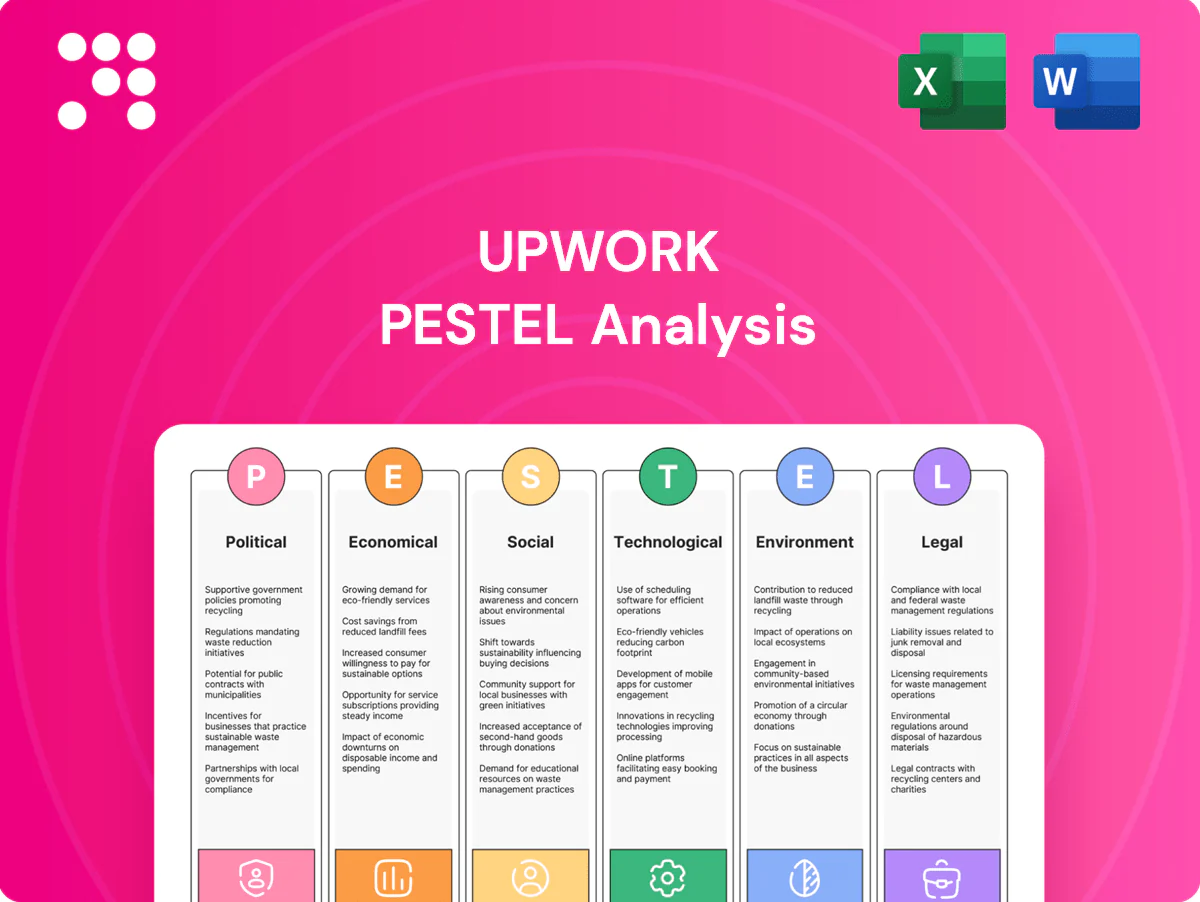
Upwork PESTLE Analysis

Plan Smarter. Present Sharper. Compete Stronger.
Get a strategic edge with our PESTLE Analysis of Upwork—three-plus pages of expert insight into political, economic, social, technological, legal, and environmental forces shaping its future. Use these findings to stress-test forecasts, identify risks, and uncover new growth levers for investors and strategists. Purchase the full, downloadable report for the complete, editable analysis and actionable recommendations.
Political factors

Cross-border policy stability
Upwork depends on predictable cross-border policies to connect clients and freelancers across jurisdictions, and operates in 180+ countries and territories. Sudden regulatory shifts can impede onboarding, payments, or service delivery and raise compliance costs. Stable bilateral agreements and national digital economy strategies support seamless collaboration, while policy volatility increases marketplace friction and operational risk.
Geopolitics and sanctions
Sanction regimes (covering over 40 jurisdictions under major US/EU/UK programs) can bar freelancers and block cross-border payments, forcing platform account freezes. Geopolitical tensions shrink freelancer supply and client demand in affected markets. Upwork must run robust screening against evolving lists and AML controls. Diversifying markets—North America historically ~60% of revenue—buffers regional shocks.

Digital services taxation
Governments increasingly impose digital services taxes on platforms; notable examples include the UK DST at 2% on UK revenues above £25m and France at 3% on revenues above €25m. These levies can compress margins or be passed to users, raising pricing sensitivity. Compliance requires granular, country-level revenue attribution and reporting. Complexity grows as over 15 jurisdictions now maintain distinct DST frameworks.

Government procurement openness
Public-sector acceptance of freelance platforms is expanding enterprise demand as the independent workforce surpassed 60 million in the US by 2024, and government procurement remains a $600B+ annual market, creating scale opportunities for Upwork. Policies favoring flexible staffing and remote contracting open new channels, while restrictive procurement rules and legacy vendor lists limit access. Certification, compliance and high security standards are decisive to win government work.
- Public-sector demand: +60M independent workers (US, 2024)
- Market size: government procurement >$600B annually
- Risks: restrictive procurement rules, legacy vendors
- Key enablers: certifications, FedRAMP/CMMC-level security
Localization and national tech strategies
Data localization mandates and national digital strategies (eg China, Russia, EU adequacy rules, India policy shifts) force Upwork to adapt infrastructure choices; the platform operates in 180+ countries while over 140 jurisdictions now have data protection laws, driving regional storage and local partnership needs. These rules raise operating costs and architectural complexity but aligning with national priorities eases market entry and trust.
- Regional storage required — increases infrastructure spend
- Local partnerships necessary — speeds regulatory approval
- Alignment with national priorities — improves client trust and market access
Global freelance marketplace: sanctions, data laws and North America reliance reshape growth
Upwork relies on stable cross-border policies across 180+ countries; sudden regulatory shifts raise compliance and payment risks. Sanctions (40+ jurisdictions) and data localization (140+ data protection laws) increase operational cost and screening needs. North America ≈60% revenue buffers shocks; public-sector demand (US independent workforce ~60M, government procurement >$600B) offers growth with strict compliance.
| Metric | Value |
|---|---|
| Countries served | 180+ |
| Sanctioned jurisdictions | 40+ |
| Data protection laws | 140+ |
| NA revenue share | ~60% |
| US independent workers (2024) | ~60M |
| Govt procurement market | >$600B |
What is included in the product
 Detailed Word Document
Explores how macro-environmental forces uniquely impact Upwork across Political, Economic, Social, Technological, Environmental and Legal dimensions, with data-driven trends and region-specific regulatory context. Designed for executives, consultants and investors, it highlights actionable threats, opportunities and forward-looking scenarios ready for inclusion in business plans or investor materials.

 Customizable Excel Spreadsheet
A concise, visually segmented Upwork PESTLE summary that clarifies external risks and opportunities, is easily dropped into presentations or shared across teams, and uses simple language for fast alignment during strategic planning.
Economic factors

Macro cycle sensitivity
Freelance spend is cyclical, expanding in growth phases and tightening in downturns; Upwork reported $621.5m revenue in 2023, reflecting platform sensitivity to macro swings. Recessions often shift demand from full-time hires to flexible talent, but company budget cuts can still lower overall project volume. Upwork’s diversified client base across tech, marketing and SMBs helps mitigate volatility, smoothing revenue impact.
Currency and FX exposure
Multi-currency transactions expose Upwork earnings to FX swings, with the platform’s Gross Services Volume of about $4.0 billion in 2024 magnifying cross-currency translation effects. Volatility alters freelancer take-home pay and client budgets across regions, as exchange-rate moves of 5–10% in 2024 materially shifted local purchasing power. Hedging and currency-conversion routing affect net take-rate stability, while transparent FX fees—clearly disclosed at checkout—are critical to maintaining user trust.

Labor cost arbitrage
Global wage differentials—often delivering 30–70% lower labor costs versus onshore hires—drive client adoption of Upwork for cost-effective talent. As emerging-market wages climbed roughly 5–7% in 2023–24, arbitrage has narrowed, pressuring pure cost-based propositions. Skill scarcity in niches like AI and cybersecurity lets specialists command premium rates, offsetting local wage inflation. Upwork’s matching efficiency and tools sustain client ROI by reducing hiring time and mismatches.

Inflation and fee elasticity
Inflation (US CPI 2023: 3.4%) lifts operating and payment processing costs, squeezing Upwork’s margins as merchant fees (card + processing ~2–3%) and wage inflation rise. Passing costs to buyers via higher service fees risks churn in a price‑sensitive freelance marketplace; tiered pricing and subscription models can shift burden while protecting retention. Efficiency gains and AI tooling (automation, matching) can offset cost pressure and preserve margins.
- Inflation: US CPI 2023 3.4%
- Processing fees: ~2–3%
- Mitigants: tiered pricing, subscriptions, AI-driven efficiency
Competitive dynamics
Intense competition from Fiverr, Toptal and enterprise in-house sourcing compresses Upwork’s take rate, pressuring marketplace revenue; Upwork reported FY2024 revenue of $835 million and emphasized enterprise growth in 2024 earnings. Differentiation via trust signals, vetted talent and workflow tools drives higher retention and pricing power, while network effects push winner-take-most dynamics. Strategic partnerships (e.g., enterprise alliances) expanded Upwork’s enterprise pipeline in 2024, contributing to stronger average contract sizes.
- Take rate pressure: platform vs in-house
- FY2024 revenue: $835M (company disclosure)
- Key levers: trust, talent quality, workflow tools
- Network effects → winner-take-most
- Partnerships boost enterprise pipeline
Global freelance marketplace: sanctions, data laws and North America reliance reshape growth
Upwork’s revenue sensitivity to cycles is clear: $621.5m (2023) to $835m (FY2024) with GSV ~ $4.0B (2024), so macro swings and budget cuts affect volume even as clients shift to flexible talent. FX volatility (5–10% moves in 2024) and multi-currency GSV amplify translation risk and freelancer purchasing power. Wage inflation in emerging markets (5–7% 2023–24) and payment fees (~2–3%) compress margins; pricing tiers, subscriptions and AI efficiency are key mitigants.
| Metric | Value |
|---|---|
| Revenue | $835M (FY2024) |
| GSV | $4.0B (2024) |
| FX moves | 5–10% (2024) |
| Wage growth | 5–7% (EM, 2023–24) |
| Processing fees | ~2–3% |
Preview Before You Purchase
Upwork PESTLE Analysis
The preview shown here is the exact document you’ll receive after purchase—fully formatted and ready to use. This Upwork PESTLE Analysis covers political, economic, social, technological, legal, and environmental factors with clear headings and actionable insights. No placeholders or teasers—what you see is the final, downloadable file.

Original: $10.00
-65%$10.00
$3.50Product Information
Product Information
Shipping & Returns
Shipping & Returns
Description
Plan Smarter. Present Sharper. Compete Stronger.
Get a strategic edge with our PESTLE Analysis of Upwork—three-plus pages of expert insight into political, economic, social, technological, legal, and environmental forces shaping its future. Use these findings to stress-test forecasts, identify risks, and uncover new growth levers for investors and strategists. Purchase the full, downloadable report for the complete, editable analysis and actionable recommendations.
Political factors
Cross-border policy stability
Upwork depends on predictable cross-border policies to connect clients and freelancers across jurisdictions, and operates in 180+ countries and territories. Sudden regulatory shifts can impede onboarding, payments, or service delivery and raise compliance costs. Stable bilateral agreements and national digital economy strategies support seamless collaboration, while policy volatility increases marketplace friction and operational risk.
Geopolitics and sanctions
Sanction regimes (covering over 40 jurisdictions under major US/EU/UK programs) can bar freelancers and block cross-border payments, forcing platform account freezes. Geopolitical tensions shrink freelancer supply and client demand in affected markets. Upwork must run robust screening against evolving lists and AML controls. Diversifying markets—North America historically ~60% of revenue—buffers regional shocks.
Digital services taxation
Governments increasingly impose digital services taxes on platforms; notable examples include the UK DST at 2% on UK revenues above £25m and France at 3% on revenues above €25m. These levies can compress margins or be passed to users, raising pricing sensitivity. Compliance requires granular, country-level revenue attribution and reporting. Complexity grows as over 15 jurisdictions now maintain distinct DST frameworks.
Government procurement openness
Public-sector acceptance of freelance platforms is expanding enterprise demand as the independent workforce surpassed 60 million in the US by 2024, and government procurement remains a $600B+ annual market, creating scale opportunities for Upwork. Policies favoring flexible staffing and remote contracting open new channels, while restrictive procurement rules and legacy vendor lists limit access. Certification, compliance and high security standards are decisive to win government work.
- Public-sector demand: +60M independent workers (US, 2024)
- Market size: government procurement >$600B annually
- Risks: restrictive procurement rules, legacy vendors
- Key enablers: certifications, FedRAMP/CMMC-level security
Localization and national tech strategies
Data localization mandates and national digital strategies (eg China, Russia, EU adequacy rules, India policy shifts) force Upwork to adapt infrastructure choices; the platform operates in 180+ countries while over 140 jurisdictions now have data protection laws, driving regional storage and local partnership needs. These rules raise operating costs and architectural complexity but aligning with national priorities eases market entry and trust.
- Regional storage required — increases infrastructure spend
- Local partnerships necessary — speeds regulatory approval
- Alignment with national priorities — improves client trust and market access
Global freelance marketplace: sanctions, data laws and North America reliance reshape growth
Upwork relies on stable cross-border policies across 180+ countries; sudden regulatory shifts raise compliance and payment risks. Sanctions (40+ jurisdictions) and data localization (140+ data protection laws) increase operational cost and screening needs. North America ≈60% revenue buffers shocks; public-sector demand (US independent workforce ~60M, government procurement >$600B) offers growth with strict compliance.
| Metric | Value |
|---|---|
| Countries served | 180+ |
| Sanctioned jurisdictions | 40+ |
| Data protection laws | 140+ |
| NA revenue share | ~60% |
| US independent workers (2024) | ~60M |
| Govt procurement market | >$600B |
What is included in the product
Detailed Word Document
Explores how macro-environmental forces uniquely impact Upwork across Political, Economic, Social, Technological, Environmental and Legal dimensions, with data-driven trends and region-specific regulatory context. Designed for executives, consultants and investors, it highlights actionable threats, opportunities and forward-looking scenarios ready for inclusion in business plans or investor materials.
Customizable Excel Spreadsheet
A concise, visually segmented Upwork PESTLE summary that clarifies external risks and opportunities, is easily dropped into presentations or shared across teams, and uses simple language for fast alignment during strategic planning.
Economic factors
Macro cycle sensitivity
Freelance spend is cyclical, expanding in growth phases and tightening in downturns; Upwork reported $621.5m revenue in 2023, reflecting platform sensitivity to macro swings. Recessions often shift demand from full-time hires to flexible talent, but company budget cuts can still lower overall project volume. Upwork’s diversified client base across tech, marketing and SMBs helps mitigate volatility, smoothing revenue impact.
Currency and FX exposure
Multi-currency transactions expose Upwork earnings to FX swings, with the platform’s Gross Services Volume of about $4.0 billion in 2024 magnifying cross-currency translation effects. Volatility alters freelancer take-home pay and client budgets across regions, as exchange-rate moves of 5–10% in 2024 materially shifted local purchasing power. Hedging and currency-conversion routing affect net take-rate stability, while transparent FX fees—clearly disclosed at checkout—are critical to maintaining user trust.
Labor cost arbitrage
Global wage differentials—often delivering 30–70% lower labor costs versus onshore hires—drive client adoption of Upwork for cost-effective talent. As emerging-market wages climbed roughly 5–7% in 2023–24, arbitrage has narrowed, pressuring pure cost-based propositions. Skill scarcity in niches like AI and cybersecurity lets specialists command premium rates, offsetting local wage inflation. Upwork’s matching efficiency and tools sustain client ROI by reducing hiring time and mismatches.
Inflation and fee elasticity
Inflation (US CPI 2023: 3.4%) lifts operating and payment processing costs, squeezing Upwork’s margins as merchant fees (card + processing ~2–3%) and wage inflation rise. Passing costs to buyers via higher service fees risks churn in a price‑sensitive freelance marketplace; tiered pricing and subscription models can shift burden while protecting retention. Efficiency gains and AI tooling (automation, matching) can offset cost pressure and preserve margins.
- Inflation: US CPI 2023 3.4%
- Processing fees: ~2–3%
- Mitigants: tiered pricing, subscriptions, AI-driven efficiency
Competitive dynamics
Intense competition from Fiverr, Toptal and enterprise in-house sourcing compresses Upwork’s take rate, pressuring marketplace revenue; Upwork reported FY2024 revenue of $835 million and emphasized enterprise growth in 2024 earnings. Differentiation via trust signals, vetted talent and workflow tools drives higher retention and pricing power, while network effects push winner-take-most dynamics. Strategic partnerships (e.g., enterprise alliances) expanded Upwork’s enterprise pipeline in 2024, contributing to stronger average contract sizes.
- Take rate pressure: platform vs in-house
- FY2024 revenue: $835M (company disclosure)
- Key levers: trust, talent quality, workflow tools
- Network effects → winner-take-most
- Partnerships boost enterprise pipeline
Global freelance marketplace: sanctions, data laws and North America reliance reshape growth
Upwork’s revenue sensitivity to cycles is clear: $621.5m (2023) to $835m (FY2024) with GSV ~ $4.0B (2024), so macro swings and budget cuts affect volume even as clients shift to flexible talent. FX volatility (5–10% moves in 2024) and multi-currency GSV amplify translation risk and freelancer purchasing power. Wage inflation in emerging markets (5–7% 2023–24) and payment fees (~2–3%) compress margins; pricing tiers, subscriptions and AI efficiency are key mitigants.
| Metric | Value |
|---|---|
| Revenue | $835M (FY2024) |
| GSV | $4.0B (2024) |
| FX moves | 5–10% (2024) |
| Wage growth | 5–7% (EM, 2023–24) |
| Processing fees | ~2–3% |
Preview Before You Purchase
Upwork PESTLE Analysis
The preview shown here is the exact document you’ll receive after purchase—fully formatted and ready to use. This Upwork PESTLE Analysis covers political, economic, social, technological, legal, and environmental factors with clear headings and actionable insights. No placeholders or teasers—what you see is the final, downloadable file.