Ubiquiti PESTLE Analysis

Skip the Research. Get the Strategy.
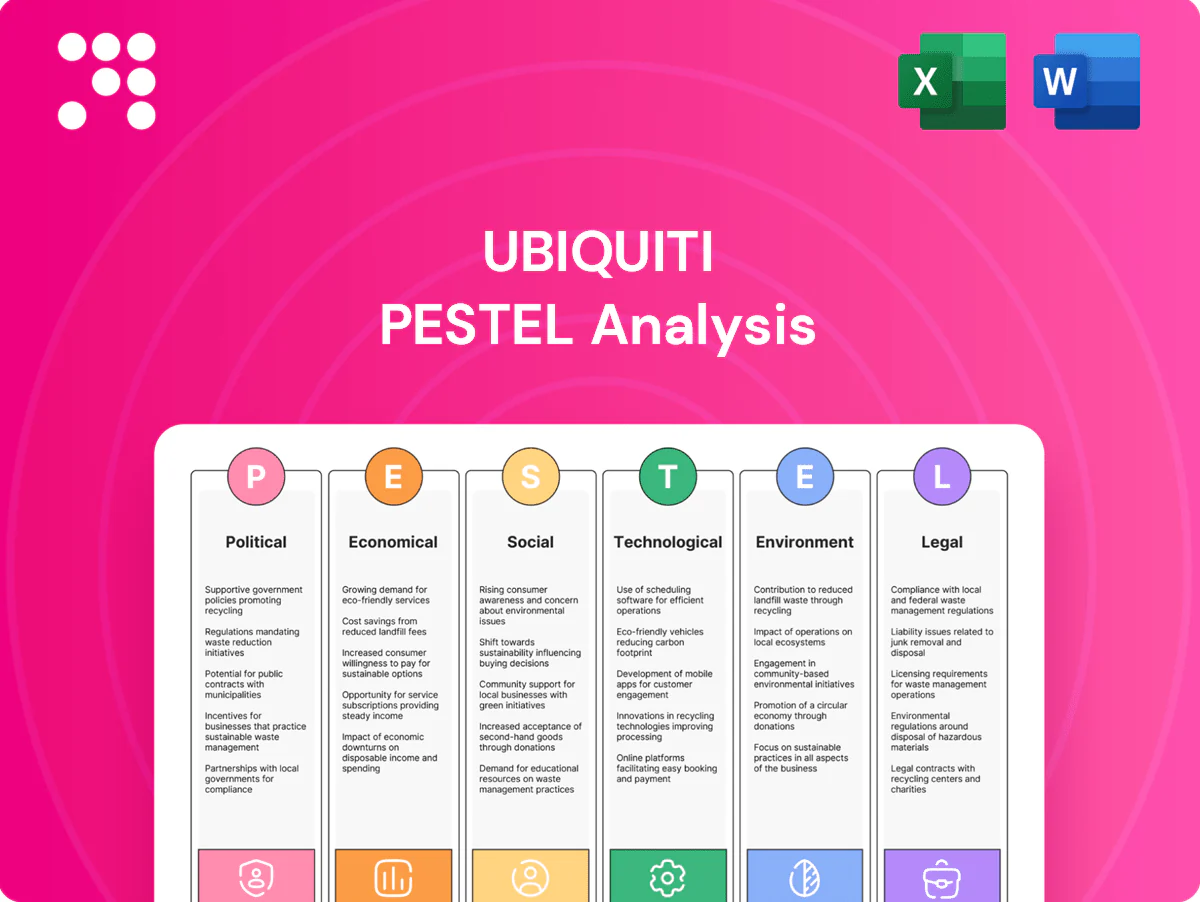
Our Ubiquiti PESTLE Analysis reveals how political shifts, economic cycles, social trends, tech innovation, legal changes, and environmental pressures shape the company's prospects. Use these insights to anticipate risks and spot strategic opportunities. Purchase the full PESTLE for the complete, downloadable breakdown and actionable recommendations.
Political factors

Trade tariffs
Shifts in US–China and EU tariff regimes, notably US Section 301 duties up to 25% on many electronics, can materially raise Ubiquiti’s bill-of-materials and retail pricing. Ubiquiti’s cost-focused positioning is highly sensitive to small landed-cost changes, so scenario-planning for tariff escalations and temporary exclusion windows is essential. Use bonded warehouses to defer duties and diversify sourcing to mitigate volatility.
Export controls
Stricter US export controls on semiconductors and surveillance tech, tightened notably in October 2022 and followed by subsequent updates, can curtail Ubiquiti shipments to restricted regions or customers. Ubiquiti must classify SKUs under the EAR accurately and monitor BIS Entity List updates from the Commerce Department in real time. Building alternative component options preserves product availability amid supply constraints. Strengthening compliance automation reduces shipping holds and exposure to multi‑million‑dollar penalties.

Telecom policy
Government broadband initiatives such as the US BEAD program (42.45 billion USD) and growing municipal public Wi‑Fi rollouts drive enterprise and service‑provider demand for Ubiquiti networking gear. Alignment with spectrum policies (eg CBRS 3550–3700 MHz shared band, ~150 MHz) and rapid standards adoption (3GPP Release 18/5G‑Advanced) accelerates deployment. Position products to meet government procurement specs and local content rules and engage in standards bodies to influence technical baselines.

Geopolitical supply risk
Regional instability, port congestion, and sanctions continue to threaten component flow for network hardware vendors; Ubiquiti mitigates this by using multi-region contract manufacturing with at least two independent sites to avoid single-point exposure.
Maintain 3 months safety stock for critical chipsets and power modules and secure political risk insurance for high-risk corridors to limit revenue disruption and margin volatility.
- multi-region manufacturing: 2+ sites
- safety stock: 3 months
- insurance: political risk for high-risk corridors
Public procurement rules
Buy-American, TAA and national security restrictions materially affect Ubiquiti’s eligibility for public-sector contracts; U.S. federal contract obligations exceeded roughly 700 billion in FY2024, heightening scrutiny of supplier provenance.
Ubiquiti must certify products, document supply-chain provenance, offer compliant hardware/software configurations and train channel partners on tender requirements to avoid disqualification.
- Certify products and maintain provenance logs
- Provide TAA/Buy-American compliant configurations
- Train channels on tender rules and documentation
- Monitor national-security watchlists and contract thresholds
Tariffs, export controls raise COGS; dual-sourcing and provenance logs enable compliance
Tariff shifts (eg US Section 301 up to 25%) and export controls (BIS updates since Oct 2022) raise COGS and restrict markets; maintain 3 months safety stock and dual-sourcing. Government programs (US BEAD 42.45B, US federal contracts ~700B in FY2024) drive demand but require TAA/Buy‑American compliance. Use multi-region CM, provenance logs, compliance automation and political-risk insurance for high‑risk corridors.
| Risk | Impact | Key metric |
|---|---|---|
| Tariffs | ↑COGS | Section 301 up to 25% |
| Export controls | Market bans | BIS list updates (post‑2022) |
| Procurement rules | Contract eligibility | BEAD 42.45B; FY2024 ~$700B |
What is included in the product
 Detailed Word Document
Explores how macro-environmental factors uniquely affect Ubiquiti across Political, Economic, Social, Technological, Environmental, and Legal dimensions, with each section backed by current data and trend analysis; designed for executives, consultants, and entrepreneurs to identify risks, opportunities, and strategic responses, delivered in clean, ready-to-use format with forward-looking insights for scenario planning and investor communication.

 Customizable Excel Spreadsheet
Concise, visually segmented Ubiquiti PESTLE summary that eases meeting prep and slide insertion, and is editable for region- or product-specific notes to align teams quickly during planning sessions.
Economic factors

Capex cycles
Enterprise and ISP spending closely follows macro growth and credit conditions; IMF WEO (July 2024) projects global GDP growth of 3.1% in 2024 and 3.0% in 2025, which constrains or unlocks network refreshes. Slowdowns defer capital upgrades while recoveries accelerate Wi‑Fi and switching replacement cycles. Maintain a barbell portfolio across price tiers to capture varied budgets and emphasize TCO savings to win in constrained environments.
FX and costs
Ubiquiti’s global revenue of about $2.05 billion in FY2024 collected in multiple currencies against largely USD-denominated component and logistics costs creates material margin risk when FX moves. Active hedging and local currency pricing helped stabilize gross margins in 2024, and calibrated pass-through pricing is needed to preserve Ubiquiti’s premium value positioning. Monitor DRAM/flash/RF cycles—memory spot prices fell roughly 40% in 2023–24—to time buys and protect cost of goods sold.

Inflation and rates
High inflation (US CPI 12-month ~3.3% June 2025) pressures wages, logistics and components, while policy rates at 5.25–5.50% (July 2025) curb IT financing and extend payback periods. Ubiquiti should optimize channel inventory and cut working capital to preserve cash and liquidity. Expanding subscription/cloud management smooths revenue and increases ARR visibility. Highlight device energy savings as an operating-expense offset for customers.

Emerging market demand
Rapid urbanization (World Bank projects ~58% urban by 2030) and IMF-estimated emerging-market GDP growth ~4.3% in 2024 boost SME digitization, creating demand for affordable Ubiquiti networking; tailoring SKUs and local pricing improves conversion. Expanding distribution and community support lowers adoption friction, while selective credit terms and distributor partnerships manage receivable risk.
- Urbanization: 58% by 2030 (World Bank)
- EM growth: ~4.3% in 2024 (IMF)
- SKU/pricing: align to local purchasing power
- Distribution: channel + community to reduce friction
- Risk: selective credit + distributor terms
Competitive pricing
Competitive pricing pressures intensify as incumbents often deploy deep discounts in downturns; Ubiquiti offsets this by differentiating on ease-of-deploy, controller software, and lower TCO to defend margins and share.
Protect hero SKUs while using targeted promos on elastic segments, and monitor gray-market leakage—industry estimates place channel leakage risk as a material threat to ASPs and brand integrity.
- Differentiate: ease-of-deploy, controller software, TCO
- Protect: hero SKUs, targeted promos on elastic segments
- Monitor: gray-market leakage to defend channel integrity
Tariffs, export controls raise COGS; dual-sourcing and provenance logs enable compliance
Macro growth (IMF WEO 3.1% 2024, 3.0% 2025) and credit costs (policy rates 5.25–5.50% July 2025) drive enterprise/ISP capex timing; Ubiquiti revenue ~$2.05B FY2024 and FX exposure require hedging and pass-through pricing. Inflation (US CPI ~3.3% June 2025) and wages squeeze margins while memory prices fell ~40% in 2023–24 offering buy windows. EM urbanization (58% by 2030) and ~4.3% EM growth 2024 expand SME demand; manage inventory, channel and receivable risk.
| Metric | Value |
|---|---|
| Global GDP 2024/25 | 3.1% / 3.0% |
| Ubiquiti Rev FY2024 | $2.05B |
| US CPI Jun 2025 | ~3.3% |
| Policy rates Jul 2025 | 5.25–5.50% |
| Memory price change | -40% (2023–24) |
| EM growth 2024 | ~4.3% |
Same Document Delivered
Ubiquiti PESTLE Analysis
The preview shown here is the exact Ubiquiti PESTLE Analysis document you’ll receive after purchase—fully formatted and ready to use. The layout, content, and structure match the downloadable file exactly, with no placeholders or teasers. After payment you’ll instantly obtain this final, professionally structured report.

Product Information
Product Information
Shipping & Returns
Shipping & Returns
Description
Skip the Research. Get the Strategy.
Our Ubiquiti PESTLE Analysis reveals how political shifts, economic cycles, social trends, tech innovation, legal changes, and environmental pressures shape the company's prospects. Use these insights to anticipate risks and spot strategic opportunities. Purchase the full PESTLE for the complete, downloadable breakdown and actionable recommendations.
Political factors
Trade tariffs
Shifts in US–China and EU tariff regimes, notably US Section 301 duties up to 25% on many electronics, can materially raise Ubiquiti’s bill-of-materials and retail pricing. Ubiquiti’s cost-focused positioning is highly sensitive to small landed-cost changes, so scenario-planning for tariff escalations and temporary exclusion windows is essential. Use bonded warehouses to defer duties and diversify sourcing to mitigate volatility.
Export controls
Stricter US export controls on semiconductors and surveillance tech, tightened notably in October 2022 and followed by subsequent updates, can curtail Ubiquiti shipments to restricted regions or customers. Ubiquiti must classify SKUs under the EAR accurately and monitor BIS Entity List updates from the Commerce Department in real time. Building alternative component options preserves product availability amid supply constraints. Strengthening compliance automation reduces shipping holds and exposure to multi‑million‑dollar penalties.
Telecom policy
Government broadband initiatives such as the US BEAD program (42.45 billion USD) and growing municipal public Wi‑Fi rollouts drive enterprise and service‑provider demand for Ubiquiti networking gear. Alignment with spectrum policies (eg CBRS 3550–3700 MHz shared band, ~150 MHz) and rapid standards adoption (3GPP Release 18/5G‑Advanced) accelerates deployment. Position products to meet government procurement specs and local content rules and engage in standards bodies to influence technical baselines.
Geopolitical supply risk
Regional instability, port congestion, and sanctions continue to threaten component flow for network hardware vendors; Ubiquiti mitigates this by using multi-region contract manufacturing with at least two independent sites to avoid single-point exposure.
Maintain 3 months safety stock for critical chipsets and power modules and secure political risk insurance for high-risk corridors to limit revenue disruption and margin volatility.
- multi-region manufacturing: 2+ sites
- safety stock: 3 months
- insurance: political risk for high-risk corridors
Public procurement rules
Buy-American, TAA and national security restrictions materially affect Ubiquiti’s eligibility for public-sector contracts; U.S. federal contract obligations exceeded roughly 700 billion in FY2024, heightening scrutiny of supplier provenance.
Ubiquiti must certify products, document supply-chain provenance, offer compliant hardware/software configurations and train channel partners on tender requirements to avoid disqualification.
- Certify products and maintain provenance logs
- Provide TAA/Buy-American compliant configurations
- Train channels on tender rules and documentation
- Monitor national-security watchlists and contract thresholds
Tariffs, export controls raise COGS; dual-sourcing and provenance logs enable compliance
Tariff shifts (eg US Section 301 up to 25%) and export controls (BIS updates since Oct 2022) raise COGS and restrict markets; maintain 3 months safety stock and dual-sourcing. Government programs (US BEAD 42.45B, US federal contracts ~700B in FY2024) drive demand but require TAA/Buy‑American compliance. Use multi-region CM, provenance logs, compliance automation and political-risk insurance for high‑risk corridors.
| Risk | Impact | Key metric |
|---|---|---|
| Tariffs | ↑COGS | Section 301 up to 25% |
| Export controls | Market bans | BIS list updates (post‑2022) |
| Procurement rules | Contract eligibility | BEAD 42.45B; FY2024 ~$700B |
What is included in the product
Detailed Word Document
Explores how macro-environmental factors uniquely affect Ubiquiti across Political, Economic, Social, Technological, Environmental, and Legal dimensions, with each section backed by current data and trend analysis; designed for executives, consultants, and entrepreneurs to identify risks, opportunities, and strategic responses, delivered in clean, ready-to-use format with forward-looking insights for scenario planning and investor communication.
Customizable Excel Spreadsheet
Concise, visually segmented Ubiquiti PESTLE summary that eases meeting prep and slide insertion, and is editable for region- or product-specific notes to align teams quickly during planning sessions.
Economic factors
Capex cycles
Enterprise and ISP spending closely follows macro growth and credit conditions; IMF WEO (July 2024) projects global GDP growth of 3.1% in 2024 and 3.0% in 2025, which constrains or unlocks network refreshes. Slowdowns defer capital upgrades while recoveries accelerate Wi‑Fi and switching replacement cycles. Maintain a barbell portfolio across price tiers to capture varied budgets and emphasize TCO savings to win in constrained environments.
FX and costs
Ubiquiti’s global revenue of about $2.05 billion in FY2024 collected in multiple currencies against largely USD-denominated component and logistics costs creates material margin risk when FX moves. Active hedging and local currency pricing helped stabilize gross margins in 2024, and calibrated pass-through pricing is needed to preserve Ubiquiti’s premium value positioning. Monitor DRAM/flash/RF cycles—memory spot prices fell roughly 40% in 2023–24—to time buys and protect cost of goods sold.
Inflation and rates
High inflation (US CPI 12-month ~3.3% June 2025) pressures wages, logistics and components, while policy rates at 5.25–5.50% (July 2025) curb IT financing and extend payback periods. Ubiquiti should optimize channel inventory and cut working capital to preserve cash and liquidity. Expanding subscription/cloud management smooths revenue and increases ARR visibility. Highlight device energy savings as an operating-expense offset for customers.
Emerging market demand
Rapid urbanization (World Bank projects ~58% urban by 2030) and IMF-estimated emerging-market GDP growth ~4.3% in 2024 boost SME digitization, creating demand for affordable Ubiquiti networking; tailoring SKUs and local pricing improves conversion. Expanding distribution and community support lowers adoption friction, while selective credit terms and distributor partnerships manage receivable risk.
- Urbanization: 58% by 2030 (World Bank)
- EM growth: ~4.3% in 2024 (IMF)
- SKU/pricing: align to local purchasing power
- Distribution: channel + community to reduce friction
- Risk: selective credit + distributor terms
Competitive pricing
Competitive pricing pressures intensify as incumbents often deploy deep discounts in downturns; Ubiquiti offsets this by differentiating on ease-of-deploy, controller software, and lower TCO to defend margins and share.
Protect hero SKUs while using targeted promos on elastic segments, and monitor gray-market leakage—industry estimates place channel leakage risk as a material threat to ASPs and brand integrity.
- Differentiate: ease-of-deploy, controller software, TCO
- Protect: hero SKUs, targeted promos on elastic segments
- Monitor: gray-market leakage to defend channel integrity
Tariffs, export controls raise COGS; dual-sourcing and provenance logs enable compliance
Macro growth (IMF WEO 3.1% 2024, 3.0% 2025) and credit costs (policy rates 5.25–5.50% July 2025) drive enterprise/ISP capex timing; Ubiquiti revenue ~$2.05B FY2024 and FX exposure require hedging and pass-through pricing. Inflation (US CPI ~3.3% June 2025) and wages squeeze margins while memory prices fell ~40% in 2023–24 offering buy windows. EM urbanization (58% by 2030) and ~4.3% EM growth 2024 expand SME demand; manage inventory, channel and receivable risk.
| Metric | Value |
|---|---|
| Global GDP 2024/25 | 3.1% / 3.0% |
| Ubiquiti Rev FY2024 | $2.05B |
| US CPI Jun 2025 | ~3.3% |
| Policy rates Jul 2025 | 5.25–5.50% |
| Memory price change | -40% (2023–24) |
| EM growth 2024 | ~4.3% |
Same Document Delivered
Ubiquiti PESTLE Analysis
The preview shown here is the exact Ubiquiti PESTLE Analysis document you’ll receive after purchase—fully formatted and ready to use. The layout, content, and structure match the downloadable file exactly, with no placeholders or teasers. After payment you’ll instantly obtain this final, professionally structured report.