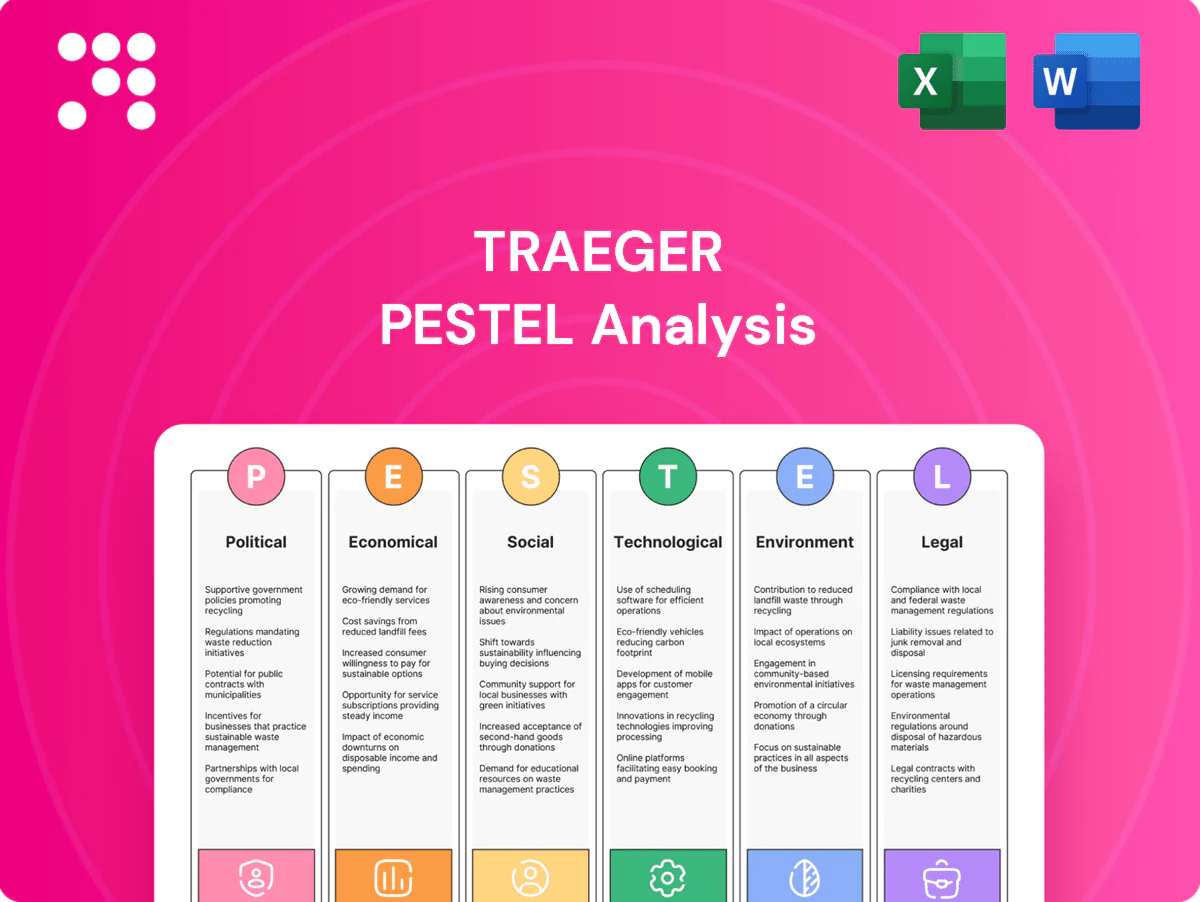
Traeger PESTLE Analysis

Skip the Research. Get the Strategy.
Discover how political shifts, economic cycles, social trends, technological innovation, environmental pressures, and legal changes are shaping Traeger's future in our focused PESTLE Analysis. Use these insights to identify risks and growth opportunities and strengthen your strategy. Purchase the full version for the complete, ready-to-use report and actionable recommendations.
Political factors

Tariffs and trade policy on metals and components
Import tariffs such as US Section 232 — 25% on steel and 10% on aluminum — and Section 301 tariffs up to 25% on many Chinese goods can swing Traeger’s bill-of-materials and retail pricing. Shifts in US–China/EU relations alter landed cost and margin planning. Sourcing diversification lowers exposure but raises supply-chain complexity and admin costs. Continuous monitoring enables hedging and timely price actions.
Incentives and policy for biomass and renewables
Policies that classify wood pellets as renewable—driven by frameworks tied to the US Inflation Reduction Act (approximately 369 billion USD for clean energy) and EU Fit for 55 targets—support Traeger demand and premium positioning. Tax credits and USDA/DOE grants can compress pellet input costs, improving margins. If sustainability definitions tighten, policy headwinds could cut incentives. Active advocacy helps shape standards favoring responsibly sourced pellets.

Product safety and certification regimes
National and local regimes like UL, CSA and CE shape Traeger product design and testing, often adding 2–9 months to time-to-market and raising upfront compliance costs by roughly 2–5% of unit cost; stricter norms raise barriers to low-quality entrants and protect margins. Recalls risk reputational damage and fines—US CPSC reported about 300 consumer-product recalls in 2023—so early regulator alignment shortens approvals.

Geopolitical supply chain disruptions
Conflicts, sanctions and export controls have disrupted electronics, chips and metals flows, driving component lead times up to 30% and chip spot premiums near 20% in 2021–24. Freight-route volatility raises lead times and carrying costs. Dual-sourcing and nearshoring mitigate shocks but require capital and vendor development; scenario planning supports inventory and pricing decisions.
- Disruptions: chips/metals
- Impact: lead times +30%, premiums ~20%
- Response: dual-sourcing, nearshoring (capex)
- Tool: scenario planning for inventory/pricing
State and municipal restrictions on outdoor burning
Wildfire-prone regions impose temporary outdoor-burning bans that can suppress pellet-grill use and local retail demand; US wildfires burned about 7.2 million acres in 2023 (NIFC), driving more frequent local restrictions. Patchwork rules complicate marketing and seasonality planning, so clear consumer guidance and built-in compliance features reduce legal risk and liability, while regional inventory and promo strategies allow rapid adaptation to localized bans.
- Impact: reduced local sales during bans
- Risk mitigation: compliance features and guidance
- Ops: region-based inventory and targeted promos
Tariffs 25%, IRA $369bn, compliance 2–5%
Tariffs (US Sec 232/301 up to 25%) and US–China/EU tensions can shift COGS and retail pricing; dual-sourcing/nearshoring raise capex but cut lead-time risk. Renewable-pellet policies (IRA ~369bn, EU Fit for 55) support demand but rule tightening could remove incentives. Compliance/testing adds 2–9 months and ~2–5% unit cost; wildfires (7.2M acres in 2023) create local bans and sales volatility.
| Factor | Metric | Impact |
|---|---|---|
| Tariffs | up to 25% | ↑COGS |
| IRA | $369bn | ↑pellet demand |
| Compliance | 2–9 months; 2–5% | ↑TtM/cost |
What is included in the product
 Detailed Word Document
Explores how Political, Economic, Social, Technological, Environmental, and Legal forces uniquely impact Traeger's strategy and operations, with each category expanded into detailed, example-driven subpoints. Backed by current data and forward-looking insights, the analysis is tailored for executives and investors and formatted for direct inclusion in business plans, decks, or reports.

 Customizable Excel Spreadsheet
A concise, visually segmented Traeger PESTLE summary that relieves pain by surfacing key political, economic, social, technological, legal and environmental risks at a glance, easily dropped into presentations, shared across teams, and annotated for region- or product-specific planning.
Economic factors

Consumer discretionary spending cycles
Grills and accessories are cyclical, closely tied to employment, wages and consumer confidence; with US unemployment near 3.7% (mid‑2025) discretionary spending remains sensitive to shocks. Downturns drive trading‑down and delay of big‑ticket purchases, pressuring premium brands unless they emphasize value and offer financing. Strong accessory and consumable attach rates can stabilize revenue by converting deferred grill buyers into ongoing spenders.
Input cost inflation and commodity volatility
Steel, electronics, packaging and wood-pellet feedstock track global supply–demand and showed heightened volatility in 2024–25, pressuring Traeger’s gross margin when pricing power is limited; commodity-driven input spikes have historically eroded appliance margins by mid-single digits. Hedging, design-for-cost and multi-year supply contracts can smooth variance, while transparent, indexed price architecture enables faster pass-through to retail.

Logistics and freight constraints
Containers, congested ports and domestic trucking—which carries about 72% of US freight tonnage by ton-miles—drive landed cost and in-stock rates for Traeger. Oversized grills trigger dimensional-weight billing (carriers commonly use a divisor of 139 in inches), inflating transport spend. Placing regional DCs and optimizing loads reduces cost-to-serve and transit time. Reliable delivery improves retailer partnerships and DTC satisfaction.

Interest rates and housing/outdoor living trends
Higher policy rates (Fed funds 5.25–5.50% and 30‑year mortgage near 6.7% mid‑2025) have dampened discretionary home improvement and backyard upgrade activity, softening demand for premium grills. New home starts and patio remodel cycles remain key demand drivers for Traeger, and bundled outdoor‑kitchen offers can capture upsell; promotional financing and 0% APR terms help offset rate headwinds.
- rates: Fed 5.25–5.50%
- mortgage: 30‑yr ≈6.7% (mid‑2025)
- strategy: bundles + outdoor kitchens
- tactic: promotional financing to sustain demand
FX exposure on global sourcing and sales
Currency swings alter Traeger’s import costs and international pricing: a stronger US dollar (DXY ~105 mid-2024) compresses overseas revenue while lowering sourcing costs; a weaker dollar raises COGS but boosts reported sales abroad. Natural hedges and forwards are used to reduce FX-driven earnings volatility and protect margins. Localized pricing strategies preserve market share in key regions.
- FX impact: import cost vs. revenue
- Mid-2024 DXY ~105
- Hedging: forwards/natural hedges
- Localized pricing protects share
Tariffs 25%, IRA $369bn, compliance 2–5%
Grill demand is cyclical and sensitive to employment and consumer confidence; US unemployment ~3.7% (mid‑2025) and Fed funds 5.25–5.50% have tempered premium sales. Input volatility in 2024–25 pressured margins by mid‑single digits; strong accessory attach rates and financing offers stabilize revenue. Logistics (72% trucking share) and dimensional-weight (divisor 139) raise landed costs, so regional DCs and hedging are critical.
| Metric | Value |
|---|---|
| Fed funds | 5.25–5.50% |
| 30‑yr mortgage | ≈6.7% (mid‑2025) |
| Unemployment | ≈3.7% (mid‑2025) |
| DXY | ~105 (mid‑2024) |
| Trucking share | ~72% |
| Dimensional divisor | 139 |
Preview Before You Purchase
Traeger PESTLE Analysis
The preview shown here is the exact Traeger PESTLE Analysis you’ll receive after purchase—fully formatted and ready to use. The content, layout, and structure visible in this screenshot are the real, finished document with no placeholders. After payment you’ll instantly download this exact file, ready for review or presentation.

Original: $10.00
-65%$10.00
$3.50Product Information
Product Information
Shipping & Returns
Shipping & Returns
Description
Skip the Research. Get the Strategy.
Discover how political shifts, economic cycles, social trends, technological innovation, environmental pressures, and legal changes are shaping Traeger's future in our focused PESTLE Analysis. Use these insights to identify risks and growth opportunities and strengthen your strategy. Purchase the full version for the complete, ready-to-use report and actionable recommendations.
Political factors
Tariffs and trade policy on metals and components
Import tariffs such as US Section 232 — 25% on steel and 10% on aluminum — and Section 301 tariffs up to 25% on many Chinese goods can swing Traeger’s bill-of-materials and retail pricing. Shifts in US–China/EU relations alter landed cost and margin planning. Sourcing diversification lowers exposure but raises supply-chain complexity and admin costs. Continuous monitoring enables hedging and timely price actions.
Incentives and policy for biomass and renewables
Policies that classify wood pellets as renewable—driven by frameworks tied to the US Inflation Reduction Act (approximately 369 billion USD for clean energy) and EU Fit for 55 targets—support Traeger demand and premium positioning. Tax credits and USDA/DOE grants can compress pellet input costs, improving margins. If sustainability definitions tighten, policy headwinds could cut incentives. Active advocacy helps shape standards favoring responsibly sourced pellets.
Product safety and certification regimes
National and local regimes like UL, CSA and CE shape Traeger product design and testing, often adding 2–9 months to time-to-market and raising upfront compliance costs by roughly 2–5% of unit cost; stricter norms raise barriers to low-quality entrants and protect margins. Recalls risk reputational damage and fines—US CPSC reported about 300 consumer-product recalls in 2023—so early regulator alignment shortens approvals.
Geopolitical supply chain disruptions
Conflicts, sanctions and export controls have disrupted electronics, chips and metals flows, driving component lead times up to 30% and chip spot premiums near 20% in 2021–24. Freight-route volatility raises lead times and carrying costs. Dual-sourcing and nearshoring mitigate shocks but require capital and vendor development; scenario planning supports inventory and pricing decisions.
- Disruptions: chips/metals
- Impact: lead times +30%, premiums ~20%
- Response: dual-sourcing, nearshoring (capex)
- Tool: scenario planning for inventory/pricing
State and municipal restrictions on outdoor burning
Wildfire-prone regions impose temporary outdoor-burning bans that can suppress pellet-grill use and local retail demand; US wildfires burned about 7.2 million acres in 2023 (NIFC), driving more frequent local restrictions. Patchwork rules complicate marketing and seasonality planning, so clear consumer guidance and built-in compliance features reduce legal risk and liability, while regional inventory and promo strategies allow rapid adaptation to localized bans.
- Impact: reduced local sales during bans
- Risk mitigation: compliance features and guidance
- Ops: region-based inventory and targeted promos
Tariffs 25%, IRA $369bn, compliance 2–5%
Tariffs (US Sec 232/301 up to 25%) and US–China/EU tensions can shift COGS and retail pricing; dual-sourcing/nearshoring raise capex but cut lead-time risk. Renewable-pellet policies (IRA ~369bn, EU Fit for 55) support demand but rule tightening could remove incentives. Compliance/testing adds 2–9 months and ~2–5% unit cost; wildfires (7.2M acres in 2023) create local bans and sales volatility.
| Factor | Metric | Impact |
|---|---|---|
| Tariffs | up to 25% | ↑COGS |
| IRA | $369bn | ↑pellet demand |
| Compliance | 2–9 months; 2–5% | ↑TtM/cost |
What is included in the product
Detailed Word Document
Explores how Political, Economic, Social, Technological, Environmental, and Legal forces uniquely impact Traeger's strategy and operations, with each category expanded into detailed, example-driven subpoints. Backed by current data and forward-looking insights, the analysis is tailored for executives and investors and formatted for direct inclusion in business plans, decks, or reports.
Customizable Excel Spreadsheet
A concise, visually segmented Traeger PESTLE summary that relieves pain by surfacing key political, economic, social, technological, legal and environmental risks at a glance, easily dropped into presentations, shared across teams, and annotated for region- or product-specific planning.
Economic factors
Consumer discretionary spending cycles
Grills and accessories are cyclical, closely tied to employment, wages and consumer confidence; with US unemployment near 3.7% (mid‑2025) discretionary spending remains sensitive to shocks. Downturns drive trading‑down and delay of big‑ticket purchases, pressuring premium brands unless they emphasize value and offer financing. Strong accessory and consumable attach rates can stabilize revenue by converting deferred grill buyers into ongoing spenders.
Input cost inflation and commodity volatility
Steel, electronics, packaging and wood-pellet feedstock track global supply–demand and showed heightened volatility in 2024–25, pressuring Traeger’s gross margin when pricing power is limited; commodity-driven input spikes have historically eroded appliance margins by mid-single digits. Hedging, design-for-cost and multi-year supply contracts can smooth variance, while transparent, indexed price architecture enables faster pass-through to retail.
Logistics and freight constraints
Containers, congested ports and domestic trucking—which carries about 72% of US freight tonnage by ton-miles—drive landed cost and in-stock rates for Traeger. Oversized grills trigger dimensional-weight billing (carriers commonly use a divisor of 139 in inches), inflating transport spend. Placing regional DCs and optimizing loads reduces cost-to-serve and transit time. Reliable delivery improves retailer partnerships and DTC satisfaction.
Interest rates and housing/outdoor living trends
Higher policy rates (Fed funds 5.25–5.50% and 30‑year mortgage near 6.7% mid‑2025) have dampened discretionary home improvement and backyard upgrade activity, softening demand for premium grills. New home starts and patio remodel cycles remain key demand drivers for Traeger, and bundled outdoor‑kitchen offers can capture upsell; promotional financing and 0% APR terms help offset rate headwinds.
- rates: Fed 5.25–5.50%
- mortgage: 30‑yr ≈6.7% (mid‑2025)
- strategy: bundles + outdoor kitchens
- tactic: promotional financing to sustain demand
FX exposure on global sourcing and sales
Currency swings alter Traeger’s import costs and international pricing: a stronger US dollar (DXY ~105 mid-2024) compresses overseas revenue while lowering sourcing costs; a weaker dollar raises COGS but boosts reported sales abroad. Natural hedges and forwards are used to reduce FX-driven earnings volatility and protect margins. Localized pricing strategies preserve market share in key regions.
- FX impact: import cost vs. revenue
- Mid-2024 DXY ~105
- Hedging: forwards/natural hedges
- Localized pricing protects share
Tariffs 25%, IRA $369bn, compliance 2–5%
Grill demand is cyclical and sensitive to employment and consumer confidence; US unemployment ~3.7% (mid‑2025) and Fed funds 5.25–5.50% have tempered premium sales. Input volatility in 2024–25 pressured margins by mid‑single digits; strong accessory attach rates and financing offers stabilize revenue. Logistics (72% trucking share) and dimensional-weight (divisor 139) raise landed costs, so regional DCs and hedging are critical.
| Metric | Value |
|---|---|
| Fed funds | 5.25–5.50% |
| 30‑yr mortgage | ≈6.7% (mid‑2025) |
| Unemployment | ≈3.7% (mid‑2025) |
| DXY | ~105 (mid‑2024) |
| Trucking share | ~72% |
| Dimensional divisor | 139 |
Preview Before You Purchase
Traeger PESTLE Analysis
The preview shown here is the exact Traeger PESTLE Analysis you’ll receive after purchase—fully formatted and ready to use. The content, layout, and structure visible in this screenshot are the real, finished document with no placeholders. After payment you’ll instantly download this exact file, ready for review or presentation.











