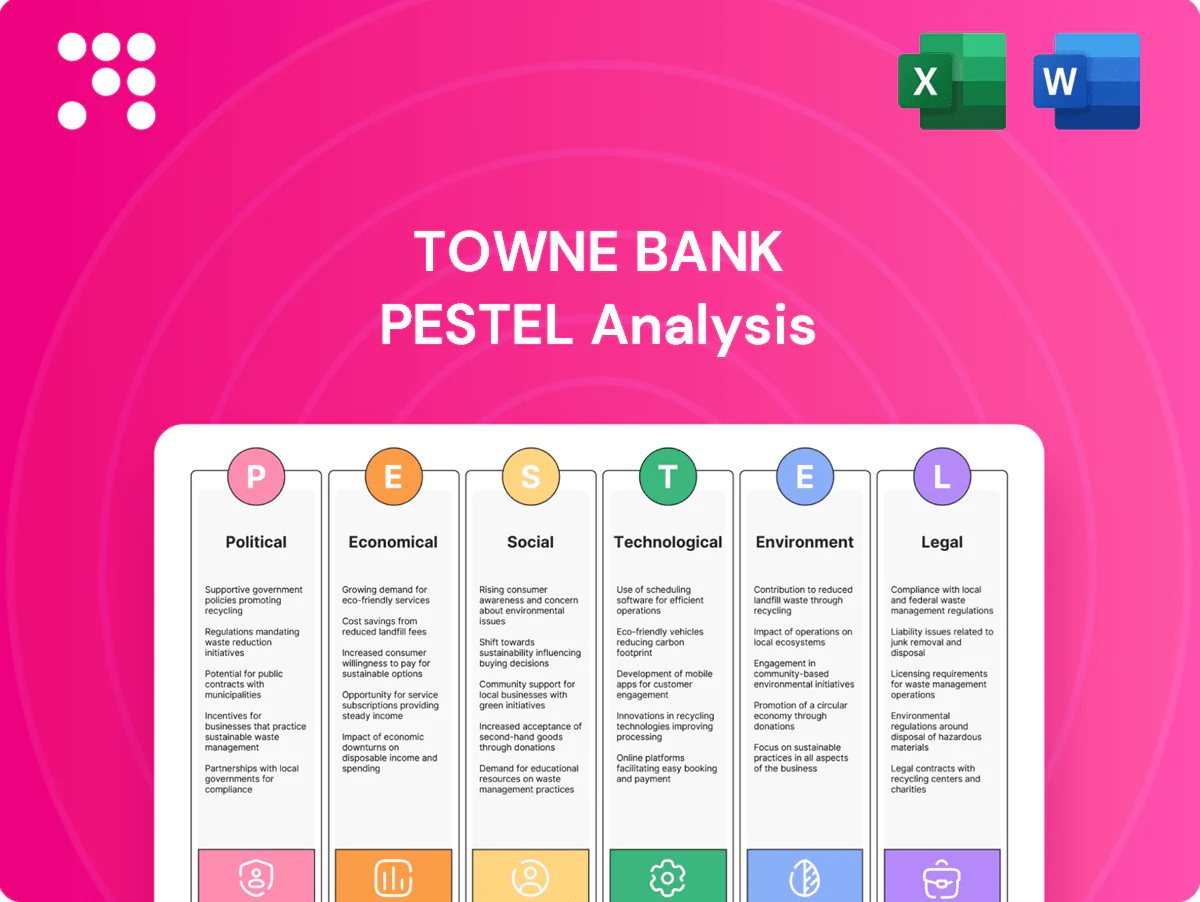
Towne Bank PESTLE Analysis

Skip the Research. Get the Strategy.
Discover how regulatory shifts, regional economic trends, and technological disruption are shaping Towne Bank’s strategic horizon in our focused PESTLE Analysis. This concise briefing highlights key risks and opportunities investors and strategists need now. Purchase the full report to access the complete, editable breakdown and actionable recommendations for immediate use.
Political factors

Regulatory posture of U.S. banking
Since the March 2023 regional-bank shocks regulators increased supervisory scrutiny, issuing interagency guidance on capital planning, liquidity management and resolution expectations that intensified through 2024; TowneBank must monitor these shifts for impacts on its balance-sheet strategy, dividends and growth pacing. Policy priorities change with administration and congressional oversight, driving closer engagement with the OCC, FDIC and Federal Reserve in the Mid-Atlantic footprint. Ongoing exams emphasize stronger liquidity buffers and clearer resolution playbooks.
State and local policy in the Mid-Atlantic
State and local incentives in the Mid-Atlantic—in Virginia (pop ~8.64M) and North Carolina (pop ~10.71M)—shape loan demand via tax credits and site-prep grants that attract firms and housing projects. Infrastructure and housing initiatives, including state transportation and affordable housing funds, boost commercial real estate and construction lending. Slow zoning and permitting delays defer project pipelines and shift credit timing. Maintaining ties with city councils and development authorities helps anticipate policy shifts and lending risk.

Small business and SBA programs
Federal and state support for SBA 7(a) (maximum loan 5,000,000, guaranty typically 85% under 150,000 and 75% over) and CDC/504 (typical 50/40/10 structure; CDC debenture cap ~5,500,000) directly shapes TowneBank’s small-business lending mix. Policy changes to guarantees, fees, or eligibility materially alter product economics and pricing. TowneBank should advocate streamlined processes to improve borrower access and bank efficiency. Monitor program expansions or constraints for directional volume impact.

Public procurement and anchor institutions
Track government procurement cycles and anchor institutions: Naval Station Norfolk (the world’s largest naval base) anchors Hampton Roads, and U.S. defense spending exceeded 800 billion dollars in 2024, driving predictable payrolls and contracts; regional hospital and education capital plans and Medicaid-driven operating budgets shape deposit flows and treasury needs. Align relationship banking to anticipated public-sector cash management and payment cycles to capture stable deposits and fees.
- Monitor defense contracts and base actions — major local employer
- Follow hospital/education capital budgets and Medicaid timing
- Anchor client funding stability = steady deposits + treasury demand
Housing and community development priorities
Towne Bank should monitor HUD data showing a 7.2 million shortage of affordable rental homes (HUD 2023), CRA modernization momentum after 2023 regulatory updates, and continued reliance on LIHTC (about 3 million units produced since 1986) and NMTC allocations to catalyze community investments. Aligning mortgage and community lending to exam expectations and partnering with CDFIs/nonprofits boosts impact and CRA ratings while embedding policy-driven projects into pipeline forecasting and risk review.
- Monitor HUD shortage: 7.2M affordable rental homes (2023)
- CRA modernization: post-2023 regulatory emphasis
- LIHTC impact: ~3M units since 1986
- Leverage NMTC and CDFI partnerships
- Embed policy projects in pipeline and risk reviews
Stricter supervision tightens capital, HUD 7.2M shortage and >800B defense support deposits
Heightened post‑Mar 2023 supervisory scrutiny requires stronger capital, liquidity and resolution planning that will constrain dividend/growth pacing. VA (8.64M) and NC (10.71M) incentives boost CRE and housing lending while zoning delays shift credit timing. SBA 7(a) cap 5,000,000 and HUD shortage 7.2M shape product demand; defense spend >800B (2024) supports stable deposits.
| Metric | Value |
|---|---|
| Defense spend (2024) | >800B |
| VA pop | 8.64M |
| NC pop | 10.71M |
| HUD shortage (2023) | 7.2M units |
What is included in the product
 Detailed Word Document
Explores how macro-environmental factors uniquely affect Towne Bank across Political, Economic, Social, Technological, Environmental, and Legal dimensions, with data-backed trends and forward-looking insights tailored to its regional market and regulatory landscape to aid executives, consultants, and investors.

 Customizable Excel Spreadsheet
Concise, visually segmented Towne Bank PESTLE summary that clarifies external risks and market drivers for quick inclusion in presentations or planning sessions, and is easily annotated for team-specific context or regional nuances.
Economic factors

Interest rates and yield curve
With the July 2025 federal funds target at 5.25–5.50% and a 2s–10s inversion near −70 bps, Towne must price for a Fed pause or modest cuts later in 2025 while monitoring NIM sensitivity—industry NIM moves roughly 1–3 bps per 10 bps rate change—and deposit betas of ~20–40% retail and ~10–20% commercial. Manage ALM by shortening asset duration and using pay-fixed hedges when curves steepen, and lengthen or offload risk under deep inversion. Stress-test earnings across +200/−100 bps and mixed funding mixes to quantify NII shocks and liquidity needs. Calibrate mortgage, CRE, and commercial loan pricing from scenario outputs and competitor spreads to preserve risk-adjusted margin.
Regional growth dynamics
Mid-Atlantic growth for Towne Bank is driven by port activity (Port of Virginia handled ~2.9M TEUs in 2023), defense/aerospace contracts around Hampton Roads, expanding healthcare employment and a growing tech/services cluster; these sectors support steady credit demand and deposit flows. Local unemployment near 3% and rising wages bolster consumer loans and deposits. Track migration and 10% y/y business formation pockets to site branches and digital hubs, and tailor lending, treasury and payroll products for professionals and small businesses.

Credit cycle and asset quality
Monitor CRE subsectors: office vacancy near 17% while multifamily ~6.5% and industrial ~4.8%, with cap rates rising toward 6.5% as of mid‑2025, and watch consumer credit stress—credit card delinquencies around 4.5% and auto loan delinquencies ~4.3%. Update CECL assumptions with macro GDP, unemployment and localized rent/vacancy data and raise reserves where forward stress appears. Tighten underwriting in areas with rising vacancy or cap‑rate pressure while balancing portfolio diversification against core relationship lending.

Housing affordability and construction
- price-to-income 5.8 (2024)
- median price $431,000
- inventory -22% vs 2019
- build costs +18% since 2020
- 30-yr avg 6.9% (2024)
- refi ~15% shares
- appraiser delays 7-10 days
Liquidity and competition
Towne Bank must track deposit competition from higher-yielding money markets and fintech sweep products while facing pricing pressure from larger banks; with the fed funds target near 5.25–5.50% in 2024–25, deposit costs have risen. Optimize funding via sticky core deposits, FHLB advances and selective brokered lines, expand treasury & cash‑management to deepen client ties, and preserve contingency liquidity for stress scenarios.
- Monitor money market yields vs savings
- Prioritize core deposit growth
- Maintain FHLB/brokered backstops
- Offer treasury services to increase stickiness
Stricter supervision tightens capital, HUD 7.2M shortage and >800B defense support deposits
Fed funds 5.25–5.50% (Jul 2025); NIM moves ~1–3 bps per 10 bps and deposit betas ~20–40% retail, ~10–20% commercial. Mid‑Atlantic drivers: Port of Virginia 2.9M TEUs (2023), unemployment ~3% supporting loan/deposit growth. Housing: P/I 5.8 (2024), median price $431,000, refi share ~15%; CRE office vac ~17%, multifamily ~6.5%, industrial ~4.8% (mid‑2025).
| Metric | Value |
|---|---|
| Fed funds | 5.25–5.50% (Jul 2025) |
| NIM sensitivity | 1–3 bps/10 bps |
| Deposit betas | Retail 20–40%, Commercial 10–20% |
| Unemployment | ~3% |
| Port TEUs | 2.9M (2023) |
| Median home | $431,000 (2024) |
| CRE vac. | Office 17%, MF 6.5%, Ind 4.8% (mid‑2025) |
Same Document Delivered
Towne Bank PESTLE Analysis
The Towne Bank PESTLE Analysis provides a concise, actionable review of political, economic, social, technological, legal, and environmental factors affecting the bank. The content and structure shown in the preview is the same document you’ll download after payment. Fully formatted and professionally organized, the file is ready to use immediately upon purchase.

Product Information
Product Information
Shipping & Returns
Shipping & Returns
Description
Skip the Research. Get the Strategy.
Discover how regulatory shifts, regional economic trends, and technological disruption are shaping Towne Bank’s strategic horizon in our focused PESTLE Analysis. This concise briefing highlights key risks and opportunities investors and strategists need now. Purchase the full report to access the complete, editable breakdown and actionable recommendations for immediate use.
Political factors
Regulatory posture of U.S. banking
Since the March 2023 regional-bank shocks regulators increased supervisory scrutiny, issuing interagency guidance on capital planning, liquidity management and resolution expectations that intensified through 2024; TowneBank must monitor these shifts for impacts on its balance-sheet strategy, dividends and growth pacing. Policy priorities change with administration and congressional oversight, driving closer engagement with the OCC, FDIC and Federal Reserve in the Mid-Atlantic footprint. Ongoing exams emphasize stronger liquidity buffers and clearer resolution playbooks.
State and local policy in the Mid-Atlantic
State and local incentives in the Mid-Atlantic—in Virginia (pop ~8.64M) and North Carolina (pop ~10.71M)—shape loan demand via tax credits and site-prep grants that attract firms and housing projects. Infrastructure and housing initiatives, including state transportation and affordable housing funds, boost commercial real estate and construction lending. Slow zoning and permitting delays defer project pipelines and shift credit timing. Maintaining ties with city councils and development authorities helps anticipate policy shifts and lending risk.
Small business and SBA programs
Federal and state support for SBA 7(a) (maximum loan 5,000,000, guaranty typically 85% under 150,000 and 75% over) and CDC/504 (typical 50/40/10 structure; CDC debenture cap ~5,500,000) directly shapes TowneBank’s small-business lending mix. Policy changes to guarantees, fees, or eligibility materially alter product economics and pricing. TowneBank should advocate streamlined processes to improve borrower access and bank efficiency. Monitor program expansions or constraints for directional volume impact.
Public procurement and anchor institutions
Track government procurement cycles and anchor institutions: Naval Station Norfolk (the world’s largest naval base) anchors Hampton Roads, and U.S. defense spending exceeded 800 billion dollars in 2024, driving predictable payrolls and contracts; regional hospital and education capital plans and Medicaid-driven operating budgets shape deposit flows and treasury needs. Align relationship banking to anticipated public-sector cash management and payment cycles to capture stable deposits and fees.
- Monitor defense contracts and base actions — major local employer
- Follow hospital/education capital budgets and Medicaid timing
- Anchor client funding stability = steady deposits + treasury demand
Housing and community development priorities
Towne Bank should monitor HUD data showing a 7.2 million shortage of affordable rental homes (HUD 2023), CRA modernization momentum after 2023 regulatory updates, and continued reliance on LIHTC (about 3 million units produced since 1986) and NMTC allocations to catalyze community investments. Aligning mortgage and community lending to exam expectations and partnering with CDFIs/nonprofits boosts impact and CRA ratings while embedding policy-driven projects into pipeline forecasting and risk review.
- Monitor HUD shortage: 7.2M affordable rental homes (2023)
- CRA modernization: post-2023 regulatory emphasis
- LIHTC impact: ~3M units since 1986
- Leverage NMTC and CDFI partnerships
- Embed policy projects in pipeline and risk reviews
Stricter supervision tightens capital, HUD 7.2M shortage and >800B defense support deposits
Heightened post‑Mar 2023 supervisory scrutiny requires stronger capital, liquidity and resolution planning that will constrain dividend/growth pacing. VA (8.64M) and NC (10.71M) incentives boost CRE and housing lending while zoning delays shift credit timing. SBA 7(a) cap 5,000,000 and HUD shortage 7.2M shape product demand; defense spend >800B (2024) supports stable deposits.
| Metric | Value |
|---|---|
| Defense spend (2024) | >800B |
| VA pop | 8.64M |
| NC pop | 10.71M |
| HUD shortage (2023) | 7.2M units |
What is included in the product
Detailed Word Document
Explores how macro-environmental factors uniquely affect Towne Bank across Political, Economic, Social, Technological, Environmental, and Legal dimensions, with data-backed trends and forward-looking insights tailored to its regional market and regulatory landscape to aid executives, consultants, and investors.
Customizable Excel Spreadsheet
Concise, visually segmented Towne Bank PESTLE summary that clarifies external risks and market drivers for quick inclusion in presentations or planning sessions, and is easily annotated for team-specific context or regional nuances.
Economic factors
Interest rates and yield curve
With the July 2025 federal funds target at 5.25–5.50% and a 2s–10s inversion near −70 bps, Towne must price for a Fed pause or modest cuts later in 2025 while monitoring NIM sensitivity—industry NIM moves roughly 1–3 bps per 10 bps rate change—and deposit betas of ~20–40% retail and ~10–20% commercial. Manage ALM by shortening asset duration and using pay-fixed hedges when curves steepen, and lengthen or offload risk under deep inversion. Stress-test earnings across +200/−100 bps and mixed funding mixes to quantify NII shocks and liquidity needs. Calibrate mortgage, CRE, and commercial loan pricing from scenario outputs and competitor spreads to preserve risk-adjusted margin.
Regional growth dynamics
Mid-Atlantic growth for Towne Bank is driven by port activity (Port of Virginia handled ~2.9M TEUs in 2023), defense/aerospace contracts around Hampton Roads, expanding healthcare employment and a growing tech/services cluster; these sectors support steady credit demand and deposit flows. Local unemployment near 3% and rising wages bolster consumer loans and deposits. Track migration and 10% y/y business formation pockets to site branches and digital hubs, and tailor lending, treasury and payroll products for professionals and small businesses.
Credit cycle and asset quality
Monitor CRE subsectors: office vacancy near 17% while multifamily ~6.5% and industrial ~4.8%, with cap rates rising toward 6.5% as of mid‑2025, and watch consumer credit stress—credit card delinquencies around 4.5% and auto loan delinquencies ~4.3%. Update CECL assumptions with macro GDP, unemployment and localized rent/vacancy data and raise reserves where forward stress appears. Tighten underwriting in areas with rising vacancy or cap‑rate pressure while balancing portfolio diversification against core relationship lending.
Housing affordability and construction
- price-to-income 5.8 (2024)
- median price $431,000
- inventory -22% vs 2019
- build costs +18% since 2020
- 30-yr avg 6.9% (2024)
- refi ~15% shares
- appraiser delays 7-10 days
Liquidity and competition
Towne Bank must track deposit competition from higher-yielding money markets and fintech sweep products while facing pricing pressure from larger banks; with the fed funds target near 5.25–5.50% in 2024–25, deposit costs have risen. Optimize funding via sticky core deposits, FHLB advances and selective brokered lines, expand treasury & cash‑management to deepen client ties, and preserve contingency liquidity for stress scenarios.
- Monitor money market yields vs savings
- Prioritize core deposit growth
- Maintain FHLB/brokered backstops
- Offer treasury services to increase stickiness
Stricter supervision tightens capital, HUD 7.2M shortage and >800B defense support deposits
Fed funds 5.25–5.50% (Jul 2025); NIM moves ~1–3 bps per 10 bps and deposit betas ~20–40% retail, ~10–20% commercial. Mid‑Atlantic drivers: Port of Virginia 2.9M TEUs (2023), unemployment ~3% supporting loan/deposit growth. Housing: P/I 5.8 (2024), median price $431,000, refi share ~15%; CRE office vac ~17%, multifamily ~6.5%, industrial ~4.8% (mid‑2025).
| Metric | Value |
|---|---|
| Fed funds | 5.25–5.50% (Jul 2025) |
| NIM sensitivity | 1–3 bps/10 bps |
| Deposit betas | Retail 20–40%, Commercial 10–20% |
| Unemployment | ~3% |
| Port TEUs | 2.9M (2023) |
| Median home | $431,000 (2024) |
| CRE vac. | Office 17%, MF 6.5%, Ind 4.8% (mid‑2025) |
Same Document Delivered
Towne Bank PESTLE Analysis
The Towne Bank PESTLE Analysis provides a concise, actionable review of political, economic, social, technological, legal, and environmental factors affecting the bank. The content and structure shown in the preview is the same document you’ll download after payment. Fully formatted and professionally organized, the file is ready to use immediately upon purchase.