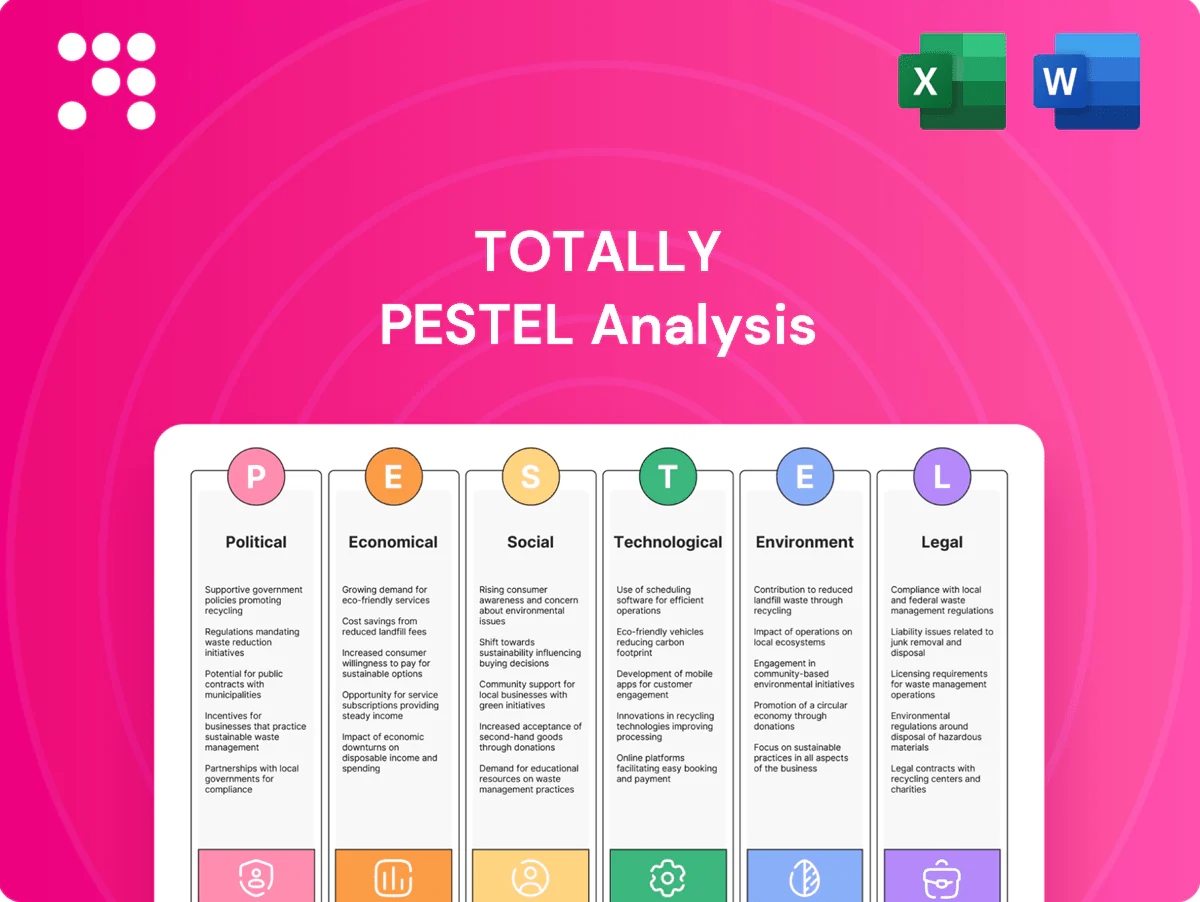
Totally PESTLE Analysis

Skip the Research. Get the Strategy.
Get a strategic advantage with our PESTLE Analysis of Totally — concise, actionable insights into political, economic, social, technological, legal, and environmental forces shaping its future. Ideal for investors, consultants, and planners, this report reveals risks and growth levers you can act on. Purchase the full analysis to download the complete, editable report and make smarter decisions fast.
Political factors

NHS commissioning and funding priorities
UK health policy and NHS England commissioning decisions determine contract volumes and pricing for urgent and elective care, with the elective waiting list around 7.6 million in 2024. The 42 integrated care systems formed nationwide can consolidate procurement and favour incumbent partners. Government focus on cutting waits drives outsourcing demand; the independent sector provides roughly 8–10% of elective activity. Policy shifts after elections can reset targets and budgets.
Public-private partnership sentiment
Political appetite for using independent providers in public pathways fluctuates; global PPP infrastructure investment reached about $121 billion in 2023 (World Bank PPP Database), and positive sentiment enabled contract renewals and clinic expansions in 2024, often tied to multi-year deals worth millions. Rising criticism of privatization can tighten access and invite parliamentary probes, so active reputation management with policymakers is essential to protect contracts and margins.

Devolved health governance in UK nations
Devolved health governance drives divergent service models across nations serving populations of c.56.5m (England), 5.5m (Scotland), 3.2m (Wales) and 1.9m (Northern Ireland), forcing bidders to adapt to different urgent-care pathways and funding rules; cross-border operational consistency is limited, so tailored stakeholder engagement per nation is essential.

Republic of Ireland health reforms
Republic of Ireland health reforms drive outsourcing as Sláintecare 10-year rollout and national targets to cut waiting lists (over 700,000 on HSE lists in 2024) force capacity shifts; HSE procurement cycles and an annual budget of about €24bn (2024) set demand for elective and specialist services; euro/GBP and cross-jurisdiction compliance add regulatory and FX complexity, while local partnerships improve tender success.
- Waiting lists: >700,000 (2024)
- HSE budget: ≈€24bn (2024)
- Currency: EUR vs GBP; cross-border compliance crucial
- Local partnerships boost tender competitiveness
Workforce planning and immigration policy
Government stances on healthcare visas, training places and retention schemes directly shape clinician supply: AAMC projects US physician shortfalls of 54,100 to 139,000 by 2033, so tightened immigration rules or frozen training places worsen shortages; public sector pay deals drive contractor wage expectations, while policy stability enables long-term rostering and service continuity.
- Visa policy: impacts foreign clinician inflow
- Training places: cap limits pipeline
- Pay deals: set market rates for contractors
- Stability: enables multi-year rostering
Policy shifts drive contracting: wait ≈ 7.6m, private share 8–10%
Political decisions on NHS commissioning, ICS procurement and post-election policy resets determine contract volumes and pricing; elective waiting list ~7.6m (2024) and independent sector delivers ~8–10% of activity. Devolved governance (England 56.5m, Scotland 5.5m, Wales 3.2m, N.I. 1.9m) forces tailored bids; ROI reforms (Sláintecare) and HSE budget ≈€24bn (2024) expand outsourcing. Visa, training caps and public pay deals drive clinician supply and contractor wage inflation.
| Metric | 2023/24 value |
|---|---|
| UK elective waiting list | ≈7.6m (2024) |
| Independent sector share | 8–10% |
| ICS formed | 42 |
| ROI HSE waiting list | >700,000 (2024) |
| HSE budget | ≈€24bn (2024) |
| Global PPP investment | $121bn (2023) |
What is included in the product
 Detailed Word Document
Explores how macro-environmental forces uniquely affect Totally across Political, Economic, Social, Technological, Environmental and Legal dimensions, with data-backed subpoints, forward-looking insights and region/industry relevance to support executives, investors and entrepreneurs in risk identification, scenario planning and funding-ready strategy design.

 Customizable Excel Spreadsheet
Totally PESTLE condenses complex external-factor research into a clean, visually segmented summary that’s instantly shareable for meetings and strategy decks; editable notes and plain language let teams tailor it by region or business line to speed alignment and risk discussions.
Economic factors

Public spending and fiscal pressures
UK and Irish budget positions directly shape allocations for outsourced health services: NHS England was allocated about £190bn in 2024/25 while Ireland's health vote was roughly €24.4bn in 2024, constraining provider margins. Austerity or deficit-control targets (UK public borrowing running in the tens of billions) can cap contract uplifts. Inflation-linked settlements (CPI ~4% in 2024) often lag cost inflation, though a 5–7% winter rise in urgent-care demand can partially offset pressures.
Inflation, wage growth, and input costs
Healthcare labor typically comprises 50–60% of provider operating costs and is highly sensitive to wage inflation, which ran near 4–5% in many advanced economies in 2024. Energy, estates and consumables add margin volatility; 2022–23 energy shocks showed indexation clauses often lag and fail to cover spikes. Productivity gains of roughly 1–3% annually are required to preserve profitability.

Elective backlog and demand elasticity
Large elective backlogs—about 7.0 million on England's waiting list in 2024—sustain demand for added diagnostic and procedural capacity; demand is relatively inelastic, supporting stable utilization despite price pressures. Funding bottlenecks and limited theatre time continue to delay throughput, while efficient scheduling and clinical triage (reducing idle time and no-shows) are essential to maximize revenue capture.

Currency and cross-border operations
- FX movement: GBP/EUR ~7% range 2024–25
- Hedging cost: 0.5–1.0% p.a.
- Inflation mid‑2025: UK 3.6% | Eurozone 2.4%
- Treasury centralization: ~50% FX volatility reduction
M&A and consolidation in healthcare services
Policy shifts drive contracting: wait ≈ 7.6m, private share 8–10%
Public budgets constrain margins: NHS £190bn (2024/25) and Ireland €24.4bn (2024) limit uplifts while CPI UK ~3.6% vs EZ 2.4% (mid‑2025) pressures costs. Labour (50–60% costs) and energy volatility compress margins; 7.0m England waits (2024) sustain demand. FX GBP/EUR ~7% (2024–25) and fed funds 5.25–5.50% raise funding costs and M&A at ~12x EV/EBITDA.
| Metric | Value |
|---|---|
| NHS budget 24/25 | £190bn |
| Ireland health 2024 | €24.4bn |
| Waiting list (Eng) | 7.0m |
| GBP/EUR range | ~7% |
| Fed funds | 5.25–5.50% |
| M&A | ~12x EV/EBITDA |
Same Document Delivered
Totally PESTLE Analysis
The preview shown here is the exact Totally PESTLE Analysis document you’ll receive after purchase—fully formatted, professionally structured, and ready to use. No placeholders or surprises; download the identical file immediately after payment.

Original: $10.00
-65%$10.00
$3.50Product Information
Product Information
Shipping & Returns
Shipping & Returns
Description
Skip the Research. Get the Strategy.
Get a strategic advantage with our PESTLE Analysis of Totally — concise, actionable insights into political, economic, social, technological, legal, and environmental forces shaping its future. Ideal for investors, consultants, and planners, this report reveals risks and growth levers you can act on. Purchase the full analysis to download the complete, editable report and make smarter decisions fast.
Political factors
NHS commissioning and funding priorities
UK health policy and NHS England commissioning decisions determine contract volumes and pricing for urgent and elective care, with the elective waiting list around 7.6 million in 2024. The 42 integrated care systems formed nationwide can consolidate procurement and favour incumbent partners. Government focus on cutting waits drives outsourcing demand; the independent sector provides roughly 8–10% of elective activity. Policy shifts after elections can reset targets and budgets.
Public-private partnership sentiment
Political appetite for using independent providers in public pathways fluctuates; global PPP infrastructure investment reached about $121 billion in 2023 (World Bank PPP Database), and positive sentiment enabled contract renewals and clinic expansions in 2024, often tied to multi-year deals worth millions. Rising criticism of privatization can tighten access and invite parliamentary probes, so active reputation management with policymakers is essential to protect contracts and margins.
Devolved health governance in UK nations
Devolved health governance drives divergent service models across nations serving populations of c.56.5m (England), 5.5m (Scotland), 3.2m (Wales) and 1.9m (Northern Ireland), forcing bidders to adapt to different urgent-care pathways and funding rules; cross-border operational consistency is limited, so tailored stakeholder engagement per nation is essential.
Republic of Ireland health reforms
Republic of Ireland health reforms drive outsourcing as Sláintecare 10-year rollout and national targets to cut waiting lists (over 700,000 on HSE lists in 2024) force capacity shifts; HSE procurement cycles and an annual budget of about €24bn (2024) set demand for elective and specialist services; euro/GBP and cross-jurisdiction compliance add regulatory and FX complexity, while local partnerships improve tender success.
- Waiting lists: >700,000 (2024)
- HSE budget: ≈€24bn (2024)
- Currency: EUR vs GBP; cross-border compliance crucial
- Local partnerships boost tender competitiveness
Workforce planning and immigration policy
Government stances on healthcare visas, training places and retention schemes directly shape clinician supply: AAMC projects US physician shortfalls of 54,100 to 139,000 by 2033, so tightened immigration rules or frozen training places worsen shortages; public sector pay deals drive contractor wage expectations, while policy stability enables long-term rostering and service continuity.
- Visa policy: impacts foreign clinician inflow
- Training places: cap limits pipeline
- Pay deals: set market rates for contractors
- Stability: enables multi-year rostering
Policy shifts drive contracting: wait ≈ 7.6m, private share 8–10%
Political decisions on NHS commissioning, ICS procurement and post-election policy resets determine contract volumes and pricing; elective waiting list ~7.6m (2024) and independent sector delivers ~8–10% of activity. Devolved governance (England 56.5m, Scotland 5.5m, Wales 3.2m, N.I. 1.9m) forces tailored bids; ROI reforms (Sláintecare) and HSE budget ≈€24bn (2024) expand outsourcing. Visa, training caps and public pay deals drive clinician supply and contractor wage inflation.
| Metric | 2023/24 value |
|---|---|
| UK elective waiting list | ≈7.6m (2024) |
| Independent sector share | 8–10% |
| ICS formed | 42 |
| ROI HSE waiting list | >700,000 (2024) |
| HSE budget | ≈€24bn (2024) |
| Global PPP investment | $121bn (2023) |
What is included in the product
Detailed Word Document
Explores how macro-environmental forces uniquely affect Totally across Political, Economic, Social, Technological, Environmental and Legal dimensions, with data-backed subpoints, forward-looking insights and region/industry relevance to support executives, investors and entrepreneurs in risk identification, scenario planning and funding-ready strategy design.
Customizable Excel Spreadsheet
Totally PESTLE condenses complex external-factor research into a clean, visually segmented summary that’s instantly shareable for meetings and strategy decks; editable notes and plain language let teams tailor it by region or business line to speed alignment and risk discussions.
Economic factors
Public spending and fiscal pressures
UK and Irish budget positions directly shape allocations for outsourced health services: NHS England was allocated about £190bn in 2024/25 while Ireland's health vote was roughly €24.4bn in 2024, constraining provider margins. Austerity or deficit-control targets (UK public borrowing running in the tens of billions) can cap contract uplifts. Inflation-linked settlements (CPI ~4% in 2024) often lag cost inflation, though a 5–7% winter rise in urgent-care demand can partially offset pressures.
Inflation, wage growth, and input costs
Healthcare labor typically comprises 50–60% of provider operating costs and is highly sensitive to wage inflation, which ran near 4–5% in many advanced economies in 2024. Energy, estates and consumables add margin volatility; 2022–23 energy shocks showed indexation clauses often lag and fail to cover spikes. Productivity gains of roughly 1–3% annually are required to preserve profitability.
Elective backlog and demand elasticity
Large elective backlogs—about 7.0 million on England's waiting list in 2024—sustain demand for added diagnostic and procedural capacity; demand is relatively inelastic, supporting stable utilization despite price pressures. Funding bottlenecks and limited theatre time continue to delay throughput, while efficient scheduling and clinical triage (reducing idle time and no-shows) are essential to maximize revenue capture.
Currency and cross-border operations
- FX movement: GBP/EUR ~7% range 2024–25
- Hedging cost: 0.5–1.0% p.a.
- Inflation mid‑2025: UK 3.6% | Eurozone 2.4%
- Treasury centralization: ~50% FX volatility reduction
M&A and consolidation in healthcare services
Policy shifts drive contracting: wait ≈ 7.6m, private share 8–10%
Public budgets constrain margins: NHS £190bn (2024/25) and Ireland €24.4bn (2024) limit uplifts while CPI UK ~3.6% vs EZ 2.4% (mid‑2025) pressures costs. Labour (50–60% costs) and energy volatility compress margins; 7.0m England waits (2024) sustain demand. FX GBP/EUR ~7% (2024–25) and fed funds 5.25–5.50% raise funding costs and M&A at ~12x EV/EBITDA.
| Metric | Value |
|---|---|
| NHS budget 24/25 | £190bn |
| Ireland health 2024 | €24.4bn |
| Waiting list (Eng) | 7.0m |
| GBP/EUR range | ~7% |
| Fed funds | 5.25–5.50% |
| M&A | ~12x EV/EBITDA |
Same Document Delivered
Totally PESTLE Analysis
The preview shown here is the exact Totally PESTLE Analysis document you’ll receive after purchase—fully formatted, professionally structured, and ready to use. No placeholders or surprises; download the identical file immediately after payment.