Toho Bank SWOT Analysis

Your Strategic Toolkit Starts Here
Toho Bank’s SWOT highlights solid regional market strength, conservative risk controls, and digital catch-up challenges amid demographic headwinds. Our full SWOT unpacks competitive threats, regulatory exposures, and growth levers with financial context and strategic recommendations. Want actionable insights for investors or planners? Purchase the complete, editable SWOT (Word + Excel) to plan with confidence.
Strengths

Deep regional footprint
Deep regional footprint: Toho Bank’s strong presence across Fukushima and neighboring prefectures—supported by roughly 130 branches—builds proximity-based trust and high customer loyalty in communities with aging populations and local industry ties. Local market knowledge enables tailored underwriting and faster decision cycles, lowering default risk and accelerating loan approvals. Branch and relationship networks deliver sticky deposits and stable funding, differentiating Toho from national players.
Comprehensive product suite
Toho Bank offers deposits, consumer and SME loans, and investment products under one roof, enabling customers to meet most financial needs without leaving the bank. Cross-product bundling increases share of wallet and lowers churn by deepening customer relationships. Diversified product mix shifts revenue sources beyond interest income, stabilizing margins in volatile rate environments.

Trusted community brand
Toho Bank's trusted community brand, reinforced by active local engagement, positions it as a partner in regional development and strengthens relationships with households and SMEs. Its long operating history underpins credibility, lowering customer acquisition costs and boosting referral-driven growth. High brand goodwill enhances deposit stability and lends resilience during economic downturns.

Strong SME relationships
Strong SME relationships drive repeat lending and fee income, with Toho Bank leveraging relationship managers to structure tailored loans and advisory; Japan’s SMEs represent 99.7% of firms and employ about 69.7% of workers (METI 2022), underscoring the market scale. Close local supply-chain insight improves credit monitoring and creates relationship moats that are difficult for newcomers to replicate.
- Repeat lending + fees: deep regional client base
- Customized solutions: RM-led advisory
- Credit monitoring: local supply-chain insight
- High entry barrier: relationship moat vs newcomers
Stable deposit base
Local retail and SME deposits form a stable, low-cost core funding source for Toho Bank, with regional retail/SME balances comprising over 70% of total deposits, lowering dependence on wholesale markets and reducing liquidity risk. This predictable funding base supports steady loan book expansion and cushions net interest income against short-term rate swings.
- Low-cost core funding: retail/SME >70%
- Reduced liquidity risk: limited wholesale reliance
- Enables steady loan growth and NII stability
Regional strength: ~130 branches, retail/SME deposits >70%
Deep regional footprint: ~130 branches across Fukushima and neighbors foster trust, fast underwriting and customer loyalty.
Diversified product suite (deposits, consumer/SME loans, investments) increases share of wallet and stabilizes fee income.
Stable funding: retail/SME deposits >70% of base; strong SME relationships (SMEs 99.7% of firms; METI 2022) lower liquidity and credit risks.
| Metric | Value |
|---|---|
| Branches | ~130 |
| Retail/SME deposits | >70% |
What is included in the product
 Detailed Word Document
Provides a concise strategic overview of Toho Bank’s internal strengths and weaknesses and external opportunities and threats, mapping competitive position, growth drivers, operational gaps, and market risks to inform strategic decision-making.

 Customizable Excel Spreadsheet
Provides a concise, visual SWOT matrix tailored to Toho Bank for rapid strategic alignment and stakeholder briefings; editable format enables quick updates as priorities or market conditions change.
Weaknesses

Geographic concentration
Toho Bank’s heavy concentration in Fukushima and neighboring prefectures concentrates economic and disaster risk, with most corporate and retail lending tied to the local economy. Local downturns and demographic decline directly pressure credit quality and loan growth. Limited out-of-area diversification reduces the bank’s ability to absorb regional shocks and can amplify earnings volatility. This geographic focus heightens exposure to single-event disasters and cyclical local weakness.
Scale constraints
As a regional bank Toho Bank lacks the scale of megabanks, which in 2024 held roughly ¥200–400 trillion each, making it harder to spread tech and compliance costs. Its smaller balance sheet—typical regional banks often sit below ¥5 trillion in assets—limits large-ticket lending and syndication capacity. Vendor pricing power may be weaker, which can compress efficiency ratios and lift cost-to-income above national peers.

Margin pressure in Japan
Japan’s ultra-low-rate legacy keeps net interest margins compressed—regional banks reported average NIMs near 0.6% in FY2024, limiting Toho Bank’s core lending profitability. Intense competition for high-quality borrowers forces loan pricing down, pushing the bank to rely on higher volumes and non-interest income. Fee growth outside its core prefectures has lagged, making regional expansion costly. Sensitivity to rate moves is asymmetric: small rate rises lift funding costs and margins only slowly.

Aging customer demographics
Regional aging (Japan 65+ 29.1% in 2023) compresses loan demand and raises deposit runoff risk as retirees draw down savings; wealth decumulation shifts Toho Bank toward low-fee, low-yield products, squeezing margins. SME succession gaps elevate credit risk and complicate five- to ten-year strategic planning and growth forecasting.
- Lower loan growth
- Deposit runoff risk
- Shift to low-margin products
- Higher SME credit/succession risk
Legacy IT and modernization gap
Legacy core systems and a modernization gap force Toho Bank to divert scarce budget and IT talent to upgrades, slowing product launches and eroding digital CX versus fintechs and megabanks. Complex integrations heighten operational risk and compliance overhead, while delays in rollout can forfeit SME and retail growth opportunities in fast-moving digital channels.
- Budget pressure
- Slower innovation
- Integration risk
- Missed growth
Fukushima risk hits sub-¥5T banks; 29.1% ageing curbs loans
Heavy regional concentration in Fukushima raises disaster and recession exposure; regional banks under ¥5 trillion face limited syndication capacity. FY2024 regional NIMs ~0.6% compress core earnings while Japan 65+ was 29.1% in 2023, reducing loan demand and raising deposit runoff risk. Legacy systems inflate IT spend and delay digital product rollout, squeezing margins and market share.
| Metric | Value |
|---|---|
| Regional bank assets | typically <¥5 trillion |
| FY2024 avg NIM | ~0.6% |
| Japan 65+ (2023) | 29.1% |
What You See Is What You Get
Toho Bank SWOT Analysis
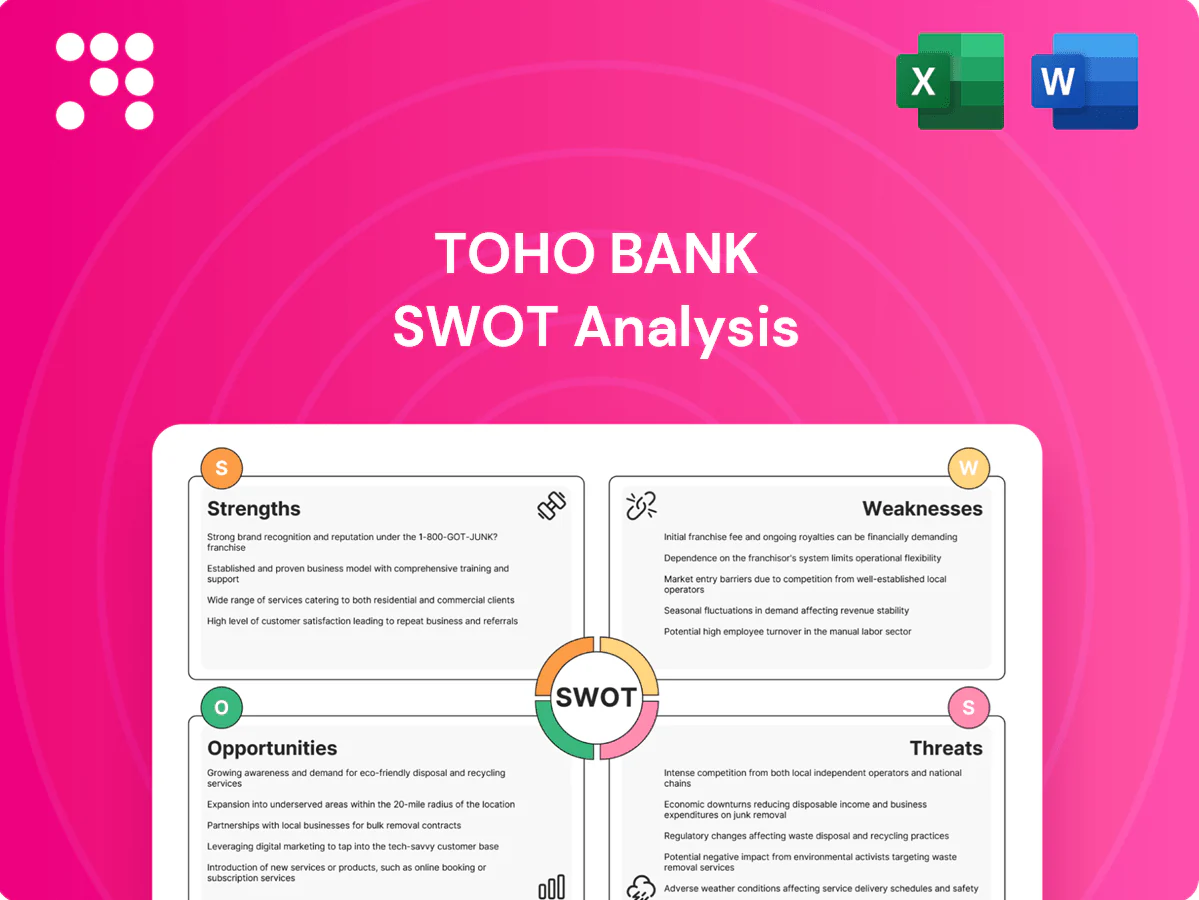
This is the actual SWOT analysis document you’ll receive upon purchase—no surprises, just professional quality. The preview below is taken directly from the full SWOT report you'll get; purchase unlocks the entire in-depth version. The file shown is the real, editable analysis you'll download after checkout.

Original: $10.00
-65%$10.00
$3.50Product Information
Product Information
Shipping & Returns
Shipping & Returns
Description
Your Strategic Toolkit Starts Here
Toho Bank’s SWOT highlights solid regional market strength, conservative risk controls, and digital catch-up challenges amid demographic headwinds. Our full SWOT unpacks competitive threats, regulatory exposures, and growth levers with financial context and strategic recommendations. Want actionable insights for investors or planners? Purchase the complete, editable SWOT (Word + Excel) to plan with confidence.
Strengths
Deep regional footprint
Deep regional footprint: Toho Bank’s strong presence across Fukushima and neighboring prefectures—supported by roughly 130 branches—builds proximity-based trust and high customer loyalty in communities with aging populations and local industry ties. Local market knowledge enables tailored underwriting and faster decision cycles, lowering default risk and accelerating loan approvals. Branch and relationship networks deliver sticky deposits and stable funding, differentiating Toho from national players.
Comprehensive product suite
Toho Bank offers deposits, consumer and SME loans, and investment products under one roof, enabling customers to meet most financial needs without leaving the bank. Cross-product bundling increases share of wallet and lowers churn by deepening customer relationships. Diversified product mix shifts revenue sources beyond interest income, stabilizing margins in volatile rate environments.
Trusted community brand
Toho Bank's trusted community brand, reinforced by active local engagement, positions it as a partner in regional development and strengthens relationships with households and SMEs. Its long operating history underpins credibility, lowering customer acquisition costs and boosting referral-driven growth. High brand goodwill enhances deposit stability and lends resilience during economic downturns.
Strong SME relationships
Strong SME relationships drive repeat lending and fee income, with Toho Bank leveraging relationship managers to structure tailored loans and advisory; Japan’s SMEs represent 99.7% of firms and employ about 69.7% of workers (METI 2022), underscoring the market scale. Close local supply-chain insight improves credit monitoring and creates relationship moats that are difficult for newcomers to replicate.
- Repeat lending + fees: deep regional client base
- Customized solutions: RM-led advisory
- Credit monitoring: local supply-chain insight
- High entry barrier: relationship moat vs newcomers
Stable deposit base
Local retail and SME deposits form a stable, low-cost core funding source for Toho Bank, with regional retail/SME balances comprising over 70% of total deposits, lowering dependence on wholesale markets and reducing liquidity risk. This predictable funding base supports steady loan book expansion and cushions net interest income against short-term rate swings.
- Low-cost core funding: retail/SME >70%
- Reduced liquidity risk: limited wholesale reliance
- Enables steady loan growth and NII stability
Regional strength: ~130 branches, retail/SME deposits >70%
Deep regional footprint: ~130 branches across Fukushima and neighbors foster trust, fast underwriting and customer loyalty.
Diversified product suite (deposits, consumer/SME loans, investments) increases share of wallet and stabilizes fee income.
Stable funding: retail/SME deposits >70% of base; strong SME relationships (SMEs 99.7% of firms; METI 2022) lower liquidity and credit risks.
| Metric | Value |
|---|---|
| Branches | ~130 |
| Retail/SME deposits | >70% |
What is included in the product
Detailed Word Document
Provides a concise strategic overview of Toho Bank’s internal strengths and weaknesses and external opportunities and threats, mapping competitive position, growth drivers, operational gaps, and market risks to inform strategic decision-making.
Customizable Excel Spreadsheet
Provides a concise, visual SWOT matrix tailored to Toho Bank for rapid strategic alignment and stakeholder briefings; editable format enables quick updates as priorities or market conditions change.
Weaknesses
Geographic concentration
Toho Bank’s heavy concentration in Fukushima and neighboring prefectures concentrates economic and disaster risk, with most corporate and retail lending tied to the local economy. Local downturns and demographic decline directly pressure credit quality and loan growth. Limited out-of-area diversification reduces the bank’s ability to absorb regional shocks and can amplify earnings volatility. This geographic focus heightens exposure to single-event disasters and cyclical local weakness.
Scale constraints
As a regional bank Toho Bank lacks the scale of megabanks, which in 2024 held roughly ¥200–400 trillion each, making it harder to spread tech and compliance costs. Its smaller balance sheet—typical regional banks often sit below ¥5 trillion in assets—limits large-ticket lending and syndication capacity. Vendor pricing power may be weaker, which can compress efficiency ratios and lift cost-to-income above national peers.
Margin pressure in Japan
Japan’s ultra-low-rate legacy keeps net interest margins compressed—regional banks reported average NIMs near 0.6% in FY2024, limiting Toho Bank’s core lending profitability. Intense competition for high-quality borrowers forces loan pricing down, pushing the bank to rely on higher volumes and non-interest income. Fee growth outside its core prefectures has lagged, making regional expansion costly. Sensitivity to rate moves is asymmetric: small rate rises lift funding costs and margins only slowly.
Aging customer demographics
Regional aging (Japan 65+ 29.1% in 2023) compresses loan demand and raises deposit runoff risk as retirees draw down savings; wealth decumulation shifts Toho Bank toward low-fee, low-yield products, squeezing margins. SME succession gaps elevate credit risk and complicate five- to ten-year strategic planning and growth forecasting.
- Lower loan growth
- Deposit runoff risk
- Shift to low-margin products
- Higher SME credit/succession risk
Legacy IT and modernization gap
Legacy core systems and a modernization gap force Toho Bank to divert scarce budget and IT talent to upgrades, slowing product launches and eroding digital CX versus fintechs and megabanks. Complex integrations heighten operational risk and compliance overhead, while delays in rollout can forfeit SME and retail growth opportunities in fast-moving digital channels.
- Budget pressure
- Slower innovation
- Integration risk
- Missed growth
Fukushima risk hits sub-¥5T banks; 29.1% ageing curbs loans
Heavy regional concentration in Fukushima raises disaster and recession exposure; regional banks under ¥5 trillion face limited syndication capacity. FY2024 regional NIMs ~0.6% compress core earnings while Japan 65+ was 29.1% in 2023, reducing loan demand and raising deposit runoff risk. Legacy systems inflate IT spend and delay digital product rollout, squeezing margins and market share.
| Metric | Value |
|---|---|
| Regional bank assets | typically <¥5 trillion |
| FY2024 avg NIM | ~0.6% |
| Japan 65+ (2023) | 29.1% |
What You See Is What You Get
Toho Bank SWOT Analysis
This is the actual SWOT analysis document you’ll receive upon purchase—no surprises, just professional quality. The preview below is taken directly from the full SWOT report you'll get; purchase unlocks the entire in-depth version. The file shown is the real, editable analysis you'll download after checkout.