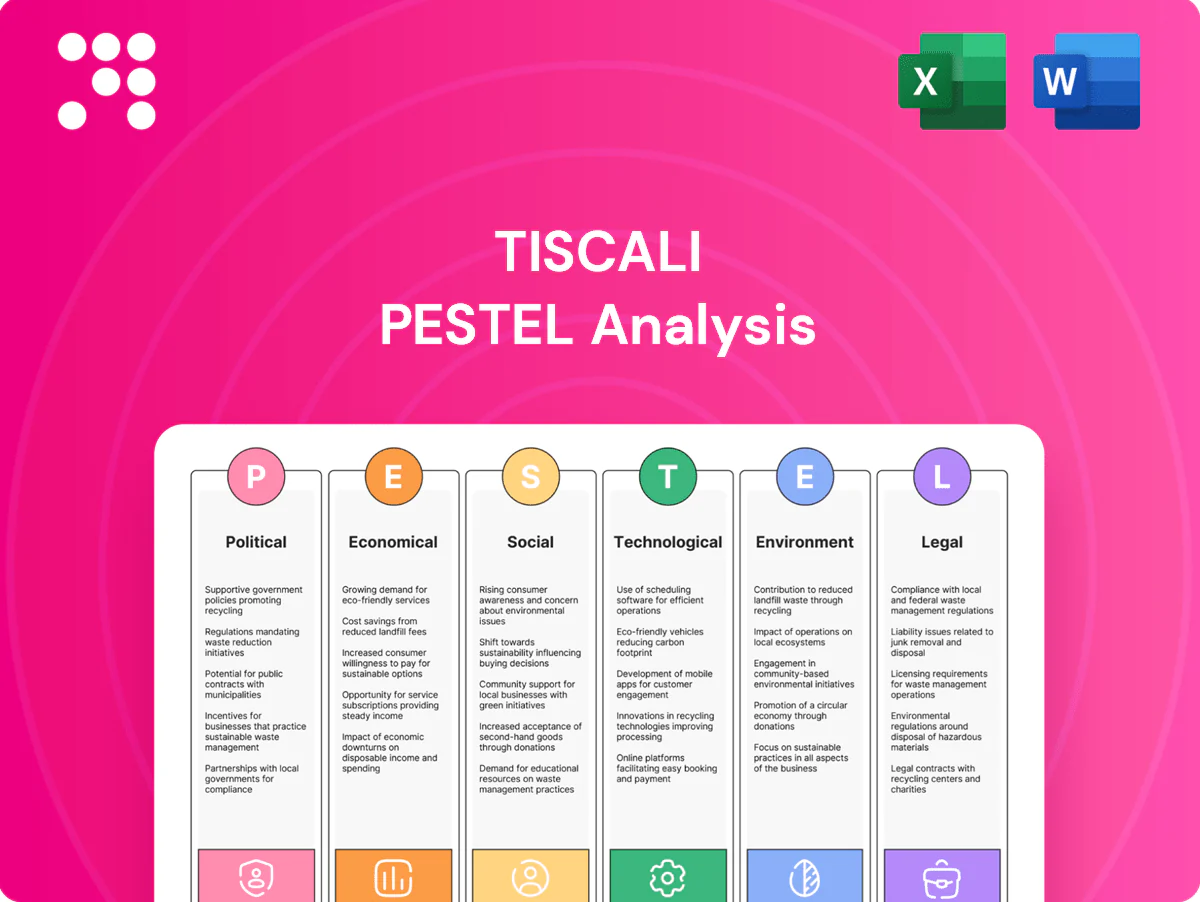
Tiscali PESTLE Analysis

Make Smarter Strategic Decisions with a Complete PESTEL View
Unlock how political, economic, social, technological, legal, and environmental forces are reshaping Tiscali’s strategy and market position; our PESTLE highlights regulatory risks, broadband demand trends, and digital disruption. Ideal for investors, consultants, and strategists seeking concise, actionable intelligence. Purchase the full PESTLE to get the complete, ready-to-use analysis and strategic recommendations instantly.
Political factors

National broadband and digitalization agendas
Italy's government prioritizes nationwide ultrabroadband rollout tied to EU 2025 Gigabit Society targets, with Italy receiving about 191.5 billion euros from the EU Recovery and Resilience Facility that funds infrastructure projects. Programs tied to RRF can subsidize fiber in underserved areas, favoring operators with competitive proposals and unlocking public tenders and partnerships. Misalignment risks exclusion from subsidies and slower market access.
EU telecommunications policy direction
Brussels shapes competition, spectrum (notably 3.4–3.8 GHz) and infrastructure-sharing rules that cascade into Italy, affecting operators like Tiscali. EU pushes network co-investment and occasional consolidation-friendly signals, shifting market structure and pricing power. The Digital Decade sets gigabit-for-all households and 5G-for-all populated areas by 2030, raising capex and performance thresholds. Policy unpredictability complicates multi-year planning.

Spectrum allocation and 5G policy
Government-led spectrum auctions, such as Italy’s 2018 sale that raised €6.55bn for mid‑band 3.6 GHz licenses, set upfront costs and usage obligations that directly shape mobile economics for operators like Tiscali. Coverage mandates and renewal terms drive timing and capex for fixed–wireless access and bundled mobile offers; onerous fees compress EBITDA margins while favorable terms reduce financial strain. Policy enabling private networks and shared spectrum use expands addressable enterprise and industrial segments.

Public–private infrastructure models
Political support for open-access fiber and rural coverage shapes Tiscali's wholesale costs and reach; EU Digital Decade targets and Italy's NextGenerationEU PNRR allocated about €6.7bn to broadband create funding windows for expansion. State decisions on state-backed vehicles and municipal fiber projects steer ISP partnerships and market entry routes, while politicization can delay builds and raise risk premiums. Neutral-host access and transparent governance lower deployment barriers and speed roll-out.
- Policy: EU Digital Decade & Italy PNRR €6.7bn
- Partnerships: state/municipal projects determine ISP routes
- Risk: transparent governance reduces delays
- Market speed: neutral-host access accelerates expansion
Geopolitical supply chain exposure
EU–China tech tensions push Tiscali toward vetted vendors and away from high‑risk suppliers, while NIS2 (adopted 2023, transposition deadline Oct 2024) raises mandatory security certification and incident reporting for telecom operators.
Diversifying suppliers is politically favored but can increase capex/OPEX and extend procurement lead times and risk during geopolitical shocks.
- vendor-selection: NIS2 (2023) tightens certification
- cost-impact: supplier diversification raises procurement costs
- risk: longer lead times and higher supply disruption exposure
EU and Italy funding, spectrum rules and NIS2 push fiber rollout and stricter telco security
Italy/EU funding (RRF ~€191.5bn; Italy PNRR broadband €6.7bn) channels subsidies to fiber projects, favoring bidders with compliant proposals and unlocking public tenders. EU rules (3.4–3.8 GHz spectrum, Digital Decade targets 2030) and Italy's 2018 auction (€6.55bn) raise capex and coverage obligations. NIS2 (adopted 2023, transposition Oct 2024) requires tighter security and reporting for telcos.
| Item | Value/Impact |
|---|---|
| RRF (EU) | €191.5bn |
| Italy PNRR broadband | €6.7bn |
| 2018 spectrum auction | €6.55bn |
| NIS2 | Adopted 2023; transpos. Oct 2024 |
What is included in the product
 Detailed Word Document
Explores how macro-environmental factors uniquely affect Tiscali across Political, Economic, Social, Technological, Environmental and Legal dimensions, with data-backed trends, forward-looking insights and actionable implications to help executives and investors spot risks, opportunities and inform strategy.

 Customizable Excel Spreadsheet
A concise, visually segmented PESTLE summary of Tiscali that can be dropped into presentations, edited for local context, and easily shared across teams to streamline external risk discussions and strategic planning.
Economic factors

Macroeconomic growth and consumer spending
Italy's modest GDP recovery (approx +0.6% in 2024, ~+1.0% in 2025) supports consumer spending that enables broadband tier upgrades and add-ons, lifting ARPU by an estimated 3–5% for premium bundles.
Household disposable income trends (real income upticks around +1% in 2024) drive upsell, while downturns raise churn to cheaper plans and increase payment delays.
High price sensitivity in Italy's competitive fixed-broadband market caps pricing power despite GDP-led demand tailwinds.
Inflation and energy costs
Network operations are energy-intensive, and wholesale power volatility—wholesale prices fell roughly 50% from 2022 peaks by 2024—remains material to margins. Inflation pressures wages and vendor contracts amid post-2022 cost normalization, challenging fixed-price retail plans. Index-linked pricing can mitigate exposure but faces regulatory and reputational constraints in Italy. Efficiency programs and green power PPAs are being used to stabilize costs.

Competitive pricing and ARPU pressure
Italy’s telecom market remains price-aggressive, driven by low-cost entrants such as Iliad (which reached ~11% mobile share by 2021) and frequent promotional campaigns in 2024, putting ARPU under pressure. Sustaining ARPU for Tiscali requires clear differentiation via superior speed, reliability, and value-added services. Strategic bundling of fixed, mobile, content and cloud can raise customer lifetime value, while excessive discounting risks margin compression and brand erosion.

Capital expenditure and financing access
Fiber and 5G require sustained capex; Tiscali (group service revenue ~EUR 286m in 2023) faces rollout pacing set by financing terms and partner access.
Rising interest rates (ECB deposit rate ~4.0% mid‑2025) lift WACC and hurdle rates, slowing greenfield builds unless mitigated.
Co‑investment, wholesale leasing and sharing cut capex intensity; EU/ national grants materially boost IRR in white/grey areas.
- Capex drivers: fiber+5G
- Financing: rates↑ → WACC↑
- Mitigants: co‑invest, leasing, sharing
- Grants: raise project IRR
SME and enterprise demand cycles
SME demand for business connectivity, SD-WAN and cloud voice tracks investment cycles as firms delay CAPEX during downturns but seek reliable, cost-effective managed packages; SMEs represent 99% of EU businesses, driving volume-led opportunities.
Economic uncertainty stalls large upgrades yet increases appetite for flexible OPEX contracts and pay-as-you-grow models, while upselling security and collaboration tools raises ARPU and diversifies revenue.
- SME share: 99% of EU businesses
- Trend: rising SD-WAN and cloud voice adoption tied to flexible OPEX
- Opportunity: managed services + security upsell increases ARPU
EU and Italy funding, spectrum rules and NIS2 push fiber rollout and stricter telco security
Italy GDP ~+0.6% (2024)/~+1.0% (2025) supports modest ARPU upside (≈+3–5%) but high price sensitivity limits pricing power; energy price relief (~50% drop vs 2022) helps margins while inflation and ECB rate ~4.0% (mid‑2025) raise WACC and capex costs. Fiber/5G capex and SME demand (SMEs=99% EU firms) drive volume and managed-services upsell; grants, co‑invest and leasing reduce rollout risk.
| Metric | Value |
|---|---|
| Italy GDP | +0.6% (2024)/+1.0% (2025) |
| Tiscali rev (2023) | ≈EUR 286m |
| ECB rate | ≈4.0% (mid‑2025) |
| ARPU lift | ≈3–5% |
Preview the Actual Deliverable
Tiscali PESTLE Analysis
The preview shown here is the exact Tiscali PESTLE Analysis document you’ll receive after purchase—fully formatted and ready to use. It includes political, economic, social, technological, legal and environmental insights specific to Tiscali, with professional structure and actionable findings. No placeholders or teasers; you’ll download this final file immediately after payment.

Original: $10.00
-65%$10.00
$3.50Product Information
Product Information
Shipping & Returns
Shipping & Returns
Description
Make Smarter Strategic Decisions with a Complete PESTEL View
Unlock how political, economic, social, technological, legal, and environmental forces are reshaping Tiscali’s strategy and market position; our PESTLE highlights regulatory risks, broadband demand trends, and digital disruption. Ideal for investors, consultants, and strategists seeking concise, actionable intelligence. Purchase the full PESTLE to get the complete, ready-to-use analysis and strategic recommendations instantly.
Political factors
National broadband and digitalization agendas
Italy's government prioritizes nationwide ultrabroadband rollout tied to EU 2025 Gigabit Society targets, with Italy receiving about 191.5 billion euros from the EU Recovery and Resilience Facility that funds infrastructure projects. Programs tied to RRF can subsidize fiber in underserved areas, favoring operators with competitive proposals and unlocking public tenders and partnerships. Misalignment risks exclusion from subsidies and slower market access.
EU telecommunications policy direction
Brussels shapes competition, spectrum (notably 3.4–3.8 GHz) and infrastructure-sharing rules that cascade into Italy, affecting operators like Tiscali. EU pushes network co-investment and occasional consolidation-friendly signals, shifting market structure and pricing power. The Digital Decade sets gigabit-for-all households and 5G-for-all populated areas by 2030, raising capex and performance thresholds. Policy unpredictability complicates multi-year planning.
Spectrum allocation and 5G policy
Government-led spectrum auctions, such as Italy’s 2018 sale that raised €6.55bn for mid‑band 3.6 GHz licenses, set upfront costs and usage obligations that directly shape mobile economics for operators like Tiscali. Coverage mandates and renewal terms drive timing and capex for fixed–wireless access and bundled mobile offers; onerous fees compress EBITDA margins while favorable terms reduce financial strain. Policy enabling private networks and shared spectrum use expands addressable enterprise and industrial segments.
Public–private infrastructure models
Political support for open-access fiber and rural coverage shapes Tiscali's wholesale costs and reach; EU Digital Decade targets and Italy's NextGenerationEU PNRR allocated about €6.7bn to broadband create funding windows for expansion. State decisions on state-backed vehicles and municipal fiber projects steer ISP partnerships and market entry routes, while politicization can delay builds and raise risk premiums. Neutral-host access and transparent governance lower deployment barriers and speed roll-out.
- Policy: EU Digital Decade & Italy PNRR €6.7bn
- Partnerships: state/municipal projects determine ISP routes
- Risk: transparent governance reduces delays
- Market speed: neutral-host access accelerates expansion
Geopolitical supply chain exposure
EU–China tech tensions push Tiscali toward vetted vendors and away from high‑risk suppliers, while NIS2 (adopted 2023, transposition deadline Oct 2024) raises mandatory security certification and incident reporting for telecom operators.
Diversifying suppliers is politically favored but can increase capex/OPEX and extend procurement lead times and risk during geopolitical shocks.
- vendor-selection: NIS2 (2023) tightens certification
- cost-impact: supplier diversification raises procurement costs
- risk: longer lead times and higher supply disruption exposure
EU and Italy funding, spectrum rules and NIS2 push fiber rollout and stricter telco security
Italy/EU funding (RRF ~€191.5bn; Italy PNRR broadband €6.7bn) channels subsidies to fiber projects, favoring bidders with compliant proposals and unlocking public tenders. EU rules (3.4–3.8 GHz spectrum, Digital Decade targets 2030) and Italy's 2018 auction (€6.55bn) raise capex and coverage obligations. NIS2 (adopted 2023, transposition Oct 2024) requires tighter security and reporting for telcos.
| Item | Value/Impact |
|---|---|
| RRF (EU) | €191.5bn |
| Italy PNRR broadband | €6.7bn |
| 2018 spectrum auction | €6.55bn |
| NIS2 | Adopted 2023; transpos. Oct 2024 |
What is included in the product
Detailed Word Document
Explores how macro-environmental factors uniquely affect Tiscali across Political, Economic, Social, Technological, Environmental and Legal dimensions, with data-backed trends, forward-looking insights and actionable implications to help executives and investors spot risks, opportunities and inform strategy.
Customizable Excel Spreadsheet
A concise, visually segmented PESTLE summary of Tiscali that can be dropped into presentations, edited for local context, and easily shared across teams to streamline external risk discussions and strategic planning.
Economic factors
Macroeconomic growth and consumer spending
Italy's modest GDP recovery (approx +0.6% in 2024, ~+1.0% in 2025) supports consumer spending that enables broadband tier upgrades and add-ons, lifting ARPU by an estimated 3–5% for premium bundles.
Household disposable income trends (real income upticks around +1% in 2024) drive upsell, while downturns raise churn to cheaper plans and increase payment delays.
High price sensitivity in Italy's competitive fixed-broadband market caps pricing power despite GDP-led demand tailwinds.
Inflation and energy costs
Network operations are energy-intensive, and wholesale power volatility—wholesale prices fell roughly 50% from 2022 peaks by 2024—remains material to margins. Inflation pressures wages and vendor contracts amid post-2022 cost normalization, challenging fixed-price retail plans. Index-linked pricing can mitigate exposure but faces regulatory and reputational constraints in Italy. Efficiency programs and green power PPAs are being used to stabilize costs.
Competitive pricing and ARPU pressure
Italy’s telecom market remains price-aggressive, driven by low-cost entrants such as Iliad (which reached ~11% mobile share by 2021) and frequent promotional campaigns in 2024, putting ARPU under pressure. Sustaining ARPU for Tiscali requires clear differentiation via superior speed, reliability, and value-added services. Strategic bundling of fixed, mobile, content and cloud can raise customer lifetime value, while excessive discounting risks margin compression and brand erosion.
Capital expenditure and financing access
Fiber and 5G require sustained capex; Tiscali (group service revenue ~EUR 286m in 2023) faces rollout pacing set by financing terms and partner access.
Rising interest rates (ECB deposit rate ~4.0% mid‑2025) lift WACC and hurdle rates, slowing greenfield builds unless mitigated.
Co‑investment, wholesale leasing and sharing cut capex intensity; EU/ national grants materially boost IRR in white/grey areas.
- Capex drivers: fiber+5G
- Financing: rates↑ → WACC↑
- Mitigants: co‑invest, leasing, sharing
- Grants: raise project IRR
SME and enterprise demand cycles
SME demand for business connectivity, SD-WAN and cloud voice tracks investment cycles as firms delay CAPEX during downturns but seek reliable, cost-effective managed packages; SMEs represent 99% of EU businesses, driving volume-led opportunities.
Economic uncertainty stalls large upgrades yet increases appetite for flexible OPEX contracts and pay-as-you-grow models, while upselling security and collaboration tools raises ARPU and diversifies revenue.
- SME share: 99% of EU businesses
- Trend: rising SD-WAN and cloud voice adoption tied to flexible OPEX
- Opportunity: managed services + security upsell increases ARPU
EU and Italy funding, spectrum rules and NIS2 push fiber rollout and stricter telco security
Italy GDP ~+0.6% (2024)/~+1.0% (2025) supports modest ARPU upside (≈+3–5%) but high price sensitivity limits pricing power; energy price relief (~50% drop vs 2022) helps margins while inflation and ECB rate ~4.0% (mid‑2025) raise WACC and capex costs. Fiber/5G capex and SME demand (SMEs=99% EU firms) drive volume and managed-services upsell; grants, co‑invest and leasing reduce rollout risk.
| Metric | Value |
|---|---|
| Italy GDP | +0.6% (2024)/+1.0% (2025) |
| Tiscali rev (2023) | ≈EUR 286m |
| ECB rate | ≈4.0% (mid‑2025) |
| ARPU lift | ≈3–5% |
Preview the Actual Deliverable
Tiscali PESTLE Analysis
The preview shown here is the exact Tiscali PESTLE Analysis document you’ll receive after purchase—fully formatted and ready to use. It includes political, economic, social, technological, legal and environmental insights specific to Tiscali, with professional structure and actionable findings. No placeholders or teasers; you’ll download this final file immediately after payment.