Thomson Reuters PESTLE Analysis

Your Shortcut to Market Insight Starts Here
Unlock how political, economic, social, technological, legal, and environmental forces are reshaping Thomson Reuters with our concise PESTLE snapshot—designed for investors and strategists who need rapid, actionable context. Buy the full analysis for detailed risk assessments, opportunity mapping, and ready-to-use insights you can deploy today.
Political factors

Geopolitical risk and sanctions
Shifts in sanctions regimes and geopolitical tensions force Thomson Reuters to adapt risk, compliance and news products as US, EU, UK and UN lists change daily and encompass thousands of entities. Coverage breadth, entity-screening content and update cadence must track rapidly evolving lists so government clients—who often boost compliance spend during crises—get timely intelligence, while commercial clients reassess exposure. Localization and contingency sourcing reduce country-specific disruption risk.
Government procurement and budgets
Thomson Reuters serves public-sector legal, tax and investigative users who operate on appropriations cycles, with public-sector contracts contributing to its recurring-revenue book within the company’s roughly $7.6bn 2024 revenue base. Policy priorities—eg, AML, tax transparency and regulatory reform—increase demand for regulatory intelligence and analytics, while contracting rules, security clearances and data-hosting mandates shape win rates and cloud/on-prem delivery models. Budget tightening across OECD governments has lengthened sales cycles, with buyers favoring modular, subscription-based offerings that lower upfront costs and enable phased deployments.

Data sovereignty and localization policy
National data-residency rules force TR to adapt cloud architecture, vendor selection and raise cost-to-serve; over 60 countries had localization measures by 2024. TR must offer region-specific hosting, granular access controls and audit trails to keep public and regulated clients, while divergent standards impede product uniformity and expose TR to fines and revenue risk (GDPR fines hit €2.6B in 2023).

Media independence and press freedom
Political pressure on journalism undermines newsgathering, source protection and staff safety, raising legal and operational risk when Thomson Reuters operates in restrictive regimes; the 2024 RSF World Press Freedom Index covers 180 countries and highlights widening constraints. Strong editorial standards sustain trust with enterprise clients and exchanges, while balanced coverage preserves brand equity across jurisdictions.
- Impact: source protection, staff safety
- Risk: restrictive regimes, legal exposure
- Trust: editorial standards for enterprise clients/exchanges
- Stat: RSF World Press Freedom Index covers 180 countries (2024)
Trade policy and export controls
Export restrictions on advanced analytics, AI chips and encryption—expanded by US controls in 2023–24—shape Thomson Reuters product features and where software can be deployed; Section 301 tariffs on ~360bn USD of Chinese goods and trade disputes can raise input costs and delay data‑center hardware, sometimes by months and increasing costs 5–15%. Cross‑border data transfers face intense regulatory scrutiny, requiring compliant routing, SCCs/DPF and contractual safeguards; proactive compliance limits service interruptions and preserves revenue streams.
- Impact: export controls limit features and countries
- Cost: ~$360bn in tariffs affect hardware pricing
- Risk: delays can add 5–15% to deployment costs
- Mitigation: SCCs, binding contracts, routing controls ensure continuity
Sanctions, export controls and data-residency drive localization; $7.6bn backs compliance
Shifts in sanctions, export controls and data‑residency rules force Thomson Reuters to adapt products and hosting; govt demand (AML, tax) lifts compliance spend while OECD budget tightening lengthens sales cycles. Pressures on journalism increase legal/operational risk; TR’s 2024 revenue ~$7.6bn underpins investment in compliance and localization.
| Metric | Value |
|---|---|
| 2024 revenue | $7.6bn |
| Countries with localization (2024) | 60+ |
| GDPR fines (2023) | €2.6B |
| Section 301 tariff scope | ~$360bn |
| Deployment cost impact | 5–15% |
What is included in the product
 Detailed Word Document
Explores how macro-environmental forces—Political, Economic, Social, Technological, Environmental, and Legal—specifically impact Thomson Reuters, combining data-backed trends and regional regulatory context with forward-looking insights to identify risks and opportunities for executives, investors, and strategists; delivered in clean, report-ready format to support scenario planning, funding pitches, and strategic decision-making.

 Customizable Excel Spreadsheet
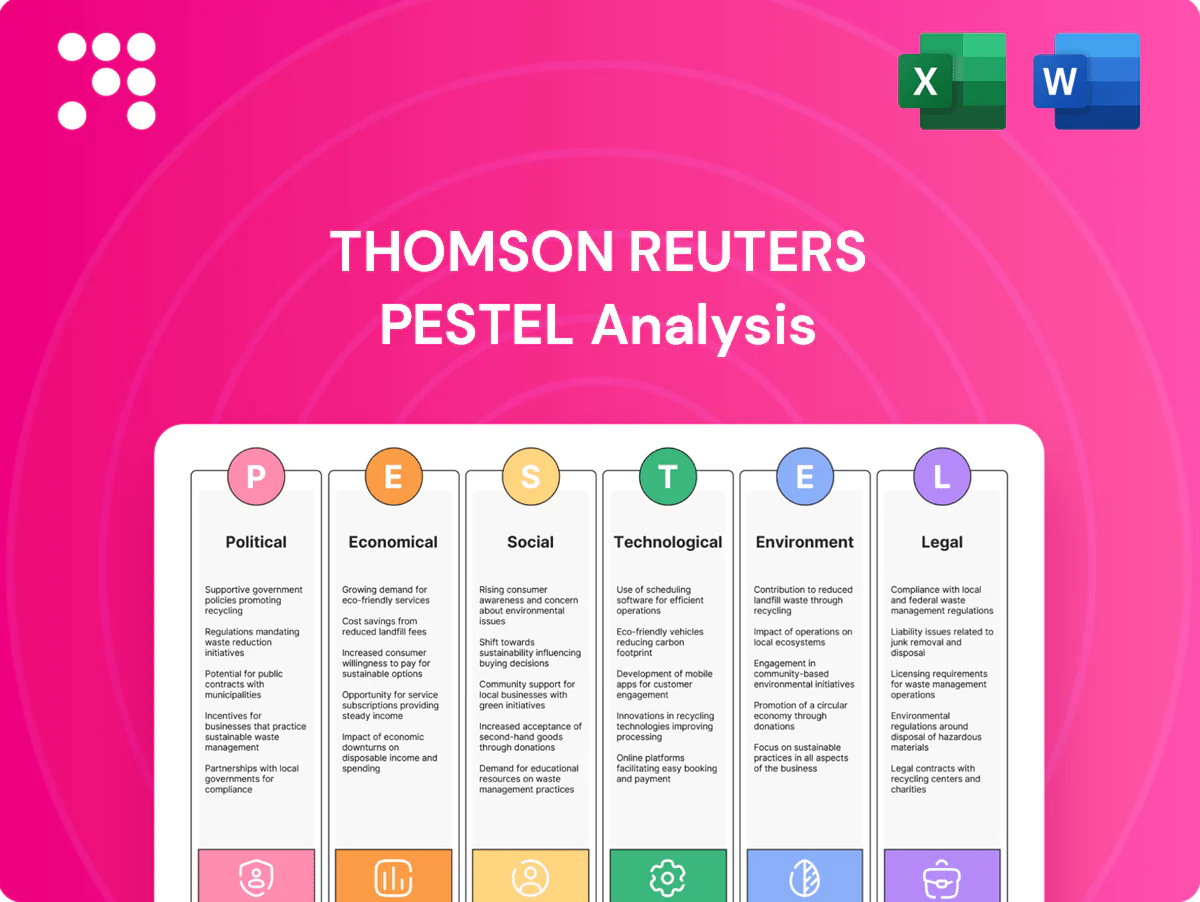
A concise, visually segmented Thomson Reuters PESTLE summary that’s editable, easily dropped into presentations or shared across teams to streamline external risk discussions and accelerate strategic decision-making.
Economic factors

Recurring revenue resilience
Subscription and workflow solutions provide defensible, high-visibility cash flows, with about 90% of Thomson Reuters revenue classed as recurring per company disclosures. Macro downturns may pressure new sales, but renewals and upsells—with reported renewal rates above 90%—remain comparatively stable. Embedded, mission-critical use cases strengthen pricing power. Usage-based modules allow revenue to flex with client activity.
Client budget cycles and rate environment
Law firms, tax advisors and corporates recalibrate subscriptions as benchmark rates and litigation/M&A volumes shift; US federal funds were 5.25–5.50% by mid‑2025. Tight credit has damped deal flow—Refinitiv reported global M&A fell ~20% to roughly $2.0tn in 2024—reducing demand for transaction datasets. Compliance and restructuring needs can offset softness, while price indexing must mirror inflation (US CPI ~3.4% in 2024) without driving churn.

Foreign exchange exposure
Thomson Reuters, which reported roughly $7.5 billion in FY2024 revenue, faces currency translation risk as global billings and costs are booked in multiple currencies. A stronger US dollar can depress reported international revenue while lowering some input costs, with USD appreciation of about 4% in 2024 amplifying this effect. Hedging programs smooth reported earnings but cannot eliminate volatility, and local pricing strategies are used to align perceived value and affordability.

Wage inflation and talent costs
Specialized editors, data scientists and engineers command premium pay—data scientist median US base ~$120k in 2024—driving unit-cost inflation with tech wage growth roughly 5–7% in 2024; persistent wage pressure raises content and product development costs. Automation and generative AI can expand margins if quality is maintained, while hub and nearshore strategies balance cost and capability.
- Higher talent costs: 5–7% wage growth (2024)
- Data scientist pay: median ~$120k (2024)
- AI automation: potential margin uplift if quality preserved
- Hub + nearshore: cost-capability tradeoff
SMB vs enterprise adoption
Economic stress widens the adoption gap as SMBs, which represent over 90% of firms globally, face tighter budgets while large enterprises show resilience; Thomson Reuters’ shift to subscription models (over 80% recurring revenue in 2024) lets suites drive ARPU through integrated workflows. Packaging, tiering and partner channels extend reach into cost-sensitive segments, and flexible contracting reduces procurement friction for both cohorts.
- SMB sensitivity: >90% of global firms
- Recurring revenue: >80% (2024)
- ARPU uplift: driven by integrated suites
- Go-to-market: packaging, tiers, partners, flexible contracts
Sanctions, export controls and data-residency drive localization; $7.6bn backs compliance
Subscription resilience drives ~90% recurring revenue on $7.5bn FY2024; renewal rates >90% protect cashflows, while macro (Fed 5.25–5.50% mid‑2025) and M&A down ~20% to ~$2.0tn (2024) pressure new sales; CPI ~3.4% and USD +4% (2024) create pricing and translation risk; tech wages +5–7%, data scientist median ~$120k raise content costs but AI offers margin upside.
| Metric | Value |
|---|---|
| Revenue FY2024 | $7.5bn |
| Recurring | ~90% |
| M&A 2024 | ~$2.0tn (-20%) |
| US CPI 2024 | 3.4% |
| USD FX 2024 | +4% |
| Tech wage growth 2024 | 5–7% |
| Data scientist median | $120k |
Preview Before You Purchase
Thomson Reuters PESTLE Analysis
The preview of the Thomson Reuters PESTLE Analysis shown here is the exact document you’ll receive after purchase—fully formatted and ready to use. This is a real screenshot of the product with no placeholders or teasers. The layout, content, and structure visible here are exactly what you’ll download immediately after buying.

Product Information
Product Information
Shipping & Returns
Shipping & Returns
Description
Your Shortcut to Market Insight Starts Here
Unlock how political, economic, social, technological, legal, and environmental forces are reshaping Thomson Reuters with our concise PESTLE snapshot—designed for investors and strategists who need rapid, actionable context. Buy the full analysis for detailed risk assessments, opportunity mapping, and ready-to-use insights you can deploy today.
Political factors
Geopolitical risk and sanctions
Shifts in sanctions regimes and geopolitical tensions force Thomson Reuters to adapt risk, compliance and news products as US, EU, UK and UN lists change daily and encompass thousands of entities. Coverage breadth, entity-screening content and update cadence must track rapidly evolving lists so government clients—who often boost compliance spend during crises—get timely intelligence, while commercial clients reassess exposure. Localization and contingency sourcing reduce country-specific disruption risk.
Government procurement and budgets
Thomson Reuters serves public-sector legal, tax and investigative users who operate on appropriations cycles, with public-sector contracts contributing to its recurring-revenue book within the company’s roughly $7.6bn 2024 revenue base. Policy priorities—eg, AML, tax transparency and regulatory reform—increase demand for regulatory intelligence and analytics, while contracting rules, security clearances and data-hosting mandates shape win rates and cloud/on-prem delivery models. Budget tightening across OECD governments has lengthened sales cycles, with buyers favoring modular, subscription-based offerings that lower upfront costs and enable phased deployments.
Data sovereignty and localization policy
National data-residency rules force TR to adapt cloud architecture, vendor selection and raise cost-to-serve; over 60 countries had localization measures by 2024. TR must offer region-specific hosting, granular access controls and audit trails to keep public and regulated clients, while divergent standards impede product uniformity and expose TR to fines and revenue risk (GDPR fines hit €2.6B in 2023).
Media independence and press freedom
Political pressure on journalism undermines newsgathering, source protection and staff safety, raising legal and operational risk when Thomson Reuters operates in restrictive regimes; the 2024 RSF World Press Freedom Index covers 180 countries and highlights widening constraints. Strong editorial standards sustain trust with enterprise clients and exchanges, while balanced coverage preserves brand equity across jurisdictions.
- Impact: source protection, staff safety
- Risk: restrictive regimes, legal exposure
- Trust: editorial standards for enterprise clients/exchanges
- Stat: RSF World Press Freedom Index covers 180 countries (2024)
Trade policy and export controls
Export restrictions on advanced analytics, AI chips and encryption—expanded by US controls in 2023–24—shape Thomson Reuters product features and where software can be deployed; Section 301 tariffs on ~360bn USD of Chinese goods and trade disputes can raise input costs and delay data‑center hardware, sometimes by months and increasing costs 5–15%. Cross‑border data transfers face intense regulatory scrutiny, requiring compliant routing, SCCs/DPF and contractual safeguards; proactive compliance limits service interruptions and preserves revenue streams.
- Impact: export controls limit features and countries
- Cost: ~$360bn in tariffs affect hardware pricing
- Risk: delays can add 5–15% to deployment costs
- Mitigation: SCCs, binding contracts, routing controls ensure continuity
Sanctions, export controls and data-residency drive localization; $7.6bn backs compliance
Shifts in sanctions, export controls and data‑residency rules force Thomson Reuters to adapt products and hosting; govt demand (AML, tax) lifts compliance spend while OECD budget tightening lengthens sales cycles. Pressures on journalism increase legal/operational risk; TR’s 2024 revenue ~$7.6bn underpins investment in compliance and localization.
| Metric | Value |
|---|---|
| 2024 revenue | $7.6bn |
| Countries with localization (2024) | 60+ |
| GDPR fines (2023) | €2.6B |
| Section 301 tariff scope | ~$360bn |
| Deployment cost impact | 5–15% |
What is included in the product
Detailed Word Document
Explores how macro-environmental forces—Political, Economic, Social, Technological, Environmental, and Legal—specifically impact Thomson Reuters, combining data-backed trends and regional regulatory context with forward-looking insights to identify risks and opportunities for executives, investors, and strategists; delivered in clean, report-ready format to support scenario planning, funding pitches, and strategic decision-making.
Customizable Excel Spreadsheet
A concise, visually segmented Thomson Reuters PESTLE summary that’s editable, easily dropped into presentations or shared across teams to streamline external risk discussions and accelerate strategic decision-making.
Economic factors
Recurring revenue resilience
Subscription and workflow solutions provide defensible, high-visibility cash flows, with about 90% of Thomson Reuters revenue classed as recurring per company disclosures. Macro downturns may pressure new sales, but renewals and upsells—with reported renewal rates above 90%—remain comparatively stable. Embedded, mission-critical use cases strengthen pricing power. Usage-based modules allow revenue to flex with client activity.
Client budget cycles and rate environment
Law firms, tax advisors and corporates recalibrate subscriptions as benchmark rates and litigation/M&A volumes shift; US federal funds were 5.25–5.50% by mid‑2025. Tight credit has damped deal flow—Refinitiv reported global M&A fell ~20% to roughly $2.0tn in 2024—reducing demand for transaction datasets. Compliance and restructuring needs can offset softness, while price indexing must mirror inflation (US CPI ~3.4% in 2024) without driving churn.
Foreign exchange exposure
Thomson Reuters, which reported roughly $7.5 billion in FY2024 revenue, faces currency translation risk as global billings and costs are booked in multiple currencies. A stronger US dollar can depress reported international revenue while lowering some input costs, with USD appreciation of about 4% in 2024 amplifying this effect. Hedging programs smooth reported earnings but cannot eliminate volatility, and local pricing strategies are used to align perceived value and affordability.
Wage inflation and talent costs
Specialized editors, data scientists and engineers command premium pay—data scientist median US base ~$120k in 2024—driving unit-cost inflation with tech wage growth roughly 5–7% in 2024; persistent wage pressure raises content and product development costs. Automation and generative AI can expand margins if quality is maintained, while hub and nearshore strategies balance cost and capability.
- Higher talent costs: 5–7% wage growth (2024)
- Data scientist pay: median ~$120k (2024)
- AI automation: potential margin uplift if quality preserved
- Hub + nearshore: cost-capability tradeoff
SMB vs enterprise adoption
Economic stress widens the adoption gap as SMBs, which represent over 90% of firms globally, face tighter budgets while large enterprises show resilience; Thomson Reuters’ shift to subscription models (over 80% recurring revenue in 2024) lets suites drive ARPU through integrated workflows. Packaging, tiering and partner channels extend reach into cost-sensitive segments, and flexible contracting reduces procurement friction for both cohorts.
- SMB sensitivity: >90% of global firms
- Recurring revenue: >80% (2024)
- ARPU uplift: driven by integrated suites
- Go-to-market: packaging, tiers, partners, flexible contracts
Sanctions, export controls and data-residency drive localization; $7.6bn backs compliance
Subscription resilience drives ~90% recurring revenue on $7.5bn FY2024; renewal rates >90% protect cashflows, while macro (Fed 5.25–5.50% mid‑2025) and M&A down ~20% to ~$2.0tn (2024) pressure new sales; CPI ~3.4% and USD +4% (2024) create pricing and translation risk; tech wages +5–7%, data scientist median ~$120k raise content costs but AI offers margin upside.
| Metric | Value |
|---|---|
| Revenue FY2024 | $7.5bn |
| Recurring | ~90% |
| M&A 2024 | ~$2.0tn (-20%) |
| US CPI 2024 | 3.4% |
| USD FX 2024 | +4% |
| Tech wage growth 2024 | 5–7% |
| Data scientist median | $120k |
Preview Before You Purchase
Thomson Reuters PESTLE Analysis
The preview of the Thomson Reuters PESTLE Analysis shown here is the exact document you’ll receive after purchase—fully formatted and ready to use. This is a real screenshot of the product with no placeholders or teasers. The layout, content, and structure visible here are exactly what you’ll download immediately after buying.