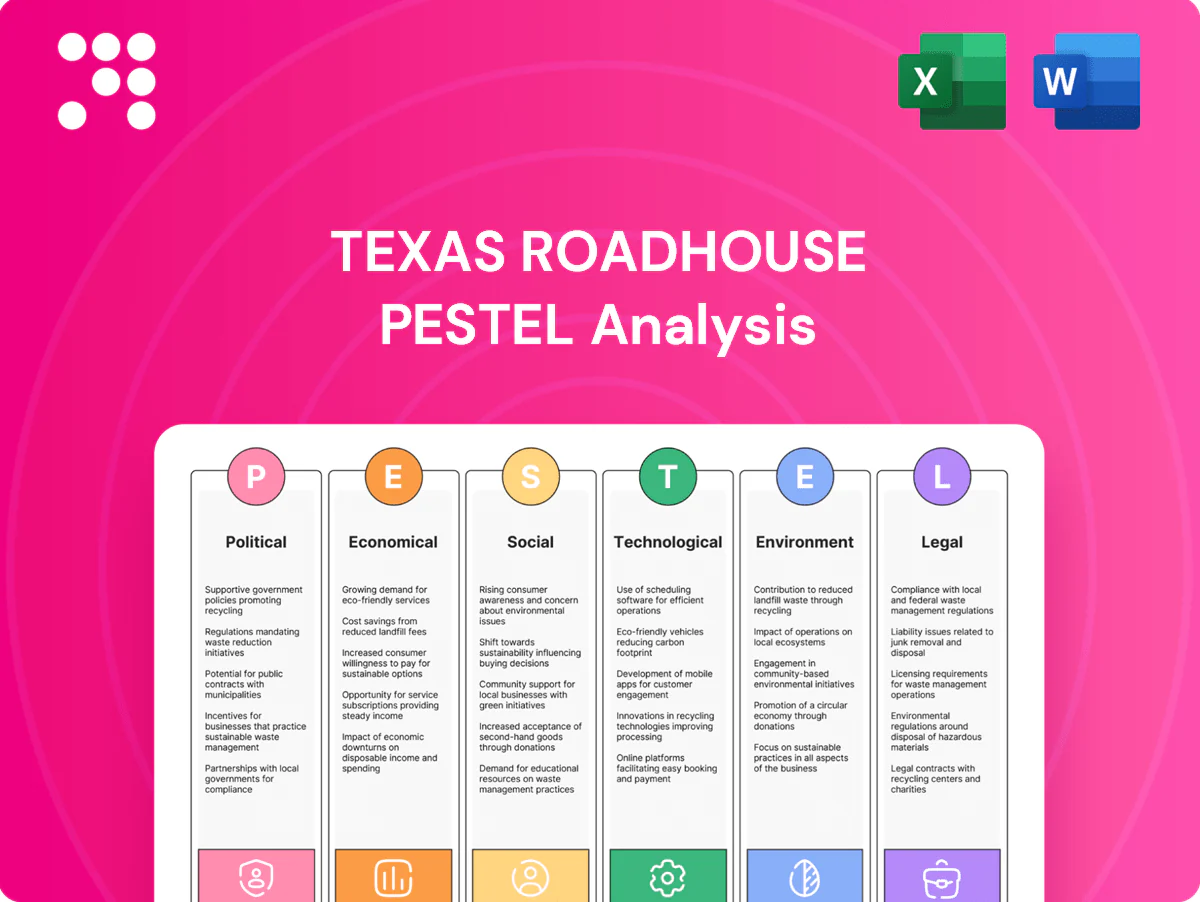
Texas Roadhouse PESTLE Analysis

Plan Smarter. Present Sharper. Compete Stronger.
Unlock how political shifts, economic cycles, and changing consumer tastes are reshaping Texas Roadhouse’s prospects in our concise PESTLE snapshot. This analysis highlights regulatory risks, labor dynamics, and tech-driven service trends that matter to investors and strategists. Ready-made and actionable, it’s ideal for planning or due diligence. Purchase the full PESTLE to access the complete, editable report now.
Political factors

Minimum wage and labor policy
Federal and Texas minimum wage remain $7.25, but rising local mandates and some US cities with $15+ minimums can materially widen Texas Roadhouse store-level labor costs, given restaurant labor typically runs 30–35% of sales. Tip-credit rules and service charge policies shift pay mix for servers/bartenders and affect margins. The chain must monitor ballot initiatives and ordinances that outpace inflation and use scenario planning with staggered price moves to protect value positioning.
Food safety and inspection regimes
USDA and FDA oversight shape Texas Roadhouse sourcing, storage and in-restaurant handling, with FSMA and FSIS rules driving supplier specs and cold-chain controls. Stricter inspection protocols raise compliance costs and can slow throughput, but strong adherence supports trust in hand-cut steaks and scratch kitchens. With CDC estimating 48 million foodborne illnesses/year (128,000 hospitalizations, 3,000 deaths), investment in staff training and audit rigor reduces disruption risk.

Trade and import dynamics
Tariffs on beef, pork and key inputs can materially shift commodity costs and force Texas Roadhouse to change its supplier mix, while cross-border dynamics for kitchen equipment and packaged goods can delay build-out timelines and increase capex. Policy shifts push the chain toward diversified sourcing and commodity hedging programs. Close supplier relationships and strategic inventory buffers mitigate lead-time volatility and protect margin stability.

Alcohol regulation and local licensing
Local permitting and state-level alcohol laws enforced by the Texas Alcoholic Beverage Commission drive bar revenue potential and daypart strategy, with local option control across Texas' 254 counties. Dry counties or restricted hours can materially reduce evening sales and average checks. Compliance requires TABC-approved server certification and robust ID-verification systems. Site selection must factor permitting friction and renewal risks.
- Permits and TABC control
- Dry/restricted counties cut check averages
- Mandatory server certification & ID systems
- Regulatory friction & renewal risk in site choice
Healthcare and benefits policy
Changes to employer mandates (ACA applies to employers with 50+ FTEs) shift full-/part-time mixes and scheduling; premium inflation (KFF 2024 average family premium $23,170, +3% vs 2023) and reporting rules raise G&A and HR system costs, affecting Texas Roadhouse (FY2024 revenue ~ $3.6B), Bubba’s 33 and Jaggers. Competitive benefits cut turnover amid a tight labor market (BLS leisure & hospitality quits ~4.3% May 2024) and provide clarity for multi-year staffing plans.
- Employer mandate: 50+ FTE
- KFF 2024 family premium: $23,170 (+3%)
- TXRH FY2024 revenue: ~ $3.6B
- BLS quits (leisure & hospitality): ~4.3% May 2024
Local $15+ wages and compliance squeeze labor costs despite $3.6B revenue
Federal min wage $7.25 vs some cities $15+ raises store-level labor cost pressure; labor typically 30–35% of sales. USDA/FDA/CDC rules and 48M annual US foodborne illnesses push compliance spend; FY2024 revenue ~ $3.6B supports this investment. Tariffs and supply chain shifts affect beef costs and capex timing.
| Metric | Value |
|---|---|
| FY2024 revenue | $3.6B |
| KFF 2024 family premium | $23,170 (+3%) |
| BLS leisure & hospitality quits May 2024 | ~4.3% |
| US foodborne illnesses (CDC) | 48M/yr |
| Federal min wage / local highs | $7.25 / $15+ |
What is included in the product
 Detailed Word Document
Explores how Political, Economic, Social, Technological, Environmental and Legal forces specifically impact Texas Roadhouse, using current data and industry trends to identify risks and opportunities. Delivered in concise, evidence-backed sections ready for strategy, scenario planning, investor materials, or internal reports.

 Customizable Excel Spreadsheet
Condensed Texas Roadhouse PESTLE summary that clearly segments political, economic, social, technological, legal and environmental risks to streamline meeting discussions, support quick decision-making, and be easily dropped into presentations or shared across teams.
Economic factors

Consumer discretionary spending
Restaurant traffic closely follows real wages, employment, and consumer confidence; with US unemployment around 3.7% (June 2024) and Conference Board confidence near 103 in 2025, downturns drive guests to trade down or reduce visits, pressuring comps. Texas Roadhouse mitigates with value engineering and frequent limited-time offers to defend traffic. Its family-friendly positioning helps capture resilient group occasions and larger check sizes.
Commodity and beef price volatility
Beef is a high‑mix item for Texas Roadhouse, making margins sensitive to cattle cycles and feed costs; CME Live Cattle futures swung roughly $130–$200 per cwt across 2024–2025, amplifying input volatility. This forces multi‑supplier sourcing and selective forward coverage while managing menu mix—shifting toward ribs, chicken and add‑ons—to offset spikes. Transparent pricing and clear guest communication preserve trust during inflationary periods.

Labor market tightness
Tight U.S. labor markets pushed leisure and hospitality average hourly earnings to about $22.06 in 2024 (BLS), forcing Texas Roadhouse to raise wages, sign-on bonuses, and BOH/FOH training spend. Industry turnover remains elevated—above 70%—eroding guest experience and throughput unless addressed. Investments in culture, scheduling tech, and clear career paths materially cut churn; modest throughput gains can offset higher labor per hour.

Interest rates and development cadence
Higher policy rates (federal funds ~5.25–5.50% and bank prime ~8.25% in 2024–25) push up build-out and lease financing costs and raise development hurdle rates, requiring site-pipeline pacing to reflect higher WACC and cash-return thresholds; Texas Roadhouse’s strong unit economics allow selective expansion even with tighter credit, while landlord negotiations remain a key source of TI and rent abatements.
- Higher rates: increase capex/lease costs
- Pipeline: must reflect WACC/cash returns
- Unit economics: support selective growth
- Landlords: negotiate TI and abatements
Delivery economics and fees
Third-party delivery take rates, typically 15–30% (industry avg ~20%), compress margins on Texas Roadhouse off-premise sales and require modeling of reduced gross profit. Menu pricing parity and added packaging costs (~$0.50–$1.50/order) force careful P&L assumptions. Shifting volume to pickup avoids commission drag while maintaining convenience; brand experience must be preserved across packaging and digital presentation.
- Delivery take rate: 15–30% (avg ~20%)
- Packaging cost: ~$0.50–$1.50/order
- Off-premise mix for casual dining: ~25–35%
- Pickup reduces commission, preserves margins
Local $15+ wages and compliance squeeze labor costs despite $3.6B revenue
Restaurant traffic tracks real wages and confidence (US unemployment ~3.7% Jun 2024; Conference Board ~103 in 2025), so downturns pressure comps; Texas Roadhouse defends with value offers and family-focused occasions. Beef volatility (CME Live Cattle ~$130–$200/cwt 2024–25) and tight labor (avg hourly ~$22.06 2024; turnover >70%) squeeze margins; higher rates (fed ~5.25–5.50%, prime ~8.25%) raise build/lease costs.
| Metric | Value |
|---|---|
| Unemployment | ~3.7% (Jun 2024) |
| Conf. Board | ~103 (2025) |
| Live Cattle | $130–$200/cwt (2024–25) |
| Avg hourly | $22.06 (2024) |
| Fed funds | 5.25–5.50% |
| Delivery take | 15–30% (avg ~20%) |
Same Document Delivered
Texas Roadhouse PESTLE Analysis
The Texas Roadhouse PESTLE Analysis shown here is the exact document you’ll receive after purchase—fully formatted and ready to use. It provides comprehensive political, economic, social, technological, legal, and environmental factors affecting the company, organized for immediate application. No placeholders or teasers—this is the finished file you’ll download upon payment.

Original: $10.00
-65%$10.00
$3.50Product Information
Product Information
Shipping & Returns
Shipping & Returns
Description
Plan Smarter. Present Sharper. Compete Stronger.
Unlock how political shifts, economic cycles, and changing consumer tastes are reshaping Texas Roadhouse’s prospects in our concise PESTLE snapshot. This analysis highlights regulatory risks, labor dynamics, and tech-driven service trends that matter to investors and strategists. Ready-made and actionable, it’s ideal for planning or due diligence. Purchase the full PESTLE to access the complete, editable report now.
Political factors
Minimum wage and labor policy
Federal and Texas minimum wage remain $7.25, but rising local mandates and some US cities with $15+ minimums can materially widen Texas Roadhouse store-level labor costs, given restaurant labor typically runs 30–35% of sales. Tip-credit rules and service charge policies shift pay mix for servers/bartenders and affect margins. The chain must monitor ballot initiatives and ordinances that outpace inflation and use scenario planning with staggered price moves to protect value positioning.
Food safety and inspection regimes
USDA and FDA oversight shape Texas Roadhouse sourcing, storage and in-restaurant handling, with FSMA and FSIS rules driving supplier specs and cold-chain controls. Stricter inspection protocols raise compliance costs and can slow throughput, but strong adherence supports trust in hand-cut steaks and scratch kitchens. With CDC estimating 48 million foodborne illnesses/year (128,000 hospitalizations, 3,000 deaths), investment in staff training and audit rigor reduces disruption risk.
Trade and import dynamics
Tariffs on beef, pork and key inputs can materially shift commodity costs and force Texas Roadhouse to change its supplier mix, while cross-border dynamics for kitchen equipment and packaged goods can delay build-out timelines and increase capex. Policy shifts push the chain toward diversified sourcing and commodity hedging programs. Close supplier relationships and strategic inventory buffers mitigate lead-time volatility and protect margin stability.
Alcohol regulation and local licensing
Local permitting and state-level alcohol laws enforced by the Texas Alcoholic Beverage Commission drive bar revenue potential and daypart strategy, with local option control across Texas' 254 counties. Dry counties or restricted hours can materially reduce evening sales and average checks. Compliance requires TABC-approved server certification and robust ID-verification systems. Site selection must factor permitting friction and renewal risks.
- Permits and TABC control
- Dry/restricted counties cut check averages
- Mandatory server certification & ID systems
- Regulatory friction & renewal risk in site choice
Healthcare and benefits policy
Changes to employer mandates (ACA applies to employers with 50+ FTEs) shift full-/part-time mixes and scheduling; premium inflation (KFF 2024 average family premium $23,170, +3% vs 2023) and reporting rules raise G&A and HR system costs, affecting Texas Roadhouse (FY2024 revenue ~ $3.6B), Bubba’s 33 and Jaggers. Competitive benefits cut turnover amid a tight labor market (BLS leisure & hospitality quits ~4.3% May 2024) and provide clarity for multi-year staffing plans.
- Employer mandate: 50+ FTE
- KFF 2024 family premium: $23,170 (+3%)
- TXRH FY2024 revenue: ~ $3.6B
- BLS quits (leisure & hospitality): ~4.3% May 2024
Local $15+ wages and compliance squeeze labor costs despite $3.6B revenue
Federal min wage $7.25 vs some cities $15+ raises store-level labor cost pressure; labor typically 30–35% of sales. USDA/FDA/CDC rules and 48M annual US foodborne illnesses push compliance spend; FY2024 revenue ~ $3.6B supports this investment. Tariffs and supply chain shifts affect beef costs and capex timing.
| Metric | Value |
|---|---|
| FY2024 revenue | $3.6B |
| KFF 2024 family premium | $23,170 (+3%) |
| BLS leisure & hospitality quits May 2024 | ~4.3% |
| US foodborne illnesses (CDC) | 48M/yr |
| Federal min wage / local highs | $7.25 / $15+ |
What is included in the product
Detailed Word Document
Explores how Political, Economic, Social, Technological, Environmental and Legal forces specifically impact Texas Roadhouse, using current data and industry trends to identify risks and opportunities. Delivered in concise, evidence-backed sections ready for strategy, scenario planning, investor materials, or internal reports.
Customizable Excel Spreadsheet
Condensed Texas Roadhouse PESTLE summary that clearly segments political, economic, social, technological, legal and environmental risks to streamline meeting discussions, support quick decision-making, and be easily dropped into presentations or shared across teams.
Economic factors
Consumer discretionary spending
Restaurant traffic closely follows real wages, employment, and consumer confidence; with US unemployment around 3.7% (June 2024) and Conference Board confidence near 103 in 2025, downturns drive guests to trade down or reduce visits, pressuring comps. Texas Roadhouse mitigates with value engineering and frequent limited-time offers to defend traffic. Its family-friendly positioning helps capture resilient group occasions and larger check sizes.
Commodity and beef price volatility
Beef is a high‑mix item for Texas Roadhouse, making margins sensitive to cattle cycles and feed costs; CME Live Cattle futures swung roughly $130–$200 per cwt across 2024–2025, amplifying input volatility. This forces multi‑supplier sourcing and selective forward coverage while managing menu mix—shifting toward ribs, chicken and add‑ons—to offset spikes. Transparent pricing and clear guest communication preserve trust during inflationary periods.
Labor market tightness
Tight U.S. labor markets pushed leisure and hospitality average hourly earnings to about $22.06 in 2024 (BLS), forcing Texas Roadhouse to raise wages, sign-on bonuses, and BOH/FOH training spend. Industry turnover remains elevated—above 70%—eroding guest experience and throughput unless addressed. Investments in culture, scheduling tech, and clear career paths materially cut churn; modest throughput gains can offset higher labor per hour.
Interest rates and development cadence
Higher policy rates (federal funds ~5.25–5.50% and bank prime ~8.25% in 2024–25) push up build-out and lease financing costs and raise development hurdle rates, requiring site-pipeline pacing to reflect higher WACC and cash-return thresholds; Texas Roadhouse’s strong unit economics allow selective expansion even with tighter credit, while landlord negotiations remain a key source of TI and rent abatements.
- Higher rates: increase capex/lease costs
- Pipeline: must reflect WACC/cash returns
- Unit economics: support selective growth
- Landlords: negotiate TI and abatements
Delivery economics and fees
Third-party delivery take rates, typically 15–30% (industry avg ~20%), compress margins on Texas Roadhouse off-premise sales and require modeling of reduced gross profit. Menu pricing parity and added packaging costs (~$0.50–$1.50/order) force careful P&L assumptions. Shifting volume to pickup avoids commission drag while maintaining convenience; brand experience must be preserved across packaging and digital presentation.
- Delivery take rate: 15–30% (avg ~20%)
- Packaging cost: ~$0.50–$1.50/order
- Off-premise mix for casual dining: ~25–35%
- Pickup reduces commission, preserves margins
Local $15+ wages and compliance squeeze labor costs despite $3.6B revenue
Restaurant traffic tracks real wages and confidence (US unemployment ~3.7% Jun 2024; Conference Board ~103 in 2025), so downturns pressure comps; Texas Roadhouse defends with value offers and family-focused occasions. Beef volatility (CME Live Cattle ~$130–$200/cwt 2024–25) and tight labor (avg hourly ~$22.06 2024; turnover >70%) squeeze margins; higher rates (fed ~5.25–5.50%, prime ~8.25%) raise build/lease costs.
| Metric | Value |
|---|---|
| Unemployment | ~3.7% (Jun 2024) |
| Conf. Board | ~103 (2025) |
| Live Cattle | $130–$200/cwt (2024–25) |
| Avg hourly | $22.06 (2024) |
| Fed funds | 5.25–5.50% |
| Delivery take | 15–30% (avg ~20%) |
Same Document Delivered
Texas Roadhouse PESTLE Analysis
The Texas Roadhouse PESTLE Analysis shown here is the exact document you’ll receive after purchase—fully formatted and ready to use. It provides comprehensive political, economic, social, technological, legal, and environmental factors affecting the company, organized for immediate application. No placeholders or teasers—this is the finished file you’ll download upon payment.