Tejas Networks PESTLE Analysis

Skip the Research. Get the Strategy.
Discover how political shifts, regulatory changes, economic cycles and rapid tech innovation are shaping Tejas Networks' growth prospects. Our concise PESTLE highlights risk areas and opportunity hotspots to inform investment and strategy decisions. Buy the full analysis for actionable, ready-to-use insights and detailed recommendations.
Political factors

Policy support & PLI
India’s Make in India and PLI (telecom & networking PLI: Rs 12,195 crore) strongly incentivize local optical and data-network OEMs, and preferential procurement rules can tilt large tenders toward domestic content. Compliance thresholds and localization mandates, often in the 30–50% range, increase execution complexity. Aligning bills of material with policy definitions is critical to capture subsidies and tender advantages.
Spectrum and 5G roadmap
Government timelines—eg 2022 pan-India 5G spectrum auction—drive operator capex cycles; faster policy clarity accelerates network expansion and vendor orders, while delays or high reserve prices (seen in 2022) compress telco budgets and defer spend. BharatNet’s drive to connect ~250,000+ gram panchayats creates predictable public-sector demand that benefits vendors like Tejas Networks.

Geopolitics & vendor diversification
Global tensions push governments and telcos to diversify away from certain foreign vendors, creating demand for trusted domestic suppliers like Tejas; export openings grow in friendly markets while some regions stay restricted, making country-of-origin sensitivities critical for deal approvals and supply-chain planning.

Government & defense procurement
Large government and defence orders for Tejas Networks hinge on transparent tendering, L1 norms and rigorous technical qualification; India’s defence budget was INR 6.04 lakh crore in 2024–25, underscoring available spend. Long approval cycles (commonly 6–24 months) delay revenue recognition and working capital turn. Indigenization and Make in India targets and offset-like policies favour local R&D and manufacturing, supporting multi-year supply contracts.
- Procurement rule: L1 and technical qualification drive win-rate
- Budget: INR 6.04 lakh crore (2024–25) = demand pool
- Timing: 6–24 month approval lag affects cash flow
- Policy: indigenization boosts local R&D and multi-year programs
Critical infrastructure and cyber policy
Designation of telecom as critical infrastructure raises compliance and security requirements for Tejas, reinforced by CERT-In directions 2022 (amended 2023) and the Digital Personal Data Protection Act 2023; India had about 1.18 billion wireless subscribers per TRAI 2024, increasing exposure and scrutiny.
- Vendor selection impacted by national security clearances and supply-chain vetting
- Local testing/certification mandates can add time/cost to deployments
- Alignment with national cyber directives is a commercial differentiator
PLI Rs 12,195 cr + 30–50% localization boost domestic demand; 6–24m approval lag pressures cash
Policy push—Make in India and telecom PLI (Rs 12,195 crore) plus 30–50% localization mandates materially raise domestic content demand and tender preference for Tejas. 2022–24 5G/auction timing and BharatNet rollout (≈250,000+ gram panchayats) drive predictable capex, but 6–24 month approval lags strain cash flow. National-security vetting, CERT-In directives and DPDP 2023 increase compliance costs while creating advantage for vetted domestic vendors.
| Metric | Value |
|---|---|
| Telecom PLI | Rs 12,195 cr |
| Defence budget 2024–25 | INR 6.04 lakh cr |
| Wireless subs (TRAI 2024) | ≈1.18 billion |
| Approval lag | 6–24 months |
What is included in the product
 Detailed Word Document
Explores how political, economic, social, technological, environmental and legal forces shape Tejas Networks’ strategy and risk profile; each section is data-backed with regional and industry-specific examples and forward-looking insights to inform executives, investors and planners.

 Customizable Excel Spreadsheet
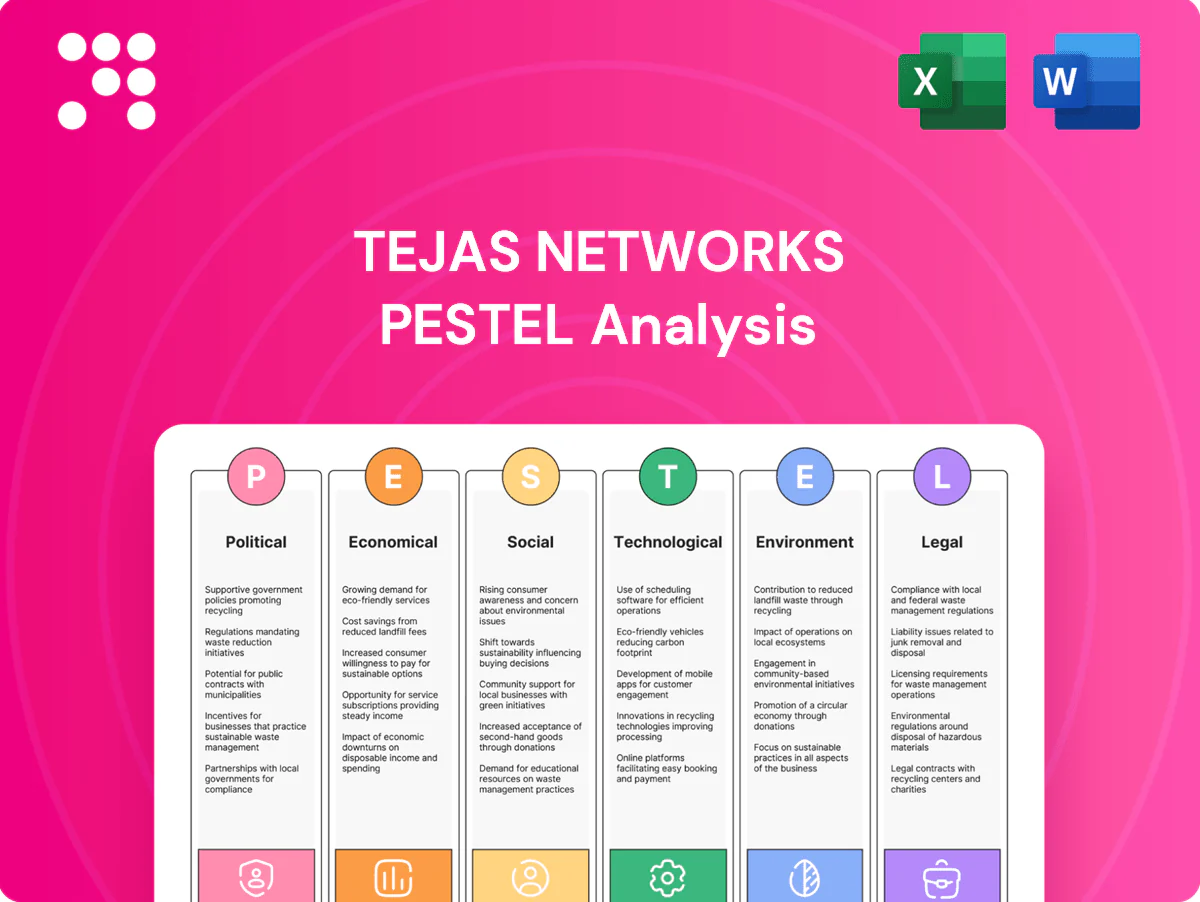
A concise, visually segmented PESTLE summary for Tejas Networks that can be dropped into presentations, edited with region-specific notes, and easily shared across teams to streamline discussions on regulatory risks, market positioning, and strategic planning.
Economic factors

Telco capex and ARPU trends
Operator profitability and modest ARPU growth constrain spending on optical backbones and access upgrades, though global telco capex reached about $280bn in 2024, supporting vendor demand. Market consolidation—fewer large operators—concentrates purchasing power and puts downward pressure on prices and margins for suppliers. 5G and FTTx monetization efforts drove sustained capex commitments into 2025, but weak consumer demand or slowing ARPU can defer projects and lengthen sales cycles for Tejas Networks.
Currency and import inflation
Rupee volatility (USD/INR ~82–83 in 2024–25) raises costs for imported semiconductors and components, directly pressuring Tejas Networks’ COGS. The company’s hedging policy and use of forward contracts materially influence gross margins during FX swings. Tariffs and rising logistics costs increase pricing for BOM-heavy systems, while progressive local sourcing and Make in India initiatives are reducing FX exposure over time.

Interest rates and financing
Higher interest rates — RBI repo at 6.50% and US policy rates around 5.25–5.50% in 2024–25 — lift WACC for telcos, slowing capex and fibre builds; public or multilateral financing (ADB/World Bank programs) can de-risk rural and strategic deployments; vendor financing terms increasingly determine win rates in tenders; easing rates historically spur order intake and backlog recovery.

Supply chain and semiconductor cycles
- Higher lead times: 20–26 weeks in peak shortages
- Fab slots: 6–18 months
- Mitigants: strategic inventory, multi-sourcing
- Opportunity: downcycles improve margins via cost cuts
Government infrastructure spend
Government infrastructure programs — National Broadband Mission aiming full village coverage by 2025, 100 Smart Cities rollout, utilities digitalization and rising defense network spend (defence budget ~INR 5.94 lakh crore in 2024–25) create steady demand for Tejas Networks’ optical and broadband gear; quarterly revenues hinge on pace of budget execution and project rollouts. Public‑private models under BharatNet and smart city PPPs can unlock last‑mile expansion while growing export orders reduce domestic cyclicality.
- National broadband: village coverage target 2025
- Defence capex: INR 5.94 lakh crore (2024–25)
- Union capex ~INR 11.1 lakh crore (2024–25) supports projects
- PPP/export diversification mitigates domestic cycles
PLI Rs 12,195 cr + 30–50% localization boost domestic demand; 6–24m approval lag pressures cash
Operator margin pressure and modest ARPU growth limit telco capex despite global telco capex ~$280bn in 2024, prolonging sales cycles for Tejas. FX (USD/INR ~82–83) and commodity/transport inflation raise COGS; hedging and local sourcing mitigate. Higher rates (RBI 6.50%) lift WACC, slowing fibre/5G builds; government capex (Union ~INR 11.1L cr; defence INR 5.94L cr) offsets cyclicality.
| Metric | Value (2024–25) |
|---|---|
| Global telco capex | $280bn |
| USD/INR | 82–83 |
| RBI repo | 6.50% |
| Union capex | INR 11.1L cr |
| Defence capex | INR 5.94L cr |
| Lead times (chip peaks) | 20–26 wks |
| Fab slots | 6–18 months |
Full Version Awaits
Tejas Networks PESTLE Analysis
This Tejas Networks PESTLE Analysis provides a concise evaluation of political, economic, social, technological, legal, and environmental factors affecting the company. The preview shown here is the exact document you’ll receive after purchase—fully formatted and ready to use. It’s the final file you’ll download immediately and requires no edits.

Original: $10.00
-65%$10.00
$3.50Product Information
Product Information
Shipping & Returns
Shipping & Returns
Description
Skip the Research. Get the Strategy.
Discover how political shifts, regulatory changes, economic cycles and rapid tech innovation are shaping Tejas Networks' growth prospects. Our concise PESTLE highlights risk areas and opportunity hotspots to inform investment and strategy decisions. Buy the full analysis for actionable, ready-to-use insights and detailed recommendations.
Political factors
Policy support & PLI
India’s Make in India and PLI (telecom & networking PLI: Rs 12,195 crore) strongly incentivize local optical and data-network OEMs, and preferential procurement rules can tilt large tenders toward domestic content. Compliance thresholds and localization mandates, often in the 30–50% range, increase execution complexity. Aligning bills of material with policy definitions is critical to capture subsidies and tender advantages.
Spectrum and 5G roadmap
Government timelines—eg 2022 pan-India 5G spectrum auction—drive operator capex cycles; faster policy clarity accelerates network expansion and vendor orders, while delays or high reserve prices (seen in 2022) compress telco budgets and defer spend. BharatNet’s drive to connect ~250,000+ gram panchayats creates predictable public-sector demand that benefits vendors like Tejas Networks.
Geopolitics & vendor diversification
Global tensions push governments and telcos to diversify away from certain foreign vendors, creating demand for trusted domestic suppliers like Tejas; export openings grow in friendly markets while some regions stay restricted, making country-of-origin sensitivities critical for deal approvals and supply-chain planning.
Government & defense procurement
Large government and defence orders for Tejas Networks hinge on transparent tendering, L1 norms and rigorous technical qualification; India’s defence budget was INR 6.04 lakh crore in 2024–25, underscoring available spend. Long approval cycles (commonly 6–24 months) delay revenue recognition and working capital turn. Indigenization and Make in India targets and offset-like policies favour local R&D and manufacturing, supporting multi-year supply contracts.
- Procurement rule: L1 and technical qualification drive win-rate
- Budget: INR 6.04 lakh crore (2024–25) = demand pool
- Timing: 6–24 month approval lag affects cash flow
- Policy: indigenization boosts local R&D and multi-year programs
Critical infrastructure and cyber policy
Designation of telecom as critical infrastructure raises compliance and security requirements for Tejas, reinforced by CERT-In directions 2022 (amended 2023) and the Digital Personal Data Protection Act 2023; India had about 1.18 billion wireless subscribers per TRAI 2024, increasing exposure and scrutiny.
- Vendor selection impacted by national security clearances and supply-chain vetting
- Local testing/certification mandates can add time/cost to deployments
- Alignment with national cyber directives is a commercial differentiator
PLI Rs 12,195 cr + 30–50% localization boost domestic demand; 6–24m approval lag pressures cash
Policy push—Make in India and telecom PLI (Rs 12,195 crore) plus 30–50% localization mandates materially raise domestic content demand and tender preference for Tejas. 2022–24 5G/auction timing and BharatNet rollout (≈250,000+ gram panchayats) drive predictable capex, but 6–24 month approval lags strain cash flow. National-security vetting, CERT-In directives and DPDP 2023 increase compliance costs while creating advantage for vetted domestic vendors.
| Metric | Value |
|---|---|
| Telecom PLI | Rs 12,195 cr |
| Defence budget 2024–25 | INR 6.04 lakh cr |
| Wireless subs (TRAI 2024) | ≈1.18 billion |
| Approval lag | 6–24 months |
What is included in the product
Detailed Word Document
Explores how political, economic, social, technological, environmental and legal forces shape Tejas Networks’ strategy and risk profile; each section is data-backed with regional and industry-specific examples and forward-looking insights to inform executives, investors and planners.
Customizable Excel Spreadsheet
A concise, visually segmented PESTLE summary for Tejas Networks that can be dropped into presentations, edited with region-specific notes, and easily shared across teams to streamline discussions on regulatory risks, market positioning, and strategic planning.
Economic factors
Telco capex and ARPU trends
Operator profitability and modest ARPU growth constrain spending on optical backbones and access upgrades, though global telco capex reached about $280bn in 2024, supporting vendor demand. Market consolidation—fewer large operators—concentrates purchasing power and puts downward pressure on prices and margins for suppliers. 5G and FTTx monetization efforts drove sustained capex commitments into 2025, but weak consumer demand or slowing ARPU can defer projects and lengthen sales cycles for Tejas Networks.
Currency and import inflation
Rupee volatility (USD/INR ~82–83 in 2024–25) raises costs for imported semiconductors and components, directly pressuring Tejas Networks’ COGS. The company’s hedging policy and use of forward contracts materially influence gross margins during FX swings. Tariffs and rising logistics costs increase pricing for BOM-heavy systems, while progressive local sourcing and Make in India initiatives are reducing FX exposure over time.
Interest rates and financing
Higher interest rates — RBI repo at 6.50% and US policy rates around 5.25–5.50% in 2024–25 — lift WACC for telcos, slowing capex and fibre builds; public or multilateral financing (ADB/World Bank programs) can de-risk rural and strategic deployments; vendor financing terms increasingly determine win rates in tenders; easing rates historically spur order intake and backlog recovery.
Supply chain and semiconductor cycles
- Higher lead times: 20–26 weeks in peak shortages
- Fab slots: 6–18 months
- Mitigants: strategic inventory, multi-sourcing
- Opportunity: downcycles improve margins via cost cuts
Government infrastructure spend
Government infrastructure programs — National Broadband Mission aiming full village coverage by 2025, 100 Smart Cities rollout, utilities digitalization and rising defense network spend (defence budget ~INR 5.94 lakh crore in 2024–25) create steady demand for Tejas Networks’ optical and broadband gear; quarterly revenues hinge on pace of budget execution and project rollouts. Public‑private models under BharatNet and smart city PPPs can unlock last‑mile expansion while growing export orders reduce domestic cyclicality.
- National broadband: village coverage target 2025
- Defence capex: INR 5.94 lakh crore (2024–25)
- Union capex ~INR 11.1 lakh crore (2024–25) supports projects
- PPP/export diversification mitigates domestic cycles
PLI Rs 12,195 cr + 30–50% localization boost domestic demand; 6–24m approval lag pressures cash
Operator margin pressure and modest ARPU growth limit telco capex despite global telco capex ~$280bn in 2024, prolonging sales cycles for Tejas. FX (USD/INR ~82–83) and commodity/transport inflation raise COGS; hedging and local sourcing mitigate. Higher rates (RBI 6.50%) lift WACC, slowing fibre/5G builds; government capex (Union ~INR 11.1L cr; defence INR 5.94L cr) offsets cyclicality.
| Metric | Value (2024–25) |
|---|---|
| Global telco capex | $280bn |
| USD/INR | 82–83 |
| RBI repo | 6.50% |
| Union capex | INR 11.1L cr |
| Defence capex | INR 5.94L cr |
| Lead times (chip peaks) | 20–26 wks |
| Fab slots | 6–18 months |
Full Version Awaits
Tejas Networks PESTLE Analysis
This Tejas Networks PESTLE Analysis provides a concise evaluation of political, economic, social, technological, legal, and environmental factors affecting the company. The preview shown here is the exact document you’ll receive after purchase—fully formatted and ready to use. It’s the final file you’ll download immediately and requires no edits.