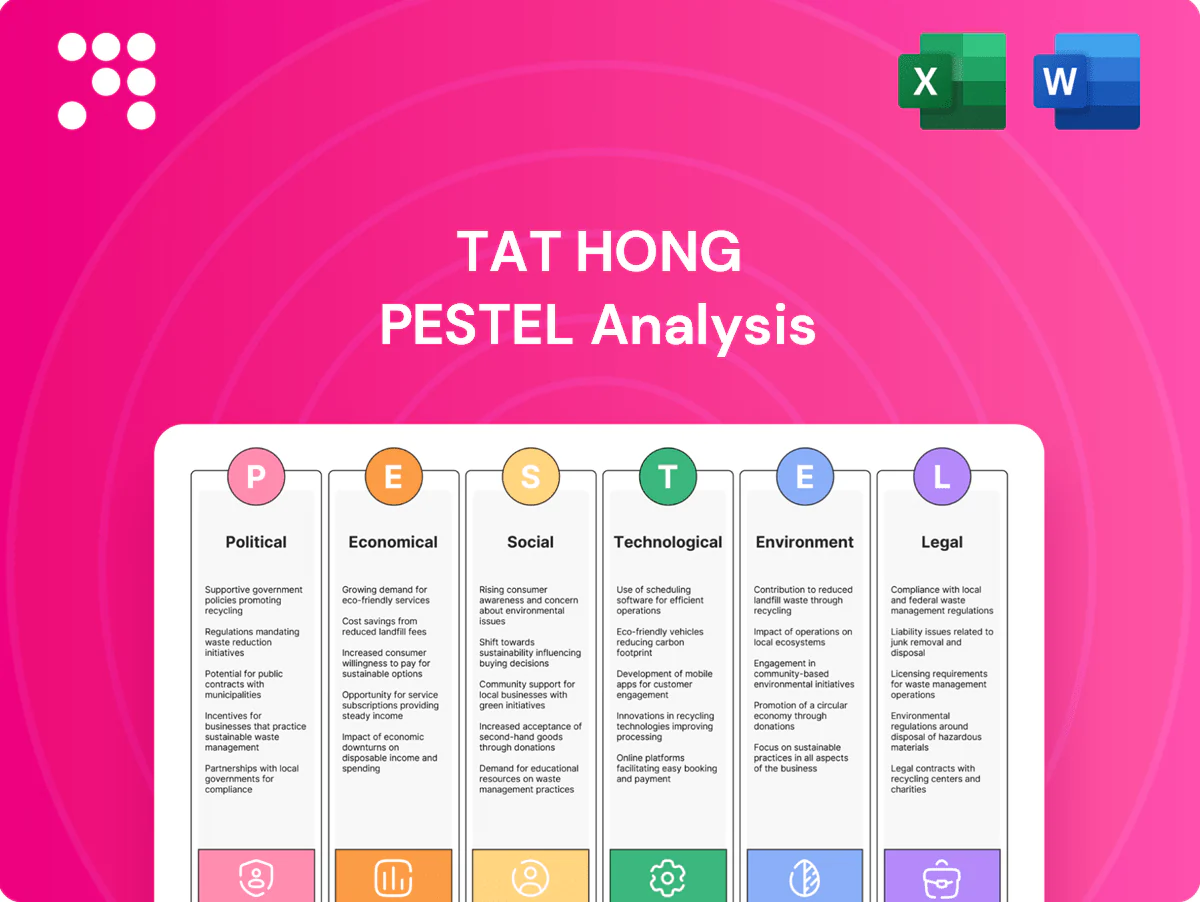
Tat Hong PESTLE Analysis

Your Shortcut to Market Insight Starts Here
Unlock strategic clarity with our tailored PESTLE Analysis of Tat Hong—three to five expert-level insights reveal how political, economic, social, technological, legal, and environmental forces shape its prospects. Perfect for investors, consultants, and planners, this concise briefing highlights risks and opportunities you can act on. Purchase the full report to get the complete, editable analysis instantly.
Political factors

Government infrastructure spend
Public capex pipelines, with ASEAN infrastructure needs at about USD210bn/year and global needs estimated at USD94tn to 2040, directly drive crane rental demand in construction and infrastructure. Multi-year budgets and targeted stimulus for transport, energy and utilities underpin utilization and pricing, supporting fleet returns. Delays or cuts in public works create short-term volatility in deployment and rates. Diversifying across countries smooths policy-driven cycles.
Permitting and project approvals
Lengthy approvals for mega-projects can defer crane mobilization and revenue, with delays commonly exceeding 12 months in large infrastructure projects, pushing utilization down and idle fleet costs up. Streamlined permitting accelerates start dates and can improve utilization rates by double-digit percentages. Policy shifts in 2024–25 toward fast-tracking ports and grid projects are positive. Compliance teams must track local approval regimes to reduce idle time.

Trade policy and import tariffs
Tariffs on cranes, parts or steel directly raise Tat Hong’s acquisition and maintenance costs; WTO data show global average applied MFN tariffs around 3% (2023) while major measures like US Section 232 steel tariffs remain at 25%, affecting global steel pricing. Cross-border operations hinge on customs efficiency and harmonized standards across ASEAN (most AFTA tariffs at or near 0–5%). Protectionist measures can delay fleet renewal, whereas FTAs (e.g., CPTPP, RCEP) ease sourcing and lower landed costs. Scenario planning should model tariff pass-through to customers and diversify sourcing to low-tariff suppliers or local fabrication.

Geopolitics and regional stability
Project risk rises sharply with political instability in emerging markets where heavy-lift is needed; sanctions have curtailed oil & gas and infrastructure bids, tightening margins and timelines. ASEAN GDP ~US$3.6 trillion (2024) and stable Australia plus selective Middle East exposure help spread country risk. Robust security and contingency logistics plans are essential for cross-border mobilization and contract continuity.
- Risk: sanctions limit oil & gas/infra contracts
- Mitigation: diversify to ASEAN, Australia, select ME
- Action: formal security & contingency logistics plans
Public procurement and SOE policies
Public procurement and SOE tender rules dictate pricing, localization and partnership models for Tat Hong, often forcing joint ventures or local-content arrangements; tenders increasingly favor domestic vendors, pressuring margins and bid structures.
- Retention commonly 5–10% and payment cycles 60–180 days impact cash flow
- Localization/local JV requirements drive capex and OPEX allocation
- Strong compliance and bid discipline preserve margins in competitive SOE tenders
Public capex and political cycles boost crane demand; tariffs and 60-180d payments compress margins
Political cycles and public capex (ASEAN infra ~USD210bn/yr; global needs ~USD94tn to 2040) drive crane demand but procurement, tariffs (global MFN ~3% in 2023; US steel 25%) and approvals create timing and cost risks; SOE-localization and retention (5–10%) with 60–180 day payments pressure cash flow and margins.
| Metric | Value | Impact |
|---|---|---|
| ASEAN infra | USD210bn/yr | Demand support |
| Global infra | USD94tn to 2040 | Long-term market |
| Tariffs | MFN ~3% (2023); US steel 25% | Cost/renewal |
| Payments/retention | 60–180d / 5–10% | Cashflow strain |
What is included in the product
 Detailed Word Document
Explores how macro-environmental factors uniquely affect Tat Hong across Political, Economic, Social, Technological, Environmental and Legal dimensions, with data-backed trends and region-specific examples; designed for executives and investors, it delivers forward-looking insights ready for strategy, pitch decks and scenario planning.

 Customizable Excel Spreadsheet
A compact, PESTLE‑segmented summary of Tat Hong's external environment for quick inclusion in presentations or team sessions, enabling stakeholders to align on regulatory, economic and market risks; editable notes support regional or business‑line context and fast decision-making.
Economic factors

Construction and capex cycles
Crane rental revenue for Tat Hong closely tracks construction, infrastructure and industrial capex cycles; downturns compress fleet utilization and daily rates while upcycles tighten availability and lift pricing. Diversified exposure across construction, energy and logistics mitigates single‑sector shocks. Flexible fleet allocation and short‑term leasing improve yield by shifting assets to stronger markets.
Oil & gas and commodities
Rising energy prices drive upstream and downstream project starts that demand heavy-lift capacity; Brent averaged about 86 USD/bbl in 2024 and traded near 78 USD/bbl in mid‑2025, directly lifting demand for Tat Hong’s heavy‑lift rentals.
Strong commodity prices—iron ore and base metals rallies in 2024 and a ~15% rise in global mining capex—spurred mining and petrochemical expansions, increasing equipment hire cycles.
High volatility (OVX elevated in 2024) forces dynamic pricing and flexible contract structures, while optimizing sector mix across oil & gas, mining and construction stabilizes revenue through commodity cycles.

Interest rates and financing costs
Cranes are capital-intensive; higher benchmark rates—US Fed funds at 5.25–5.50% in 2025—raise ownership and refinancing costs and push up borrowing spreads for equipment lenders. Rising WACC compresses fleet renewal timing and reduces expansion ROI, with corporate bond yields (BBB ~5–6% in 2024) lifting hurdle rates. Rate-sensitive customers may defer projects, lowering utilization; aligning lease tenors with fixed-rate debt protects margins.

FX movements and cross-border revenues
Multi-country operations expose Tat Hong revenues and capex to currency swings; USD and JPY moves (JPY reached about 151 per USD in Oct 2022) can widen mismatches between USD/JPY-linked crane purchases and local-currency rents. Hedging programs and natural revenue/cost offsets help mitigate volatility; contractual FX pricing clauses can shift risk to clients.
- FX exposure
- JPY/USD capex risk
- Hedging offsets
- Pricing clauses
Inflation and input costs
Rising costs for parts, tyres, steel and labour have squeezed Tat Hong margins, while supply‑chain tightness lengthens lead times for major overhauls, delaying revenue recognition.
Index‑linked contracts and surcharge mechanisms have supported recovery by passing costs to clients, and efficiency gains plus telematics cut fuel and maintenance hours per operating hour.
- cost-pressure: parts/tyres/steel/labour
- lead-times: extended for overhauls
- recovery-tools: index-linked contracts, surcharges
- efficiency: telematics reduce fuel & maintenance
Public capex and political cycles boost crane demand; tariffs and 60-180d payments compress margins
Crane demand tracks construction, mining and energy cycles; Brent averaged ~86 USD/bbl in 2024 and remained near 78 USD/bbl in mid‑2025, supporting rental volumes. Higher rates (US Fed funds 5.25–5.50% in 2025) raise ownership costs and delay fleet renewal. FX and input inflation (steel, parts, labour) compress margins despite index‑linked contracts and telematics gains.
| Indicator | 2024/2025 |
|---|---|
| Brent (avg) | ~86 USD/bbl (2024); ~78 mid‑2025 |
| Fed funds | 5.25–5.50% (2025) |
| Mining capex | +~15% (2024) |
| FX note | USD/JPY ~151 (Oct 2022) |
Full Version Awaits
Tat Hong PESTLE Analysis
The Tat Hong PESTLE Analysis preview shown here is the exact document you’ll receive after purchase—fully formatted and professionally structured. This is a real screenshot of the product you’re buying and the content, layout, and analysis are delivered exactly as shown. No placeholders or teasers—download the final file immediately after payment.

Original: $10.00
-65%$10.00
$3.50Product Information
Product Information
Shipping & Returns
Shipping & Returns
Description
Your Shortcut to Market Insight Starts Here
Unlock strategic clarity with our tailored PESTLE Analysis of Tat Hong—three to five expert-level insights reveal how political, economic, social, technological, legal, and environmental forces shape its prospects. Perfect for investors, consultants, and planners, this concise briefing highlights risks and opportunities you can act on. Purchase the full report to get the complete, editable analysis instantly.
Political factors
Government infrastructure spend
Public capex pipelines, with ASEAN infrastructure needs at about USD210bn/year and global needs estimated at USD94tn to 2040, directly drive crane rental demand in construction and infrastructure. Multi-year budgets and targeted stimulus for transport, energy and utilities underpin utilization and pricing, supporting fleet returns. Delays or cuts in public works create short-term volatility in deployment and rates. Diversifying across countries smooths policy-driven cycles.
Permitting and project approvals
Lengthy approvals for mega-projects can defer crane mobilization and revenue, with delays commonly exceeding 12 months in large infrastructure projects, pushing utilization down and idle fleet costs up. Streamlined permitting accelerates start dates and can improve utilization rates by double-digit percentages. Policy shifts in 2024–25 toward fast-tracking ports and grid projects are positive. Compliance teams must track local approval regimes to reduce idle time.
Trade policy and import tariffs
Tariffs on cranes, parts or steel directly raise Tat Hong’s acquisition and maintenance costs; WTO data show global average applied MFN tariffs around 3% (2023) while major measures like US Section 232 steel tariffs remain at 25%, affecting global steel pricing. Cross-border operations hinge on customs efficiency and harmonized standards across ASEAN (most AFTA tariffs at or near 0–5%). Protectionist measures can delay fleet renewal, whereas FTAs (e.g., CPTPP, RCEP) ease sourcing and lower landed costs. Scenario planning should model tariff pass-through to customers and diversify sourcing to low-tariff suppliers or local fabrication.
Geopolitics and regional stability
Project risk rises sharply with political instability in emerging markets where heavy-lift is needed; sanctions have curtailed oil & gas and infrastructure bids, tightening margins and timelines. ASEAN GDP ~US$3.6 trillion (2024) and stable Australia plus selective Middle East exposure help spread country risk. Robust security and contingency logistics plans are essential for cross-border mobilization and contract continuity.
- Risk: sanctions limit oil & gas/infra contracts
- Mitigation: diversify to ASEAN, Australia, select ME
- Action: formal security & contingency logistics plans
Public procurement and SOE policies
Public procurement and SOE tender rules dictate pricing, localization and partnership models for Tat Hong, often forcing joint ventures or local-content arrangements; tenders increasingly favor domestic vendors, pressuring margins and bid structures.
- Retention commonly 5–10% and payment cycles 60–180 days impact cash flow
- Localization/local JV requirements drive capex and OPEX allocation
- Strong compliance and bid discipline preserve margins in competitive SOE tenders
Public capex and political cycles boost crane demand; tariffs and 60-180d payments compress margins
Political cycles and public capex (ASEAN infra ~USD210bn/yr; global needs ~USD94tn to 2040) drive crane demand but procurement, tariffs (global MFN ~3% in 2023; US steel 25%) and approvals create timing and cost risks; SOE-localization and retention (5–10%) with 60–180 day payments pressure cash flow and margins.
| Metric | Value | Impact |
|---|---|---|
| ASEAN infra | USD210bn/yr | Demand support |
| Global infra | USD94tn to 2040 | Long-term market |
| Tariffs | MFN ~3% (2023); US steel 25% | Cost/renewal |
| Payments/retention | 60–180d / 5–10% | Cashflow strain |
What is included in the product
Detailed Word Document
Explores how macro-environmental factors uniquely affect Tat Hong across Political, Economic, Social, Technological, Environmental and Legal dimensions, with data-backed trends and region-specific examples; designed for executives and investors, it delivers forward-looking insights ready for strategy, pitch decks and scenario planning.
Customizable Excel Spreadsheet
A compact, PESTLE‑segmented summary of Tat Hong's external environment for quick inclusion in presentations or team sessions, enabling stakeholders to align on regulatory, economic and market risks; editable notes support regional or business‑line context and fast decision-making.
Economic factors
Construction and capex cycles
Crane rental revenue for Tat Hong closely tracks construction, infrastructure and industrial capex cycles; downturns compress fleet utilization and daily rates while upcycles tighten availability and lift pricing. Diversified exposure across construction, energy and logistics mitigates single‑sector shocks. Flexible fleet allocation and short‑term leasing improve yield by shifting assets to stronger markets.
Oil & gas and commodities
Rising energy prices drive upstream and downstream project starts that demand heavy-lift capacity; Brent averaged about 86 USD/bbl in 2024 and traded near 78 USD/bbl in mid‑2025, directly lifting demand for Tat Hong’s heavy‑lift rentals.
Strong commodity prices—iron ore and base metals rallies in 2024 and a ~15% rise in global mining capex—spurred mining and petrochemical expansions, increasing equipment hire cycles.
High volatility (OVX elevated in 2024) forces dynamic pricing and flexible contract structures, while optimizing sector mix across oil & gas, mining and construction stabilizes revenue through commodity cycles.
Interest rates and financing costs
Cranes are capital-intensive; higher benchmark rates—US Fed funds at 5.25–5.50% in 2025—raise ownership and refinancing costs and push up borrowing spreads for equipment lenders. Rising WACC compresses fleet renewal timing and reduces expansion ROI, with corporate bond yields (BBB ~5–6% in 2024) lifting hurdle rates. Rate-sensitive customers may defer projects, lowering utilization; aligning lease tenors with fixed-rate debt protects margins.
FX movements and cross-border revenues
Multi-country operations expose Tat Hong revenues and capex to currency swings; USD and JPY moves (JPY reached about 151 per USD in Oct 2022) can widen mismatches between USD/JPY-linked crane purchases and local-currency rents. Hedging programs and natural revenue/cost offsets help mitigate volatility; contractual FX pricing clauses can shift risk to clients.
- FX exposure
- JPY/USD capex risk
- Hedging offsets
- Pricing clauses
Inflation and input costs
Rising costs for parts, tyres, steel and labour have squeezed Tat Hong margins, while supply‑chain tightness lengthens lead times for major overhauls, delaying revenue recognition.
Index‑linked contracts and surcharge mechanisms have supported recovery by passing costs to clients, and efficiency gains plus telematics cut fuel and maintenance hours per operating hour.
- cost-pressure: parts/tyres/steel/labour
- lead-times: extended for overhauls
- recovery-tools: index-linked contracts, surcharges
- efficiency: telematics reduce fuel & maintenance
Public capex and political cycles boost crane demand; tariffs and 60-180d payments compress margins
Crane demand tracks construction, mining and energy cycles; Brent averaged ~86 USD/bbl in 2024 and remained near 78 USD/bbl in mid‑2025, supporting rental volumes. Higher rates (US Fed funds 5.25–5.50% in 2025) raise ownership costs and delay fleet renewal. FX and input inflation (steel, parts, labour) compress margins despite index‑linked contracts and telematics gains.
| Indicator | 2024/2025 |
|---|---|
| Brent (avg) | ~86 USD/bbl (2024); ~78 mid‑2025 |
| Fed funds | 5.25–5.50% (2025) |
| Mining capex | +~15% (2024) |
| FX note | USD/JPY ~151 (Oct 2022) |
Full Version Awaits
Tat Hong PESTLE Analysis
The Tat Hong PESTLE Analysis preview shown here is the exact document you’ll receive after purchase—fully formatted and professionally structured. This is a real screenshot of the product you’re buying and the content, layout, and analysis are delivered exactly as shown. No placeholders or teasers—download the final file immediately after payment.











