Taishin Financial Holdings PESTLE Analysis

Make Smarter Strategic Decisions with a Complete PESTEL View
Unlock strategic clarity with our PESTLE Analysis of Taishin Financial Holdings—three to five actionable insights into political, economic, social, technological, legal, and environmental forces shaping its future. Perfect for investors, advisors, and strategists, this concise briefing highlights risks and opportunities you can act on immediately. Purchase the full report to access the complete, editable analysis and make smarter decisions today.
Political factors

Cross-Strait geopolitical risk
Heightened China–Taiwan tensions can raise risk premiums and funding costs for Taishin, requiring scenario planning for market volatility, FX swings and supply‑chain shocks that hit corporate clients. Taiwan's foreign exchange reserves were about US$540 billion at end‑2024, underscoring systemic liquidity importance. Business continuity plans and liquidity buffers must be stress‑tested; diversification of offshore booking centers reduces concentration risk.
Regulatory oversight by Taiwan FSC
Frequent supervisory updates from the Taiwan Financial Supervisory Commission, including its fintech sandbox launched in 2016 and open banking guidelines issued in 2021, force Taishin to adjust capital allocation, product design and sales practices. Proactive compliance and RegTech adoption have been shown to cut remediation cycles and costs in regional banks. Active engagement with the FSC can influence rule-making, while strong governance boosts stakeholder trust.

Monetary policy coordination
Central Bank of the Republic of China rate moves (policy rate at 1.875% as of mid-2025) materially shift Taishin’s NIM (group NIM 1.31% in 2024), loan demand (loan growth -2.3% in 2024) and securities valuations; rapid tightening elevates credit risk while easing compresses margins. Asset-liability duration management is essential given duration gaps and rising rates, and hedging policies should align with expected policy cycles to protect capital and NIM.

Public-sector digital finance initiatives
Public-sector digital ID, e-payments and inclusive finance programs reshape competition in Taiwan (population ~23.5 million) by lowering onboarding friction and expanding market reach; Taishin can partner with government and fintechs to capture new retail segments. Participation in national payment rails boosts Taishin's ecosystem relevance and transaction volumes, while compliance with standards avoids fines and preserves clearing access.
- Digital ID: faster KYC, lower onboarding costs
- e-payments: increased transaction flow, fee income
- Inclusive finance: new customer segments
- Standards compliance: access to rails, avoids penalties
Election cycles and policy continuity
Election cycles like Taiwan’s Jan 13, 2024 vote drive shifts in fiscal priorities; housing measures and SME support alter household and corporate credit growth patterns, affecting Taishin’s loan mix and provisioning. Pre- and post-election volatility can lift trading income while increasing VaR and capital charges. Scenario-based planning (stress tests across policy paths) aids budget setting, and proactive stakeholder communication manages reputational exposure in a market of ~23.5 million people.
- Shift impact: housing/SME policies → loan mix & provisioning
- Market effect: election volatility → trading income up, VaR up
- Mitigation: scenario planning & stakeholder comms
Cross-strait tensions lift funding costs and FX risk; reserves and rate squeeze margins
Heightened China–Taiwan tensions raise funding costs and FX risk for Taishin; Taiwan FX reserves ~US$540bn (end‑2024) support systemic liquidity. FSC regulatory updates and fintech rules force capital/product shifts; proactive RegTech reduces remediation costs. CBC policy rate 1.875% (mid‑2025) affects NIM (group NIM 1.31% in 2024) and loan demand (loan growth −2.3% 2024).
| Factor | Key data |
|---|---|
| FX reserves | US$540bn (end‑2024) |
| Policy rate | 1.875% (mid‑2025) |
| Group NIM | 1.31% (2024) |
| Loan growth | −2.3% (2024) |
| Population | ~23.5m |
What is included in the product
 Detailed Word Document
Explores how macro-environmental forces uniquely affect Taishin Financial Holdings across Political, Economic, Social, Technological, Environmental and Legal dimensions, with data-driven insights tied to Taiwan’s market and regional dynamics. Designed for executives and investors, the analysis highlights threats, opportunities and forward-looking scenarios to support strategic planning, risk management and funding decisions.

 Customizable Excel Spreadsheet
Concise, visually segmented PESTLE summary of Taishin Financial Holdings for quick reference in meetings or presentations, editable for region or business-line notes and easily shared across teams to streamline external risk discussions and strategic planning.
Economic factors

Export-led GDP cyclicality
Taiwan’s GDP is highly export-led, with semiconductors the single largest merchandise export category accounting for over 30% of goods exports, so swings in global tech demand drive loan growth and wealth flows. Downturns elevate NPL risk among SME exporters, historically translating into sectoral credit stress. Countercyclical provisioning can smooth earnings volatility. Regulatory sectoral concentration limits should be enforced to cap systemic exposure.
Interest rate and NIM dynamics
Rate levels (CBC policy rate 1.875% in July 2025) drive deposit beta, asset repricing speed and NIM stability for Taishin; lower deposit beta preserves margins while rapid hikes compress them. Taishin’s barbell strategy—floating-rate corporate loans plus fixed-rate mortgages—helps stabilize earnings versus a reported group NIM around 1.3% in 2024. Robust FTP frameworks align product pricing with funding costs and internal transfer rates. Regulatory stress tests should include rapid 200–300bp rate shock scenarios to assess liquidity and margin resilience.

Housing market and collateral values
Real estate cycles drive Taishin’s mortgage origination and LGD modelling as mortgage book growth slowed to about 2.5% YoY in 2024 while Taiwan household debt remained near 82% of GDP, pressuring collateral assumptions. Macroprudential measures have tightened LTVs—investor loan limits in hot markets often targeted around 60%—reducing origination risk. Geographic and segment diversification in Taishin’s portfolio lowers concentration, and strengthened appraisal governance with early-warning triggers has been prioritized to protect collateral values.

FX exposure and capital flows
USD/TWD volatility—which swung roughly between 29.5 and 34.5 in 2023–24—heightens client hedging demand and drives securities gains and losses; Taishin leverages treasury solutions to deepen corporate relationships while keeping open FX positions small to protect capital, and maintains liquidity buffers in USD, EUR and JPY to lower rollover risk.
- USD/TWD 2023–24 range ~29.5–34.5
- Taiwan FX reserves ~USD 545bn (end-2024)
- Prudent open FX positions = capital protection
- Liquidity buffers in major currencies = reduced rollover risk
Household wealth and savings rate
High household savings (around 10% national savings rate in 2023) underpins Taishin Financials wealth management AUM and fee income, while Taiwan’s aging population—65+ about 17% in 2023—fuels retirement planning demand that lifts cross‑sell into insurance and asset management.
Digital advisory platforms can scale mass‑affluent penetration, lowering costs per client and boosting recurring fee revenue.
Cross-strait tensions lift funding costs and FX risk; reserves and rate squeeze margins
Taiwan’s export‑led GDP (semiconductors >30% of goods exports) makes Taishin sensitive to global tech cycles, affecting loan growth and NPLs. CBC policy rate 1.875% (Jul 2025) and NIM ~1.3% (2024) shape margin dynamics; rapid 200–300bp shocks raise stress. Mortgage book +2.5% YoY (2024) amid household debt ~82% GDP and 65+ ~17% (2023), boosting wealth demand.
| Metric | Value |
|---|---|
| CBC rate Jul 2025 | 1.875% |
| NIM (2024) | ~1.3% |
| Semiconductor exports | >30% |
| FX reserves end‑2024 | USD 545bn |
| Household debt | ~82% GDP |
Preview the Actual Deliverable
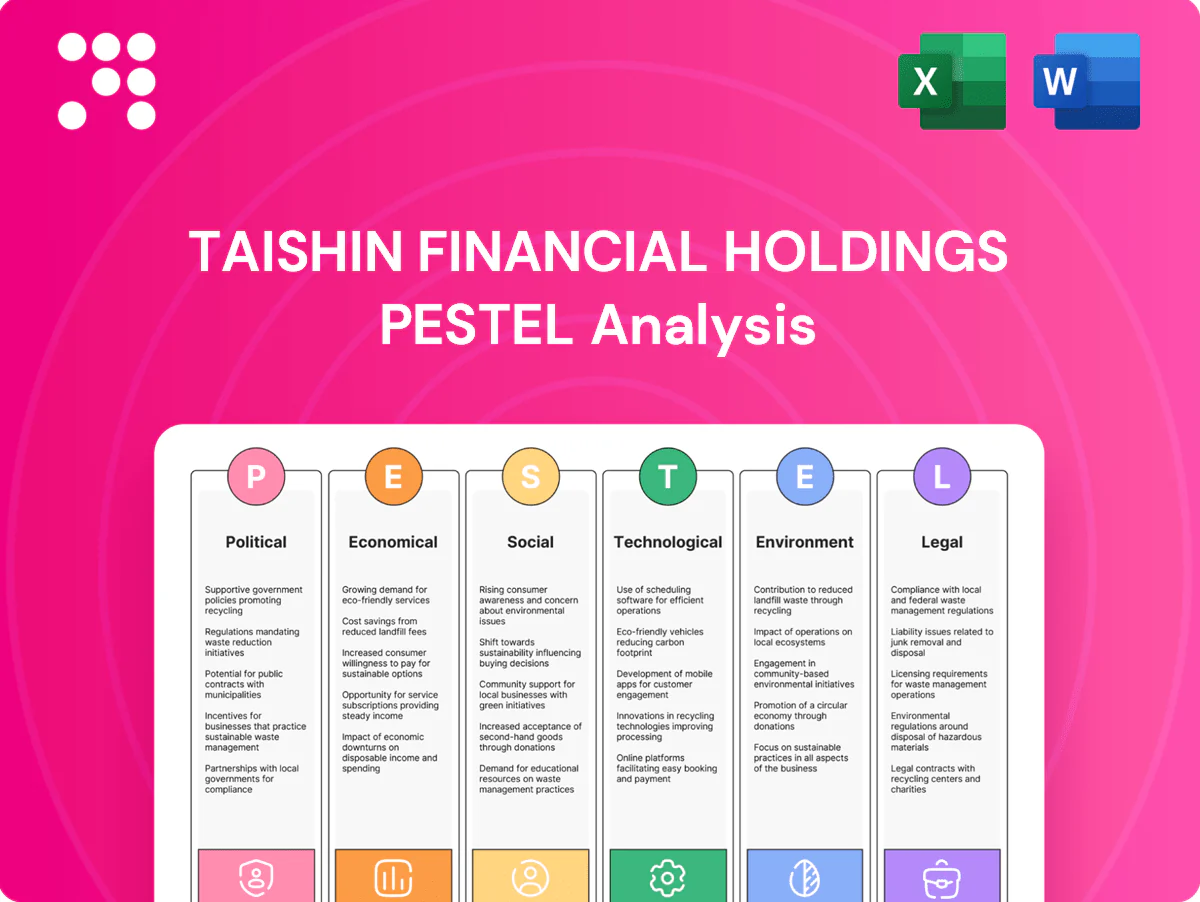
Taishin Financial Holdings PESTLE Analysis
This Taishin Financial Holdings PESTLE Analysis provides a concise, professionally structured review of political, economic, social, technological, legal, and environmental factors affecting the group. The preview shown here is the exact document you’ll receive after purchase—fully formatted and ready to use. No placeholders or teasers; the file you see is the final version available instantly after checkout.

Original: $10.00
-65%$10.00
$3.50Product Information
Product Information
Shipping & Returns
Shipping & Returns
Description
Make Smarter Strategic Decisions with a Complete PESTEL View
Unlock strategic clarity with our PESTLE Analysis of Taishin Financial Holdings—three to five actionable insights into political, economic, social, technological, legal, and environmental forces shaping its future. Perfect for investors, advisors, and strategists, this concise briefing highlights risks and opportunities you can act on immediately. Purchase the full report to access the complete, editable analysis and make smarter decisions today.
Political factors
Cross-Strait geopolitical risk
Heightened China–Taiwan tensions can raise risk premiums and funding costs for Taishin, requiring scenario planning for market volatility, FX swings and supply‑chain shocks that hit corporate clients. Taiwan's foreign exchange reserves were about US$540 billion at end‑2024, underscoring systemic liquidity importance. Business continuity plans and liquidity buffers must be stress‑tested; diversification of offshore booking centers reduces concentration risk.
Regulatory oversight by Taiwan FSC
Frequent supervisory updates from the Taiwan Financial Supervisory Commission, including its fintech sandbox launched in 2016 and open banking guidelines issued in 2021, force Taishin to adjust capital allocation, product design and sales practices. Proactive compliance and RegTech adoption have been shown to cut remediation cycles and costs in regional banks. Active engagement with the FSC can influence rule-making, while strong governance boosts stakeholder trust.
Monetary policy coordination
Central Bank of the Republic of China rate moves (policy rate at 1.875% as of mid-2025) materially shift Taishin’s NIM (group NIM 1.31% in 2024), loan demand (loan growth -2.3% in 2024) and securities valuations; rapid tightening elevates credit risk while easing compresses margins. Asset-liability duration management is essential given duration gaps and rising rates, and hedging policies should align with expected policy cycles to protect capital and NIM.
Public-sector digital finance initiatives
Public-sector digital ID, e-payments and inclusive finance programs reshape competition in Taiwan (population ~23.5 million) by lowering onboarding friction and expanding market reach; Taishin can partner with government and fintechs to capture new retail segments. Participation in national payment rails boosts Taishin's ecosystem relevance and transaction volumes, while compliance with standards avoids fines and preserves clearing access.
- Digital ID: faster KYC, lower onboarding costs
- e-payments: increased transaction flow, fee income
- Inclusive finance: new customer segments
- Standards compliance: access to rails, avoids penalties
Election cycles and policy continuity
Election cycles like Taiwan’s Jan 13, 2024 vote drive shifts in fiscal priorities; housing measures and SME support alter household and corporate credit growth patterns, affecting Taishin’s loan mix and provisioning. Pre- and post-election volatility can lift trading income while increasing VaR and capital charges. Scenario-based planning (stress tests across policy paths) aids budget setting, and proactive stakeholder communication manages reputational exposure in a market of ~23.5 million people.
- Shift impact: housing/SME policies → loan mix & provisioning
- Market effect: election volatility → trading income up, VaR up
- Mitigation: scenario planning & stakeholder comms
Cross-strait tensions lift funding costs and FX risk; reserves and rate squeeze margins
Heightened China–Taiwan tensions raise funding costs and FX risk for Taishin; Taiwan FX reserves ~US$540bn (end‑2024) support systemic liquidity. FSC regulatory updates and fintech rules force capital/product shifts; proactive RegTech reduces remediation costs. CBC policy rate 1.875% (mid‑2025) affects NIM (group NIM 1.31% in 2024) and loan demand (loan growth −2.3% 2024).
| Factor | Key data |
|---|---|
| FX reserves | US$540bn (end‑2024) |
| Policy rate | 1.875% (mid‑2025) |
| Group NIM | 1.31% (2024) |
| Loan growth | −2.3% (2024) |
| Population | ~23.5m |
What is included in the product
Detailed Word Document
Explores how macro-environmental forces uniquely affect Taishin Financial Holdings across Political, Economic, Social, Technological, Environmental and Legal dimensions, with data-driven insights tied to Taiwan’s market and regional dynamics. Designed for executives and investors, the analysis highlights threats, opportunities and forward-looking scenarios to support strategic planning, risk management and funding decisions.
Customizable Excel Spreadsheet
Concise, visually segmented PESTLE summary of Taishin Financial Holdings for quick reference in meetings or presentations, editable for region or business-line notes and easily shared across teams to streamline external risk discussions and strategic planning.
Economic factors
Export-led GDP cyclicality
Taiwan’s GDP is highly export-led, with semiconductors the single largest merchandise export category accounting for over 30% of goods exports, so swings in global tech demand drive loan growth and wealth flows. Downturns elevate NPL risk among SME exporters, historically translating into sectoral credit stress. Countercyclical provisioning can smooth earnings volatility. Regulatory sectoral concentration limits should be enforced to cap systemic exposure.
Interest rate and NIM dynamics
Rate levels (CBC policy rate 1.875% in July 2025) drive deposit beta, asset repricing speed and NIM stability for Taishin; lower deposit beta preserves margins while rapid hikes compress them. Taishin’s barbell strategy—floating-rate corporate loans plus fixed-rate mortgages—helps stabilize earnings versus a reported group NIM around 1.3% in 2024. Robust FTP frameworks align product pricing with funding costs and internal transfer rates. Regulatory stress tests should include rapid 200–300bp rate shock scenarios to assess liquidity and margin resilience.
Housing market and collateral values
Real estate cycles drive Taishin’s mortgage origination and LGD modelling as mortgage book growth slowed to about 2.5% YoY in 2024 while Taiwan household debt remained near 82% of GDP, pressuring collateral assumptions. Macroprudential measures have tightened LTVs—investor loan limits in hot markets often targeted around 60%—reducing origination risk. Geographic and segment diversification in Taishin’s portfolio lowers concentration, and strengthened appraisal governance with early-warning triggers has been prioritized to protect collateral values.
FX exposure and capital flows
USD/TWD volatility—which swung roughly between 29.5 and 34.5 in 2023–24—heightens client hedging demand and drives securities gains and losses; Taishin leverages treasury solutions to deepen corporate relationships while keeping open FX positions small to protect capital, and maintains liquidity buffers in USD, EUR and JPY to lower rollover risk.
- USD/TWD 2023–24 range ~29.5–34.5
- Taiwan FX reserves ~USD 545bn (end-2024)
- Prudent open FX positions = capital protection
- Liquidity buffers in major currencies = reduced rollover risk
Household wealth and savings rate
High household savings (around 10% national savings rate in 2023) underpins Taishin Financials wealth management AUM and fee income, while Taiwan’s aging population—65+ about 17% in 2023—fuels retirement planning demand that lifts cross‑sell into insurance and asset management.
Digital advisory platforms can scale mass‑affluent penetration, lowering costs per client and boosting recurring fee revenue.
Cross-strait tensions lift funding costs and FX risk; reserves and rate squeeze margins
Taiwan’s export‑led GDP (semiconductors >30% of goods exports) makes Taishin sensitive to global tech cycles, affecting loan growth and NPLs. CBC policy rate 1.875% (Jul 2025) and NIM ~1.3% (2024) shape margin dynamics; rapid 200–300bp shocks raise stress. Mortgage book +2.5% YoY (2024) amid household debt ~82% GDP and 65+ ~17% (2023), boosting wealth demand.
| Metric | Value |
|---|---|
| CBC rate Jul 2025 | 1.875% |
| NIM (2024) | ~1.3% |
| Semiconductor exports | >30% |
| FX reserves end‑2024 | USD 545bn |
| Household debt | ~82% GDP |
Preview the Actual Deliverable
Taishin Financial Holdings PESTLE Analysis
This Taishin Financial Holdings PESTLE Analysis provides a concise, professionally structured review of political, economic, social, technological, legal, and environmental factors affecting the group. The preview shown here is the exact document you’ll receive after purchase—fully formatted and ready to use. No placeholders or teasers; the file you see is the final version available instantly after checkout.