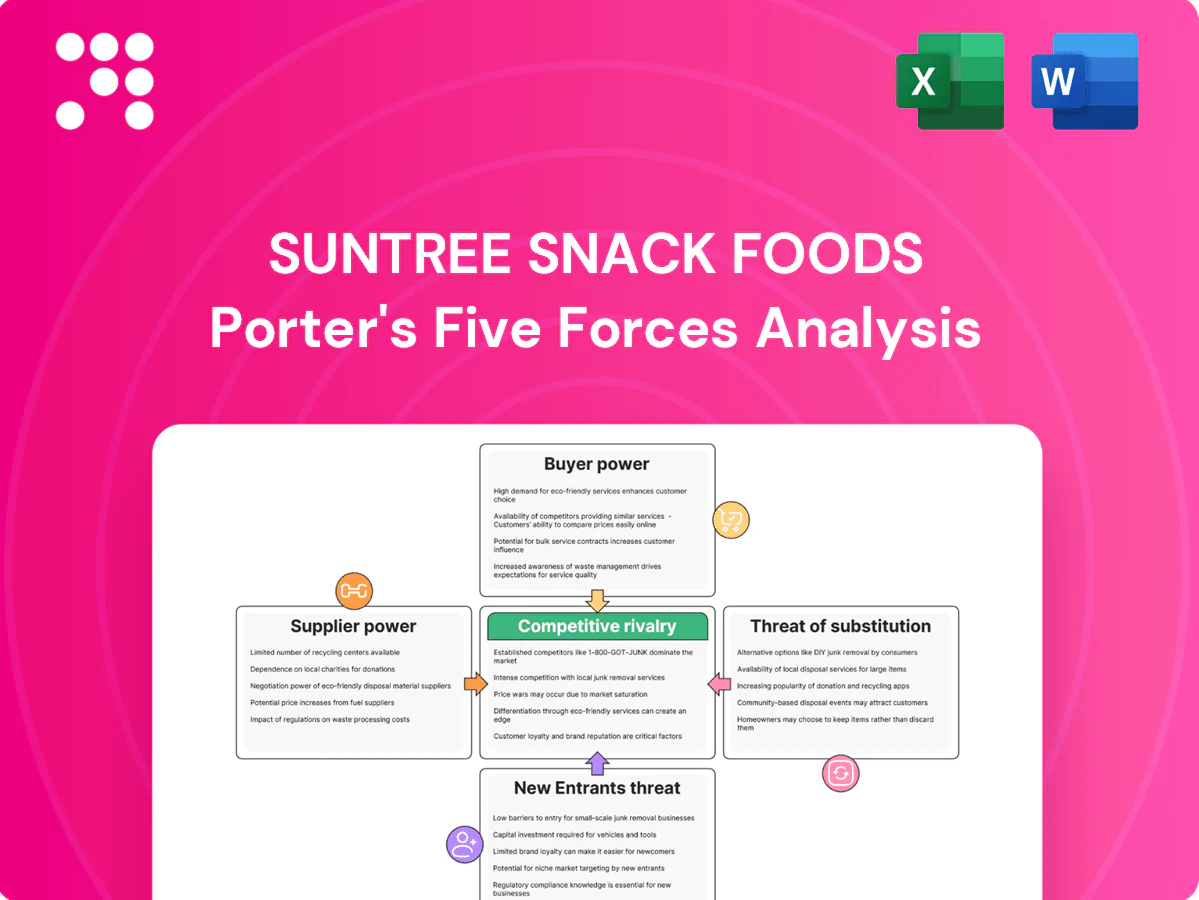
SunTree Snack Foods Porter's Five Forces Analysis

A Must-Have Tool for Decision-Makers
SunTree faces strong buyer power and growing substitute threats as health trends reshape snacking. Supplier leverage and retailer gatekeeping can compress margins. Economies of scale limit new entrants. This brief snapshot only scratches the surface. Unlock the full Porter's Five Forces Analysis to explore SunTree Snack Foods’s competitive dynamics, market pressures, and strategic advantages in detail.
Suppliers Bargaining Power

Concentrated nut origins
Core inputs like almonds and pistachios are highly concentrated—California supplies roughly 80% of the world almond crop—while cashew processing is dominated by Vietnam and West African exporters, creating supplier leverage. Weather shocks, export curbs and yield variability have driven spot nut prices swings exceeding 20% in some seasons. Supplier power spikes during shortages; long-term contracts and multi-origin sourcing can partially offset this risk.
Commodity price volatility
Nuts, cocoa, sugar and dairy for yogurt coatings saw global swings—commodity prices moved roughly 20–40% across 2022–2024, complicating long‑term pricing commitments and squeezing SunTree's margins. Suppliers often pass cost spikes faster than buyers accept, creating timing mismatches. Hedging and indexed pricing (e.g., cocoa and sugar indices, dairy futures) are used to stabilize exposure, reducing margin volatility.

Quality and certification requirements
FSMA compliance and GFSI-benchmarked certification (about 20 schemes as of 2024), plus organic, non-GMO and strict allergen controls, shrink the pool of qualified raw-material suppliers, concentrating purchasing power. Fewer compliant suppliers can command better pricing and payment terms, and organic/non-GMO premiums often add 5–30% to input costs. SunTree’s detailed specs and third-party audits raise switching costs and contract lock-in, while supplier development programs can expand qualified options over time.

Packaging and specialty inputs
Packaging components—film, cans, jars, valves, printing—come from specialized converters with typical lead times of 8–12 weeks and MOQs often >50,000 units in 2024, giving suppliers pricing and timing leverage during tight capacity; design changes and tooling (setup costs up to $100k) create lock-in that raises switching costs for SunTree.
- Top converters: ~60% market share (top 5, 2024)
- Lead times: 8–12 weeks
- MOQs: >50k units
- Dual-sourcing + standard formats can cut disruption exposure ≈40%
Logistics and freight constraints
Refrigerated and dry freight costs swing with fuel and capacity cycles: US diesel averaged about $3.60/gal in 2024 and spot ocean rates spiked 30–60% in peak windows; port congestion (LA/LB dwell ~3.5 days in 2024) and geopolitical risks to major suppliers (Ivory Coast supplies ~40% of world cocoa) can delay nuts and cocoa, boosting carrier and broker leverage.
- Forward-booked lanes reduce spot exposure
- Near-port warehousing cuts delay costs
- Peak-season surcharges raise rates 20–50%
Supplier control: concentrated packaging, volatile commodities and certification premiums
Supplier power is high: California supplies ~80% of almonds and top 5 packaging converters hold ~60% market share (2024), concentrating leverage. Commodity inputs (nuts, cocoa, sugar, dairy) swung 20–40% across 2022–2024, squeezing margins. Certification/spec requirements narrow qualified suppliers, adding 5–30% premiums. Dual-sourcing, hedging and forward freight reduce exposure.
| Metric | Value (2024) |
|---|---|
| Almond supply (CA) | ~80% |
| Packaging top5 share | ~60% |
| Commodity volatility | 20–40% |
| Organic/non‑GMO premium | 5–30% |
What is included in the product
 Detailed Word Document
Tailored Porter's Five Forces analysis for SunTree Snack Foods, uncovering key drivers of competition, supplier and buyer power, substitutes, and entry threats; identifies disruptive forces and strategic levers affecting pricing and profitability to inform investor and management decisions.

 Customizable Excel Spreadsheet
Compact Porter's Five Forces snapshot for SunTree Snack Foods—quickly identify supplier pressure, buyer leverage, new-entry risk, substitutes, and competitive rivalry to soothe strategic uncertainty and speed board-level decisions.
Customers Bargaining Power

Large retailers’ scale leverage
Grocers, club stores and mass merchants like Walmart (≈24% of US grocery sales in 2024) and Costco exert scale leverage, commanding shelf access and volume. They press for low pricing, chargebacks and strict OTIF terms; private brands reached roughly 18% of US grocery sales in 2024, amplifying negotiating power. SunTree must trade price for volume, share POS data or offer exclusives to secure placement.
Private label price sensitivity
Private-label buyers benchmark aggressively across co-packers—2024 U.S. grocery private-label penetration reached about 19%, intensifying price-comparison pressure on SunTree. Small spec differences (ingredient, pack weight, shelf life) routinely trigger competitive bids and re-sourcing within weeks. Thin, single-digit private-label margins heighten buyer scrutiny of yields and scrap, while demonstrated efficiency and service KPIs (fill rate, on-time %) reduce constant rebids.

Switching ease among co-packers
Comparable roasting, mixing and coating capabilities are widely available among co-packers, so switching is often measured in weeks to a few months and costs are moderate when formulas and packaging are standardized. Custom blends, proprietary seasoning IP and certified processes create stronger barriers by requiring formulation transfer and QA validation. Performance guarantees, joint demand planning and slotting agreements increase stickiness and reduce buyer leverage.

Multi-channel diversification
Multi-channel diversification in 2024 shows foodservice and industrial buyers deliver volume but press on cost-to-serve, squeezing per-unit margins; concentration among top retail accounts amplifies buyer power while a broad customer mix dilutes any single buyer’s influence; channel-specific SLAs help defend margins by allocating service costs appropriately.
- Foodservice/industrial: volume vs cost-to-serve
- Top retail concentration increases leverage
- Broad mix reduces single-buyer risk
- Channel SLAs protect margins
Demand for sustainability and transparency
Buyers increasingly demand traceability, ethical sourcing, and carbon reporting, raising compliance costs and narrowing supplier options while still expecting stable prices; certifications and audited programs therefore shift from differentiators to procurement requirements. The EU CSRD rollout in 2024 extends reporting to about 50,000 companies, increasing verified supply-chain disclosures and justifying premiums or preferred status for compliant suppliers.
- Traceability required
- CSRD: ~50,000 firms affected (2024)
- Certifications now RFP baseline
- Audited programs → premium/preferred
Retail price power: private-label 19%, CSRD 50k
Large retailers (Walmart ≈24% US grocery sales 2024) and club chains exert strong price/placement leverage; private-label penetration ~19% in 2024 intensifies price benchmarking. Switching to co-packers is fast for standard SKUs, raising buyer power, while proprietary formulations and SLAs add stickiness. Traceability and CSRD compliance (~50,000 firms affected in 2024) are now procurement baselines, raising supplier costs.
| Metric | 2024 Value |
|---|---|
| Walmart share | ≈24% |
| Private-label grocery | ≈19% |
| CSRD scope | ~50,000 firms |
Full Version Awaits
SunTree Snack Foods Porter's Five Forces Analysis
This preview shows the exact Porter’s Five Forces analysis for SunTree Snack Foods you’ll receive after purchase—fully formatted, complete, and ready for immediate use. No samples, no placeholders: the document displayed is the final deliverable. Once you buy, you’ll get instant access to this same file for download and application.

Product Information
Product Information
Shipping & Returns
Shipping & Returns
Description
A Must-Have Tool for Decision-Makers
SunTree faces strong buyer power and growing substitute threats as health trends reshape snacking. Supplier leverage and retailer gatekeeping can compress margins. Economies of scale limit new entrants. This brief snapshot only scratches the surface. Unlock the full Porter's Five Forces Analysis to explore SunTree Snack Foods’s competitive dynamics, market pressures, and strategic advantages in detail.
Suppliers Bargaining Power
Concentrated nut origins
Core inputs like almonds and pistachios are highly concentrated—California supplies roughly 80% of the world almond crop—while cashew processing is dominated by Vietnam and West African exporters, creating supplier leverage. Weather shocks, export curbs and yield variability have driven spot nut prices swings exceeding 20% in some seasons. Supplier power spikes during shortages; long-term contracts and multi-origin sourcing can partially offset this risk.
Commodity price volatility
Nuts, cocoa, sugar and dairy for yogurt coatings saw global swings—commodity prices moved roughly 20–40% across 2022–2024, complicating long‑term pricing commitments and squeezing SunTree's margins. Suppliers often pass cost spikes faster than buyers accept, creating timing mismatches. Hedging and indexed pricing (e.g., cocoa and sugar indices, dairy futures) are used to stabilize exposure, reducing margin volatility.
Quality and certification requirements
FSMA compliance and GFSI-benchmarked certification (about 20 schemes as of 2024), plus organic, non-GMO and strict allergen controls, shrink the pool of qualified raw-material suppliers, concentrating purchasing power. Fewer compliant suppliers can command better pricing and payment terms, and organic/non-GMO premiums often add 5–30% to input costs. SunTree’s detailed specs and third-party audits raise switching costs and contract lock-in, while supplier development programs can expand qualified options over time.
Packaging and specialty inputs
Packaging components—film, cans, jars, valves, printing—come from specialized converters with typical lead times of 8–12 weeks and MOQs often >50,000 units in 2024, giving suppliers pricing and timing leverage during tight capacity; design changes and tooling (setup costs up to $100k) create lock-in that raises switching costs for SunTree.
- Top converters: ~60% market share (top 5, 2024)
- Lead times: 8–12 weeks
- MOQs: >50k units
- Dual-sourcing + standard formats can cut disruption exposure ≈40%
Logistics and freight constraints
Refrigerated and dry freight costs swing with fuel and capacity cycles: US diesel averaged about $3.60/gal in 2024 and spot ocean rates spiked 30–60% in peak windows; port congestion (LA/LB dwell ~3.5 days in 2024) and geopolitical risks to major suppliers (Ivory Coast supplies ~40% of world cocoa) can delay nuts and cocoa, boosting carrier and broker leverage.
- Forward-booked lanes reduce spot exposure
- Near-port warehousing cuts delay costs
- Peak-season surcharges raise rates 20–50%
Supplier control: concentrated packaging, volatile commodities and certification premiums
Supplier power is high: California supplies ~80% of almonds and top 5 packaging converters hold ~60% market share (2024), concentrating leverage. Commodity inputs (nuts, cocoa, sugar, dairy) swung 20–40% across 2022–2024, squeezing margins. Certification/spec requirements narrow qualified suppliers, adding 5–30% premiums. Dual-sourcing, hedging and forward freight reduce exposure.
| Metric | Value (2024) |
|---|---|
| Almond supply (CA) | ~80% |
| Packaging top5 share | ~60% |
| Commodity volatility | 20–40% |
| Organic/non‑GMO premium | 5–30% |
What is included in the product
Detailed Word Document
Tailored Porter's Five Forces analysis for SunTree Snack Foods, uncovering key drivers of competition, supplier and buyer power, substitutes, and entry threats; identifies disruptive forces and strategic levers affecting pricing and profitability to inform investor and management decisions.
Customizable Excel Spreadsheet
Compact Porter's Five Forces snapshot for SunTree Snack Foods—quickly identify supplier pressure, buyer leverage, new-entry risk, substitutes, and competitive rivalry to soothe strategic uncertainty and speed board-level decisions.
Customers Bargaining Power
Large retailers’ scale leverage
Grocers, club stores and mass merchants like Walmart (≈24% of US grocery sales in 2024) and Costco exert scale leverage, commanding shelf access and volume. They press for low pricing, chargebacks and strict OTIF terms; private brands reached roughly 18% of US grocery sales in 2024, amplifying negotiating power. SunTree must trade price for volume, share POS data or offer exclusives to secure placement.
Private label price sensitivity
Private-label buyers benchmark aggressively across co-packers—2024 U.S. grocery private-label penetration reached about 19%, intensifying price-comparison pressure on SunTree. Small spec differences (ingredient, pack weight, shelf life) routinely trigger competitive bids and re-sourcing within weeks. Thin, single-digit private-label margins heighten buyer scrutiny of yields and scrap, while demonstrated efficiency and service KPIs (fill rate, on-time %) reduce constant rebids.
Switching ease among co-packers
Comparable roasting, mixing and coating capabilities are widely available among co-packers, so switching is often measured in weeks to a few months and costs are moderate when formulas and packaging are standardized. Custom blends, proprietary seasoning IP and certified processes create stronger barriers by requiring formulation transfer and QA validation. Performance guarantees, joint demand planning and slotting agreements increase stickiness and reduce buyer leverage.
Multi-channel diversification
Multi-channel diversification in 2024 shows foodservice and industrial buyers deliver volume but press on cost-to-serve, squeezing per-unit margins; concentration among top retail accounts amplifies buyer power while a broad customer mix dilutes any single buyer’s influence; channel-specific SLAs help defend margins by allocating service costs appropriately.
- Foodservice/industrial: volume vs cost-to-serve
- Top retail concentration increases leverage
- Broad mix reduces single-buyer risk
- Channel SLAs protect margins
Demand for sustainability and transparency
Buyers increasingly demand traceability, ethical sourcing, and carbon reporting, raising compliance costs and narrowing supplier options while still expecting stable prices; certifications and audited programs therefore shift from differentiators to procurement requirements. The EU CSRD rollout in 2024 extends reporting to about 50,000 companies, increasing verified supply-chain disclosures and justifying premiums or preferred status for compliant suppliers.
- Traceability required
- CSRD: ~50,000 firms affected (2024)
- Certifications now RFP baseline
- Audited programs → premium/preferred
Retail price power: private-label 19%, CSRD 50k
Large retailers (Walmart ≈24% US grocery sales 2024) and club chains exert strong price/placement leverage; private-label penetration ~19% in 2024 intensifies price benchmarking. Switching to co-packers is fast for standard SKUs, raising buyer power, while proprietary formulations and SLAs add stickiness. Traceability and CSRD compliance (~50,000 firms affected in 2024) are now procurement baselines, raising supplier costs.
| Metric | 2024 Value |
|---|---|
| Walmart share | ≈24% |
| Private-label grocery | ≈19% |
| CSRD scope | ~50,000 firms |
Full Version Awaits
SunTree Snack Foods Porter's Five Forces Analysis
This preview shows the exact Porter’s Five Forces analysis for SunTree Snack Foods you’ll receive after purchase—fully formatted, complete, and ready for immediate use. No samples, no placeholders: the document displayed is the final deliverable. Once you buy, you’ll get instant access to this same file for download and application.