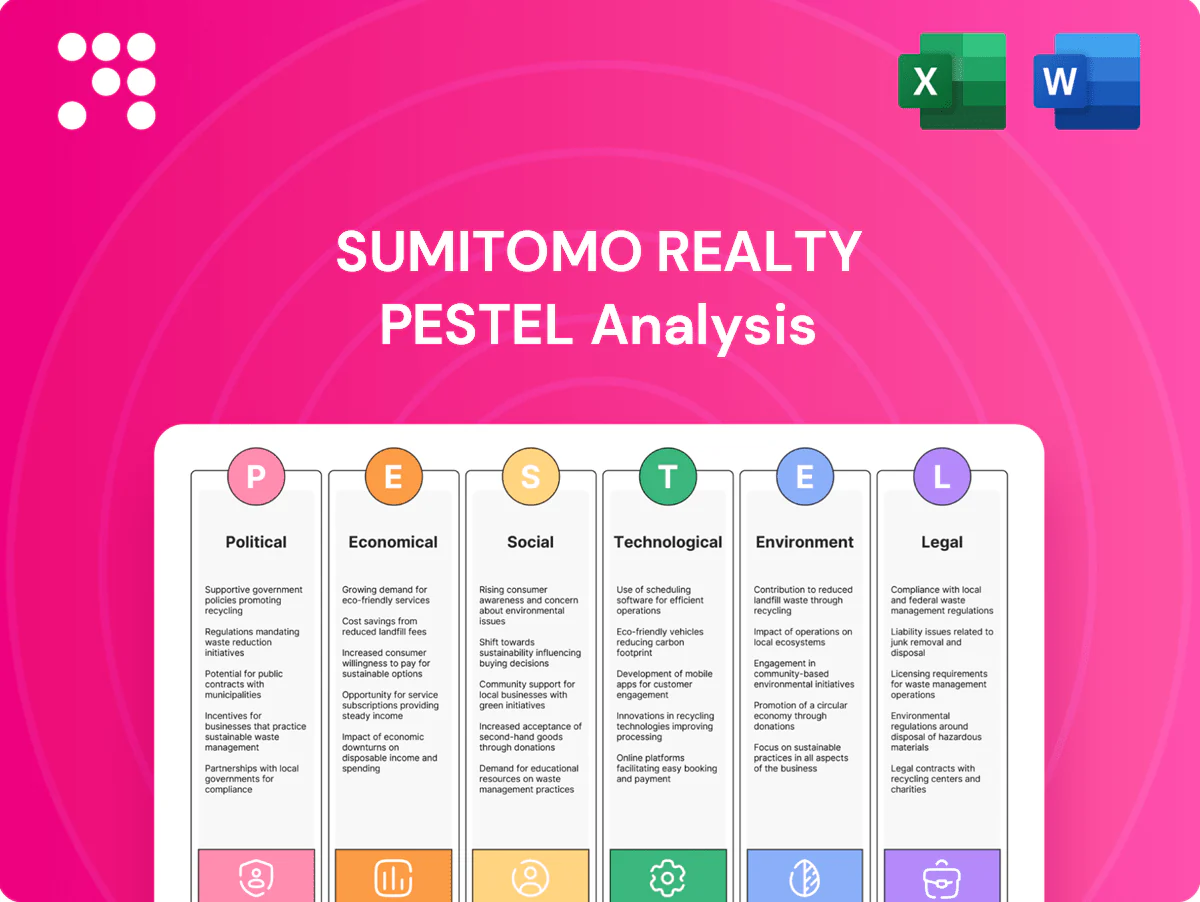
Sumitomo Realty PESTLE Analysis

Skip the Research. Get the Strategy.
Discover how political shifts, economic cycles, social trends, technological advances, legal frameworks, and environmental pressures are shaping Sumitomo Realty's strategic outlook in our concise PESTLE snapshot. This analysis highlights key risks and opportunities investors and planners need now. Buy the full PESTLE to get the complete, ready-to-use insights and actionable recommendations.
Political factors

Urban redevelopment priorities
National and Tokyo metropolitan policies steer where large-scale redevelopment occurs, concentrating projects in priority zones serving Tokyo's ~14 million residents. Priority designation can unlock higher floor-area ratios and infrastructure co-funding, de-risking entitlements and accelerating timelines for developers like Sumitomo Realty. Misalignment with government masterplans can stall approvals and raise carrying costs through longer holding periods.
Zoning and land-use stability
Local governments control zoning, density and use changes critical for Sumitomo Realty's mixed-use projects; Tokyo's 23 wards house about 9.7 million residents, concentrating demand and regulatory scrutiny. Stable zoning frameworks reduce entitlement risk and preserve land-bank value, while sudden revisions can materially impair asset valuations. Transparent processes aid underwriting by shortening approval uncertainty. Political turnover can change timelines and approval criteria, raising execution risk.

Public infrastructure investment
Transit expansions and resilience works, including the Chuo Shinkansen partial opening planned for 2027, boost site accessibility and can lift nearby asset values by improving commuter flows. Coordination with rail operators and municipal agencies accelerates transit-oriented development and higher footfall. Delays or budget cuts reduce projected rents and visitation. Strategic site assembly near funded corridors is a clear competitive advantage.

Tourism and visa policies
Inbound travel rules directly drive hotel occupancy and ADR; Japan received 31.88 million visitors in 2023 (JNTO), and visa easing and promotional campaigns have lifted ADR and RevPAR versus pandemic lows while restrictions compress revenues. Predictable policy timelines inform capex for hotel pipelines, and regional diplomatic shifts rapidly redirect visitor flows.
- 2023 inbound tourists: 31.88M (JNTO)
- Visa easing → higher ADR/occupancy
- Restrictions → immediate revenue hit
- Policy predictability guides hotel capex
- Regional diplomacy alters visitor sources
Disaster preparedness initiatives
Government mandates on disaster readiness shape Sumitomo Realty building specs and operations, reflecting Japan's high seismicity with roughly 1,500 felt earthquakes yearly; subsidies and guidance for seismic retrofits (reducing retrofit costs) and evacuation infrastructure lower compliance burdens. Participation in public-private drills boosts reputation and tenant trust, while non-compliance risks fines and reputational damage.
- Mandates: drive design/ops
- Subsidies: cut retrofit costs
- Drills: improve trust
- Non-compliance: fines/reputation
Redevelopment near 14.0M residents boosts TOD, hotels, seismic retrofits
National and Tokyo policies concentrate redevelopment in priority zones near 14.0M Tokyo residents and 9.7M in 23 wards, speeding approvals and boosting FAR benefits for Sumitomo Realty. Transit projects (Chuo Shinkansen partial 2027) and 31.88M inbound tourists in 2023 raise TOD and hotel upside, while ~1,500 felt quakes/yr drive seismic mandates and retrofit subsidies.
| Metric | Value |
|---|---|
| Tokyo pop. | 14.0M |
| 23 wards pop. | 9.7M |
| Inbound tourists 2023 | 31.88M |
| Felt earthquakes/yr | ~1,500 |
| Chuo Shinkansen | partial 2027 |
What is included in the product
 Detailed Word Document
Explores how macro-environmental forces—Political, Economic, Social, Technological, Environmental, and Legal—specifically impact Sumitomo Realty, with each section backed by current data and trends to identify risks and opportunities; designed for executives and investors and includes forward‑looking insights for scenario planning.

 Customizable Excel Spreadsheet
A concise, visually segmented PESTLE summary of Sumitomo Realty that’s easy to drop into presentations or pitch packs, editable for local context and business lines to support quick team alignment and external risk discussions.
Economic factors

Interest rate and credit conditions
Financing costs drive development feasibility and asset valuations for Sumitomo Realty, with BOJ policy rates near 0–0.1% in 2024–25 and global funding (US Fed funds ~5.25–5.50%) influencing cross-border capital. Central bank policy and bank lending appetite affect cap rates and pipeline pacing, where low rates support refinancing and acquisitions while tightening compresses margins. Access to green or sustainability-linked loans helps offset rate pressure and lower effective borrowing costs.
Construction costs and labor
Input inflation in construction materials and skilled labour has compressed project IRRs for Sumitomo Realty, forcing tighter margins and more rigorous bid screening.
Supply-chain volatility requires contingencies and early procurement to lock prices and protect timelines.
Partnering with reliable general-contractor networks stabilizes schedules and reduces delay risk.
Value engineering and modularization are active strategies to defend margins and accelerate delivery.

Demand for office and retail
Hybrid work is reshaping office footprints and tenant priorities, pushing demand toward flexible, amenity-rich spaces while reducing need for commodity floorplate. Prime, green-certified assets command rent resilience; commodity stock faces downward pressure. Retail recovery depends on consumer confidence and tourism—Japan saw 31.88 million inbound visitors in 2023—so active asset management and repositioning remain vital.

Housing market dynamics
Demographics and mortgage availability shape condo versus detached absorption in Japan’s shrinking population of about 125 million (2024); urban cores like Tokyo 23 wards (≈9.7m) sustain demand due to transport links and wages, while pricing power varies widely by micro-market and unit mix; pre-sales pace controls cash flow and leverage for developers amid higher funding costs since BOJ policy normalization.
- Demographics: Japan ≈125m (2024)
- Urban resilience: Tokyo 23 wards ≈9.7m
- Pricing: micro-market/unit mix dependent
- Cash flow: pre-sales pace dictates leverage
Currency and inbound capital
- USD/JPY ~155 (mid‑2025)
- Inbound tourists ~25M (2024)
- Hedging mitigates FX translation/transaction risk
- Global liquidity affects JV exits and pricing
Redevelopment near 14.0M residents boosts TOD, hotels, seismic retrofits
Low BOJ rates (0–0.1% 2024–25) but higher global funding (US Fed 5.25–5.50%) shape cap rates and refinancing. Construction inflation and labour squeeze IRRs; modularization and green loans offset costs. Yen ~155 (mid‑2025) and 25M inbound tourists (2024) support hospitality; Tokyo cores (≈9.7M) preserve demand amid Japan population ≈125M.
| Metric | Value |
|---|---|
| BOJ policy | 0–0.1% (2024–25) |
| US Fed | 5.25–5.50% |
| USD/JPY | ~155 (mid‑2025) |
| Inbound tourists | 25M (2024) |
| Japan pop | ≈125M (2024) |
| Tokyo 23W | ≈9.7M |
Preview the Actual Deliverable
Sumitomo Realty PESTLE Analysis
The preview of the Sumitomo Realty PESTLE Analysis shown here is the exact document you’ll receive after purchase—fully formatted and ready to use. This is the real, final file with complete content, structure, and professional layout. No placeholders or teasers; you’ll download this same document immediately after checkout.

Product Information
Product Information
Shipping & Returns
Shipping & Returns
Description
Skip the Research. Get the Strategy.
Discover how political shifts, economic cycles, social trends, technological advances, legal frameworks, and environmental pressures are shaping Sumitomo Realty's strategic outlook in our concise PESTLE snapshot. This analysis highlights key risks and opportunities investors and planners need now. Buy the full PESTLE to get the complete, ready-to-use insights and actionable recommendations.
Political factors
Urban redevelopment priorities
National and Tokyo metropolitan policies steer where large-scale redevelopment occurs, concentrating projects in priority zones serving Tokyo's ~14 million residents. Priority designation can unlock higher floor-area ratios and infrastructure co-funding, de-risking entitlements and accelerating timelines for developers like Sumitomo Realty. Misalignment with government masterplans can stall approvals and raise carrying costs through longer holding periods.
Zoning and land-use stability
Local governments control zoning, density and use changes critical for Sumitomo Realty's mixed-use projects; Tokyo's 23 wards house about 9.7 million residents, concentrating demand and regulatory scrutiny. Stable zoning frameworks reduce entitlement risk and preserve land-bank value, while sudden revisions can materially impair asset valuations. Transparent processes aid underwriting by shortening approval uncertainty. Political turnover can change timelines and approval criteria, raising execution risk.
Public infrastructure investment
Transit expansions and resilience works, including the Chuo Shinkansen partial opening planned for 2027, boost site accessibility and can lift nearby asset values by improving commuter flows. Coordination with rail operators and municipal agencies accelerates transit-oriented development and higher footfall. Delays or budget cuts reduce projected rents and visitation. Strategic site assembly near funded corridors is a clear competitive advantage.
Tourism and visa policies
Inbound travel rules directly drive hotel occupancy and ADR; Japan received 31.88 million visitors in 2023 (JNTO), and visa easing and promotional campaigns have lifted ADR and RevPAR versus pandemic lows while restrictions compress revenues. Predictable policy timelines inform capex for hotel pipelines, and regional diplomatic shifts rapidly redirect visitor flows.
- 2023 inbound tourists: 31.88M (JNTO)
- Visa easing → higher ADR/occupancy
- Restrictions → immediate revenue hit
- Policy predictability guides hotel capex
- Regional diplomacy alters visitor sources
Disaster preparedness initiatives
Government mandates on disaster readiness shape Sumitomo Realty building specs and operations, reflecting Japan's high seismicity with roughly 1,500 felt earthquakes yearly; subsidies and guidance for seismic retrofits (reducing retrofit costs) and evacuation infrastructure lower compliance burdens. Participation in public-private drills boosts reputation and tenant trust, while non-compliance risks fines and reputational damage.
- Mandates: drive design/ops
- Subsidies: cut retrofit costs
- Drills: improve trust
- Non-compliance: fines/reputation
Redevelopment near 14.0M residents boosts TOD, hotels, seismic retrofits
National and Tokyo policies concentrate redevelopment in priority zones near 14.0M Tokyo residents and 9.7M in 23 wards, speeding approvals and boosting FAR benefits for Sumitomo Realty. Transit projects (Chuo Shinkansen partial 2027) and 31.88M inbound tourists in 2023 raise TOD and hotel upside, while ~1,500 felt quakes/yr drive seismic mandates and retrofit subsidies.
| Metric | Value |
|---|---|
| Tokyo pop. | 14.0M |
| 23 wards pop. | 9.7M |
| Inbound tourists 2023 | 31.88M |
| Felt earthquakes/yr | ~1,500 |
| Chuo Shinkansen | partial 2027 |
What is included in the product
Detailed Word Document
Explores how macro-environmental forces—Political, Economic, Social, Technological, Environmental, and Legal—specifically impact Sumitomo Realty, with each section backed by current data and trends to identify risks and opportunities; designed for executives and investors and includes forward‑looking insights for scenario planning.
Customizable Excel Spreadsheet
A concise, visually segmented PESTLE summary of Sumitomo Realty that’s easy to drop into presentations or pitch packs, editable for local context and business lines to support quick team alignment and external risk discussions.
Economic factors
Interest rate and credit conditions
Financing costs drive development feasibility and asset valuations for Sumitomo Realty, with BOJ policy rates near 0–0.1% in 2024–25 and global funding (US Fed funds ~5.25–5.50%) influencing cross-border capital. Central bank policy and bank lending appetite affect cap rates and pipeline pacing, where low rates support refinancing and acquisitions while tightening compresses margins. Access to green or sustainability-linked loans helps offset rate pressure and lower effective borrowing costs.
Construction costs and labor
Input inflation in construction materials and skilled labour has compressed project IRRs for Sumitomo Realty, forcing tighter margins and more rigorous bid screening.
Supply-chain volatility requires contingencies and early procurement to lock prices and protect timelines.
Partnering with reliable general-contractor networks stabilizes schedules and reduces delay risk.
Value engineering and modularization are active strategies to defend margins and accelerate delivery.
Demand for office and retail
Hybrid work is reshaping office footprints and tenant priorities, pushing demand toward flexible, amenity-rich spaces while reducing need for commodity floorplate. Prime, green-certified assets command rent resilience; commodity stock faces downward pressure. Retail recovery depends on consumer confidence and tourism—Japan saw 31.88 million inbound visitors in 2023—so active asset management and repositioning remain vital.
Housing market dynamics
Demographics and mortgage availability shape condo versus detached absorption in Japan’s shrinking population of about 125 million (2024); urban cores like Tokyo 23 wards (≈9.7m) sustain demand due to transport links and wages, while pricing power varies widely by micro-market and unit mix; pre-sales pace controls cash flow and leverage for developers amid higher funding costs since BOJ policy normalization.
- Demographics: Japan ≈125m (2024)
- Urban resilience: Tokyo 23 wards ≈9.7m
- Pricing: micro-market/unit mix dependent
- Cash flow: pre-sales pace dictates leverage
Currency and inbound capital
- USD/JPY ~155 (mid‑2025)
- Inbound tourists ~25M (2024)
- Hedging mitigates FX translation/transaction risk
- Global liquidity affects JV exits and pricing
Redevelopment near 14.0M residents boosts TOD, hotels, seismic retrofits
Low BOJ rates (0–0.1% 2024–25) but higher global funding (US Fed 5.25–5.50%) shape cap rates and refinancing. Construction inflation and labour squeeze IRRs; modularization and green loans offset costs. Yen ~155 (mid‑2025) and 25M inbound tourists (2024) support hospitality; Tokyo cores (≈9.7M) preserve demand amid Japan population ≈125M.
| Metric | Value |
|---|---|
| BOJ policy | 0–0.1% (2024–25) |
| US Fed | 5.25–5.50% |
| USD/JPY | ~155 (mid‑2025) |
| Inbound tourists | 25M (2024) |
| Japan pop | ≈125M (2024) |
| Tokyo 23W | ≈9.7M |
Preview the Actual Deliverable
Sumitomo Realty PESTLE Analysis
The preview of the Sumitomo Realty PESTLE Analysis shown here is the exact document you’ll receive after purchase—fully formatted and ready to use. This is the real, final file with complete content, structure, and professional layout. No placeholders or teasers; you’ll download this same document immediately after checkout.