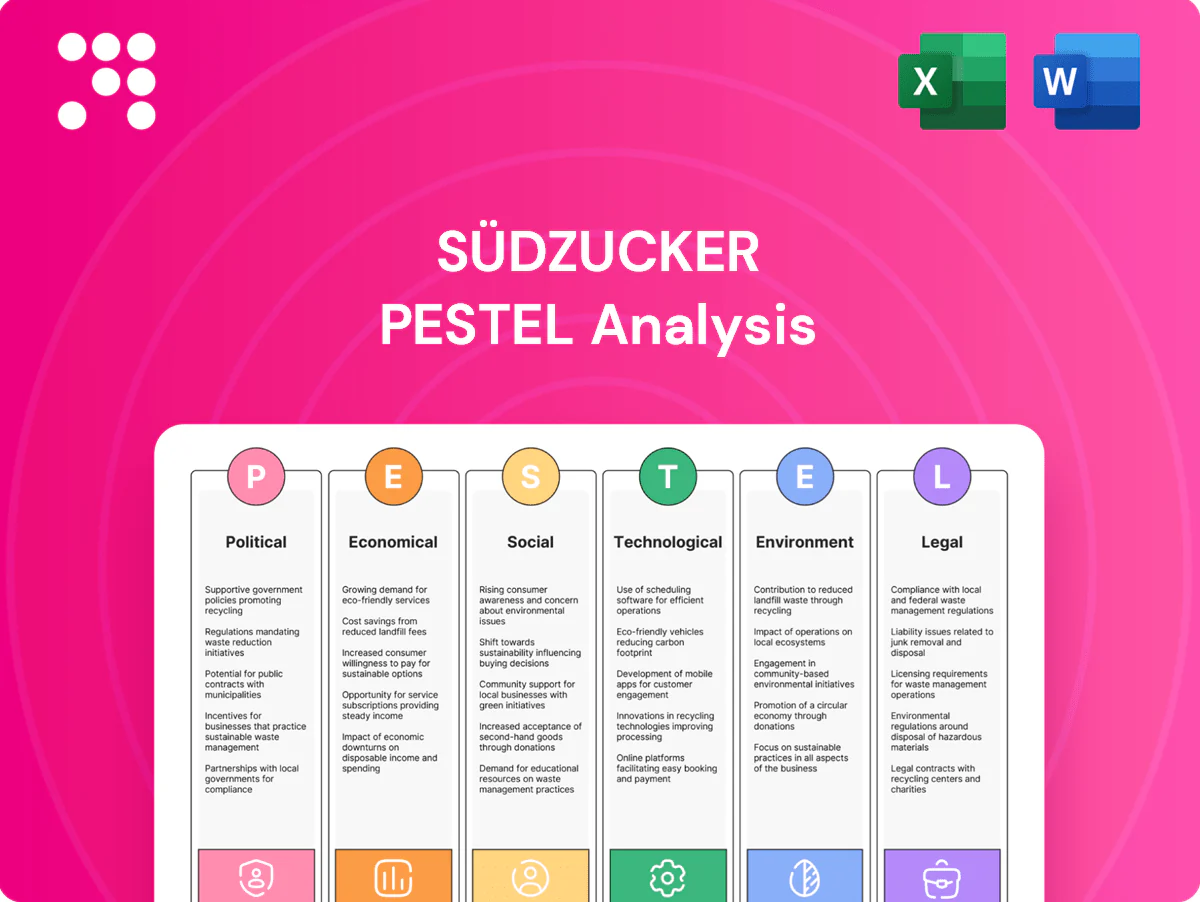
Südzucker PESTLE Analysis

Skip the Research. Get the Strategy.
Discover how political shifts, commodity prices, environmental regulation and changing consumer tastes are shaping Südzucker's strategic outlook in our concise PESTLE snapshot. Ideal for investors and strategists, this summary highlights key risks and opportunities. Purchase the full PESTLE for the complete, actionable analysis and editable deliverables.
Political factors

EU CAP reforms and farm subsidies
EU Common Agricultural Policy budget for 2021–27 is about €387 billion, and reforms altering payments directly affect beet growers’ incomes and crop choices, shifting Südzucker’s beet supply and raw-material costs.
Greening and eco-scheme requirements (notably crop diversification and reduced inputs) are changing rotations and fertilizer/pesticide use, impacting yields per hectare on the EU’s ~1.1 million ha sugar‑beet area.
Südzucker’s active engagement with farmer networks and contractual buying helps stabilize volumes amid shifting subsidy incentives, while policy shifts can accelerate or slow the company’s push to diversify beyond sugar into alternatives such as bioethanol and special sugars.
Trade policy, tariffs, and import quotas
EU tariff-rate quotas for raw cane sugar (~1.35 million tonnes) and an MFN duty around 339 EUR/t shape competitive pressure from imports such as cane sugar and starch derivatives, directly influencing Südzucker’s pricing power and refinery utilization. Any relaxation/tightening of TRQs or duties alters margins and factory run rates. Export growth for starch and fruit preparations depends on bilateral trade deals; sanctions or geopolitical frictions can interrupt ingredient supply chains.

Biofuel and renewable mandates
EU renewable targets under RED II (32% renewables by 2030) and the stronger RED III proposal (about 42.5% by 2030) directly affect beet-byproduct valorization—higher biofuel blending lifts bioethanol demand, co-product margins and plant load factors. Policy support and national blending mandates can materially improve ethanol and biogas unit economics and shorten payback on energy-from-waste investments. Conversely, stricter sustainability criteria and ILUC rules under RED updates may narrow feedstock eligibility and reduce demand for certain beet-derived fuels. These shifts drive Südzucker to reallocate capital across ethanol, biogas and waste-to-energy projects based on evolving mandate certainty.

Geopolitical supply chain risks
Conflict and trade disruptions in Europe push energy and fertilizer costs and clog transport routes; Südzucker, with roughly 17,000 employees and reported group revenue of about €7.9bn in 2023/24, sees margin pressure when TTF natural gas volatility or fertilizer scarcity raises input costs. Its multi-country footprint across ~25 European countries reduces but does not remove route concentration risk. Government interventions (price caps, subsidies) can stabilize or distort costs, making strategic inventories and supplier diversification highly policy-sensitive.
- Energy exposure: gas price volatility
- Fertilizer supply: input availability risk
- Transport routes: regional chokepoints
- Mitigation: multi-country footprint, inventories, supplier diversification
Public health policy and lobbying
- policy: WHO <10% free sugars guidance
- regulation: >50 jurisdictions with SSB taxes by mid‑2024
- engagement: shapes realistic reformulation timelines
- market: higher demand for alternative sweeteners
EU CAP €387bn, RED III boosts bioethanol demand; TRQs, duties and SSB taxes reshape sugar trade
EU CAP €387bn (2021–27) plus greening on ~1.1M ha shift beet incomes and costs; TRQs ~1.35M t and MFN duty ≈339 EUR/t alter import pressure. RED II/RED III (32% / ~42.5% by 2030) and >50 SSB-tax jurisdictions (mid‑2024) reshape bioethanol and reformulation demand. Südzucker (≈€7.9bn rev 2023/24, 17,000 employees) faces input‑cost and trade risks.
| Metric | Value |
|---|---|
| CAP | €387bn |
| TRQ | ~1.35M t |
| RED targets | 32% / ~42.5% (2030) |
What is included in the product
 Detailed Word Document
Explores how macro-environmental factors uniquely affect Südzucker across Political, Economic, Social, Technological, Environmental and Legal dimensions, with data-driven examples and trends tailored to the European sugar and bio-products market. Designed for executives, investors and strategists, it highlights actionable risks and opportunities and includes forward-looking insights for scenario planning and funding-ready presentation use.

 Customizable Excel Spreadsheet
A clean, summarized Südzucker PESTLE for easy referencing in meetings, visually segmented by category and editable for regional or business-line notes—drop-in ready for PowerPoints, shareable across teams, and ideal for supporting external risk discussions and client reports.
Economic factors

Sugar price volatility and cyclicality
Global and EU sugar cycles drive Südzucker revenue swings and capacity use, with world raw sugar averaging about 21.5 c/lb in 2024 (~473 USD/t) and EU white-sugar spot ranges near €450–600/t during 2023–24, shifting margins sharply.
Market tightness or surplus moves refined sugar and molasses prices; hedging mitigates but cannot fully offset multi-year cyclic swings.
Diversification into starch, fruit and pizza businesses has reduced group earnings volatility by spreading exposure beyond sugar.
Energy and logistics cost inflation
Refining and evaporation are energy-intensive processes, so swings in European TTF gas (around 35 EUR/MWh in 2024) and industrial power prices materially affect Südzucker unit costs. Transport tightness — with EU average diesel near 1.60 EUR/L in 2024 — raises inbound beet and outbound finished-goods expenses. Efficiency projects, long-term energy contracts and site-network optimization support margin resilience against these shocks.

Consumer spending and private label dynamics
Household budget pressure in 2024 reduced discretionary spend on frozen pizzas while keeping demand for sugar and staples relatively resilient; euro‑area inflation eased to ~2.6% (2024 average). Downtrading lifted private‑label share to about 34% in Western Europe (PLMA 2024), boosting volumes but compressing margins. Branded innovation and operational excellence can protect mix and pricing power. European foodservice was ~98% of 2019 levels by 2023–24, supporting pizza and fruit‑prep orders.

Input markets for beets, grains, and fruit
Farmer planting decisions respond to relative crop prices and weather, driving seasonal swings in beet availability and input costs. Fruit procurement faces harvest variability and currency-exposed sourcing that can widen cost volatility. Grain and starch derivatives move with global commodity cycles, while strategic contracts and multi-origin sourcing help smooth supply and price shocks.
- beet availability: price- and weather-driven
- fruit procurement: harvest variability, FX exposure
- grain/starch: tied to global commodity cycles
- risk mitigation: contracts and multi-origin sourcing
FX and interest rate environment
EUR strength (EUR/USD ~1.08 in June 2025) reduces Südzucker competitiveness abroad and compresses translated non-euro earnings, while a weaker euro boosts export margins. ECB policy rate ~4.00% (July 2025) raises financing costs for energy-efficiency and tech capex. Prudent leverage and staggered maturities support ongoing investments. Currency hedges limit procurement FX exposure.
- EUR/USD ~1.08 (Jun 2025)
- ECB rate ~4.00% (Jul 2025)
- Hedges mitigate raw-material FX risk
- Staggered debt supports capex
EU CAP €387bn, RED III boosts bioethanol demand; TRQs, duties and SSB taxes reshape sugar trade
Global/EU sugar cycles drive revenue swings; raw sugar ~21.5 c/lb (2024) and EU white sugar €450–600/t (2023–24) shift margins.
Energy (TTF ~35 EUR/MWh in 2024) and diesel (~1.60 EUR/L 2024) materially affect unit costs; efficiency and contracts mitigate.
Private‑label share ~34% (PLMA 2024) cushions volumes but compresses margins; pizza/fruit demand near pre‑COVID levels.
EUR/USD ~1.08 (Jun 2025) and ECB rate ~4.00% (Jul 2025) influence competitiveness and financing costs.
| Metric | Value |
|---|---|
| Raw sugar | 21.5 c/lb (2024) |
| EU white sugar | €450–600/t (2023–24) |
| TTF gas | ~35 EUR/MWh (2024) |
| Diesel | ~1.60 EUR/L (2024) |
| Private‑label | ~34% (2024) |
| EUR/USD | ~1.08 (Jun 2025) |
| ECB rate | ~4.00% (Jul 2025) |
Preview the Actual Deliverable
Südzucker PESTLE Analysis
The preview shown here is the exact Südzucker PESTLE Analysis you’ll receive after purchase—fully formatted and ready to use. It contains the complete Political, Economic, Social, Technological, Legal and Environmental assessment, structured for immediate application. No placeholders or teasers—this is the real, final file you can download after checkout.

Original: $10.00
-65%$10.00
$3.50Product Information
Product Information
Shipping & Returns
Shipping & Returns
Description
Skip the Research. Get the Strategy.
Discover how political shifts, commodity prices, environmental regulation and changing consumer tastes are shaping Südzucker's strategic outlook in our concise PESTLE snapshot. Ideal for investors and strategists, this summary highlights key risks and opportunities. Purchase the full PESTLE for the complete, actionable analysis and editable deliverables.
Political factors
EU CAP reforms and farm subsidies
EU Common Agricultural Policy budget for 2021–27 is about €387 billion, and reforms altering payments directly affect beet growers’ incomes and crop choices, shifting Südzucker’s beet supply and raw-material costs.
Greening and eco-scheme requirements (notably crop diversification and reduced inputs) are changing rotations and fertilizer/pesticide use, impacting yields per hectare on the EU’s ~1.1 million ha sugar‑beet area.
Südzucker’s active engagement with farmer networks and contractual buying helps stabilize volumes amid shifting subsidy incentives, while policy shifts can accelerate or slow the company’s push to diversify beyond sugar into alternatives such as bioethanol and special sugars.
Trade policy, tariffs, and import quotas
EU tariff-rate quotas for raw cane sugar (~1.35 million tonnes) and an MFN duty around 339 EUR/t shape competitive pressure from imports such as cane sugar and starch derivatives, directly influencing Südzucker’s pricing power and refinery utilization. Any relaxation/tightening of TRQs or duties alters margins and factory run rates. Export growth for starch and fruit preparations depends on bilateral trade deals; sanctions or geopolitical frictions can interrupt ingredient supply chains.
Biofuel and renewable mandates
EU renewable targets under RED II (32% renewables by 2030) and the stronger RED III proposal (about 42.5% by 2030) directly affect beet-byproduct valorization—higher biofuel blending lifts bioethanol demand, co-product margins and plant load factors. Policy support and national blending mandates can materially improve ethanol and biogas unit economics and shorten payback on energy-from-waste investments. Conversely, stricter sustainability criteria and ILUC rules under RED updates may narrow feedstock eligibility and reduce demand for certain beet-derived fuels. These shifts drive Südzucker to reallocate capital across ethanol, biogas and waste-to-energy projects based on evolving mandate certainty.
Geopolitical supply chain risks
Conflict and trade disruptions in Europe push energy and fertilizer costs and clog transport routes; Südzucker, with roughly 17,000 employees and reported group revenue of about €7.9bn in 2023/24, sees margin pressure when TTF natural gas volatility or fertilizer scarcity raises input costs. Its multi-country footprint across ~25 European countries reduces but does not remove route concentration risk. Government interventions (price caps, subsidies) can stabilize or distort costs, making strategic inventories and supplier diversification highly policy-sensitive.
- Energy exposure: gas price volatility
- Fertilizer supply: input availability risk
- Transport routes: regional chokepoints
- Mitigation: multi-country footprint, inventories, supplier diversification
Public health policy and lobbying
- policy: WHO <10% free sugars guidance
- regulation: >50 jurisdictions with SSB taxes by mid‑2024
- engagement: shapes realistic reformulation timelines
- market: higher demand for alternative sweeteners
EU CAP €387bn, RED III boosts bioethanol demand; TRQs, duties and SSB taxes reshape sugar trade
EU CAP €387bn (2021–27) plus greening on ~1.1M ha shift beet incomes and costs; TRQs ~1.35M t and MFN duty ≈339 EUR/t alter import pressure. RED II/RED III (32% / ~42.5% by 2030) and >50 SSB-tax jurisdictions (mid‑2024) reshape bioethanol and reformulation demand. Südzucker (≈€7.9bn rev 2023/24, 17,000 employees) faces input‑cost and trade risks.
| Metric | Value |
|---|---|
| CAP | €387bn |
| TRQ | ~1.35M t |
| RED targets | 32% / ~42.5% (2030) |
What is included in the product
Detailed Word Document
Explores how macro-environmental factors uniquely affect Südzucker across Political, Economic, Social, Technological, Environmental and Legal dimensions, with data-driven examples and trends tailored to the European sugar and bio-products market. Designed for executives, investors and strategists, it highlights actionable risks and opportunities and includes forward-looking insights for scenario planning and funding-ready presentation use.
Customizable Excel Spreadsheet
A clean, summarized Südzucker PESTLE for easy referencing in meetings, visually segmented by category and editable for regional or business-line notes—drop-in ready for PowerPoints, shareable across teams, and ideal for supporting external risk discussions and client reports.
Economic factors
Sugar price volatility and cyclicality
Global and EU sugar cycles drive Südzucker revenue swings and capacity use, with world raw sugar averaging about 21.5 c/lb in 2024 (~473 USD/t) and EU white-sugar spot ranges near €450–600/t during 2023–24, shifting margins sharply.
Market tightness or surplus moves refined sugar and molasses prices; hedging mitigates but cannot fully offset multi-year cyclic swings.
Diversification into starch, fruit and pizza businesses has reduced group earnings volatility by spreading exposure beyond sugar.
Energy and logistics cost inflation
Refining and evaporation are energy-intensive processes, so swings in European TTF gas (around 35 EUR/MWh in 2024) and industrial power prices materially affect Südzucker unit costs. Transport tightness — with EU average diesel near 1.60 EUR/L in 2024 — raises inbound beet and outbound finished-goods expenses. Efficiency projects, long-term energy contracts and site-network optimization support margin resilience against these shocks.
Consumer spending and private label dynamics
Household budget pressure in 2024 reduced discretionary spend on frozen pizzas while keeping demand for sugar and staples relatively resilient; euro‑area inflation eased to ~2.6% (2024 average). Downtrading lifted private‑label share to about 34% in Western Europe (PLMA 2024), boosting volumes but compressing margins. Branded innovation and operational excellence can protect mix and pricing power. European foodservice was ~98% of 2019 levels by 2023–24, supporting pizza and fruit‑prep orders.
Input markets for beets, grains, and fruit
Farmer planting decisions respond to relative crop prices and weather, driving seasonal swings in beet availability and input costs. Fruit procurement faces harvest variability and currency-exposed sourcing that can widen cost volatility. Grain and starch derivatives move with global commodity cycles, while strategic contracts and multi-origin sourcing help smooth supply and price shocks.
- beet availability: price- and weather-driven
- fruit procurement: harvest variability, FX exposure
- grain/starch: tied to global commodity cycles
- risk mitigation: contracts and multi-origin sourcing
FX and interest rate environment
EUR strength (EUR/USD ~1.08 in June 2025) reduces Südzucker competitiveness abroad and compresses translated non-euro earnings, while a weaker euro boosts export margins. ECB policy rate ~4.00% (July 2025) raises financing costs for energy-efficiency and tech capex. Prudent leverage and staggered maturities support ongoing investments. Currency hedges limit procurement FX exposure.
- EUR/USD ~1.08 (Jun 2025)
- ECB rate ~4.00% (Jul 2025)
- Hedges mitigate raw-material FX risk
- Staggered debt supports capex
EU CAP €387bn, RED III boosts bioethanol demand; TRQs, duties and SSB taxes reshape sugar trade
Global/EU sugar cycles drive revenue swings; raw sugar ~21.5 c/lb (2024) and EU white sugar €450–600/t (2023–24) shift margins.
Energy (TTF ~35 EUR/MWh in 2024) and diesel (~1.60 EUR/L 2024) materially affect unit costs; efficiency and contracts mitigate.
Private‑label share ~34% (PLMA 2024) cushions volumes but compresses margins; pizza/fruit demand near pre‑COVID levels.
EUR/USD ~1.08 (Jun 2025) and ECB rate ~4.00% (Jul 2025) influence competitiveness and financing costs.
| Metric | Value |
|---|---|
| Raw sugar | 21.5 c/lb (2024) |
| EU white sugar | €450–600/t (2023–24) |
| TTF gas | ~35 EUR/MWh (2024) |
| Diesel | ~1.60 EUR/L (2024) |
| Private‑label | ~34% (2024) |
| EUR/USD | ~1.08 (Jun 2025) |
| ECB rate | ~4.00% (Jul 2025) |
Preview the Actual Deliverable
Südzucker PESTLE Analysis
The preview shown here is the exact Südzucker PESTLE Analysis you’ll receive after purchase—fully formatted and ready to use. It contains the complete Political, Economic, Social, Technological, Legal and Environmental assessment, structured for immediate application. No placeholders or teasers—this is the real, final file you can download after checkout.