Strides Pharma Science PESTLE Analysis

Your Competitive Advantage Starts with This Report
Gain strategic clarity with our PESTLE Analysis of Strides Pharma Science. Understand political, economic, social, technological, legal and environmental forces shaping growth and risks. Buy the full report for actionable insights, ready-to-use charts and executive-ready recommendations.
Political factors

US FDA oversight
Strides depends on US FDA approvals and inspections to sustain regulated-market revenue and access to the roughly $600 billion US pharmaceutical market in 2024. Variations in enforcement intensity or inspection backlogs can delay product launches and lower capacity utilization. Rising political focus on drug safety tightens cGMP scrutiny. Proactive compliance and remediation planning reduce disruption risk.
Trade policy volatility
Tariffs, export controls and retaliatory measures drive up costs for APIs and excipients—India sources roughly 70% of its APIs from China—raising procurement risk for Strides and peers. Geopolitical tensions can delay cross-border logistics for finished doses, compressing delivery windows to regulated markets. Diversified supply chains, dual sourcing and hedging lower exposure, while nearshoring shortens lead times and stabilizes margins.

Healthcare pricing agendas
Government-led price controls in the US, EU and emerging markets are compressing generic margins; in the US generics account for ~90% of prescriptions but only ~20% of drug spend. Policy moves such as Medicare negotiation under the Inflation Reduction Act (negotiations start 2026 targeting initial drugs) and centralized tenders intensify competition. Strides must prioritize complex generics and niche dosages to defend pricing and margins. Active policy monitoring should inform portfolio mix and launch sequencing.

India policy stability
As an India-headquartered manufacturer, incentives such as the Rs 6,940 crore PLI for pharma and an optional 22% corporate tax materially shape Strides Pharma Science capex and location choices; enhanced pharma-park funding and subsidies compress unit cost curves, while regulatory simplification (CDSCO digitalisation) speeds domestic approvals, and political continuity after the 2024 election underpins multi-year manufacturing investments.
- PLI: Rs 6,940 crore
- Tax: optional 22% corporate rate
- Political continuity: 2024 re-elected government supports long-term manufacturing
Local content and procurement
Local-content rules in key markets—backed by policies like India’s Public Procurement (Preference to Make in India) Order, 2017—increase the advantage for domestic suppliers and can require minimum local content or localized manufacturing arrangements; the Indian pharma market was about USD 45 billion in 2024, underscoring procurement scale. Make-in-country clauses often necessitate tech transfer or contract manufacturing partnerships, so aligning with local stakeholders and calibrating footprint across regions improves access to public tenders and procurement pipelines.
- Local-preference policies: apply in India, Brazil, South Africa
- Compliance levers: tech transfer, contract manufacturing
- Strategic focus: stakeholder engagement, balanced footprint
FDA approvals risk access to $600B US market; India ~70% APIs from China
Strides’ regulated-market access hinges on US FDA approvals; US pharma market ≈ $600B (2024) and FDA inspection variability can delay launches.
Supply risk: India sources ~70% of APIs from China; tariffs, export controls and logistics disruption raise COGS and lead times.
Policy shifts compress margins: India PLI Rs 6,940 crore, optional 22% tax, Medicare negotiation starts 2026—portfolio and sourcing must adapt.
| Metric | Value |
|---|---|
| US market | $600B (2024) |
| India pharma | $45B (2024) |
| APIs from China | ~70% |
| PLI | Rs 6,940 crore |
What is included in the product
 Detailed Word Document
Explores how Political, Economic, Social, Technological, Environmental and Legal factors uniquely impact Strides Pharma Science, with data-backed trends and region-specific regulatory context to identify threats and opportunities for executives, investors and strategists. Delivered in clean, ready-to-use format with forward-looking insights for scenario planning.

 Customizable Excel Spreadsheet
Strides Pharma Science PESTLE Analysis provides a clean, summarized and visually segmented external-risk overview that teams can drop into presentations, annotate for local context, and share for quick alignment across departments.
Economic factors

Currency fluctuations
Revenues booked in USD/EUR vs costs in INR leave Strides exposed to FX; India pharma exports reached about 26.5 billion USD in FY24, underscoring trade scale. Sharp INR appreciation can compress export margins while depreciation boosts reported rupee revenue. Use of natural hedges, derivatives and contract pricing clauses can materially smooth earnings volatility.
API cost cycles
API cost cycles are driven by China, which accounts for roughly 40% of global API output, plus volatile energy costs and periodic environmental crackdowns that in 2021–22 caused API price spikes up to about 30% in some segments. Such spikes erode generic profitability and can delay product launches. Maintaining strategic inventories and multi-sourcing shields gross margins, while backward integration where feasible builds supply resilience.

Interest rate environment
Higher global rates — US Fed funds at 5.25–5.50% and RBI repo ~6.50% mid‑2025 — raise Strides Pharma Science’s capex and working capital borrowing costs, increase discount rates and hurdle rates for new injectable lines, and make efficient cash conversion plus phased, disciplined capex critical; optimizing debt mix (short vs long, INR vs FCY) reduces interest burden.

Demand elasticity in recessions
Pharma remains defensive with the global market at about $1.6 trillion in 2024 (IQVIA), but discretionary OTC and premium niches can contract in recessions while generics — ~43% of dispensed volumes (IQVIA 2024) — often gain share as payers and patients downtrade; Strides can capture volume by emphasizing cost-effective alternatives and adjusting inventory for a defensive yet shifting product mix.
- Defensive market: $1.6T (2024)
- Generics ~43% dispensed volumes (IQVIA 2024)
- Focus: cost-effective alternatives
- Inventory: prioritize high-turn generics, limit premium OTC
Market consolidation
Buyer consolidation in the US (three PBMs ~80% share; three wholesalers ~85% of distribution) compresses prices and tightens contract terms; supplier consolidation among API producers increases input bargaining power. Strategic partnerships and scale in select therapies lift Strides’ negotiating leverage, while portfolio pruning improves ROI and frees capital for high-margin assets.
- PBM/wholesaler concentration ~80–85%
- API supplier power rising
- Partnerships + scale = better terms
- Portfolio pruning → higher ROI
FDA approvals risk access to $600B US market; India ~70% APIs from China
Strides faces FX exposure from USD/EUR revenues vs INR costs; India pharma exports $26.5B (FY24) so INR moves materially affect margins. Rising rates (Fed 5.25–5.50%, RBI repo ~6.5% mid‑2025) raise borrowing costs and WACC. Global pharma $1.6T (2024) with generics ~43% dispensed volumes points to defensive volume opportunities.
| Metric | Value |
|---|---|
| India pharma exports FY24 | $26.5B |
| Global pharma 2024 | $1.6T |
| Generics dispensed 2024 | 43% |
| RBI repo mid‑2025 | ~6.5% |
Preview the Actual Deliverable
Strides Pharma Science PESTLE Analysis
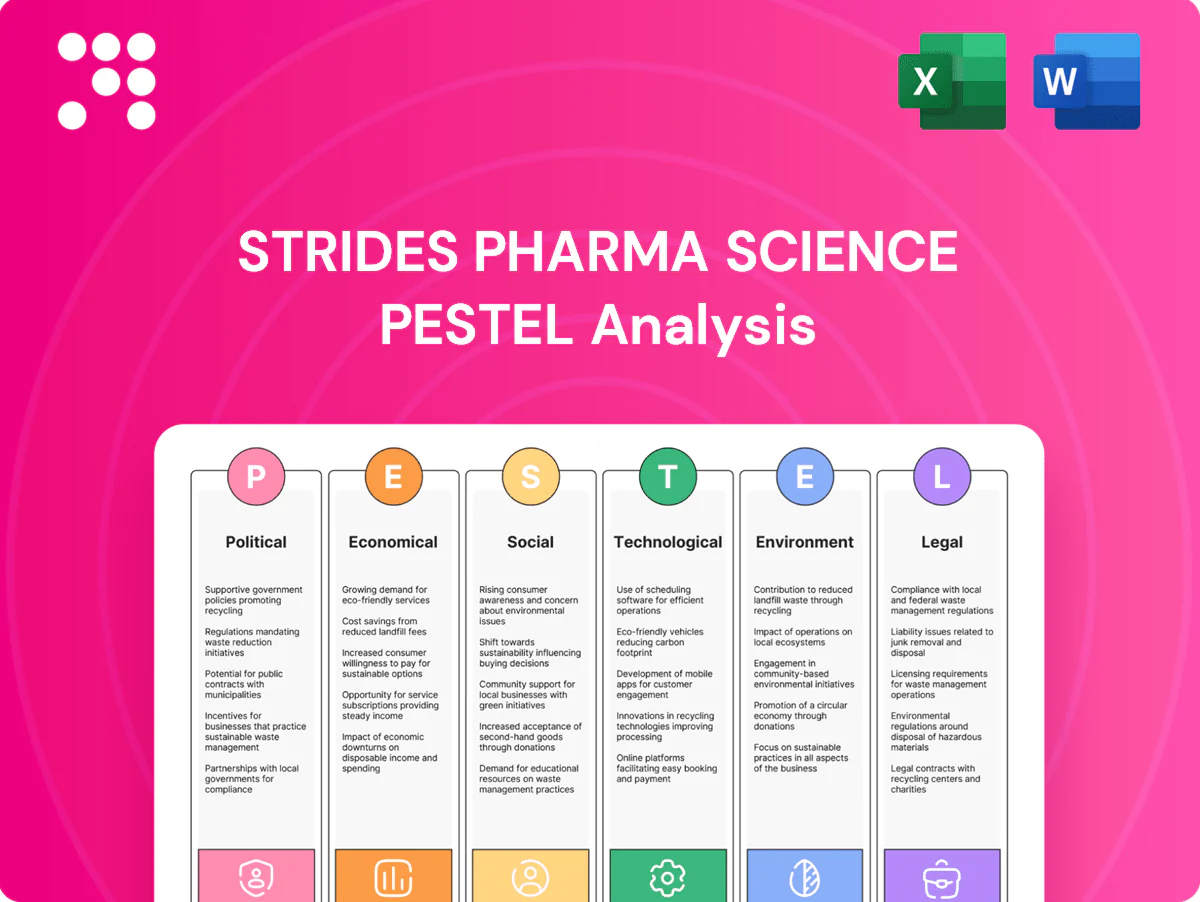
The Strides Pharma Science PESTLE Analysis preview shown here is the exact document you’ll receive after purchase—fully formatted and ready to use. It covers Political, Economic, Social, Technological, Legal and Environmental factors relevant to Strides. No placeholders or teasers—this is the final, professional file available for immediate download.

Original: $10.00
-65%$10.00
$3.50Product Information
Product Information
Shipping & Returns
Shipping & Returns
Description
Your Competitive Advantage Starts with This Report
Gain strategic clarity with our PESTLE Analysis of Strides Pharma Science. Understand political, economic, social, technological, legal and environmental forces shaping growth and risks. Buy the full report for actionable insights, ready-to-use charts and executive-ready recommendations.
Political factors
US FDA oversight
Strides depends on US FDA approvals and inspections to sustain regulated-market revenue and access to the roughly $600 billion US pharmaceutical market in 2024. Variations in enforcement intensity or inspection backlogs can delay product launches and lower capacity utilization. Rising political focus on drug safety tightens cGMP scrutiny. Proactive compliance and remediation planning reduce disruption risk.
Trade policy volatility
Tariffs, export controls and retaliatory measures drive up costs for APIs and excipients—India sources roughly 70% of its APIs from China—raising procurement risk for Strides and peers. Geopolitical tensions can delay cross-border logistics for finished doses, compressing delivery windows to regulated markets. Diversified supply chains, dual sourcing and hedging lower exposure, while nearshoring shortens lead times and stabilizes margins.
Healthcare pricing agendas
Government-led price controls in the US, EU and emerging markets are compressing generic margins; in the US generics account for ~90% of prescriptions but only ~20% of drug spend. Policy moves such as Medicare negotiation under the Inflation Reduction Act (negotiations start 2026 targeting initial drugs) and centralized tenders intensify competition. Strides must prioritize complex generics and niche dosages to defend pricing and margins. Active policy monitoring should inform portfolio mix and launch sequencing.
India policy stability
As an India-headquartered manufacturer, incentives such as the Rs 6,940 crore PLI for pharma and an optional 22% corporate tax materially shape Strides Pharma Science capex and location choices; enhanced pharma-park funding and subsidies compress unit cost curves, while regulatory simplification (CDSCO digitalisation) speeds domestic approvals, and political continuity after the 2024 election underpins multi-year manufacturing investments.
- PLI: Rs 6,940 crore
- Tax: optional 22% corporate rate
- Political continuity: 2024 re-elected government supports long-term manufacturing
Local content and procurement
Local-content rules in key markets—backed by policies like India’s Public Procurement (Preference to Make in India) Order, 2017—increase the advantage for domestic suppliers and can require minimum local content or localized manufacturing arrangements; the Indian pharma market was about USD 45 billion in 2024, underscoring procurement scale. Make-in-country clauses often necessitate tech transfer or contract manufacturing partnerships, so aligning with local stakeholders and calibrating footprint across regions improves access to public tenders and procurement pipelines.
- Local-preference policies: apply in India, Brazil, South Africa
- Compliance levers: tech transfer, contract manufacturing
- Strategic focus: stakeholder engagement, balanced footprint
FDA approvals risk access to $600B US market; India ~70% APIs from China
Strides’ regulated-market access hinges on US FDA approvals; US pharma market ≈ $600B (2024) and FDA inspection variability can delay launches.
Supply risk: India sources ~70% of APIs from China; tariffs, export controls and logistics disruption raise COGS and lead times.
Policy shifts compress margins: India PLI Rs 6,940 crore, optional 22% tax, Medicare negotiation starts 2026—portfolio and sourcing must adapt.
| Metric | Value |
|---|---|
| US market | $600B (2024) |
| India pharma | $45B (2024) |
| APIs from China | ~70% |
| PLI | Rs 6,940 crore |
What is included in the product
Detailed Word Document
Explores how Political, Economic, Social, Technological, Environmental and Legal factors uniquely impact Strides Pharma Science, with data-backed trends and region-specific regulatory context to identify threats and opportunities for executives, investors and strategists. Delivered in clean, ready-to-use format with forward-looking insights for scenario planning.
Customizable Excel Spreadsheet
Strides Pharma Science PESTLE Analysis provides a clean, summarized and visually segmented external-risk overview that teams can drop into presentations, annotate for local context, and share for quick alignment across departments.
Economic factors
Currency fluctuations
Revenues booked in USD/EUR vs costs in INR leave Strides exposed to FX; India pharma exports reached about 26.5 billion USD in FY24, underscoring trade scale. Sharp INR appreciation can compress export margins while depreciation boosts reported rupee revenue. Use of natural hedges, derivatives and contract pricing clauses can materially smooth earnings volatility.
API cost cycles
API cost cycles are driven by China, which accounts for roughly 40% of global API output, plus volatile energy costs and periodic environmental crackdowns that in 2021–22 caused API price spikes up to about 30% in some segments. Such spikes erode generic profitability and can delay product launches. Maintaining strategic inventories and multi-sourcing shields gross margins, while backward integration where feasible builds supply resilience.
Interest rate environment
Higher global rates — US Fed funds at 5.25–5.50% and RBI repo ~6.50% mid‑2025 — raise Strides Pharma Science’s capex and working capital borrowing costs, increase discount rates and hurdle rates for new injectable lines, and make efficient cash conversion plus phased, disciplined capex critical; optimizing debt mix (short vs long, INR vs FCY) reduces interest burden.
Demand elasticity in recessions
Pharma remains defensive with the global market at about $1.6 trillion in 2024 (IQVIA), but discretionary OTC and premium niches can contract in recessions while generics — ~43% of dispensed volumes (IQVIA 2024) — often gain share as payers and patients downtrade; Strides can capture volume by emphasizing cost-effective alternatives and adjusting inventory for a defensive yet shifting product mix.
- Defensive market: $1.6T (2024)
- Generics ~43% dispensed volumes (IQVIA 2024)
- Focus: cost-effective alternatives
- Inventory: prioritize high-turn generics, limit premium OTC
Market consolidation
Buyer consolidation in the US (three PBMs ~80% share; three wholesalers ~85% of distribution) compresses prices and tightens contract terms; supplier consolidation among API producers increases input bargaining power. Strategic partnerships and scale in select therapies lift Strides’ negotiating leverage, while portfolio pruning improves ROI and frees capital for high-margin assets.
- PBM/wholesaler concentration ~80–85%
- API supplier power rising
- Partnerships + scale = better terms
- Portfolio pruning → higher ROI
FDA approvals risk access to $600B US market; India ~70% APIs from China
Strides faces FX exposure from USD/EUR revenues vs INR costs; India pharma exports $26.5B (FY24) so INR moves materially affect margins. Rising rates (Fed 5.25–5.50%, RBI repo ~6.5% mid‑2025) raise borrowing costs and WACC. Global pharma $1.6T (2024) with generics ~43% dispensed volumes points to defensive volume opportunities.
| Metric | Value |
|---|---|
| India pharma exports FY24 | $26.5B |
| Global pharma 2024 | $1.6T |
| Generics dispensed 2024 | 43% |
| RBI repo mid‑2025 | ~6.5% |
Preview the Actual Deliverable
Strides Pharma Science PESTLE Analysis
The Strides Pharma Science PESTLE Analysis preview shown here is the exact document you’ll receive after purchase—fully formatted and ready to use. It covers Political, Economic, Social, Technological, Legal and Environmental factors relevant to Strides. No placeholders or teasers—this is the final, professional file available for immediate download.