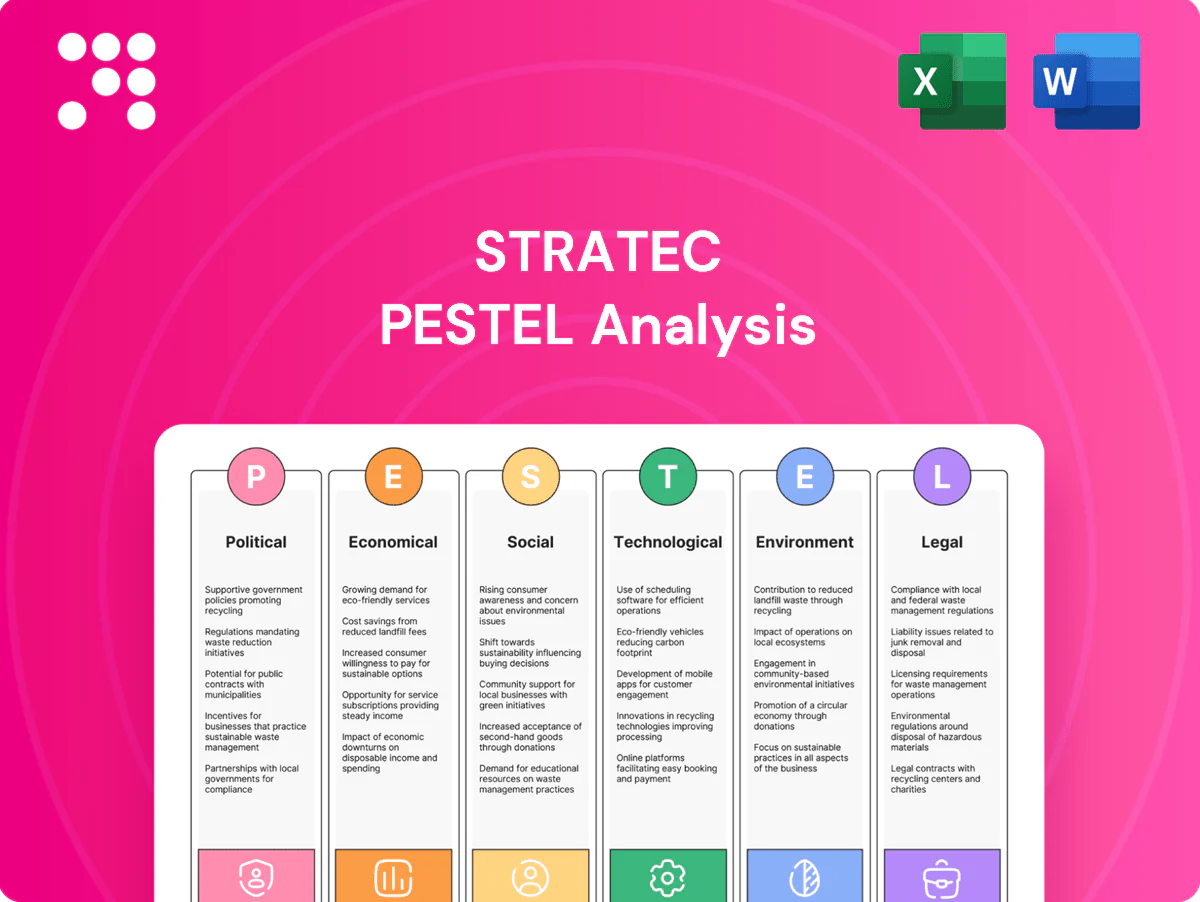
STRATEC PESTLE Analysis

Plan Smarter. Present Sharper. Compete Stronger.
Gain a competitive edge with our PESTLE analysis tailored for STRATEC. It maps political, economic, social, technological, legal and environmental forces affecting growth and risk. Purchase the full report for actionable insights and ready-to-use slides and data.
Political factors

Healthcare funding priorities
Government budgeting shapes OEM orders and partner investment: EU public health spending was 9.9% of GDP in 2022 (Eurostat) and EU4Health has €5.3bn for 2021–27, which can fast-track analyzer procurements and validation under pandemic preparedness; austerity cycles, by contrast, delay tenders and limit test-menu expansion, so STRATEC must align roadmaps with national and EU health strategies to secure long-term pipelines.
Regulatory harmonization
Divergent rules between the EU, US and emerging markets force STRATEC to customize devices and extend time-to-market, with EU IVDR coming into effect 26 May 2022 increasing conformity assessment complexity. Political moves toward harmonization, including IMDRF (established 2011) workstreams, can cut duplicate submissions and lower OEM compliance costs. Reversals delay certification cycles and raise engineering overhead; active engagement in standards bodies helps anticipate shifts and design for global clearance.

Trade policy and tariffs
Tariffs on electronics, optics and precision components — including US Section 301 duties of up to 25% on many Chinese-made tech goods — materially lift bill of materials for STRATEC analyzers and consumables. Recent US export controls (tightened 2022–23) on advanced electronics and select biotech products constrain shipment routes and partner allocations. Trade disputes between the US and China repeatedly disrupt just-in-time sourcing from Asia or the US. Diversified supplier footprints and tariff engineering are used to mitigate these shocks.

Geopolitical supply resilience
Geopolitical tensions elevate risks to rare materials (China ~58% of refined rare earths in 2023), semiconductors (US CHIPS Act: $52bn; EU Chips Act: €43bn) and logistics corridors, prompting governments to incentivize regional manufacturing and medical-device stockpiles. Participation in such programs can secure priority access and funding but increases compliance and reporting burdens; dual- or multi-sourcing becomes a political and operational necessity.
- Risk: concentrated rare-earth supply (~58% China, 2023)
- Incentives: US $52bn, EU €43bn
- Benefit: priority access/funding vs compliance cost
- Mitigation: mandatory dual-/multi-sourcing
Public procurement dynamics
- localization: some member states use local-content thresholds up to 30%
- sustainability: sustainability criteria now appear in a majority of EU health tenders
- cybersecurity: NIS2 (2024) expands supplier obligations for digital health
Public health budgets, regulatory divergence and supply concentration reshape analyzer tenders
Public health budgets (EU 9.9% GDP 2022) and EU4Health €5.3bn (2021–27) drive analyzer tenders, while austerity delays orders. Regulatory divergence (IVDR effective 26‑May‑2022; NIS2 enforced 2024) raises compliance costs; harmonization via IMDRF may reduce duplications. Trade controls, tariffs and supply concentration (China ~58% rare earths 2023) force multi‑sourcing.
| Item | Key figure |
|---|---|
| EU4Health | €5.3bn (2021–27) |
| EU health spend | 9.9% GDP (2022) |
| Rare earths | ~58% China (2023) |
What is included in the product
 Detailed Word Document
Explores how macro-environmental factors uniquely affect STRATEC across Political, Economic, Social, Technological, Environmental and Legal dimensions, with data-driven trends and region/industry relevance to surface threats and opportunities; designed for executives, consultants and investors and including forward-looking insights for scenario planning and strategic action.

 Customizable Excel Spreadsheet
A concise, visually segmented STRATEC PESTLE summary that’s easy to drop into presentations, editable for regional or business-line context, and shareable across teams to streamline discussions on external risks, market positioning, and planning sessions.
Economic factors

IVD market cyclicality
Core diagnostics demand is resilient: the global IVD market was about $90B in 2023 and is forecast to grow ~4.5% annually through 2028, but capital-equipment cycles fluctuate with lab budgets and macro stress, causing uneven instrument placements after pandemic normalization. Consumables provide steady revenue, and rising chronic disease testing (diabetes affected 537M adults in 2021) supports utilization; STRATEC’s OEM model and diversified partner mix buffer volatility.
Currency and cost inflation
FX swings (EUR/USD ~1.09, USD/CNY ~7.2 in mid‑2025) materially affect STRATEC revenues and imported component costs, with intra‑year moves often in the mid‑single digits. Electronics and precision‑machining inflation ran near 5–7% in 2024–25, compressing margins on fixed‑price OEM contracts. Active hedging and indexation clauses are essential to protect profitability, while value engineering and redesign can recapture roughly 3–6% of costs over 12–24 months.

Consolidation of diagnostics players
M&A among top diagnostics firms has concentrated purchasing power—top five IVD players account for roughly 50% of the global market—driving platform standardization and larger, integrated program scopes. Fewer but larger customers increase dependency risk while enabling multi-year, higher-value contracts. Post-merger platform harmonization often creates retooling and retrofit opportunities for OEMs. STRATEC must counter key-account concentration with targeted pipeline diversification and strategic account management.

Scale economies and throughput
High-volume manufacturing lowers unit costs for analyzers and smart consumables, while demand clustering in high-throughput labs (>1,000 tests/day) favors modular, scalable designs; reusable sub-systems across platforms create economies of scope, and investment in automated assembly strengthens cost competitiveness and margin resilience.
- Unit-cost reduction: high-volume manufacturing
- Design: modular for >1,000 tests/day labs
- Scope: reusable sub-systems across platforms
- Automation: automated assembly enhances competitiveness
Emerging market expansion
Rising lab capacity across Asia, LATAM and MEA is expanding the TAM for mid-range analyzers; the Asia‑Pacific IVD market reached about USD 30B in 2024 and regional lab networks are growing faster than global averages. Price sensitivity forces cost‑optimized configurations and strong service models. Financing solutions and PPPs (mobilizing ~USD 12B+ in health projects in 2024) can unlock procurements, while local partnerships enable entry and lifecycle support.
- APAC ~USD 30B (2024)
- PPPs mobilized ~USD 12B+ (2024)
- Price-sensitive → cost-optimized configs
- Local partners for service & procurement
Public health budgets, regulatory divergence and supply concentration reshape analyzer tenders
Core IVD demand resilient (global ~USD 90B in 2023; ~4.5% CAGR to 2028) with consumables steady; FX (EUR/USD ~1.09 mid‑2025) and 5–7% electronics inflation in 2024–25 pressure margins. Top‑5 players ~50% share increases account concentration but creates retrofit opportunities; APAC ~USD 30B (2024) and PPPs ~USD 12B (2024) expand TAM.
| Metric | Value |
|---|---|
| Global IVD (2023) | ~USD 90B |
| CAGR to 2028 | ~4.5% |
| APAC (2024) | ~USD 30B |
| Diabetes (2021) | 537M adults |
| FX EUR/USD (mid‑2025) | ~1.09 |
| Electronics inflation (2024–25) | 5–7% |
| Top‑5 market share | ~50% |
| PPPs mobilized (2024) | ~USD 12B+ |
Preview the Actual Deliverable
STRATEC PESTLE Analysis
The preview shown here is the exact STRATEC PESTLE Analysis document you’ll receive after purchase—fully formatted and ready to use. The content, layout, and structure in this preview are identical to the downloadable file, with no placeholders or teasers. After checkout you’ll instantly get this finished, professionally structured report.

Original: $10.00
-65%$10.00
$3.50Product Information
Product Information
Shipping & Returns
Shipping & Returns
Description
Plan Smarter. Present Sharper. Compete Stronger.
Gain a competitive edge with our PESTLE analysis tailored for STRATEC. It maps political, economic, social, technological, legal and environmental forces affecting growth and risk. Purchase the full report for actionable insights and ready-to-use slides and data.
Political factors
Healthcare funding priorities
Government budgeting shapes OEM orders and partner investment: EU public health spending was 9.9% of GDP in 2022 (Eurostat) and EU4Health has €5.3bn for 2021–27, which can fast-track analyzer procurements and validation under pandemic preparedness; austerity cycles, by contrast, delay tenders and limit test-menu expansion, so STRATEC must align roadmaps with national and EU health strategies to secure long-term pipelines.
Regulatory harmonization
Divergent rules between the EU, US and emerging markets force STRATEC to customize devices and extend time-to-market, with EU IVDR coming into effect 26 May 2022 increasing conformity assessment complexity. Political moves toward harmonization, including IMDRF (established 2011) workstreams, can cut duplicate submissions and lower OEM compliance costs. Reversals delay certification cycles and raise engineering overhead; active engagement in standards bodies helps anticipate shifts and design for global clearance.
Trade policy and tariffs
Tariffs on electronics, optics and precision components — including US Section 301 duties of up to 25% on many Chinese-made tech goods — materially lift bill of materials for STRATEC analyzers and consumables. Recent US export controls (tightened 2022–23) on advanced electronics and select biotech products constrain shipment routes and partner allocations. Trade disputes between the US and China repeatedly disrupt just-in-time sourcing from Asia or the US. Diversified supplier footprints and tariff engineering are used to mitigate these shocks.
Geopolitical supply resilience
Geopolitical tensions elevate risks to rare materials (China ~58% of refined rare earths in 2023), semiconductors (US CHIPS Act: $52bn; EU Chips Act: €43bn) and logistics corridors, prompting governments to incentivize regional manufacturing and medical-device stockpiles. Participation in such programs can secure priority access and funding but increases compliance and reporting burdens; dual- or multi-sourcing becomes a political and operational necessity.
- Risk: concentrated rare-earth supply (~58% China, 2023)
- Incentives: US $52bn, EU €43bn
- Benefit: priority access/funding vs compliance cost
- Mitigation: mandatory dual-/multi-sourcing
Public procurement dynamics
- localization: some member states use local-content thresholds up to 30%
- sustainability: sustainability criteria now appear in a majority of EU health tenders
- cybersecurity: NIS2 (2024) expands supplier obligations for digital health
Public health budgets, regulatory divergence and supply concentration reshape analyzer tenders
Public health budgets (EU 9.9% GDP 2022) and EU4Health €5.3bn (2021–27) drive analyzer tenders, while austerity delays orders. Regulatory divergence (IVDR effective 26‑May‑2022; NIS2 enforced 2024) raises compliance costs; harmonization via IMDRF may reduce duplications. Trade controls, tariffs and supply concentration (China ~58% rare earths 2023) force multi‑sourcing.
| Item | Key figure |
|---|---|
| EU4Health | €5.3bn (2021–27) |
| EU health spend | 9.9% GDP (2022) |
| Rare earths | ~58% China (2023) |
What is included in the product
Detailed Word Document
Explores how macro-environmental factors uniquely affect STRATEC across Political, Economic, Social, Technological, Environmental and Legal dimensions, with data-driven trends and region/industry relevance to surface threats and opportunities; designed for executives, consultants and investors and including forward-looking insights for scenario planning and strategic action.
Customizable Excel Spreadsheet
A concise, visually segmented STRATEC PESTLE summary that’s easy to drop into presentations, editable for regional or business-line context, and shareable across teams to streamline discussions on external risks, market positioning, and planning sessions.
Economic factors
IVD market cyclicality
Core diagnostics demand is resilient: the global IVD market was about $90B in 2023 and is forecast to grow ~4.5% annually through 2028, but capital-equipment cycles fluctuate with lab budgets and macro stress, causing uneven instrument placements after pandemic normalization. Consumables provide steady revenue, and rising chronic disease testing (diabetes affected 537M adults in 2021) supports utilization; STRATEC’s OEM model and diversified partner mix buffer volatility.
Currency and cost inflation
FX swings (EUR/USD ~1.09, USD/CNY ~7.2 in mid‑2025) materially affect STRATEC revenues and imported component costs, with intra‑year moves often in the mid‑single digits. Electronics and precision‑machining inflation ran near 5–7% in 2024–25, compressing margins on fixed‑price OEM contracts. Active hedging and indexation clauses are essential to protect profitability, while value engineering and redesign can recapture roughly 3–6% of costs over 12–24 months.
Consolidation of diagnostics players
M&A among top diagnostics firms has concentrated purchasing power—top five IVD players account for roughly 50% of the global market—driving platform standardization and larger, integrated program scopes. Fewer but larger customers increase dependency risk while enabling multi-year, higher-value contracts. Post-merger platform harmonization often creates retooling and retrofit opportunities for OEMs. STRATEC must counter key-account concentration with targeted pipeline diversification and strategic account management.
Scale economies and throughput
High-volume manufacturing lowers unit costs for analyzers and smart consumables, while demand clustering in high-throughput labs (>1,000 tests/day) favors modular, scalable designs; reusable sub-systems across platforms create economies of scope, and investment in automated assembly strengthens cost competitiveness and margin resilience.
- Unit-cost reduction: high-volume manufacturing
- Design: modular for >1,000 tests/day labs
- Scope: reusable sub-systems across platforms
- Automation: automated assembly enhances competitiveness
Emerging market expansion
Rising lab capacity across Asia, LATAM and MEA is expanding the TAM for mid-range analyzers; the Asia‑Pacific IVD market reached about USD 30B in 2024 and regional lab networks are growing faster than global averages. Price sensitivity forces cost‑optimized configurations and strong service models. Financing solutions and PPPs (mobilizing ~USD 12B+ in health projects in 2024) can unlock procurements, while local partnerships enable entry and lifecycle support.
- APAC ~USD 30B (2024)
- PPPs mobilized ~USD 12B+ (2024)
- Price-sensitive → cost-optimized configs
- Local partners for service & procurement
Public health budgets, regulatory divergence and supply concentration reshape analyzer tenders
Core IVD demand resilient (global ~USD 90B in 2023; ~4.5% CAGR to 2028) with consumables steady; FX (EUR/USD ~1.09 mid‑2025) and 5–7% electronics inflation in 2024–25 pressure margins. Top‑5 players ~50% share increases account concentration but creates retrofit opportunities; APAC ~USD 30B (2024) and PPPs ~USD 12B (2024) expand TAM.
| Metric | Value |
|---|---|
| Global IVD (2023) | ~USD 90B |
| CAGR to 2028 | ~4.5% |
| APAC (2024) | ~USD 30B |
| Diabetes (2021) | 537M adults |
| FX EUR/USD (mid‑2025) | ~1.09 |
| Electronics inflation (2024–25) | 5–7% |
| Top‑5 market share | ~50% |
| PPPs mobilized (2024) | ~USD 12B+ |
Preview the Actual Deliverable
STRATEC PESTLE Analysis
The preview shown here is the exact STRATEC PESTLE Analysis document you’ll receive after purchase—fully formatted and ready to use. The content, layout, and structure in this preview are identical to the downloadable file, with no placeholders or teasers. After checkout you’ll instantly get this finished, professionally structured report.











