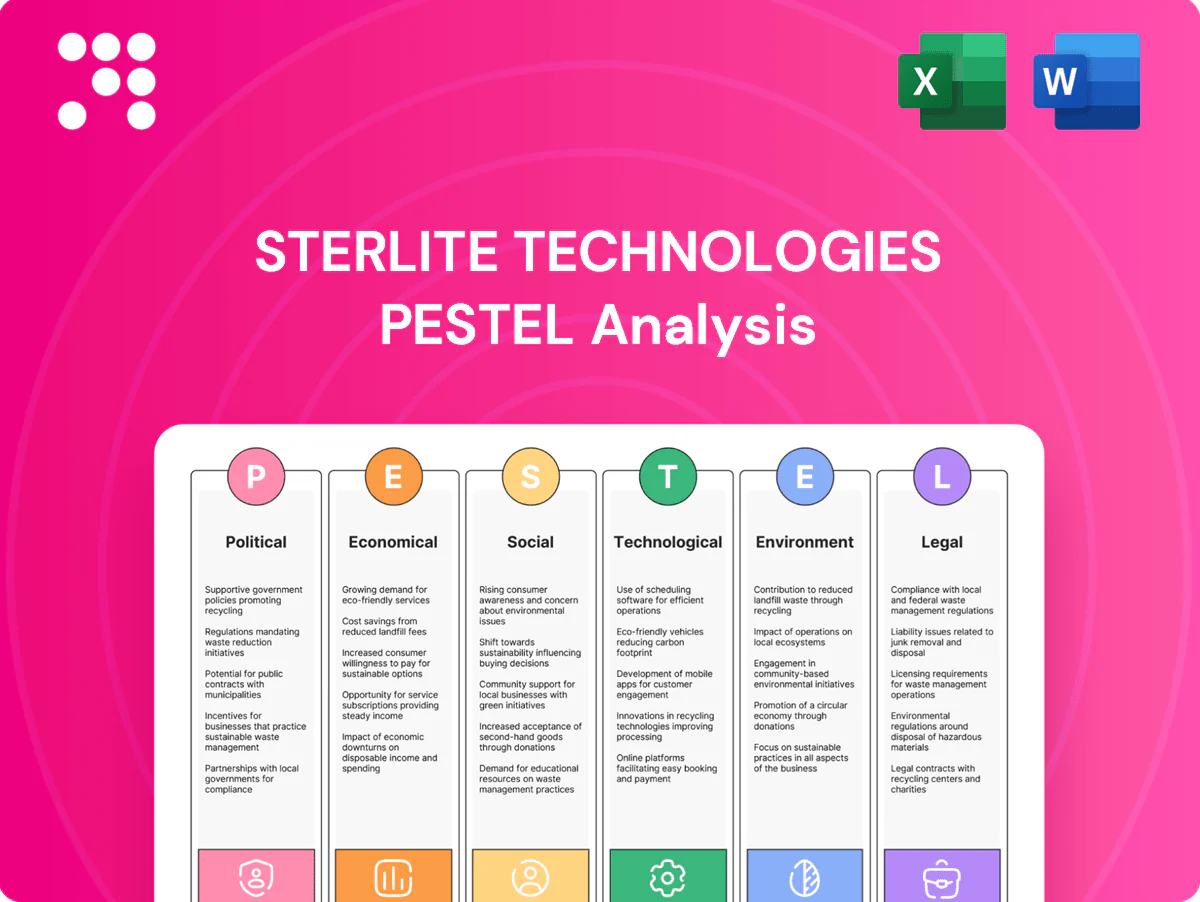
Sterlite Technologies PESTLE Analysis

Make Smarter Strategic Decisions with a Complete PESTEL View
Sterlite Technologies faces accelerating tech shifts, regulatory scrutiny, and rising sustainability demands that will reshape its growth trajectory. Our concise PESTLE highlights these external drivers and strategic risks in clear, actionable terms. For investors and strategists seeking a thorough, ready-to-use assessment, download the full PESTLE analysis now to inform smarter decisions.
Political factors

5G and broadband policy
National telecom roadmaps and spectrum policies directly shape operator capex and the timing of 5G/FTTx builds that drive STL’s order book; India’s BharatNet targets ~250,000 gram panchayats and public broadband programs have pushed fibre demand. Incentives and universal service funds—plus BharatNet-style subsidies—can accelerate rural fibre rollouts, while delays in spectrum auctions (India’s 2022 5G auction raised ~Rs 1.5 lakh crore) stall deployments. STL should align bids and capacity planning to priority geographies where policy visibility and fund flows are clearest.
Trade and tariff regimes
Tariffs on optical fiber preforms, glass, resins and cables—often ranging across 0–10% in key markets—raise input costs and squeeze STL’s price competitiveness; higher duties in 2023–24 coincided with global cable-price inflation near 6–8%. Geopolitical frictions have led to anti-dumping probes and import curbs, forcing sourcing shifts. Preferential trade agreements (FTAs) can cut duties and open markets; STL should diversify suppliers and use FTAs to optimize landed costs and margins.

Localization and industrial policy
India’s Make in initiatives and the telecom production-linked incentive (PLI) scheme worth INR 12,195 crore favor domestic manufacturing and local value addition, creating subsidies and tax benefits for compliant suppliers. Government procurement increasingly rewards indigenous content in telecom infrastructure, raising addressable tender size for local players. Compliance requires targeted capex and vendor-development spend to meet certification and local-content thresholds. STL can align plants and supply chains to qualify and capture PLI-linked demand.

Public infrastructure spending
State-backed digital infrastructure programs give multi-year visibility to STL's fiber rollout, while 5-year election cycles and interim budget reallocations can either accelerate or delay projects; multilateral funding from World Bank and DFIs often de-risks municipal and utility networks, improving bankability. STL should track central and state budget calendars to align tender pipelines and cash-flow planning.
- Track budget calendars
- Monitor election-driven shifts
- Engage DFIs for project de-risking
Sanctions and export controls
Restrictions on specific countries/entities shrink addressable markets and complicate cross-border logistics; export controls on advanced encryption and network technologies constrain STLs software and integration service offerings. Compliance failures incur severe legal penalties and reputational damage. STL must maintain rigorous screening, export-classification, and adaptable routing to stay compliant.
- Market access limits
- Encryption export controls
- High legal/reputational risk
- Rigorous screening & routing
Policy-driven 5G/FTTx, BharatNet ~250,000 GPs; spectrum delays squeeze margins
Policy-driven 5G/FTTx timelines and BharatNet (≈250,000 gram panchayats) underpin STL demand; spectrum delays (India 2022 auction ≈Rs 1.5 lakh crore) can stall rollouts. Tariffs (0–10%) and 2023 cable-price inflation (~6–8%) squeeze margins; PLI (INR 12,195 crore) and DFIs de-risk projects. Compliance with export controls and local-content rules is critical for market access.
| Item | Key figure |
|---|---|
| BharatNet targets | ~250,000 gram panchayats |
| 2022 spectrum auction | ~Rs 1.5 lakh crore |
| PLI scheme | INR 12,195 crore |
| Tariff range | 0–10% |
| Cable-price inflation (2023) | ~6–8% |
What is included in the product
 Detailed Word Document
Explores how Political, Economic, Social, Technological, Environmental and Legal factors uniquely affect Sterlite Technologies, with data-backed trends and forward-looking insights to inform executives, investors and consultants; formatted for easy inclusion in plans, decks and scenario planning.

 Customizable Excel Spreadsheet
A concise, visually segmented PESTLE summary for Sterlite Technologies that highlights external risks and strategic opportunities, easily dropped into presentations, shared across teams for quick alignment, and annotated with region- or business-specific notes for planning sessions.
Economic factors

Operator capex cycles
Operator and hyperscaler capex cycles drive near-term demand for fiber and network integration, with macro slowdowns deferring upgrades while surges in data traffic accelerate backhaul and metro builds.
STL’s revenue exhibits cycle-linked volatility as large operator rollouts and hyperscaler cloud expansion timings shift project flows.
Balanced exposure across regions and a mix of telco, enterprise and hyperscaler customers helps smooth demand swings and stabilize order visibility.
Input costs and inflation
Price swings in silica, polymers, metals and energy materially affect STL’s COGS and margins: copper rose ~15% in 2024 while Brent averaged about $86/bbl, and container freight (SCFI) traded between ~600–2,000, increasing delivery uncertainty. Index-linked contracts and hedging can stabilise margins; STL should accelerate cost engineering and lock long-term supplier agreements to protect EBITDA.

FX and interest rates
Revenue billed in USD/EUR while major costs remain in INR exposes STL to translation and transaction risk as USD/INR traded near 83 in 2024–25, and ECB/Fed-driven volatility persisted; currency mismatches can erode margins on fixed-price contracts. Rate hikes (global policy rates ~5.25–5.50% in 2024–25) raise STL’s working-capital and project-finance costs for both the company and its customers. Active hedging and currency-aligned pricing are therefore essential to protect margins.

Price cycles in optical fiber
Industry capacity additions can push optical-fiber ASPs down, while 2024 supply tightness in select regions lifted prices for specialty grades and ribbon fibers; demand-supply balance now varies widely by region and product grade, with Southeast Asia and India seeing stronger demand in 2024.
Product-mix shifts to ribbon, high-count and specialty fiber have cushioned price softness; STL should prioritize differentiated SKUs and long-term offtake agreements to stabilize margins and capture premium pricing.
Data economy growth
Data economy growth is driving surging demand for bandwidth and low latency as cloud adoption (cloud services market ~600B USD in 2024) plus AI workloads and video streaming (video ≈66% of internet traffic in 2023) push data-center and edge needs. Data-center interconnect and edge deployments stimulate high-fiber-density builds and private networks, creating opportunities for STL to target resilient-spend verticals such as cloud providers and utilities.
- IDC: global datasphere ~175 ZB by 2025
- Cloud market ≈600B USD (2024)
- Video ~66% of traffic (2023)
- Targets: cloud, utilities, enterprises with private networks
Policy-driven 5G/FTTx, BharatNet ~250,000 GPs; spectrum delays squeeze margins
Operator/hyperscaler capex cycles and regional demand divergence (stronger India/SEA, softer EU/US) drive STL revenue volatility and order timing.
Input-cost swings (copper +15% 2024, Brent ~$86/bbl) and USD/INR ~83 in 2024–25 pressure margins; hedging and long-term supply deals are critical.
Shift to ribbon/high-count fibers, differentiated SKUs and cloud/datacenter demand (cloud ~$600B, datasphere ~175 ZB by 2025) support premium pricing.
| Metric | 2024/25 |
|---|---|
| USD/INR | ~83 |
| Brent | ~$86/bbl |
| Copper | +15% (2024) |
| Cloud market | ~$600B |
Full Version Awaits
Sterlite Technologies PESTLE Analysis
The preview shown here is the exact document you’ll receive after purchase—fully formatted and ready to use. This Sterlite Technologies PESTLE analysis examines political and regulatory risks, economic drivers like infrastructure and telecom capex, social and market demand trends, technological innovation and competitive pressures, plus environmental and legal compliance factors. It highlights strategic implications and actionable recommendations for investors and managers.

Original: $10.00
-65%$10.00
$3.50Product Information
Product Information
Shipping & Returns
Shipping & Returns
Description
Make Smarter Strategic Decisions with a Complete PESTEL View
Sterlite Technologies faces accelerating tech shifts, regulatory scrutiny, and rising sustainability demands that will reshape its growth trajectory. Our concise PESTLE highlights these external drivers and strategic risks in clear, actionable terms. For investors and strategists seeking a thorough, ready-to-use assessment, download the full PESTLE analysis now to inform smarter decisions.
Political factors
5G and broadband policy
National telecom roadmaps and spectrum policies directly shape operator capex and the timing of 5G/FTTx builds that drive STL’s order book; India’s BharatNet targets ~250,000 gram panchayats and public broadband programs have pushed fibre demand. Incentives and universal service funds—plus BharatNet-style subsidies—can accelerate rural fibre rollouts, while delays in spectrum auctions (India’s 2022 5G auction raised ~Rs 1.5 lakh crore) stall deployments. STL should align bids and capacity planning to priority geographies where policy visibility and fund flows are clearest.
Trade and tariff regimes
Tariffs on optical fiber preforms, glass, resins and cables—often ranging across 0–10% in key markets—raise input costs and squeeze STL’s price competitiveness; higher duties in 2023–24 coincided with global cable-price inflation near 6–8%. Geopolitical frictions have led to anti-dumping probes and import curbs, forcing sourcing shifts. Preferential trade agreements (FTAs) can cut duties and open markets; STL should diversify suppliers and use FTAs to optimize landed costs and margins.
Localization and industrial policy
India’s Make in initiatives and the telecom production-linked incentive (PLI) scheme worth INR 12,195 crore favor domestic manufacturing and local value addition, creating subsidies and tax benefits for compliant suppliers. Government procurement increasingly rewards indigenous content in telecom infrastructure, raising addressable tender size for local players. Compliance requires targeted capex and vendor-development spend to meet certification and local-content thresholds. STL can align plants and supply chains to qualify and capture PLI-linked demand.
Public infrastructure spending
State-backed digital infrastructure programs give multi-year visibility to STL's fiber rollout, while 5-year election cycles and interim budget reallocations can either accelerate or delay projects; multilateral funding from World Bank and DFIs often de-risks municipal and utility networks, improving bankability. STL should track central and state budget calendars to align tender pipelines and cash-flow planning.
- Track budget calendars
- Monitor election-driven shifts
- Engage DFIs for project de-risking
Sanctions and export controls
Restrictions on specific countries/entities shrink addressable markets and complicate cross-border logistics; export controls on advanced encryption and network technologies constrain STLs software and integration service offerings. Compliance failures incur severe legal penalties and reputational damage. STL must maintain rigorous screening, export-classification, and adaptable routing to stay compliant.
- Market access limits
- Encryption export controls
- High legal/reputational risk
- Rigorous screening & routing
Policy-driven 5G/FTTx, BharatNet ~250,000 GPs; spectrum delays squeeze margins
Policy-driven 5G/FTTx timelines and BharatNet (≈250,000 gram panchayats) underpin STL demand; spectrum delays (India 2022 auction ≈Rs 1.5 lakh crore) can stall rollouts. Tariffs (0–10%) and 2023 cable-price inflation (~6–8%) squeeze margins; PLI (INR 12,195 crore) and DFIs de-risk projects. Compliance with export controls and local-content rules is critical for market access.
| Item | Key figure |
|---|---|
| BharatNet targets | ~250,000 gram panchayats |
| 2022 spectrum auction | ~Rs 1.5 lakh crore |
| PLI scheme | INR 12,195 crore |
| Tariff range | 0–10% |
| Cable-price inflation (2023) | ~6–8% |
What is included in the product
Detailed Word Document
Explores how Political, Economic, Social, Technological, Environmental and Legal factors uniquely affect Sterlite Technologies, with data-backed trends and forward-looking insights to inform executives, investors and consultants; formatted for easy inclusion in plans, decks and scenario planning.
Customizable Excel Spreadsheet
A concise, visually segmented PESTLE summary for Sterlite Technologies that highlights external risks and strategic opportunities, easily dropped into presentations, shared across teams for quick alignment, and annotated with region- or business-specific notes for planning sessions.
Economic factors
Operator capex cycles
Operator and hyperscaler capex cycles drive near-term demand for fiber and network integration, with macro slowdowns deferring upgrades while surges in data traffic accelerate backhaul and metro builds.
STL’s revenue exhibits cycle-linked volatility as large operator rollouts and hyperscaler cloud expansion timings shift project flows.
Balanced exposure across regions and a mix of telco, enterprise and hyperscaler customers helps smooth demand swings and stabilize order visibility.
Input costs and inflation
Price swings in silica, polymers, metals and energy materially affect STL’s COGS and margins: copper rose ~15% in 2024 while Brent averaged about $86/bbl, and container freight (SCFI) traded between ~600–2,000, increasing delivery uncertainty. Index-linked contracts and hedging can stabilise margins; STL should accelerate cost engineering and lock long-term supplier agreements to protect EBITDA.
FX and interest rates
Revenue billed in USD/EUR while major costs remain in INR exposes STL to translation and transaction risk as USD/INR traded near 83 in 2024–25, and ECB/Fed-driven volatility persisted; currency mismatches can erode margins on fixed-price contracts. Rate hikes (global policy rates ~5.25–5.50% in 2024–25) raise STL’s working-capital and project-finance costs for both the company and its customers. Active hedging and currency-aligned pricing are therefore essential to protect margins.
Price cycles in optical fiber
Industry capacity additions can push optical-fiber ASPs down, while 2024 supply tightness in select regions lifted prices for specialty grades and ribbon fibers; demand-supply balance now varies widely by region and product grade, with Southeast Asia and India seeing stronger demand in 2024.
Product-mix shifts to ribbon, high-count and specialty fiber have cushioned price softness; STL should prioritize differentiated SKUs and long-term offtake agreements to stabilize margins and capture premium pricing.
Data economy growth
Data economy growth is driving surging demand for bandwidth and low latency as cloud adoption (cloud services market ~600B USD in 2024) plus AI workloads and video streaming (video ≈66% of internet traffic in 2023) push data-center and edge needs. Data-center interconnect and edge deployments stimulate high-fiber-density builds and private networks, creating opportunities for STL to target resilient-spend verticals such as cloud providers and utilities.
- IDC: global datasphere ~175 ZB by 2025
- Cloud market ≈600B USD (2024)
- Video ~66% of traffic (2023)
- Targets: cloud, utilities, enterprises with private networks
Policy-driven 5G/FTTx, BharatNet ~250,000 GPs; spectrum delays squeeze margins
Operator/hyperscaler capex cycles and regional demand divergence (stronger India/SEA, softer EU/US) drive STL revenue volatility and order timing.
Input-cost swings (copper +15% 2024, Brent ~$86/bbl) and USD/INR ~83 in 2024–25 pressure margins; hedging and long-term supply deals are critical.
Shift to ribbon/high-count fibers, differentiated SKUs and cloud/datacenter demand (cloud ~$600B, datasphere ~175 ZB by 2025) support premium pricing.
| Metric | 2024/25 |
|---|---|
| USD/INR | ~83 |
| Brent | ~$86/bbl |
| Copper | +15% (2024) |
| Cloud market | ~$600B |
Full Version Awaits
Sterlite Technologies PESTLE Analysis
The preview shown here is the exact document you’ll receive after purchase—fully formatted and ready to use. This Sterlite Technologies PESTLE analysis examines political and regulatory risks, economic drivers like infrastructure and telecom capex, social and market demand trends, technological innovation and competitive pressures, plus environmental and legal compliance factors. It highlights strategic implications and actionable recommendations for investors and managers.