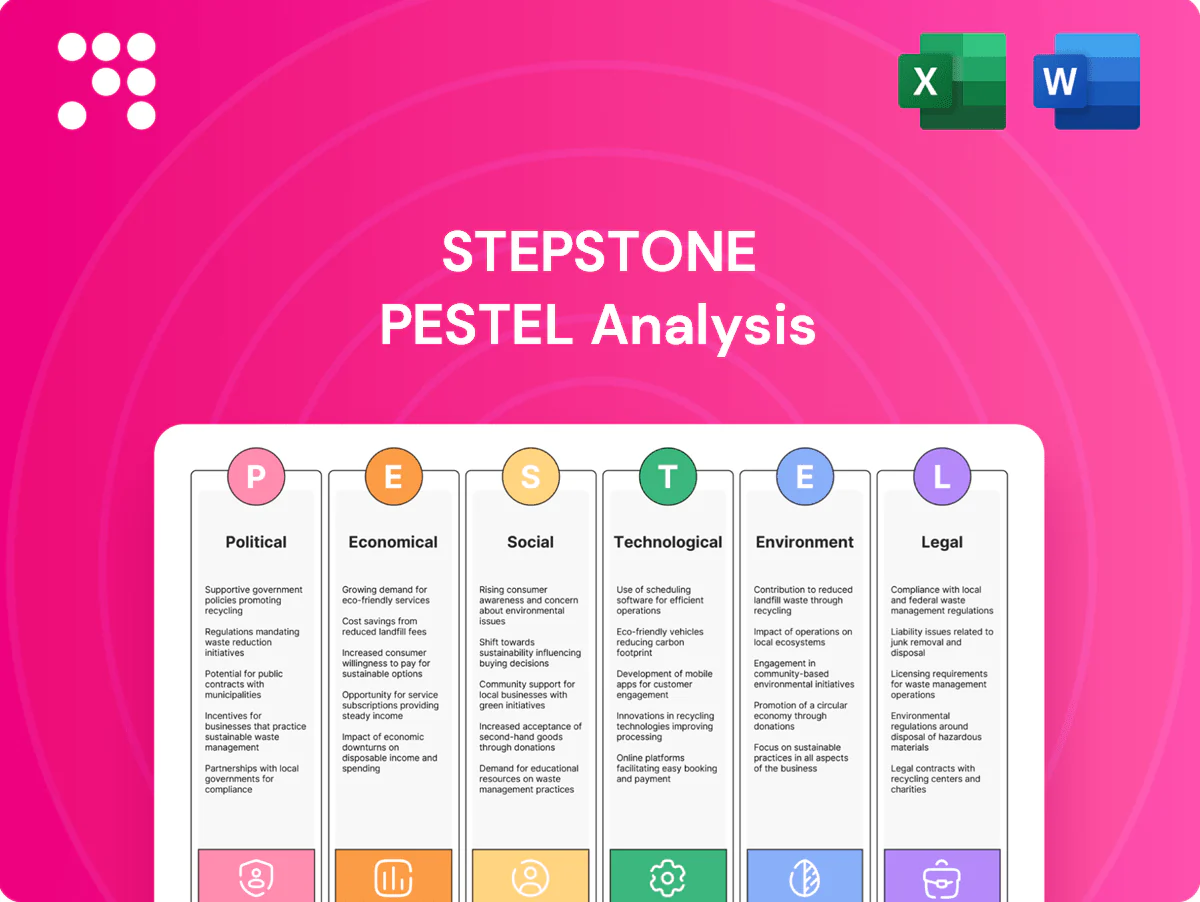
StepStone PESTLE Analysis

Your Shortcut to Market Insight Starts Here
Unlock how political shifts, economic cycles, social trends, and tech disruption shape StepStone’s outlook with our concise PESTLE Analysis. Ideal for investors and strategists, it highlights risks and opportunities you can act on. Purchase the full report to access detailed, ready-to-use insights and forecasts.
Political factors

Geopolitical tensions and sanctions
Shifting geopolitics can abruptly disrupt cross-border private deals, limit co-investments and constrain exits, with exits in sanctioned jurisdictions such as Russia and Iran largely halted after 2022; OFAC's SDN list exceeded 10,000 entries by 2024. StepStone must maintain robust sanctions screening, diversify regional exposure and use scenario planning to calibrate commitments and pacing by geography.
Public policy on pensions and SWFs
Allocation rules for public pensions and SWFs, such as Norway’s Government Pension Fund Global (~USD 1.6 trillion in 2024), directly shape StepStone’s fundraising pipeline by setting allowable private market exposure. Policy shifts favoring private assets can expand mandates, while austerity or de-risking trims commitments. Close engagement with fiduciaries and policymakers reduces unexpected mandate changes. Tailored solutions map to evolving liability profiles and contribution schedules.

Infrastructure and industrial policy
Government programs such as the US Infrastructure Investment and Jobs Act (roughly 1.2 trillion USD total), the CHIPS and Science Act (about 52 billion USD for semiconductors) and the Inflation Reduction Act (roughly 369 billion USD in clean-energy incentives) create a sizable pipeline for real assets and private equity.
Policy reversals or election outcomes can delay projects and compress IRRs, so StepStone can target policy-supported niches while explicitly underwriting policy risk.
Multi-jurisdiction diversification reduces single-policy exposure and helps stabilize expected returns across political cycles.

Tax policy and carried interest debates
- 15% global minimum tax
- 23.8% US capital gains top rate
- Proactive structuring preserves LP after-tax yields
- Continuous monitoring enables timely vehicle reconfiguration
Regulatory nationalism and market access
Regulatory nationalism—over 130 jurisdictions had FDI screening by 2024 (UNCTAD) and U.S. CFIUS-style reviews routinely delay or block transactions in semiconductors, AI and critical infrastructure, forcing deal re-structurings. Data localization and domestic procurement rules (affecting cloud, PE portfolio exits) now apply in roughly 70% of markets, shaping operations and exit timing. StepStone must build approval-timeline models and mitigation playbooks; partnering with local sponsors materially improves market access and compliance.
- FDI screening: over 130 jurisdictions (UNCTAD 2024)
- Data localization: ~70% of markets impose restrictions
- Mitigation: anticipate multi-month to multi-year approval timelines
- Access: local sponsors reduce clearance risk and speed execution
OFAC > 10,000; GPFG ~USD1.6T; Pillar Two 15% disrupt exits
Shifting geopolitics and sanctions (OFAC SDN >10,000 by 2024) disrupt exits and require sanctions screening, regional diversification and scenario planning. Pension/SWF allocation rules (Norway GPFG ~USD1.6T in 2024) and tax reforms (OECD Pillar Two 15%) reshape fundraising and structuring.
| Metric | Value |
|---|---|
| OFAC SDN (2024) | >10,000 |
| GPFG Size (2024) | ~USD1.6T |
| Pillar Two | 15% |
What is included in the product
 Detailed Word Document
Explores how macro-environmental forces uniquely affect StepStone across Political, Economic, Social, Technological, Environmental and Legal dimensions, with data-backed trends and forward-looking insights to inform scenario planning and proactive strategy. Designed for executives, investors and consultants and formatted for seamless inclusion in plans, decks or reports.

 Customizable Excel Spreadsheet
A clean, summarized StepStone PESTLE that’s visually segmented by category for easy referencing in meetings or presentations, making external risk and market positioning discussions faster and more focused.
Economic factors

Interest rates and credit conditions
Elevated policy rates (federal funds ~5.25–5.50% in 2024) have repriced leverage, compressing buyout valuations while lifting private credit yields—private debt AUM reached about $1.4 trillion in 2024, with yields often in the high single- to low double-digits. Large refinancing walls through 2025 raise default risk in stressed sectors, prompting StepStone to tilt to senior credit, special situations, or rate-resilient deals and prioritize active liability management across portfolios.
Denominator effect on LP allocations
Public market drawdowns of 20–30% can mechanically cap LP private allocations via the denominator effect, slowing new commitments; conversely, the S&P 500 rally in 2023 (about +26%) reopened pacing. StepStone’s pacing models and active secondary strategies help clients rebalance exposure and harvest liquidity. Flexible mandates enable capturing vintages at attractive entry points during dislocations.

Macro growth and inflation trends
Stubborn inflation near 3–4% (IMF/ONS consensus mid‑2025) favors real assets with CPI pass‑through while squeezing margin‑heavy growth equity. Slowing global GDP to about 3.0% in 2025 dampens exit activity and distribution velocity. StepStone can tilt to resilient cash‑flow businesses and inflation‑linked assets, using dynamic NAV forecasting to plan liquidity.

FX volatility and currency risk
Multi-currency exposures affect realized returns when translated to LP base currencies; BIS reports average daily FX turnover of about $7.5 trillion, amplifying cross-border swings. Hedging costs rise with rate differentials — 1-year hedges can add roughly 50–150 bps when policy rates diverge, compressing net IRR. StepStone can implement programmatic hedges at fund or mandate level, while geographic diversification helps smooth currency shocks.
- FX market size: $7.5T daily (BIS)
- Hedge cost range: ~50–150 bps for 1-year in divergent rate cycles
- Tactics: fund- or mandate-level programmatic hedges
- Mitigation: geographic diversification to reduce volatility
Liquidity cycles and exit markets
IPO and M&A windows drive DPI and fundraising momentum; when exits stall, secondaries and continuation vehicles step in—private capital dry powder exceeded $2 trillion in 2024, sustaining demand for liquidity solutions. StepStone’s platform sources GP-led and LP-led opportunities often at discounts, accelerating realizations. Active portfolio construction balances DPI, TVPI, and PME to optimize exit timing and fundraising pace.
- IPO/M&A: boosts DPI and fundraising
- When exits slow: secondaries & continuation vehicles
- StepStone: sources GP-/LP-led deals at discounts
- Portfolio metrics: DPI, TVPI, PME balanced
OFAC > 10,000; GPFG ~USD1.6T; Pillar Two 15% disrupt exits
Higher policy rates (~5.25–5.50% in 2024) and private debt AUM ~$1.4T push StepStone to senior credit and active liability management; inflation ~3–4% (mid‑2025) and global GDP ~3.0% (2025) favor real assets; dry powder >$2T (2024) sustains secondary/continuation activity; FX turnover ~$7.5T/day raises hedge costs ~50–150bps.
| Metric | Value | Implication |
|---|---|---|
| Policy rate | 5.25–5.50% | Reprice leverage |
| Private debt AUM | $1.4T | Higher yield ops |
| Dry powder | >$2T | Liquidity for secondaries |
What You See Is What You Get
StepStone PESTLE Analysis
The preview shown is the exact StepStone PESTLE Analysis you’ll receive after purchase—fully formatted and ready to use. The content, layout, and findings visible here are the final file with no placeholders or edits. After checkout you’ll instantly download this same professionally structured document.

Original: $10.00
-65%$10.00
$3.50Product Information
Product Information
Shipping & Returns
Shipping & Returns
Description
Your Shortcut to Market Insight Starts Here
Unlock how political shifts, economic cycles, social trends, and tech disruption shape StepStone’s outlook with our concise PESTLE Analysis. Ideal for investors and strategists, it highlights risks and opportunities you can act on. Purchase the full report to access detailed, ready-to-use insights and forecasts.
Political factors
Geopolitical tensions and sanctions
Shifting geopolitics can abruptly disrupt cross-border private deals, limit co-investments and constrain exits, with exits in sanctioned jurisdictions such as Russia and Iran largely halted after 2022; OFAC's SDN list exceeded 10,000 entries by 2024. StepStone must maintain robust sanctions screening, diversify regional exposure and use scenario planning to calibrate commitments and pacing by geography.
Public policy on pensions and SWFs
Allocation rules for public pensions and SWFs, such as Norway’s Government Pension Fund Global (~USD 1.6 trillion in 2024), directly shape StepStone’s fundraising pipeline by setting allowable private market exposure. Policy shifts favoring private assets can expand mandates, while austerity or de-risking trims commitments. Close engagement with fiduciaries and policymakers reduces unexpected mandate changes. Tailored solutions map to evolving liability profiles and contribution schedules.
Infrastructure and industrial policy
Government programs such as the US Infrastructure Investment and Jobs Act (roughly 1.2 trillion USD total), the CHIPS and Science Act (about 52 billion USD for semiconductors) and the Inflation Reduction Act (roughly 369 billion USD in clean-energy incentives) create a sizable pipeline for real assets and private equity.
Policy reversals or election outcomes can delay projects and compress IRRs, so StepStone can target policy-supported niches while explicitly underwriting policy risk.
Multi-jurisdiction diversification reduces single-policy exposure and helps stabilize expected returns across political cycles.
Tax policy and carried interest debates
- 15% global minimum tax
- 23.8% US capital gains top rate
- Proactive structuring preserves LP after-tax yields
- Continuous monitoring enables timely vehicle reconfiguration
Regulatory nationalism and market access
Regulatory nationalism—over 130 jurisdictions had FDI screening by 2024 (UNCTAD) and U.S. CFIUS-style reviews routinely delay or block transactions in semiconductors, AI and critical infrastructure, forcing deal re-structurings. Data localization and domestic procurement rules (affecting cloud, PE portfolio exits) now apply in roughly 70% of markets, shaping operations and exit timing. StepStone must build approval-timeline models and mitigation playbooks; partnering with local sponsors materially improves market access and compliance.
- FDI screening: over 130 jurisdictions (UNCTAD 2024)
- Data localization: ~70% of markets impose restrictions
- Mitigation: anticipate multi-month to multi-year approval timelines
- Access: local sponsors reduce clearance risk and speed execution
OFAC > 10,000; GPFG ~USD1.6T; Pillar Two 15% disrupt exits
Shifting geopolitics and sanctions (OFAC SDN >10,000 by 2024) disrupt exits and require sanctions screening, regional diversification and scenario planning. Pension/SWF allocation rules (Norway GPFG ~USD1.6T in 2024) and tax reforms (OECD Pillar Two 15%) reshape fundraising and structuring.
| Metric | Value |
|---|---|
| OFAC SDN (2024) | >10,000 |
| GPFG Size (2024) | ~USD1.6T |
| Pillar Two | 15% |
What is included in the product
Detailed Word Document
Explores how macro-environmental forces uniquely affect StepStone across Political, Economic, Social, Technological, Environmental and Legal dimensions, with data-backed trends and forward-looking insights to inform scenario planning and proactive strategy. Designed for executives, investors and consultants and formatted for seamless inclusion in plans, decks or reports.
Customizable Excel Spreadsheet
A clean, summarized StepStone PESTLE that’s visually segmented by category for easy referencing in meetings or presentations, making external risk and market positioning discussions faster and more focused.
Economic factors
Interest rates and credit conditions
Elevated policy rates (federal funds ~5.25–5.50% in 2024) have repriced leverage, compressing buyout valuations while lifting private credit yields—private debt AUM reached about $1.4 trillion in 2024, with yields often in the high single- to low double-digits. Large refinancing walls through 2025 raise default risk in stressed sectors, prompting StepStone to tilt to senior credit, special situations, or rate-resilient deals and prioritize active liability management across portfolios.
Denominator effect on LP allocations
Public market drawdowns of 20–30% can mechanically cap LP private allocations via the denominator effect, slowing new commitments; conversely, the S&P 500 rally in 2023 (about +26%) reopened pacing. StepStone’s pacing models and active secondary strategies help clients rebalance exposure and harvest liquidity. Flexible mandates enable capturing vintages at attractive entry points during dislocations.
Macro growth and inflation trends
Stubborn inflation near 3–4% (IMF/ONS consensus mid‑2025) favors real assets with CPI pass‑through while squeezing margin‑heavy growth equity. Slowing global GDP to about 3.0% in 2025 dampens exit activity and distribution velocity. StepStone can tilt to resilient cash‑flow businesses and inflation‑linked assets, using dynamic NAV forecasting to plan liquidity.
FX volatility and currency risk
Multi-currency exposures affect realized returns when translated to LP base currencies; BIS reports average daily FX turnover of about $7.5 trillion, amplifying cross-border swings. Hedging costs rise with rate differentials — 1-year hedges can add roughly 50–150 bps when policy rates diverge, compressing net IRR. StepStone can implement programmatic hedges at fund or mandate level, while geographic diversification helps smooth currency shocks.
- FX market size: $7.5T daily (BIS)
- Hedge cost range: ~50–150 bps for 1-year in divergent rate cycles
- Tactics: fund- or mandate-level programmatic hedges
- Mitigation: geographic diversification to reduce volatility
Liquidity cycles and exit markets
IPO and M&A windows drive DPI and fundraising momentum; when exits stall, secondaries and continuation vehicles step in—private capital dry powder exceeded $2 trillion in 2024, sustaining demand for liquidity solutions. StepStone’s platform sources GP-led and LP-led opportunities often at discounts, accelerating realizations. Active portfolio construction balances DPI, TVPI, and PME to optimize exit timing and fundraising pace.
- IPO/M&A: boosts DPI and fundraising
- When exits slow: secondaries & continuation vehicles
- StepStone: sources GP-/LP-led deals at discounts
- Portfolio metrics: DPI, TVPI, PME balanced
OFAC > 10,000; GPFG ~USD1.6T; Pillar Two 15% disrupt exits
Higher policy rates (~5.25–5.50% in 2024) and private debt AUM ~$1.4T push StepStone to senior credit and active liability management; inflation ~3–4% (mid‑2025) and global GDP ~3.0% (2025) favor real assets; dry powder >$2T (2024) sustains secondary/continuation activity; FX turnover ~$7.5T/day raises hedge costs ~50–150bps.
| Metric | Value | Implication |
|---|---|---|
| Policy rate | 5.25–5.50% | Reprice leverage |
| Private debt AUM | $1.4T | Higher yield ops |
| Dry powder | >$2T | Liquidity for secondaries |
What You See Is What You Get
StepStone PESTLE Analysis
The preview shown is the exact StepStone PESTLE Analysis you’ll receive after purchase—fully formatted and ready to use. The content, layout, and findings visible here are the final file with no placeholders or edits. After checkout you’ll instantly download this same professionally structured document.