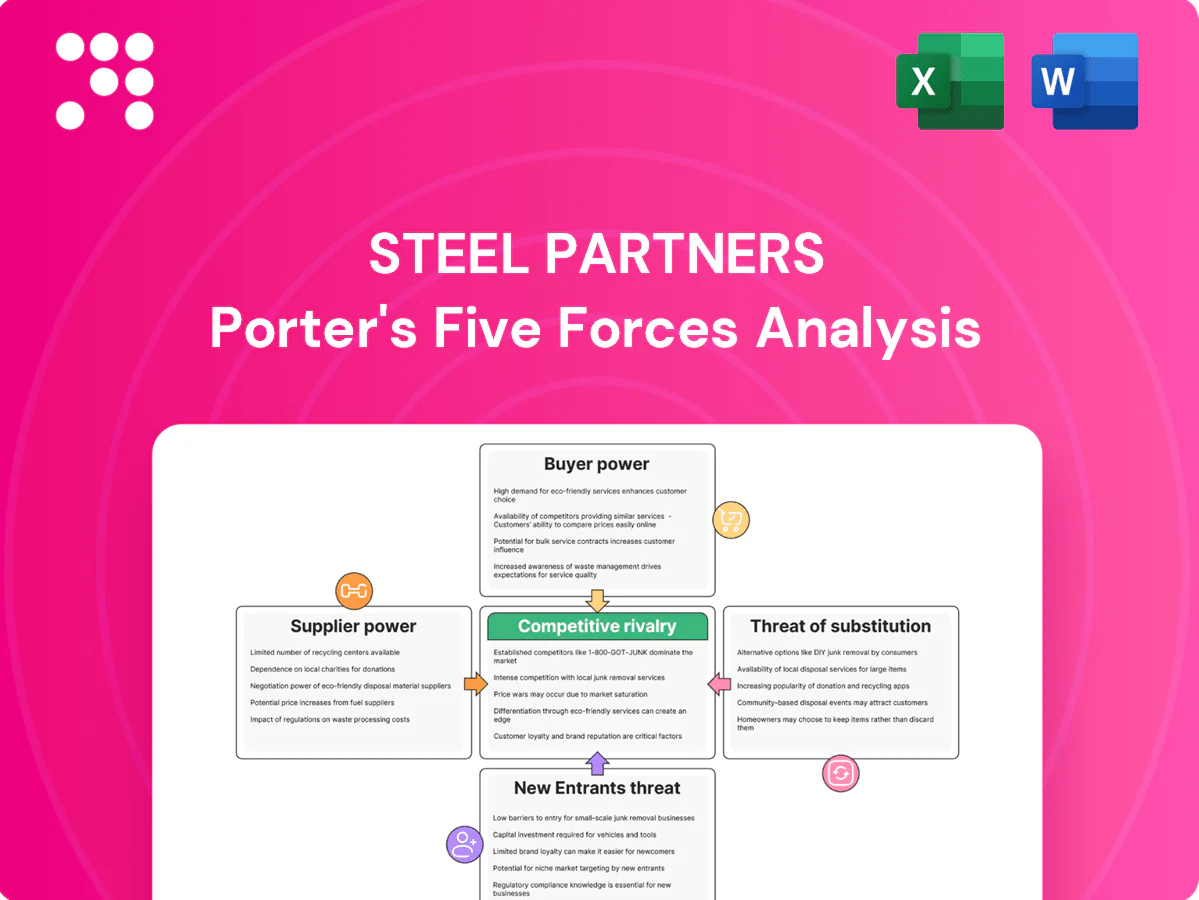
Steel Partners Porter's Five Forces Analysis

Go Beyond the Preview—Access the Full Strategic Report
Steel Partners faces moderate supplier power, concentrated buyers, and niche substitute threats that shape its competitive edge; this snapshot highlights key tensions and strategic levers. Want the full force-by-force ratings, visuals, and actionable implications? Unlock the complete Porter's Five Forces Analysis for a consultant-grade, ready-to-use report.
Suppliers Bargaining Power

Diverse input base tempers leverage
Steel Partners sources inputs across 30+ operating companies in 2024, diluting any single supplier’s leverage and enabling cross-portfolio procurement to bundle demand for better terms. Bundling across industrial, automotive, defense and electronics reduces unit costs, though niche defense and precision-manufactured components can still concentrate supplier power. Long-term supply agreements in key subsidiaries help stabilize price and quality risks.
Critical raw materials volatility
Metals, chemicals and energy inputs leave Steel Partners exposed to volatile commodity swings—Brent averaged about $85/bbl in 2024 and LME aluminium roughly $2,500/ton, pressuring margins. Suppliers of scarce alloys or specialty resins command premiums, with LME nickel near $22,000/ton in 2024 highlighting scarcity pricing. Hedging and multi-sourcing reduce exposure but raise coordination costs; vertical partnerships secure availability in tight markets.

Switching costs vary by unit
Standardized parts for Steel Partners businesses are easily substitutable, lowering supplier power, while OEM-qualified or regulated lines incur requalification that in 2024 commonly takes 3–12 months and can cost up to $1,000,000, creating supplier lock-in suppliers can exploit via price or lead-time increases; dual-qualification programs and secondary sourcing can restore negotiating balance.

Logistics and lead-time constraints
- Freight pressure: 2024 rates above 2019 on key lanes
- Lead times: 12–36 months for critical aerospace/defense parts
- Carrying cost: ~20% annual, ties up working capital
- VMI: aligns supplier incentives, reduces stockouts
Technology and IP gatekeepers
Proprietary subsystems and specialized tooling create strong supplier leverage for Steel Partners, especially where technical specs are embedded in customer certifications and replacements are operationally difficult in 2024. Joint development agreements can share IP and mitigate dependency, while careful contracting (performance clauses, IP carve-outs) preserves flexibility for second sources. Managing this risk affects capital allocation and margin stability across portfolio companies.
- Supplier lock-in: proprietary tooling raises switching costs
- Certification entrenchment: replacements constrained by embedded specs
- Mitigation: joint IP development and dual‑sourcing clauses
Cross-portfolio sourcing eases supplier leverage amid commodity volatility and long lead times
Steel Partners’ supplier power is moderated by cross-portfolio sourcing across 30+ operating companies, bundled procurement and long-term contracts, but niche aerospace/defense and proprietary tooling sustain supplier leverage. Commodity exposure (Brent ~$85/bbl, LME Al ~$2,500/t, Ni ~$22,000/t in 2024) and elevated freight/lead times (12–36 months) pressure margins; hedging, dual‑sourcing and JDA/IP clauses are primary mitigants.
| Metric | 2024 Value |
|---|---|
| Operating companies | 30+ |
| Brent | $85/bbl |
| LME Aluminium | $2,500/ton |
| LME Nickel | $22,000/ton |
| Lead times (critical) | 12–36 months |
| Inventory carrying cost | ~20% annual |
What is included in the product
 Detailed Word Document
Tailored Porter's Five Forces analysis for Steel Partners uncovering competitive intensity, buyer/supplier power, threat of entrants and substitutes, and industry rivalry. Highlights disruptors, pricing pressures, and barriers that shape Steel Partners' strategic positioning and profitability.

 Customizable Excel Spreadsheet
Clear, one-sheet Porter's Five Forces for Steel Partners—quickly gauge competitive pressures and relieve analysis bottlenecks for investment decisions.
Customers Bargaining Power

Concentrated industrial customers
Many Steel Partners portfolio companies sell primarily to large OEMs and distributors with significant scale, who in 2024 continued to negotiate aggressively on price and service.
Price transparency and bid pressure
Standard components face frequent competitive bidding, with global steel demand growing about 2% in 2024 and HRC price volatility near ±15%, driving buyers to benchmark across vendors and compress margins. Differentiation through quality, on-time delivery, and engineering support reduces pure price pressure. Framing offers around total cost of ownership, including yield and service, defends value and margin.

Switching ease depends on spec
For commoditized coils and plate, buyers can switch mills quickly with minimal risk, keeping customer bargaining power high; spot HRC trading volumes rose in 2024, reinforcing fluid sourcing. Certified or bespoke grades impose testing and downtime that often cost tens to low hundreds of thousands USD per qualification, limiting churn. Steel Partners can ethically embed services and logistics to raise switching costs, while multi-year contracts (2–5 years) secure volume visibility for both parties.

Demand cyclicality amplifies power
- Downturn order cuts: OECD 2024 apparent consumption -3%
- Upcycle allocation: premium to reliable suppliers
- Mitigants: counter-cyclical surcharges, flexible capacity
- Collaboration: forecast sharing improves planning accuracy
ESG and compliance requirements
Large industrial customers increasingly mandate ESG, traceability and cybersecurity controls; the EU Corporate Sustainability Reporting Directive (CSRD) expanded reporting in 2024 to cover roughly 50,000 companies, intensifying buyer leverage as non-compliant vendors risk exclusion from bids. Proactive certifications convert compliance from a barrier into a durable moat, while transparent reporting enables premium positioning and price negotiation power.
- CSRD (2024): ~50,000 companies covered
- Non-compliance → higher risk of bid exclusion
- Certifications = competitive moat
- Transparent ESG reporting supports premium pricing
Buyers press prices as HRC swings ±15%, demand up ~2%
Buyers retained high leverage in 2024, pressing price via competitive bids as HRC volatility reached ±15% and global steel demand grew ~2%. OEMs and distributors prioritized certified suppliers; CSRD expansion covered ~50,000 firms, raising compliance barriers. Multi-year contracts, embedded services and forecast collaboration were effective mitigants.
| Metric | 2024 |
|---|---|
| OECD apparent cons. | -3% |
| Global demand | +2% |
| HRC volatility | ±15% |
| CSRD scope | ~50,000 firms |
Preview Before You Purchase
Steel Partners Porter's Five Forces Analysis
This preview is the exact Porter’s Five Forces analysis for Steel Partners you’ll receive upon purchase—no mockups, no placeholders. The file is professionally formatted and ready to download immediately after payment. What you see here is the final, complete deliverable ready for use.

Original: $10.00
-65%$10.00
$3.50Product Information
Product Information
Shipping & Returns
Shipping & Returns
Description
Go Beyond the Preview—Access the Full Strategic Report
Steel Partners faces moderate supplier power, concentrated buyers, and niche substitute threats that shape its competitive edge; this snapshot highlights key tensions and strategic levers. Want the full force-by-force ratings, visuals, and actionable implications? Unlock the complete Porter's Five Forces Analysis for a consultant-grade, ready-to-use report.
Suppliers Bargaining Power
Diverse input base tempers leverage
Steel Partners sources inputs across 30+ operating companies in 2024, diluting any single supplier’s leverage and enabling cross-portfolio procurement to bundle demand for better terms. Bundling across industrial, automotive, defense and electronics reduces unit costs, though niche defense and precision-manufactured components can still concentrate supplier power. Long-term supply agreements in key subsidiaries help stabilize price and quality risks.
Critical raw materials volatility
Metals, chemicals and energy inputs leave Steel Partners exposed to volatile commodity swings—Brent averaged about $85/bbl in 2024 and LME aluminium roughly $2,500/ton, pressuring margins. Suppliers of scarce alloys or specialty resins command premiums, with LME nickel near $22,000/ton in 2024 highlighting scarcity pricing. Hedging and multi-sourcing reduce exposure but raise coordination costs; vertical partnerships secure availability in tight markets.
Switching costs vary by unit
Standardized parts for Steel Partners businesses are easily substitutable, lowering supplier power, while OEM-qualified or regulated lines incur requalification that in 2024 commonly takes 3–12 months and can cost up to $1,000,000, creating supplier lock-in suppliers can exploit via price or lead-time increases; dual-qualification programs and secondary sourcing can restore negotiating balance.
Logistics and lead-time constraints
- Freight pressure: 2024 rates above 2019 on key lanes
- Lead times: 12–36 months for critical aerospace/defense parts
- Carrying cost: ~20% annual, ties up working capital
- VMI: aligns supplier incentives, reduces stockouts
Technology and IP gatekeepers
Proprietary subsystems and specialized tooling create strong supplier leverage for Steel Partners, especially where technical specs are embedded in customer certifications and replacements are operationally difficult in 2024. Joint development agreements can share IP and mitigate dependency, while careful contracting (performance clauses, IP carve-outs) preserves flexibility for second sources. Managing this risk affects capital allocation and margin stability across portfolio companies.
- Supplier lock-in: proprietary tooling raises switching costs
- Certification entrenchment: replacements constrained by embedded specs
- Mitigation: joint IP development and dual‑sourcing clauses
Cross-portfolio sourcing eases supplier leverage amid commodity volatility and long lead times
Steel Partners’ supplier power is moderated by cross-portfolio sourcing across 30+ operating companies, bundled procurement and long-term contracts, but niche aerospace/defense and proprietary tooling sustain supplier leverage. Commodity exposure (Brent ~$85/bbl, LME Al ~$2,500/t, Ni ~$22,000/t in 2024) and elevated freight/lead times (12–36 months) pressure margins; hedging, dual‑sourcing and JDA/IP clauses are primary mitigants.
| Metric | 2024 Value |
|---|---|
| Operating companies | 30+ |
| Brent | $85/bbl |
| LME Aluminium | $2,500/ton |
| LME Nickel | $22,000/ton |
| Lead times (critical) | 12–36 months |
| Inventory carrying cost | ~20% annual |
What is included in the product
Detailed Word Document
Tailored Porter's Five Forces analysis for Steel Partners uncovering competitive intensity, buyer/supplier power, threat of entrants and substitutes, and industry rivalry. Highlights disruptors, pricing pressures, and barriers that shape Steel Partners' strategic positioning and profitability.
Customizable Excel Spreadsheet
Clear, one-sheet Porter's Five Forces for Steel Partners—quickly gauge competitive pressures and relieve analysis bottlenecks for investment decisions.
Customers Bargaining Power
Concentrated industrial customers
Many Steel Partners portfolio companies sell primarily to large OEMs and distributors with significant scale, who in 2024 continued to negotiate aggressively on price and service.
Price transparency and bid pressure
Standard components face frequent competitive bidding, with global steel demand growing about 2% in 2024 and HRC price volatility near ±15%, driving buyers to benchmark across vendors and compress margins. Differentiation through quality, on-time delivery, and engineering support reduces pure price pressure. Framing offers around total cost of ownership, including yield and service, defends value and margin.
Switching ease depends on spec
For commoditized coils and plate, buyers can switch mills quickly with minimal risk, keeping customer bargaining power high; spot HRC trading volumes rose in 2024, reinforcing fluid sourcing. Certified or bespoke grades impose testing and downtime that often cost tens to low hundreds of thousands USD per qualification, limiting churn. Steel Partners can ethically embed services and logistics to raise switching costs, while multi-year contracts (2–5 years) secure volume visibility for both parties.
Demand cyclicality amplifies power
- Downturn order cuts: OECD 2024 apparent consumption -3%
- Upcycle allocation: premium to reliable suppliers
- Mitigants: counter-cyclical surcharges, flexible capacity
- Collaboration: forecast sharing improves planning accuracy
ESG and compliance requirements
Large industrial customers increasingly mandate ESG, traceability and cybersecurity controls; the EU Corporate Sustainability Reporting Directive (CSRD) expanded reporting in 2024 to cover roughly 50,000 companies, intensifying buyer leverage as non-compliant vendors risk exclusion from bids. Proactive certifications convert compliance from a barrier into a durable moat, while transparent reporting enables premium positioning and price negotiation power.
- CSRD (2024): ~50,000 companies covered
- Non-compliance → higher risk of bid exclusion
- Certifications = competitive moat
- Transparent ESG reporting supports premium pricing
Buyers press prices as HRC swings ±15%, demand up ~2%
Buyers retained high leverage in 2024, pressing price via competitive bids as HRC volatility reached ±15% and global steel demand grew ~2%. OEMs and distributors prioritized certified suppliers; CSRD expansion covered ~50,000 firms, raising compliance barriers. Multi-year contracts, embedded services and forecast collaboration were effective mitigants.
| Metric | 2024 |
|---|---|
| OECD apparent cons. | -3% |
| Global demand | +2% |
| HRC volatility | ±15% |
| CSRD scope | ~50,000 firms |
Preview Before You Purchase
Steel Partners Porter's Five Forces Analysis
This preview is the exact Porter’s Five Forces analysis for Steel Partners you’ll receive upon purchase—no mockups, no placeholders. The file is professionally formatted and ready to download immediately after payment. What you see here is the final, complete deliverable ready for use.