Stater Bros PESTLE Analysis

Plan Smarter. Present Sharper. Compete Stronger.
Unlock strategic clarity with our PESTLE Analysis of Stater Bros—concise insights into political, economic, social, technological, legal, and environmental forces shaping the grocer. Ideal for investors and strategists needing fast, actionable intelligence. Purchase the full report to access the complete, editable breakdown and make smarter decisions today.
Political factors

California labor policy shifts
California frequently updates wage, break and scheduling rules that raise grocery labor costs and reduce staffing flexibility; statewide minimum wage reached 16.00 per hour on Jan 1, 2024 and many local ordinances add several dollars more. UFCW-backed initiatives continue to shape contract negotiations and workplace standards across the sector. Stater Bros must budget proactively and refine labor models to absorb policy-driven cost volatility.
Food assistance program dynamics
Changes to SNAP (national caseload ~42M in 2024) and WIC (≈6M participants) directly alter basket sizes and store traffic for Stater Bros; benefit cuts historically shift sales toward lower-cost and private label items. Compliance with WIC stocking/pricing rules demands tight execution to avoid penalties. Partnerships with community food programs helped maintain volumes during the 2022–24 downturns.

Local zoning and permitting
Local city councils and county boards in California control store siting, alcohol permits and signage, directly affecting Stater Bros, which operated about 171 stores as of 2024. Community input and CEQA reviews commonly add 6–12 months to remodels, expansions or distribution upgrades. Public incentives such as state and local redevelopment grants and Opportunity Zone tax benefits can lower project costs. Early stakeholder engagement reduces political friction and approval delays.

Trade and agricultural policy
Trade and agricultural policy—tariffs, port rules and federal farm supports—directly shape imported produce flows and California supply, with California providing nearly half of US fruits, nuts and vegetables (USDA). Border inspections and phytosanitary rules constrain availability and shelf-life; transportation policy drives freight cost and reliability, so diversified sourcing reduces geopolitical shock exposure.
- Tariffs: influence import mix
- Ports: affect lead times and spoilage
- Inspections: dictate freshness
- Transport policy: alters freight costs
- Diversified sourcing: hedges geopolitical risk
Public health and safety priorities
- 48 million annual US foodborne illnesses
- Emergency powers impact hours/capacity
- Wildfire-driven preparedness requirements
- SOPs mitigate continuity and reputational risk
CA wage hikes and SNAP/WIC shifts squeeze grocery margins amid higher freight/produce costs
California wage/scheduling laws (state min wage $16.00/hr Jan 1, 2024; many local add-ons) compress margins and limit staffing flexibility. SNAP (~42M recipients in 2024) and WIC (~6M) shift baskets toward private label. Stater Bros (≈171 stores in 2024) faces CEQA/permit delays and wildfire/emergency mandates; SOPs mitigate closure risk. Tariffs, port rules and inspections raise freight and produce costs.
| Metric | Value |
|---|---|
| CA min wage | $16.00/hr (Jan 1, 2024) |
| SNAP caseload | ~42M (2024) |
| WIC participants | ~6M (2024) |
| Stores | ≈171 (2024) |
| US foodborne illnesses | 48M annually |
What is included in the product
 Detailed Word Document
Explores how Political, Economic, Social, Technological, Environmental and Legal factors uniquely affect Stater Bros, with data-backed trends and region-specific regulatory context; designed for executives and investors, it offers forward-looking insights and ready-to-use findings for strategy, scenario planning and funding support.

 Customizable Excel Spreadsheet
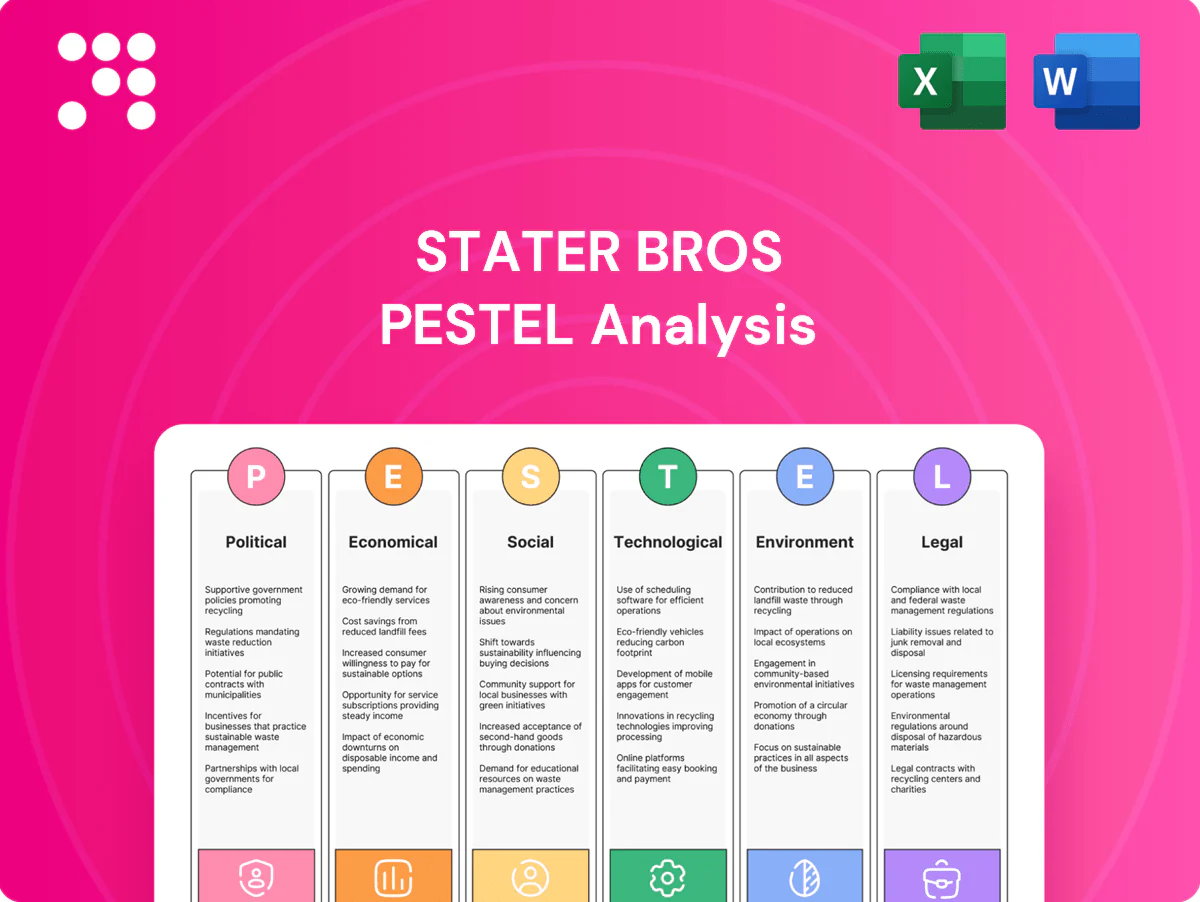
A concise, visually segmented PESTLE summary for Stater Bros that can be dropped into presentations or shared across teams, enabling quick assessment of external risks and market positioning while allowing region-specific notes for planning and decision-making.
Economic factors

Food inflation and consumer trade-down
Volatile input costs—after food-at-home inflation peaked near 13% in 2022 and eased to roughly 4–5% by 2024—drive shoppers toward value tiers and promotions. Expanding private label (US share ~18% pre-2024) can protect traffic and margins. Pricing analytics and measured elasticities enable targeted offers. Stater Bros must balance EDLP with periodic high-visibility deals to retain price-sensitive customers.
Southern California cost structure
Southern California retail rents run roughly $25–35/sq ft annually (2024) while California minimum wage is $16/hr, driving structurally high rent, utilities, logistics and labor costs for Stater Bros. Scale in procurement and efficient store footprints are critical to protect thin grocery margins. Energy-saving retrofits (LED, HVAC) can cut energy spend 20–40% over time. Distribution routing and backhaul optimization typically reduce transport costs 10–15%, protecting EBITDA.

Competitive intensity
Discounters, club stores and mass merchandisers — with Walmart alone holding roughly 26% of U.S. grocery sales and discounters/clubs near a combined 20% share in 2024 — push down prices and demand greater convenience. Regional grocers and Latino-focused formats fragment local share as the Hispanic population reaches about 19% of the U.S. population (2024). Grocery e-commerce rose to roughly 12% of sales in 2024, raising service expectations. Differentiation through superior perishables quality and curated local assortment is essential for Stater Bros.

Labor market tightness
Labor market tightness across Southern California—median rent roughly $2,400/month in 2024—plus long commutes raise recruitment and retention costs for Stater Bros, pushing entry wages up and creating wage compression risks as raises narrow pay differentials. Focused investment in training and clear career paths can cut frontline turnover materially, while predictive scheduling and targeted incentives (pilot cuts absenteeism ~10–15%) help stabilize service levels.
- Housing pressure: median SoCal rent ~$2,400 (2024)
- Wage compression: rising entry wages shrink pay tiers
- Training: reduces turnover significantly
- Scheduling: predictive shifts + incentives improve reliability ~10–15%
Macroeconomic cycles
Recessions spur pantry loading and more at-home cooking—US food-at-home CPI surged 11.4% in 2022, raising basket-value sensitivity as shoppers trade down. Recoveries reopen demand for premium and wellness lines, while fuel-price swings (gasoline peaked near 5.00/gal in 2022) alter logistics and trip frequency. Flexible merchandising hedges margin and sales across cycles.
- pantry-loading: demand spike in downturns
- basket-sensitivity: higher during inflation
- premium-rebound: recovery-driven
- fuel-volatility: impacts logistics/trips
- flex-merch: risk hedge
CA wage hikes and SNAP/WIC shifts squeeze grocery margins amid higher freight/produce costs
Inflation rebalanced from food-at-home ~13% (2022) to ~4–5% by 2024, pushing shoppers to value tiers and private label (~18% share) while pricing analytics preserve margins. Southern California cost base is high—median rent ~$2,400/mo (2024) and CA minimum wage $16/hr—raising labor and occupancy spend. Competitive pressure from Walmart (~26% US grocery) and 12% grocery e-commerce (2024) forces convenience and quality differentiation.
| Metric | 2024 |
|---|---|
| Food-at-home CPI | 4–5% |
| Private label share | ~18% |
| Walmart grocery share | ~26% |
| Grocery e‑commerce | ~12% |
| SoCal median rent | $2,400/mo |
| CA min wage | $16/hr |
Preview the Actual Deliverable
Stater Bros PESTLE Analysis
The Stater Bros PESTLE Analysis provided here is the exact, fully formatted document you'll receive after purchase. This real preview shows the final layout, content and structure with no placeholders or surprises. Download the ready-to-use file immediately after payment.

Product Information
Product Information
Shipping & Returns
Shipping & Returns
Description
Plan Smarter. Present Sharper. Compete Stronger.
Unlock strategic clarity with our PESTLE Analysis of Stater Bros—concise insights into political, economic, social, technological, legal, and environmental forces shaping the grocer. Ideal for investors and strategists needing fast, actionable intelligence. Purchase the full report to access the complete, editable breakdown and make smarter decisions today.
Political factors
California labor policy shifts
California frequently updates wage, break and scheduling rules that raise grocery labor costs and reduce staffing flexibility; statewide minimum wage reached 16.00 per hour on Jan 1, 2024 and many local ordinances add several dollars more. UFCW-backed initiatives continue to shape contract negotiations and workplace standards across the sector. Stater Bros must budget proactively and refine labor models to absorb policy-driven cost volatility.
Food assistance program dynamics
Changes to SNAP (national caseload ~42M in 2024) and WIC (≈6M participants) directly alter basket sizes and store traffic for Stater Bros; benefit cuts historically shift sales toward lower-cost and private label items. Compliance with WIC stocking/pricing rules demands tight execution to avoid penalties. Partnerships with community food programs helped maintain volumes during the 2022–24 downturns.
Local zoning and permitting
Local city councils and county boards in California control store siting, alcohol permits and signage, directly affecting Stater Bros, which operated about 171 stores as of 2024. Community input and CEQA reviews commonly add 6–12 months to remodels, expansions or distribution upgrades. Public incentives such as state and local redevelopment grants and Opportunity Zone tax benefits can lower project costs. Early stakeholder engagement reduces political friction and approval delays.
Trade and agricultural policy
Trade and agricultural policy—tariffs, port rules and federal farm supports—directly shape imported produce flows and California supply, with California providing nearly half of US fruits, nuts and vegetables (USDA). Border inspections and phytosanitary rules constrain availability and shelf-life; transportation policy drives freight cost and reliability, so diversified sourcing reduces geopolitical shock exposure.
- Tariffs: influence import mix
- Ports: affect lead times and spoilage
- Inspections: dictate freshness
- Transport policy: alters freight costs
- Diversified sourcing: hedges geopolitical risk
Public health and safety priorities
- 48 million annual US foodborne illnesses
- Emergency powers impact hours/capacity
- Wildfire-driven preparedness requirements
- SOPs mitigate continuity and reputational risk
CA wage hikes and SNAP/WIC shifts squeeze grocery margins amid higher freight/produce costs
California wage/scheduling laws (state min wage $16.00/hr Jan 1, 2024; many local add-ons) compress margins and limit staffing flexibility. SNAP (~42M recipients in 2024) and WIC (~6M) shift baskets toward private label. Stater Bros (≈171 stores in 2024) faces CEQA/permit delays and wildfire/emergency mandates; SOPs mitigate closure risk. Tariffs, port rules and inspections raise freight and produce costs.
| Metric | Value |
|---|---|
| CA min wage | $16.00/hr (Jan 1, 2024) |
| SNAP caseload | ~42M (2024) |
| WIC participants | ~6M (2024) |
| Stores | ≈171 (2024) |
| US foodborne illnesses | 48M annually |
What is included in the product
Detailed Word Document
Explores how Political, Economic, Social, Technological, Environmental and Legal factors uniquely affect Stater Bros, with data-backed trends and region-specific regulatory context; designed for executives and investors, it offers forward-looking insights and ready-to-use findings for strategy, scenario planning and funding support.
Customizable Excel Spreadsheet
A concise, visually segmented PESTLE summary for Stater Bros that can be dropped into presentations or shared across teams, enabling quick assessment of external risks and market positioning while allowing region-specific notes for planning and decision-making.
Economic factors
Food inflation and consumer trade-down
Volatile input costs—after food-at-home inflation peaked near 13% in 2022 and eased to roughly 4–5% by 2024—drive shoppers toward value tiers and promotions. Expanding private label (US share ~18% pre-2024) can protect traffic and margins. Pricing analytics and measured elasticities enable targeted offers. Stater Bros must balance EDLP with periodic high-visibility deals to retain price-sensitive customers.
Southern California cost structure
Southern California retail rents run roughly $25–35/sq ft annually (2024) while California minimum wage is $16/hr, driving structurally high rent, utilities, logistics and labor costs for Stater Bros. Scale in procurement and efficient store footprints are critical to protect thin grocery margins. Energy-saving retrofits (LED, HVAC) can cut energy spend 20–40% over time. Distribution routing and backhaul optimization typically reduce transport costs 10–15%, protecting EBITDA.
Competitive intensity
Discounters, club stores and mass merchandisers — with Walmart alone holding roughly 26% of U.S. grocery sales and discounters/clubs near a combined 20% share in 2024 — push down prices and demand greater convenience. Regional grocers and Latino-focused formats fragment local share as the Hispanic population reaches about 19% of the U.S. population (2024). Grocery e-commerce rose to roughly 12% of sales in 2024, raising service expectations. Differentiation through superior perishables quality and curated local assortment is essential for Stater Bros.
Labor market tightness
Labor market tightness across Southern California—median rent roughly $2,400/month in 2024—plus long commutes raise recruitment and retention costs for Stater Bros, pushing entry wages up and creating wage compression risks as raises narrow pay differentials. Focused investment in training and clear career paths can cut frontline turnover materially, while predictive scheduling and targeted incentives (pilot cuts absenteeism ~10–15%) help stabilize service levels.
- Housing pressure: median SoCal rent ~$2,400 (2024)
- Wage compression: rising entry wages shrink pay tiers
- Training: reduces turnover significantly
- Scheduling: predictive shifts + incentives improve reliability ~10–15%
Macroeconomic cycles
Recessions spur pantry loading and more at-home cooking—US food-at-home CPI surged 11.4% in 2022, raising basket-value sensitivity as shoppers trade down. Recoveries reopen demand for premium and wellness lines, while fuel-price swings (gasoline peaked near 5.00/gal in 2022) alter logistics and trip frequency. Flexible merchandising hedges margin and sales across cycles.
- pantry-loading: demand spike in downturns
- basket-sensitivity: higher during inflation
- premium-rebound: recovery-driven
- fuel-volatility: impacts logistics/trips
- flex-merch: risk hedge
CA wage hikes and SNAP/WIC shifts squeeze grocery margins amid higher freight/produce costs
Inflation rebalanced from food-at-home ~13% (2022) to ~4–5% by 2024, pushing shoppers to value tiers and private label (~18% share) while pricing analytics preserve margins. Southern California cost base is high—median rent ~$2,400/mo (2024) and CA minimum wage $16/hr—raising labor and occupancy spend. Competitive pressure from Walmart (~26% US grocery) and 12% grocery e-commerce (2024) forces convenience and quality differentiation.
| Metric | 2024 |
|---|---|
| Food-at-home CPI | 4–5% |
| Private label share | ~18% |
| Walmart grocery share | ~26% |
| Grocery e‑commerce | ~12% |
| SoCal median rent | $2,400/mo |
| CA min wage | $16/hr |
Preview the Actual Deliverable
Stater Bros PESTLE Analysis
The Stater Bros PESTLE Analysis provided here is the exact, fully formatted document you'll receive after purchase. This real preview shows the final layout, content and structure with no placeholders or surprises. Download the ready-to-use file immediately after payment.