Starwood Property Trust PESTLE Analysis

Your Competitive Advantage Starts with This Report
Gain a competitive edge with our PESTLE analysis of Starwood Property Trust—three concise insights into how political shifts, economic cycles, and regulatory change shape portfolio risk and returns. See how technological trends and ESG pressures affect asset valuation and operations. Purchase the full report for the complete, actionable breakdown ready for investment or strategy use.
Political factors

US housing and CRE policy
Shifts in federal and state housing and CRE priorities can reprice financing incentives, tax credits and subsidy programs, altering origination economics for investors. Changes to GSE footprints and credit support—against roughly $13.8 trillion of US mortgage debt outstanding in 2024—directly affect liquidity and yields on mortgage assets. Starwood Property Trust must track policy direction to realign origination focus and risk appetite. Political cycles drive program volatility and timing uncertainty.
REIT tax status stability
Preservation of REIT tax treatment—REITs must distribute at least 90% of taxable income to avoid entity-level tax—is politically driven and central to STWD’s after-tax returns. Any proposal narrowing deductions or altering the 90% distribution rule could constrain dividend capacity and capital formation for Starwood (market cap about $10B). STWD plans leverage and payouts around stable policy signals; advocacy and scenario planning mitigate regime risk.

Local zoning and permitting
Local zoning and permitting decisions directly shape development pipelines and collateral values, with municipal approvals often dictating project timelines. Stricter zoning or longer permitting can delay projects that back STWD loans, disrupting draw schedules and raising default risk. STWD (ticker STWD) underwrites across multiple jurisdictions and must price jurisdictional permitting variance into its risk models and valuations.

US–EU geopolitical dynamics
Operating across the US and EU exposes Starwood Property Trust assets to shifting cross-border politics: sanctions and trade tensions can slow regional growth, while NATO-related defense spending (NATO reported collective spending above $1.2 trillion in 2024) and policy shifts affect capital flows and currency volatility, prompting allocation toward jurisdictions with clearer policy frameworks.
- Exposure: US–EU trade > $1 trillion
- Risk: sanctions/trade shocks
- Macro: defense spend > $1.2T (2024)
- Action: tilt to policy-clear jurisdictions
Public infrastructure spending
Government investment in transit, utilities and resilience under the US Infrastructure Investment and Jobs Act (IIJA) — a $1.2 trillion package with about $550 billion in new spending — can uplift surrounding property values and reduce operating risk for real estate collateral. Timelines and funding certainty remain politically driven, while enhanced infrastructure lowers credit and development risk for STWD.
- IIJA: $1.2T total, ~$550B new
- Improves collateral quality, lowers LTV risk
- Prioritize markets with durable public commitments
GSE $13.8T, 90% REIT rule reshape housing finance
Federal/state housing policy, GSE support (US mortgage stock ~$13.8T in 2024) and REIT tax rules (90% distribution) directly reshape STWD origination economics and dividend capacity. Local zoning and IIJA funding (~$1.2T total, ~$550B new) affect collateral values and project timelines. Cross-border politics, NATO spend >$1.2T (2024) and US–EU trade >$1T drive allocation and liquidity risk.
| Tag | Value |
|---|---|
| GSE/Mortgage | $13.8T (2024) |
| Market cap | ~$10B |
| REIT rule | 90% distribution |
| IIJA | $1.2T total / $550B new |
What is included in the product
 Detailed Word Document
Explores how Political, Economic, Social, Technological, Environmental, and Legal forces uniquely impact Starwood Property Trust, with data-backed trends, practical subpoints, and forward-looking insights to help executives, investors, and strategists identify risks, opportunities, and actionable scenarios for planning and capital allocation.

 Customizable Excel Spreadsheet
A concise, visually segmented PESTLE summary of Starwood Property Trust that can be dropped into presentations, edited with region-specific notes, and easily shared—clarifying regulatory, economic, and market risks to support rapid alignment and planning discussions.
Economic factors

Interest rates and yield curve
With the federal funds target at about 5.25–5.50% and the 10-year Treasury near 4.2% (July 2025), Starwood Property Trust faces funding costs and loan demand tied to these levels and the curve shape; wider spreads lift yield on new originations but can mark down legacy CRE and mortgage assets; refinancing feasibility and prepayment speeds shift across rate regimes; active hedging and duration management are essential to protect NAV and spread income.
Credit cycle and delinquencies
Cyclical stress has lifted CRE default probabilities, with Trepp reporting CMBS delinquencies near 5.8% by mid-2025, elevating sector-wide credit risk. Office, hospitality and retail show divergent sensitivities—office vacancy-driven defaults remain highest, hospitality tied to tourism cycles, retail to consumer spending. Higher loss-given-defaults and prolonged workout timelines compress returns. STWD’s risk grading and reserves must meaningfully flex with these macro shifts.

Inflation and cap rates
Inflation (~3.4% in 2024) drives rent growth, increases expense pass-throughs and can lift property NOI for assets with pricing power, while weaker classes see margin compression. Rising cap rates—up ~150–250 bps versus 2021 lows—reduce collateral valuations and erode LTV cushions, stressing STWD’s loan portfolios. Underwriting should embed conservative reversion and lower terminal multiples.

Labor markets and vacancy
- Employment: US unemployment 3.7% (Dec 2024)
- Openings: 8.9M (JOLTS, Dec 2024)
- Vacancy: Office ~17%, Industrial ~4.2%, Multifamily ~5.6% (2024)
- Risk: Higher vacancy → concessions → lower DSCR
FX and European exposure
Euro and pound volatility—EUR/USD ~1.09 and GBP/USD ~1.27 (July 2025)—can compress translated earnings and affect euro/sterling-denominated collateral cash flows for Starwood Property Trust. Divergent monetary stances (Fed funds ~5.25–5.50%, ECB ~4.00%) create basis risk between USD and EUR/GBP funding. Hedging trims P&L swings but raises financing costs and reduces yield.
- FX exposure: EUR/GBP carry affects cash flow convertibility
- Rate gap: Fed vs ECB basis risk on cross-currency swaps
- Hedging: lowers volatility, increases cost
- Market select: prefer lower-correlation EU economies
GSE $13.8T, 90% REIT rule reshape housing finance
Rising policy rates (Fed 5.25–5.50%, 10y ~4.2% Jul 2025) elevate funding costs and widen CRE spreads, boosting new-origin yields but marking legacy assets. CRE delinquencies (~5.8% CMBS mid-2025) and higher office vacancy (~17%) raise credit losses and workout timelines. Inflation (~3.4% 2024) lifts NOI for price-sensitive assets but rising cap rates cut valuations and LTV cushions.
| Metric | Value |
|---|---|
| Fed funds | 5.25–5.50% |
| 10‑yr Treasury | ~4.2% |
| Inflation (2024) | ~3.4% |
| Unemployment (Dec 2024) | 3.7% |
| CMBS delinquency (mid‑2025) | ~5.8% |
| Office vacancy (2024) | ~17% |
| EUR/USD (Jul 2025) | ~1.09 |
Preview Before You Purchase
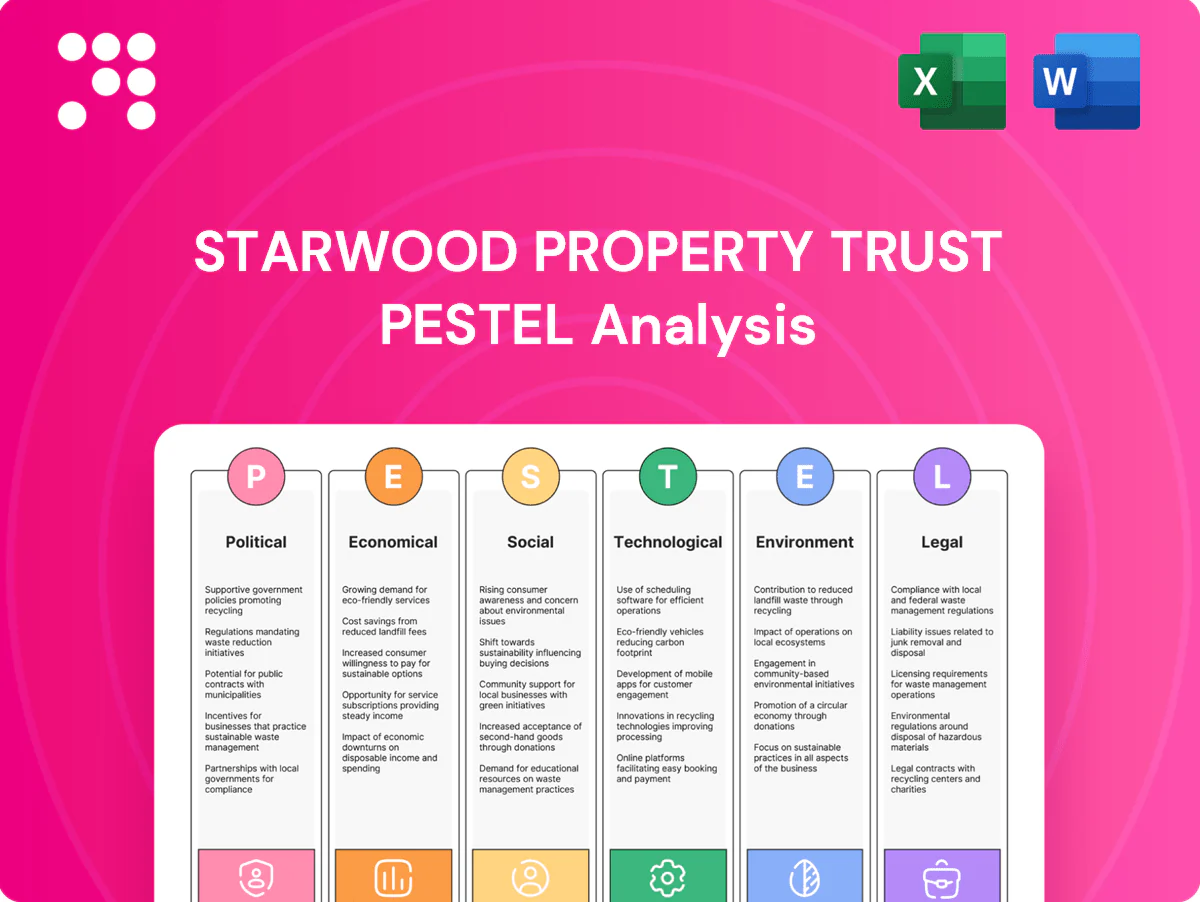
Starwood Property Trust PESTLE Analysis
The preview shown here is the exact Starwood Property Trust PESTLE Analysis document you’ll receive after purchase—fully formatted and ready to use. It covers Political, Economic, Social, Technological, Legal and Environmental factors with professional structure and actionable insights. No placeholders or teasers—this is the final file you’ll download immediately after buying.

Product Information
Product Information
Shipping & Returns
Shipping & Returns
Description
Your Competitive Advantage Starts with This Report
Gain a competitive edge with our PESTLE analysis of Starwood Property Trust—three concise insights into how political shifts, economic cycles, and regulatory change shape portfolio risk and returns. See how technological trends and ESG pressures affect asset valuation and operations. Purchase the full report for the complete, actionable breakdown ready for investment or strategy use.
Political factors
US housing and CRE policy
Shifts in federal and state housing and CRE priorities can reprice financing incentives, tax credits and subsidy programs, altering origination economics for investors. Changes to GSE footprints and credit support—against roughly $13.8 trillion of US mortgage debt outstanding in 2024—directly affect liquidity and yields on mortgage assets. Starwood Property Trust must track policy direction to realign origination focus and risk appetite. Political cycles drive program volatility and timing uncertainty.
REIT tax status stability
Preservation of REIT tax treatment—REITs must distribute at least 90% of taxable income to avoid entity-level tax—is politically driven and central to STWD’s after-tax returns. Any proposal narrowing deductions or altering the 90% distribution rule could constrain dividend capacity and capital formation for Starwood (market cap about $10B). STWD plans leverage and payouts around stable policy signals; advocacy and scenario planning mitigate regime risk.
Local zoning and permitting
Local zoning and permitting decisions directly shape development pipelines and collateral values, with municipal approvals often dictating project timelines. Stricter zoning or longer permitting can delay projects that back STWD loans, disrupting draw schedules and raising default risk. STWD (ticker STWD) underwrites across multiple jurisdictions and must price jurisdictional permitting variance into its risk models and valuations.
US–EU geopolitical dynamics
Operating across the US and EU exposes Starwood Property Trust assets to shifting cross-border politics: sanctions and trade tensions can slow regional growth, while NATO-related defense spending (NATO reported collective spending above $1.2 trillion in 2024) and policy shifts affect capital flows and currency volatility, prompting allocation toward jurisdictions with clearer policy frameworks.
- Exposure: US–EU trade > $1 trillion
- Risk: sanctions/trade shocks
- Macro: defense spend > $1.2T (2024)
- Action: tilt to policy-clear jurisdictions
Public infrastructure spending
Government investment in transit, utilities and resilience under the US Infrastructure Investment and Jobs Act (IIJA) — a $1.2 trillion package with about $550 billion in new spending — can uplift surrounding property values and reduce operating risk for real estate collateral. Timelines and funding certainty remain politically driven, while enhanced infrastructure lowers credit and development risk for STWD.
- IIJA: $1.2T total, ~$550B new
- Improves collateral quality, lowers LTV risk
- Prioritize markets with durable public commitments
GSE $13.8T, 90% REIT rule reshape housing finance
Federal/state housing policy, GSE support (US mortgage stock ~$13.8T in 2024) and REIT tax rules (90% distribution) directly reshape STWD origination economics and dividend capacity. Local zoning and IIJA funding (~$1.2T total, ~$550B new) affect collateral values and project timelines. Cross-border politics, NATO spend >$1.2T (2024) and US–EU trade >$1T drive allocation and liquidity risk.
| Tag | Value |
|---|---|
| GSE/Mortgage | $13.8T (2024) |
| Market cap | ~$10B |
| REIT rule | 90% distribution |
| IIJA | $1.2T total / $550B new |
What is included in the product
Detailed Word Document
Explores how Political, Economic, Social, Technological, Environmental, and Legal forces uniquely impact Starwood Property Trust, with data-backed trends, practical subpoints, and forward-looking insights to help executives, investors, and strategists identify risks, opportunities, and actionable scenarios for planning and capital allocation.
Customizable Excel Spreadsheet
A concise, visually segmented PESTLE summary of Starwood Property Trust that can be dropped into presentations, edited with region-specific notes, and easily shared—clarifying regulatory, economic, and market risks to support rapid alignment and planning discussions.
Economic factors
Interest rates and yield curve
With the federal funds target at about 5.25–5.50% and the 10-year Treasury near 4.2% (July 2025), Starwood Property Trust faces funding costs and loan demand tied to these levels and the curve shape; wider spreads lift yield on new originations but can mark down legacy CRE and mortgage assets; refinancing feasibility and prepayment speeds shift across rate regimes; active hedging and duration management are essential to protect NAV and spread income.
Credit cycle and delinquencies
Cyclical stress has lifted CRE default probabilities, with Trepp reporting CMBS delinquencies near 5.8% by mid-2025, elevating sector-wide credit risk. Office, hospitality and retail show divergent sensitivities—office vacancy-driven defaults remain highest, hospitality tied to tourism cycles, retail to consumer spending. Higher loss-given-defaults and prolonged workout timelines compress returns. STWD’s risk grading and reserves must meaningfully flex with these macro shifts.
Inflation and cap rates
Inflation (~3.4% in 2024) drives rent growth, increases expense pass-throughs and can lift property NOI for assets with pricing power, while weaker classes see margin compression. Rising cap rates—up ~150–250 bps versus 2021 lows—reduce collateral valuations and erode LTV cushions, stressing STWD’s loan portfolios. Underwriting should embed conservative reversion and lower terminal multiples.
Labor markets and vacancy
- Employment: US unemployment 3.7% (Dec 2024)
- Openings: 8.9M (JOLTS, Dec 2024)
- Vacancy: Office ~17%, Industrial ~4.2%, Multifamily ~5.6% (2024)
- Risk: Higher vacancy → concessions → lower DSCR
FX and European exposure
Euro and pound volatility—EUR/USD ~1.09 and GBP/USD ~1.27 (July 2025)—can compress translated earnings and affect euro/sterling-denominated collateral cash flows for Starwood Property Trust. Divergent monetary stances (Fed funds ~5.25–5.50%, ECB ~4.00%) create basis risk between USD and EUR/GBP funding. Hedging trims P&L swings but raises financing costs and reduces yield.
- FX exposure: EUR/GBP carry affects cash flow convertibility
- Rate gap: Fed vs ECB basis risk on cross-currency swaps
- Hedging: lowers volatility, increases cost
- Market select: prefer lower-correlation EU economies
GSE $13.8T, 90% REIT rule reshape housing finance
Rising policy rates (Fed 5.25–5.50%, 10y ~4.2% Jul 2025) elevate funding costs and widen CRE spreads, boosting new-origin yields but marking legacy assets. CRE delinquencies (~5.8% CMBS mid-2025) and higher office vacancy (~17%) raise credit losses and workout timelines. Inflation (~3.4% 2024) lifts NOI for price-sensitive assets but rising cap rates cut valuations and LTV cushions.
| Metric | Value |
|---|---|
| Fed funds | 5.25–5.50% |
| 10‑yr Treasury | ~4.2% |
| Inflation (2024) | ~3.4% |
| Unemployment (Dec 2024) | 3.7% |
| CMBS delinquency (mid‑2025) | ~5.8% |
| Office vacancy (2024) | ~17% |
| EUR/USD (Jul 2025) | ~1.09 |
Preview Before You Purchase
Starwood Property Trust PESTLE Analysis
The preview shown here is the exact Starwood Property Trust PESTLE Analysis document you’ll receive after purchase—fully formatted and ready to use. It covers Political, Economic, Social, Technological, Legal and Environmental factors with professional structure and actionable insights. No placeholders or teasers—this is the final file you’ll download immediately after buying.