Spectrum Brands SWOT Analysis

Your Strategic Toolkit Starts Here
Spectrum Brands' SWOT highlights strong brand portfolio and diversified channels, offset by supply-chain pressures and competitive private labels; growth hinges on innovation and margin recovery. Want the full strategic picture? Purchase the complete SWOT for a research-backed, editable Word + Excel package to plan and pitch with confidence.
Strengths

Diversified brand portfolio across everyday categories
Diversified presence across home & garden, pet care and personal care smooths category-specific volatility by offsetting seasonal swings and demand shocks; multiple need-based use cases sustain baseline demand through downturns. Cross-category consumer insights and shared R&D, supply-chain and sales capabilities drive cost efficiency and faster innovation. Being present in 160 countries boosts shelf presence and retailer relevance.
Global omnichannel distribution relationships
Global omnichannel distribution spans 170+ countries and placement with mass merchandisers, home‑improvement centers, specialty retail and expanding e‑commerce (e‑commerce up ~20% in 2023), enabling scale, channel visibility and promotional flexibility. Broad reach allows mix‑shifting toward higher‑margin specialty/e‑comm sales to optimize gross margins, while deep retailer partnerships raise switching costs and barrier to smaller rivals.

Acquisition-led growth and brand management expertise
Spectrum Brands runs a repeatable playbook of acquiring, integrating and scaling established brands, leveraging its ~4.0 billion USD annual revenue base (2023) to achieve speed-to-scale versus organic builds. The company captures synergies in sourcing, manufacturing and marketing, often converting M&A into >100 bps margin improvement through disciplined portfolio management and targeted brand renovation.

Supply chain and sourcing scale advantages
Spectrum Brands leverages procurement scale across categories and geographies to secure volume discounts and favorable supplier terms, while consolidated manufacturing and logistics networks lower unit costs and improve fill rates. SKU rationalization and shared platform designs reduce working capital needs and inventory carrying costs. Multi-sourcing strategies add resilience to supply disruptions.
Enduring consumer relevance and brand equity
Everyday-need categories drive habitual repeat purchases, strengthening Spectrum Brands' core sales stability and reducing acquisition costs; brand trust supports higher shelf pricing and recurring loyalty across battery, grooming and pet-care segments. Continuous product innovation and line extensions keep assortment fresh and margin-accretive, while widely recognized brands translate effectively across retail channels and international markets.
- habitual purchases
- pricing power & loyalty
- innovation & extensions
- channel & regional portability
Global consumer essentials platform scales omnichannel reach, captures ~20% e‑commerce growth
Spectrum Brands (2023 rev ~4.0B USD) leverages 160+ country presence and omnichannel reach to scale distribution and capture ~20% e‑commerce growth (2023). Diversified everyday categories (batteries, pet, grooming) drive repeat purchases, pricing power and steady demand. Repeatable M&A + procurement scale delivers >100 bps post‑integration margin uplift and lowers unit costs.
| Metric | Value |
|---|---|
| 2023 revenue | ~4.0B USD |
| Countries | 160+ |
| E‑commerce growth (2023) | ~20% |
| Post‑M&A uplift | >100 bps |
What is included in the product
 Detailed Word Document
Provides a concise analysis of Spectrum Brands’ internal strengths and weaknesses and external opportunities and threats, mapping competitive position, growth drivers, and market risks to inform strategic decision-making.

 Customizable Excel Spreadsheet
Provides a concise SWOT matrix tailored to Spectrum Brands for rapid strategy alignment, highlighting key brand risks and growth levers; ideal for quick stakeholder briefings and cross-unit comparisons.
Weaknesses

Exposure to retailer concentration and terms
Spectrum Brands relies heavily on large mass and home-improvement chains for volume, giving key accounts strong bargaining power over pricing, slotting and promotional terms. Assortment shifts or retailer private-label initiatives can quickly reduce shelf space and sales for core SKUs. Extended receivable cycles and retailer deductions strain working capital and compress margins, limiting flexibility for marketing and inventory investment.
Margin sensitivity to commodities and freight
Spectrum Brands relies heavily on resins, metals, specialty chemicals, packaging and transport, making input-cost swings a direct hit to gross margins. Inflation spikes historically compress margins ahead of customer price recovery, with hedges limited in scope and often subject to timing lags. The business is especially vulnerable during supply dislocations when spot input and freight premiums spike.

Portfolio complexity and execution risk
Managing a broad portfolio spanning consumer appliances, batteries and pet supplies creates complexity across brands, SKUs and geographies, raising execution risk and the potential for diluted strategic focus. This breadth can slow innovation cycles as resources are spread and product roadmaps must be coordinated. Ongoing M&A adds integration risk, while overhead creep and coordination costs can erode margins.

Intense competition and private label pressure
- Price and placement pressure
- Private-label ~18% share (2023)
- Promotions erode margins
- Copycat SKUs shorten differentiation
- Requires sustained marketing/trade spend
Product quality and recall exposure
Spectrum Brands faces heightened regulatory and safety scrutiny across pet, personal care, and home segments; product defects can trigger costly recalls, class-action litigation, and lasting brand damage. Recalls and remediation frequently run into tens of millions of dollars, while compliance and expanded testing raise operating costs. Social media rapidly amplifies incidents, accelerating reputation losses and sales declines.
- Regulatory scrutiny: pet, personal care, home
- Recall/litigation risk: tens of millions in costs
- Compliance/testing: higher OPEX
- Social media: faster reputation impact
Retail concentration, input-cost shocks and private-label pressure squeeze margins
Spectrum Brands depends on large mass/home-improvement chains, giving key accounts strong pricing and slotting power and creating extended receivable cycles that strain working capital. Heavy reliance on resins, metals and specialty chemicals makes margins vulnerable to input-cost spikes and supply dislocations. A broad, fragmented portfolio raises execution and integration risk, while private-label competition and promotions compress margins and force sustained trade spend.
| Tag | Value |
|---|---|
| Private-label share (grocery) | ~18% (2023) |
| Recall/litigation costs | Tens of millions (historical) |
| Key risks | Retail concentration; input-cost volatility; portfolio complexity |
Full Version Awaits
Spectrum Brands SWOT Analysis
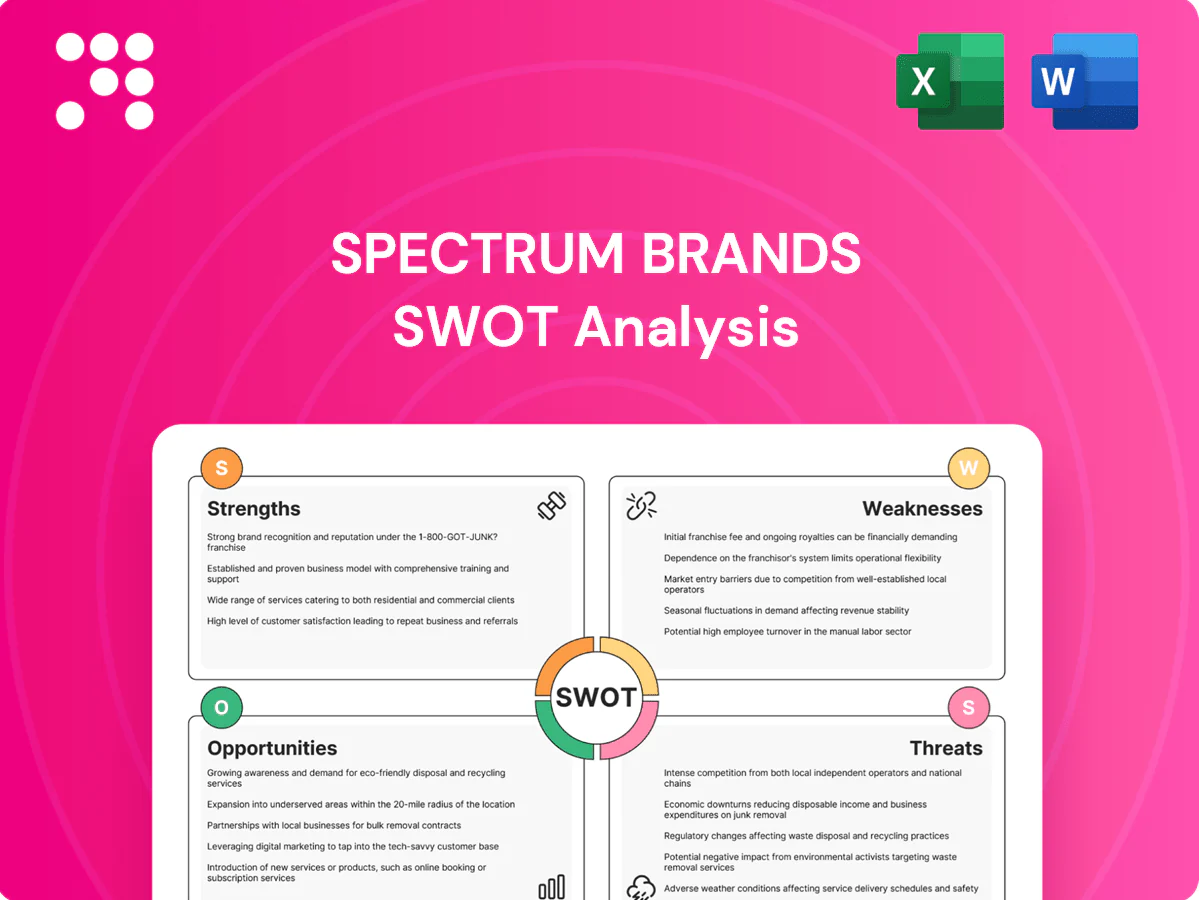
This is the actual Spectrum Brands SWOT analysis document you’ll receive upon purchase—no surprises, just professional quality. The preview below is taken directly from the full report and reflects the structure, findings, and editable formatting included in the download. Buy now to unlock the complete, detailed version immediately after checkout.

Original: $10.00
-65%$10.00
$3.50Product Information
Product Information
Shipping & Returns
Shipping & Returns
Description
Your Strategic Toolkit Starts Here
Spectrum Brands' SWOT highlights strong brand portfolio and diversified channels, offset by supply-chain pressures and competitive private labels; growth hinges on innovation and margin recovery. Want the full strategic picture? Purchase the complete SWOT for a research-backed, editable Word + Excel package to plan and pitch with confidence.
Strengths
Diversified brand portfolio across everyday categories
Diversified presence across home & garden, pet care and personal care smooths category-specific volatility by offsetting seasonal swings and demand shocks; multiple need-based use cases sustain baseline demand through downturns. Cross-category consumer insights and shared R&D, supply-chain and sales capabilities drive cost efficiency and faster innovation. Being present in 160 countries boosts shelf presence and retailer relevance.
Global omnichannel distribution relationships
Global omnichannel distribution spans 170+ countries and placement with mass merchandisers, home‑improvement centers, specialty retail and expanding e‑commerce (e‑commerce up ~20% in 2023), enabling scale, channel visibility and promotional flexibility. Broad reach allows mix‑shifting toward higher‑margin specialty/e‑comm sales to optimize gross margins, while deep retailer partnerships raise switching costs and barrier to smaller rivals.
Acquisition-led growth and brand management expertise
Spectrum Brands runs a repeatable playbook of acquiring, integrating and scaling established brands, leveraging its ~4.0 billion USD annual revenue base (2023) to achieve speed-to-scale versus organic builds. The company captures synergies in sourcing, manufacturing and marketing, often converting M&A into >100 bps margin improvement through disciplined portfolio management and targeted brand renovation.
Supply chain and sourcing scale advantages
Spectrum Brands leverages procurement scale across categories and geographies to secure volume discounts and favorable supplier terms, while consolidated manufacturing and logistics networks lower unit costs and improve fill rates. SKU rationalization and shared platform designs reduce working capital needs and inventory carrying costs. Multi-sourcing strategies add resilience to supply disruptions.
Enduring consumer relevance and brand equity
Everyday-need categories drive habitual repeat purchases, strengthening Spectrum Brands' core sales stability and reducing acquisition costs; brand trust supports higher shelf pricing and recurring loyalty across battery, grooming and pet-care segments. Continuous product innovation and line extensions keep assortment fresh and margin-accretive, while widely recognized brands translate effectively across retail channels and international markets.
- habitual purchases
- pricing power & loyalty
- innovation & extensions
- channel & regional portability
Global consumer essentials platform scales omnichannel reach, captures ~20% e‑commerce growth
Spectrum Brands (2023 rev ~4.0B USD) leverages 160+ country presence and omnichannel reach to scale distribution and capture ~20% e‑commerce growth (2023). Diversified everyday categories (batteries, pet, grooming) drive repeat purchases, pricing power and steady demand. Repeatable M&A + procurement scale delivers >100 bps post‑integration margin uplift and lowers unit costs.
| Metric | Value |
|---|---|
| 2023 revenue | ~4.0B USD |
| Countries | 160+ |
| E‑commerce growth (2023) | ~20% |
| Post‑M&A uplift | >100 bps |
What is included in the product
Detailed Word Document
Provides a concise analysis of Spectrum Brands’ internal strengths and weaknesses and external opportunities and threats, mapping competitive position, growth drivers, and market risks to inform strategic decision-making.
Customizable Excel Spreadsheet
Provides a concise SWOT matrix tailored to Spectrum Brands for rapid strategy alignment, highlighting key brand risks and growth levers; ideal for quick stakeholder briefings and cross-unit comparisons.
Weaknesses
Exposure to retailer concentration and terms
Spectrum Brands relies heavily on large mass and home-improvement chains for volume, giving key accounts strong bargaining power over pricing, slotting and promotional terms. Assortment shifts or retailer private-label initiatives can quickly reduce shelf space and sales for core SKUs. Extended receivable cycles and retailer deductions strain working capital and compress margins, limiting flexibility for marketing and inventory investment.
Margin sensitivity to commodities and freight
Spectrum Brands relies heavily on resins, metals, specialty chemicals, packaging and transport, making input-cost swings a direct hit to gross margins. Inflation spikes historically compress margins ahead of customer price recovery, with hedges limited in scope and often subject to timing lags. The business is especially vulnerable during supply dislocations when spot input and freight premiums spike.
Portfolio complexity and execution risk
Managing a broad portfolio spanning consumer appliances, batteries and pet supplies creates complexity across brands, SKUs and geographies, raising execution risk and the potential for diluted strategic focus. This breadth can slow innovation cycles as resources are spread and product roadmaps must be coordinated. Ongoing M&A adds integration risk, while overhead creep and coordination costs can erode margins.
Intense competition and private label pressure
- Price and placement pressure
- Private-label ~18% share (2023)
- Promotions erode margins
- Copycat SKUs shorten differentiation
- Requires sustained marketing/trade spend
Product quality and recall exposure
Spectrum Brands faces heightened regulatory and safety scrutiny across pet, personal care, and home segments; product defects can trigger costly recalls, class-action litigation, and lasting brand damage. Recalls and remediation frequently run into tens of millions of dollars, while compliance and expanded testing raise operating costs. Social media rapidly amplifies incidents, accelerating reputation losses and sales declines.
- Regulatory scrutiny: pet, personal care, home
- Recall/litigation risk: tens of millions in costs
- Compliance/testing: higher OPEX
- Social media: faster reputation impact
Retail concentration, input-cost shocks and private-label pressure squeeze margins
Spectrum Brands depends on large mass/home-improvement chains, giving key accounts strong pricing and slotting power and creating extended receivable cycles that strain working capital. Heavy reliance on resins, metals and specialty chemicals makes margins vulnerable to input-cost spikes and supply dislocations. A broad, fragmented portfolio raises execution and integration risk, while private-label competition and promotions compress margins and force sustained trade spend.
| Tag | Value |
|---|---|
| Private-label share (grocery) | ~18% (2023) |
| Recall/litigation costs | Tens of millions (historical) |
| Key risks | Retail concentration; input-cost volatility; portfolio complexity |
Full Version Awaits
Spectrum Brands SWOT Analysis
This is the actual Spectrum Brands SWOT analysis document you’ll receive upon purchase—no surprises, just professional quality. The preview below is taken directly from the full report and reflects the structure, findings, and editable formatting included in the download. Buy now to unlock the complete, detailed version immediately after checkout.