Spectris PESTLE Analysis

Make Smarter Strategic Decisions with a Complete PESTEL View
Unlock how political shifts, economic cycles, and tech innovation are reshaping Spectris with our concise PESTLE Analysis. This expertly researched briefing highlights risks and opportunities to inform investment and strategy decisions. Perfect for analysts and planners—buy the full report to access the complete, actionable breakdown instantly.
Political factors

Trade policy volatility
Shifts in tariffs and export restrictions can dent cross-border sales of Spectris instruments and components, with WTO projecting merchandise trade volume growth of about 1.7% in 2024. Navigating differing customs regimes and rules of origin across key markets raises compliance costs. Proactive supply‑chain routing and localized inventory reduce downtime. Ongoing monitoring of WTO disputes and regional trade blocs is essential.
Government R&D agendas
Public R&D priorities shape demand from academia and national labs—EU Horizon Europe allocates €95.5bn for 2021–27 and the US CHIPS Act provides $52bn for semiconductors, driving instrument spend. Grants for clean tech and life sciences (multi‑billion DOE/NIH programs) spur equipment purchases. Spectris can align roadmaps to funded programs and join consortia to boost visibility and adoption.

Industrial policy & onshoring
Incentives to reshore advanced manufacturing, notably the US CHIPS and Science Act (providing $52.7bn for semiconductor incentives), are driving elevated test and measurement capex in target regions and creating demand for Spectris’s instrumentation.
Local content requirements in incentive schemes are reshaping sourcing and assembly footprints, forcing suppliers to localize components and final assembly to qualify.
Establishing regional manufacturing secures program eligibility and shortens lead times, while rapid policy shifts require agile capacity allocation and flexible production footprints.

Geopolitical tensions
Geopolitical tensions, notably US‑China and EU‑China frictions, restrict Spectris access to certain customers, advanced technologies and suppliers, while sanctions and entity restrictions can curtail sales in sensitive defence and dual‑use sectors. Robust scenario planning and enhanced compliance screening let Spectris adjust channel strategies and preserve revenue visibility across shifting export controls. Diversifying end‑markets reduces concentration risk and supports resilient order books.
- Impact: restricted customers/tech
- Risk: sanctions/entity list exposure
- Mitigation: scenario planning & compliance
- Strategy: diversify end‑markets
Public procurement standards
Government buyers command an annual public procurement market of roughly €2 trillion in the EU and impose strict technical, cybersecurity (eg ISO/IEC 27001) and sustainability criteria tied to Net Zero commitments; tenders favor vendors with certifications and lifecycle support, so Spectris can differentiate through verified compliance credentials and total-cost-of-ownership propositions while managing typical B2G sales cycles of 12–24 months via robust key-account planning.
- Market size: ~€2tn EU public procurement
- Key standards: ISO/IEC 27001, ISO 9001
- Sales cycle: 12–24 months
- Edge: compliance credentials + TCO/lifecycle support
Geopolitics raise compliance costs; R&D funds (€95.5bn EU, $52.7bn US) lift certified vendors
Political shifts—tariffs, export controls and US‑China tensions—elevate compliance costs and limit access to customers/tech (WTO merchandise trade +1.7% 2024). Public R&D/reshoring incentives (EU Horizon €95.5bn 2021–27; US CHIPS $52.7bn) boost instrument demand. Public procurement (~€2tn EU) rewards certified vendors (ISO/IEC 27001).
| Factor | Metric |
|---|---|
| Trade growth 2024 | +1.7% |
| Horizon Europe | €95.5bn |
| US CHIPS | $52.7bn |
| EU procurement | €2tn |
What is included in the product
 Detailed Word Document
Explores how macro-environmental forces across Political, Economic, Social, Technological, Environmental and Legal dimensions uniquely affect Spectris, using data and current trends to identify threats and opportunities. Designed for executives, investors and advisers, it includes detailed sub-points, forward-looking insights and clean formatting ready for reports and pitch decks.

 Customizable Excel Spreadsheet
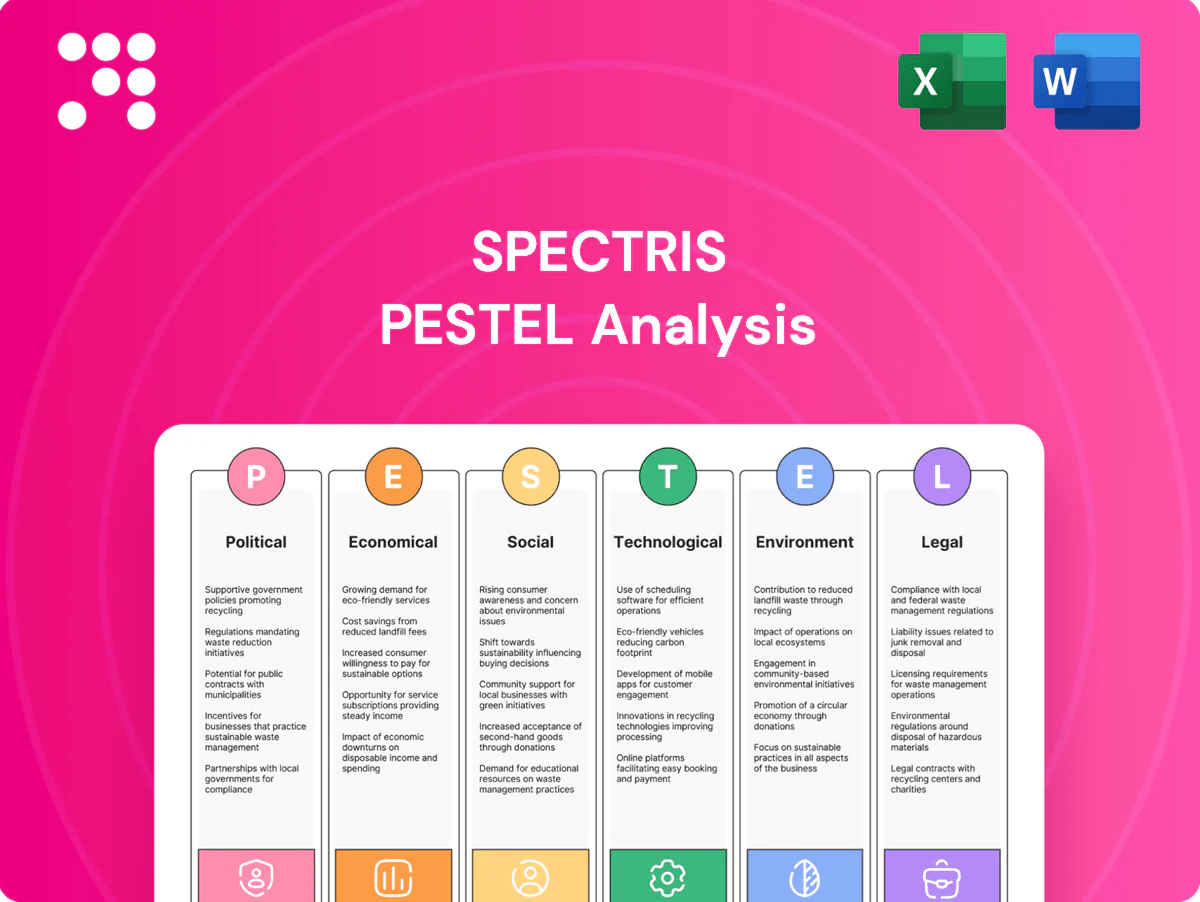
Summarized Spectris PESTLE analysis, visually segmented by category and editable for local context, provides a concise, shareable brief ideal for meetings, presentations, and cross‑team alignment.
Economic factors

Industrial cycle exposure
Orders for Spectris track capex cycles in electronics, automotive, aerospace and materials; global semiconductor capital spending was about $85bn in 2024 (SEMI), so downturns delay discretionary test and R&D spend and elongate sales funnels. A mix of aftermarket, services and software smooths volatility, while counter‑cyclical pharma (global R&D >$200bn) helps hedge cyclicality.
FX fluctuations
FX fluctuations create translation and transaction risk for Spectris as its multi-currency revenues and costs mean dollar and euro swings materially affect reported growth and margins; management has previously flagged FX as a driver of quarter-on-quarter variance. Natural hedging from regional cost bases and manufacturing footprints reduces net exposure in practice. The company also uses financial hedges and contract pricing clauses to protect profitability against short-term currency moves.

Inflation & input costs
Component, energy and logistics inflation squeezed Spectris gross margins after 2022 peaks, although UK CPI eased to about 3.9% in 2024 and wholesale gas and power prices fell roughly 40–50% from 2022 highs, while container rates dropped materially year‑on‑year. Pricing power hinges on product differentiation and mission‑critical instrumentation, enabling value‑based pricing and cost engineering to sustain spreads. Multi‑sourcing and tighter inventory discipline mitigate raw‑material and freight spikes.

Interest rates & capital access
Higher policy rates (central bank rates around 4–5% in 2024–25) lift customer project hurdle rates and raise Spectris’s internal discount rates, slowing capex cycles; leasing and subscription models help customers preserve budgets and sustain instrument adoption. Spectris’s strong balance sheet supports opportunistic M&A in softer markets, while ROI-driven sales cases become essential to close deals.
- Higher rates: increases hurdle rates
- Leasing/subscription: eases customer budgets
- Balance sheet: enables strategic M&A
- Sales focus: ROI-driven cases critical
Global growth dispersion
Demand varies markedly across regions and sectors as IMF projects 2024 global GDP growth at 3.0% with emerging markets contributing roughly 60% of that growth; this forces dynamic resource allocation. Emerging markets offer faster expansion but carry elevated credit and compliance risks. Spectris can rotate capital across its broad portfolio and leverage local service capacity to win share where growth is strongest.
- Demand dispersion: IMF 2024 global growth 3.0%
- EM contribution: ~60% of global growth
- Risks: elevated EM credit/compliance exposure
- Response: portfolio rotation + local service to capture share
Geopolitics raise compliance costs; R&D funds (€95.5bn EU, $52.7bn US) lift certified vendors
Spectris orders follow capex cycles; semiconductor capex ~$85bn (2024) and pharma R&D >$200bn smooth demand; FX swings and hedges drive reported margins; input inflation eased as UK CPI ~3.9% (2024) and energy down ~40–50% vs 2022; rates ~4–5% (2024–25) raise hurdle rates but strong balance sheet enables M&A and leasing eases customer spend.
| Metric | Value |
|---|---|
| Semiconductor capex 2024 | $85bn |
| Pharma R&D | >$200bn |
| UK CPI 2024 | ~3.9% |
| Rates 2024–25 | 4–5% |
Same Document Delivered
Spectris PESTLE Analysis
The preview shown here is the exact Spectris PESTLE Analysis document you’ll receive after purchase—fully formatted, professionally structured, and ready to use. This file is the final version, not a placeholder or teaser, and contains the complete content and layout visible in the preview. After checkout you’ll be able to download this same document immediately.

Original: $10.00
-65%$10.00
$3.50Product Information
Product Information
Shipping & Returns
Shipping & Returns
Description
Make Smarter Strategic Decisions with a Complete PESTEL View
Unlock how political shifts, economic cycles, and tech innovation are reshaping Spectris with our concise PESTLE Analysis. This expertly researched briefing highlights risks and opportunities to inform investment and strategy decisions. Perfect for analysts and planners—buy the full report to access the complete, actionable breakdown instantly.
Political factors
Trade policy volatility
Shifts in tariffs and export restrictions can dent cross-border sales of Spectris instruments and components, with WTO projecting merchandise trade volume growth of about 1.7% in 2024. Navigating differing customs regimes and rules of origin across key markets raises compliance costs. Proactive supply‑chain routing and localized inventory reduce downtime. Ongoing monitoring of WTO disputes and regional trade blocs is essential.
Government R&D agendas
Public R&D priorities shape demand from academia and national labs—EU Horizon Europe allocates €95.5bn for 2021–27 and the US CHIPS Act provides $52bn for semiconductors, driving instrument spend. Grants for clean tech and life sciences (multi‑billion DOE/NIH programs) spur equipment purchases. Spectris can align roadmaps to funded programs and join consortia to boost visibility and adoption.
Industrial policy & onshoring
Incentives to reshore advanced manufacturing, notably the US CHIPS and Science Act (providing $52.7bn for semiconductor incentives), are driving elevated test and measurement capex in target regions and creating demand for Spectris’s instrumentation.
Local content requirements in incentive schemes are reshaping sourcing and assembly footprints, forcing suppliers to localize components and final assembly to qualify.
Establishing regional manufacturing secures program eligibility and shortens lead times, while rapid policy shifts require agile capacity allocation and flexible production footprints.
Geopolitical tensions
Geopolitical tensions, notably US‑China and EU‑China frictions, restrict Spectris access to certain customers, advanced technologies and suppliers, while sanctions and entity restrictions can curtail sales in sensitive defence and dual‑use sectors. Robust scenario planning and enhanced compliance screening let Spectris adjust channel strategies and preserve revenue visibility across shifting export controls. Diversifying end‑markets reduces concentration risk and supports resilient order books.
- Impact: restricted customers/tech
- Risk: sanctions/entity list exposure
- Mitigation: scenario planning & compliance
- Strategy: diversify end‑markets
Public procurement standards
Government buyers command an annual public procurement market of roughly €2 trillion in the EU and impose strict technical, cybersecurity (eg ISO/IEC 27001) and sustainability criteria tied to Net Zero commitments; tenders favor vendors with certifications and lifecycle support, so Spectris can differentiate through verified compliance credentials and total-cost-of-ownership propositions while managing typical B2G sales cycles of 12–24 months via robust key-account planning.
- Market size: ~€2tn EU public procurement
- Key standards: ISO/IEC 27001, ISO 9001
- Sales cycle: 12–24 months
- Edge: compliance credentials + TCO/lifecycle support
Geopolitics raise compliance costs; R&D funds (€95.5bn EU, $52.7bn US) lift certified vendors
Political shifts—tariffs, export controls and US‑China tensions—elevate compliance costs and limit access to customers/tech (WTO merchandise trade +1.7% 2024). Public R&D/reshoring incentives (EU Horizon €95.5bn 2021–27; US CHIPS $52.7bn) boost instrument demand. Public procurement (~€2tn EU) rewards certified vendors (ISO/IEC 27001).
| Factor | Metric |
|---|---|
| Trade growth 2024 | +1.7% |
| Horizon Europe | €95.5bn |
| US CHIPS | $52.7bn |
| EU procurement | €2tn |
What is included in the product
Detailed Word Document
Explores how macro-environmental forces across Political, Economic, Social, Technological, Environmental and Legal dimensions uniquely affect Spectris, using data and current trends to identify threats and opportunities. Designed for executives, investors and advisers, it includes detailed sub-points, forward-looking insights and clean formatting ready for reports and pitch decks.
Customizable Excel Spreadsheet
Summarized Spectris PESTLE analysis, visually segmented by category and editable for local context, provides a concise, shareable brief ideal for meetings, presentations, and cross‑team alignment.
Economic factors
Industrial cycle exposure
Orders for Spectris track capex cycles in electronics, automotive, aerospace and materials; global semiconductor capital spending was about $85bn in 2024 (SEMI), so downturns delay discretionary test and R&D spend and elongate sales funnels. A mix of aftermarket, services and software smooths volatility, while counter‑cyclical pharma (global R&D >$200bn) helps hedge cyclicality.
FX fluctuations
FX fluctuations create translation and transaction risk for Spectris as its multi-currency revenues and costs mean dollar and euro swings materially affect reported growth and margins; management has previously flagged FX as a driver of quarter-on-quarter variance. Natural hedging from regional cost bases and manufacturing footprints reduces net exposure in practice. The company also uses financial hedges and contract pricing clauses to protect profitability against short-term currency moves.
Inflation & input costs
Component, energy and logistics inflation squeezed Spectris gross margins after 2022 peaks, although UK CPI eased to about 3.9% in 2024 and wholesale gas and power prices fell roughly 40–50% from 2022 highs, while container rates dropped materially year‑on‑year. Pricing power hinges on product differentiation and mission‑critical instrumentation, enabling value‑based pricing and cost engineering to sustain spreads. Multi‑sourcing and tighter inventory discipline mitigate raw‑material and freight spikes.
Interest rates & capital access
Higher policy rates (central bank rates around 4–5% in 2024–25) lift customer project hurdle rates and raise Spectris’s internal discount rates, slowing capex cycles; leasing and subscription models help customers preserve budgets and sustain instrument adoption. Spectris’s strong balance sheet supports opportunistic M&A in softer markets, while ROI-driven sales cases become essential to close deals.
- Higher rates: increases hurdle rates
- Leasing/subscription: eases customer budgets
- Balance sheet: enables strategic M&A
- Sales focus: ROI-driven cases critical
Global growth dispersion
Demand varies markedly across regions and sectors as IMF projects 2024 global GDP growth at 3.0% with emerging markets contributing roughly 60% of that growth; this forces dynamic resource allocation. Emerging markets offer faster expansion but carry elevated credit and compliance risks. Spectris can rotate capital across its broad portfolio and leverage local service capacity to win share where growth is strongest.
- Demand dispersion: IMF 2024 global growth 3.0%
- EM contribution: ~60% of global growth
- Risks: elevated EM credit/compliance exposure
- Response: portfolio rotation + local service to capture share
Geopolitics raise compliance costs; R&D funds (€95.5bn EU, $52.7bn US) lift certified vendors
Spectris orders follow capex cycles; semiconductor capex ~$85bn (2024) and pharma R&D >$200bn smooth demand; FX swings and hedges drive reported margins; input inflation eased as UK CPI ~3.9% (2024) and energy down ~40–50% vs 2022; rates ~4–5% (2024–25) raise hurdle rates but strong balance sheet enables M&A and leasing eases customer spend.
| Metric | Value |
|---|---|
| Semiconductor capex 2024 | $85bn |
| Pharma R&D | >$200bn |
| UK CPI 2024 | ~3.9% |
| Rates 2024–25 | 4–5% |
Same Document Delivered
Spectris PESTLE Analysis
The preview shown here is the exact Spectris PESTLE Analysis document you’ll receive after purchase—fully formatted, professionally structured, and ready to use. This file is the final version, not a placeholder or teaser, and contains the complete content and layout visible in the preview. After checkout you’ll be able to download this same document immediately.