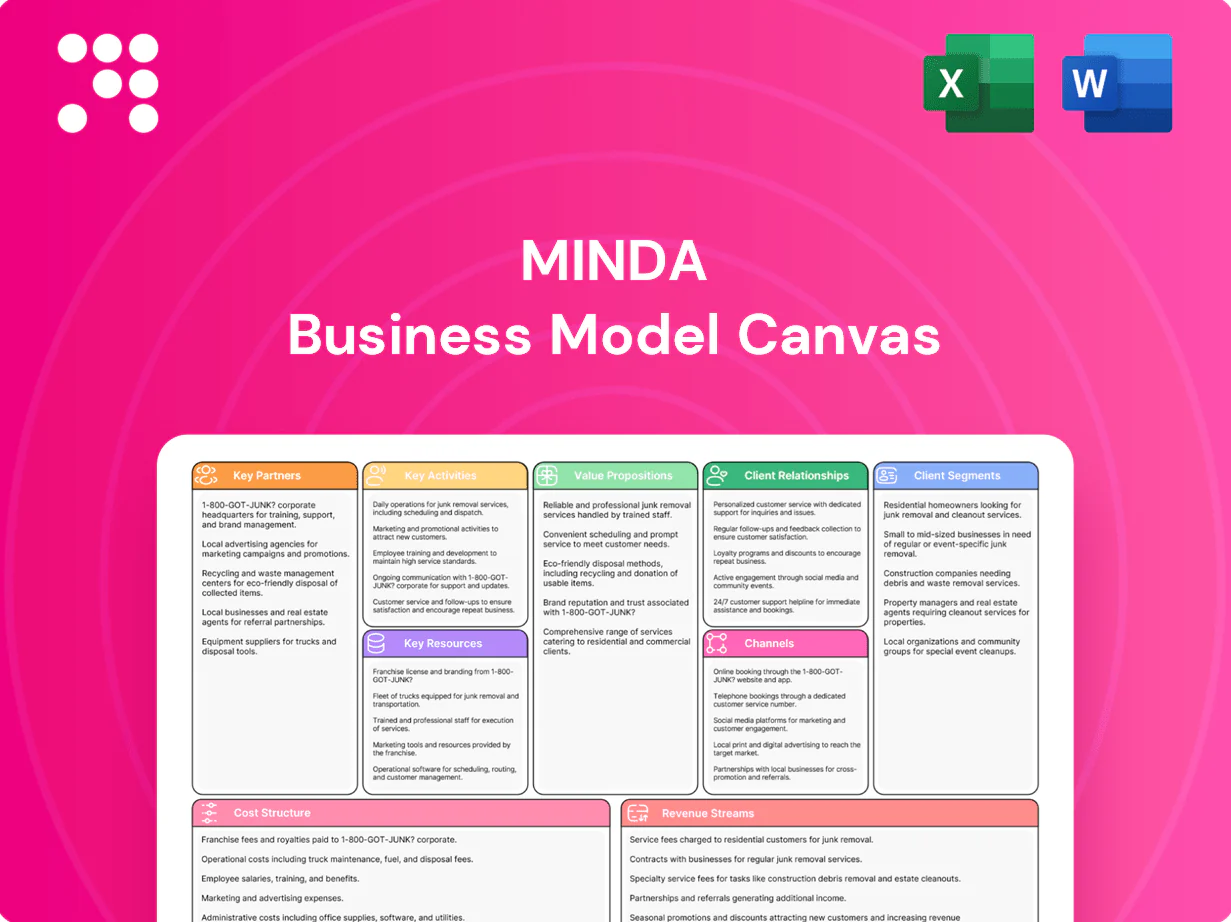
Minda Business Model Canvas

Business Model Canvas: roadmap for customer value, partners, channels, and revenue
Unlock Minda's strategic playbook with our Business Model Canvas—customer segments, value propositions, channels, and revenue streams clearly mapped. This analyst-ready snapshot shows how Minda creates value, leverages partnerships, and optimizes costs. Download the full Word/Excel canvas to benchmark, plan growth, and get investor-ready insights now.
Partnerships

OEM strategic alliances
OEM strategic alliances with leading two‑wheeler, passenger and CV makers align roadmaps and secure volume commitments as India produced over 20 million two‑wheelers in FY2024 (SIAM). Joint planning embeds security systems, wiring harnesses, clusters, sensors and telematics at platform level; early‑sourcing cuts design iterations/time‑to‑SOP; long‑term contracts stabilize capacity and raw material procurement.
Technology and semiconductor partners
Alliances with chipmakers, sensor IP providers and telematics platform vendors enable advanced features and access to reference designs that cut instrument cluster and ECU development cycles; the global automotive semiconductor market was about $57 billion in 2024, joint validation enforces automotive-grade reliability, and preferred-supplier status helps mitigate chip-shortage exposure.

Tier-2 suppliers and tooling vendors
Collaborations with connectors, plastics, copper and wire suppliers secure quality and cost control, supporting product margins amid raw-material volatility; tier-2 partnerships typically enable component cost savings of 3–7% annually. Toolmakers deliver rapid mold and die development for new platforms, often reducing lead-times to 4–8 weeks. VMI and JIT programs lift inventory turns to about 8–10x and can cut working capital by 15–25%. Dual-sourcing strategies halve single-vendor exposure and materially improve supply resilience.

Testing, certification, and compliance bodies
Partnerships with NABL-accredited labs and regulatory agencies accelerate homologation and reduce regulatory friction; NABL had over 2,000 accredited laboratories in India as of 2024, strengthening nationwide test coverage.
EMC/EMI, AIS, ISO and IATF certifications de-risk product launches and shorten market acceptance cycles, while shared test protocols cut validation timelines by enabling parallel testing.
Embedded compliance expertise ensures export readiness, aligns with destination market rules, and mitigates costly recall risks.
- NABL labs: >2,000 (2024)
- Certifications: EMC/EMI, AIS, ISO, IATF
- Benefits: faster homologation, parallel validation, export readiness
Aftermarket distributors and service networks
Distributor alliances extend Minda's reach to independent workshops and retailers, tapping into a global aftermarket worth about USD 389 billion in 2024; service partners handle installation and warranty for security systems and instrument clusters, reducing returns and boosting customer trust. Co-marketing with distributors increases brand pull during replacement cycles, while structured feedback loops from service partners feed product refreshes and parts standardization.
- Distributor reach: independent workshops & retailers
- Service partners: installation, warranty, reduced returns
- Co-marketing: stronger replacement-cycle pull
- Feedback loops: product refreshes & standardization
OEM alliances leverage >20M two‑wheelers; VMI cuts working capital 15–25% and speeds sourcing
OEM alliances secure platform fitment and volume as India produced >20M two‑wheelers in FY2024 (SIAM), enabling long‑term sourcing and reduced time‑to‑SOP. Chip/sensor partners access a ~$57B automotive semiconductor market (2024), shortening ECU/cluster cycles and lowering shortage risk. Supplier VMI/JIT and dual‑sourcing lift turns to 8–10x, cut working capital 15–25% and yield 3–7% component cost savings; NABL labs >2,000 (2024) speed homologation.
| Partner | 2024 metric | Primary benefit |
|---|---|---|
| OEMs | >20M two‑wheelers (FY2024) | Volume, platform integration |
| Semis/sensors | ~$57B market (2024) | Faster development, shortage mitigation |
| Suppliers/VMI | Turns 8–10x; WC −15–25% | Working capital & cost control |
| NABL labs | >2,000 labs (2024) | Faster homologation |
| Aftermarket/distributors | USD 389B global (2024) | Reach, service & retention |
What is included in the product
 Detailed Word Document
A comprehensive Minda Business Model Canvas detailing nine classic BMC blocks with tailored value propositions, customer segments, channels and revenue streams. Includes competitive advantage analysis, linked SWOT, real-company validation and polished presentation-ready narratives for investors and strategic decision-making.

 Customizable Excel Spreadsheet
Condenses company strategy into a digestible, one-page snapshot with editable cells, saving hours of formatting and enabling quick team collaboration and boardroom-ready deliverables.
Activities

R&D and product engineering
Design and development focus on security systems, wiring harnesses, sensors, clusters and telematics, with hardware-software co-development for embedded and connected features and prototyping through DFMEA/PFMEA and APQP to meet OEM gates. Continuous innovation targets safety, efficiency and connectivity, aligning product roadmaps with market scale—global automotive electronics reached about USD 359 billion in 2023.
Advanced manufacturing and assembly
Advanced manufacturing and assembly at Minda centers on mass production with automated crimping, molding, PCB assembly and end-of-line testing to ensure consistent output. Lean operations optimize takt time and yield while traceability systems enable rapid defect containment and recall management. Flexible lines handle multi-model variants, allowing quick changeovers and SKU mix adjustments to meet OEM demand.

Quality assurance and validation
Rigorous durability, environmental, vibration (ISO 16750) and EMC/EMI (CISPR 25) testing ensure components meet automotive specs. PPAP and SPC per AIAG maintain process control and target industry defect rates below 100 ppm. 8D drives root-cause analysis and corrective actions. Quarterly supplier audits enforce incoming quality and traceability.

Supply chain and localization
Supply chain focuses on LTAs and hedging for copper (LME avg ~9,300 USD/t in 2024), semiconductors and plastics, plus connector sourcing to stabilize margins and volume.
Localization to hit 15–20% cost reduction and capture PLI incentives, S&OP and JIT cut inventory days, and dual-sourcing and safety stock mitigate component-shortage risk.
- tags: hedging, LTA
- tags: localization, PLI
- tags: S&OP, JIT, inventory
- tags: risk-management, dual-sourcing
Sales, key account, and aftermarket support
Sales, key account and aftermarket support manage programs from RFQ to SOP and post-SOP with technical support, training and warranty handling, leveraging 2024 aftermarket growth (≈12% YoY) to expand OEM platform marketing and SKU promotion; pricing and demand planning use data analytics to optimize margins and reduce stockouts.
- Program management: RFQ→SOP→post-SOP
- Technical support & training
- Warranty handling
- OEM & aftermarket marketing
- Data-driven pricing & demand planning
Auto elec $359B, loc. 15-20%, ≤100 ppm
R&D and prototyping produce ECUs, sensors, wiring and telematics with APQP/DFMEA to meet OEM gates; auto electronics market ~USD 359B (2023).
Mass production: automated crimping, PCB assembly, EOL testing, lean S&OP and dual sourcing to target <100 ppm and lower inventory.
Supply: LTAs, hedging (copper LME ~9,300 USD/t 2024), localization (15–20% cost cut) and aftermarket growth ~12% YoY (2024).
| Metric | Value |
|---|---|
| Auto electronics 2023 | USD 359B |
| Copper LME 2024 | ~9,300 USD/t |
| Aftermarket 2024 | ~12% YoY |
| Target defect rate | <100 ppm |
What You See Is What You Get
Business Model Canvas
The document you're previewing is the actual Minda Business Model Canvas, not a mockup—it's a direct excerpt from the final file you’ll receive. Upon purchase you’ll get this exact, fully editable Business Model Canvas in Word and Excel, complete with all sections and formatting. No surprises—what you see is the deliverable, ready to present, customize, and implement.

Original: $10.00
-65%$10.00
$3.50Product Information
Product Information
Shipping & Returns
Shipping & Returns
Description
Business Model Canvas: roadmap for customer value, partners, channels, and revenue
Unlock Minda's strategic playbook with our Business Model Canvas—customer segments, value propositions, channels, and revenue streams clearly mapped. This analyst-ready snapshot shows how Minda creates value, leverages partnerships, and optimizes costs. Download the full Word/Excel canvas to benchmark, plan growth, and get investor-ready insights now.
Partnerships
OEM strategic alliances
OEM strategic alliances with leading two‑wheeler, passenger and CV makers align roadmaps and secure volume commitments as India produced over 20 million two‑wheelers in FY2024 (SIAM). Joint planning embeds security systems, wiring harnesses, clusters, sensors and telematics at platform level; early‑sourcing cuts design iterations/time‑to‑SOP; long‑term contracts stabilize capacity and raw material procurement.
Technology and semiconductor partners
Alliances with chipmakers, sensor IP providers and telematics platform vendors enable advanced features and access to reference designs that cut instrument cluster and ECU development cycles; the global automotive semiconductor market was about $57 billion in 2024, joint validation enforces automotive-grade reliability, and preferred-supplier status helps mitigate chip-shortage exposure.
Tier-2 suppliers and tooling vendors
Collaborations with connectors, plastics, copper and wire suppliers secure quality and cost control, supporting product margins amid raw-material volatility; tier-2 partnerships typically enable component cost savings of 3–7% annually. Toolmakers deliver rapid mold and die development for new platforms, often reducing lead-times to 4–8 weeks. VMI and JIT programs lift inventory turns to about 8–10x and can cut working capital by 15–25%. Dual-sourcing strategies halve single-vendor exposure and materially improve supply resilience.
Testing, certification, and compliance bodies
Partnerships with NABL-accredited labs and regulatory agencies accelerate homologation and reduce regulatory friction; NABL had over 2,000 accredited laboratories in India as of 2024, strengthening nationwide test coverage.
EMC/EMI, AIS, ISO and IATF certifications de-risk product launches and shorten market acceptance cycles, while shared test protocols cut validation timelines by enabling parallel testing.
Embedded compliance expertise ensures export readiness, aligns with destination market rules, and mitigates costly recall risks.
- NABL labs: >2,000 (2024)
- Certifications: EMC/EMI, AIS, ISO, IATF
- Benefits: faster homologation, parallel validation, export readiness
Aftermarket distributors and service networks
Distributor alliances extend Minda's reach to independent workshops and retailers, tapping into a global aftermarket worth about USD 389 billion in 2024; service partners handle installation and warranty for security systems and instrument clusters, reducing returns and boosting customer trust. Co-marketing with distributors increases brand pull during replacement cycles, while structured feedback loops from service partners feed product refreshes and parts standardization.
- Distributor reach: independent workshops & retailers
- Service partners: installation, warranty, reduced returns
- Co-marketing: stronger replacement-cycle pull
- Feedback loops: product refreshes & standardization
OEM alliances leverage >20M two‑wheelers; VMI cuts working capital 15–25% and speeds sourcing
OEM alliances secure platform fitment and volume as India produced >20M two‑wheelers in FY2024 (SIAM), enabling long‑term sourcing and reduced time‑to‑SOP. Chip/sensor partners access a ~$57B automotive semiconductor market (2024), shortening ECU/cluster cycles and lowering shortage risk. Supplier VMI/JIT and dual‑sourcing lift turns to 8–10x, cut working capital 15–25% and yield 3–7% component cost savings; NABL labs >2,000 (2024) speed homologation.
| Partner | 2024 metric | Primary benefit |
|---|---|---|
| OEMs | >20M two‑wheelers (FY2024) | Volume, platform integration |
| Semis/sensors | ~$57B market (2024) | Faster development, shortage mitigation |
| Suppliers/VMI | Turns 8–10x; WC −15–25% | Working capital & cost control |
| NABL labs | >2,000 labs (2024) | Faster homologation |
| Aftermarket/distributors | USD 389B global (2024) | Reach, service & retention |
What is included in the product
Detailed Word Document
A comprehensive Minda Business Model Canvas detailing nine classic BMC blocks with tailored value propositions, customer segments, channels and revenue streams. Includes competitive advantage analysis, linked SWOT, real-company validation and polished presentation-ready narratives for investors and strategic decision-making.
Customizable Excel Spreadsheet
Condenses company strategy into a digestible, one-page snapshot with editable cells, saving hours of formatting and enabling quick team collaboration and boardroom-ready deliverables.
Activities
R&D and product engineering
Design and development focus on security systems, wiring harnesses, sensors, clusters and telematics, with hardware-software co-development for embedded and connected features and prototyping through DFMEA/PFMEA and APQP to meet OEM gates. Continuous innovation targets safety, efficiency and connectivity, aligning product roadmaps with market scale—global automotive electronics reached about USD 359 billion in 2023.
Advanced manufacturing and assembly
Advanced manufacturing and assembly at Minda centers on mass production with automated crimping, molding, PCB assembly and end-of-line testing to ensure consistent output. Lean operations optimize takt time and yield while traceability systems enable rapid defect containment and recall management. Flexible lines handle multi-model variants, allowing quick changeovers and SKU mix adjustments to meet OEM demand.
Quality assurance and validation
Rigorous durability, environmental, vibration (ISO 16750) and EMC/EMI (CISPR 25) testing ensure components meet automotive specs. PPAP and SPC per AIAG maintain process control and target industry defect rates below 100 ppm. 8D drives root-cause analysis and corrective actions. Quarterly supplier audits enforce incoming quality and traceability.
Supply chain and localization
Supply chain focuses on LTAs and hedging for copper (LME avg ~9,300 USD/t in 2024), semiconductors and plastics, plus connector sourcing to stabilize margins and volume.
Localization to hit 15–20% cost reduction and capture PLI incentives, S&OP and JIT cut inventory days, and dual-sourcing and safety stock mitigate component-shortage risk.
- tags: hedging, LTA
- tags: localization, PLI
- tags: S&OP, JIT, inventory
- tags: risk-management, dual-sourcing
Sales, key account, and aftermarket support
Sales, key account and aftermarket support manage programs from RFQ to SOP and post-SOP with technical support, training and warranty handling, leveraging 2024 aftermarket growth (≈12% YoY) to expand OEM platform marketing and SKU promotion; pricing and demand planning use data analytics to optimize margins and reduce stockouts.
- Program management: RFQ→SOP→post-SOP
- Technical support & training
- Warranty handling
- OEM & aftermarket marketing
- Data-driven pricing & demand planning
Auto elec $359B, loc. 15-20%, ≤100 ppm
R&D and prototyping produce ECUs, sensors, wiring and telematics with APQP/DFMEA to meet OEM gates; auto electronics market ~USD 359B (2023).
Mass production: automated crimping, PCB assembly, EOL testing, lean S&OP and dual sourcing to target <100 ppm and lower inventory.
Supply: LTAs, hedging (copper LME ~9,300 USD/t 2024), localization (15–20% cost cut) and aftermarket growth ~12% YoY (2024).
| Metric | Value |
|---|---|
| Auto electronics 2023 | USD 359B |
| Copper LME 2024 | ~9,300 USD/t |
| Aftermarket 2024 | ~12% YoY |
| Target defect rate | <100 ppm |
What You See Is What You Get
Business Model Canvas
The document you're previewing is the actual Minda Business Model Canvas, not a mockup—it's a direct excerpt from the final file you’ll receive. Upon purchase you’ll get this exact, fully editable Business Model Canvas in Word and Excel, complete with all sections and formatting. No surprises—what you see is the deliverable, ready to present, customize, and implement.