Sonic Healthcare PESTLE Analysis

Make Smarter Strategic Decisions with a Complete PESTEL View
Unlock how political, economic, social, technological, legal and environmental forces are reshaping Sonic Healthcare’s prospects with our concise PESTLE snapshot. These expert insights highlight regulatory risks, market opportunities, and tech-driven service shifts to inform investment and strategic decisions. Purchase the full PESTLE for the complete, editable analysis and immediate actionable intelligence.
Political factors

Healthcare reimbursement policies
Sonic’s revenues are tightly linked to government-set tariffs and fee schedules across Australia, the U.S., Europe and other regions; in FY2024 the group reported revenue of about AUD 11.5 billion, exposing it to tariff changes. Shifts in Medicare, Medicaid and national insurance rates can compress margins or, conversely, drive volume growth when access expands. Policy moves toward value-based care may reward outcome-linked diagnostics, increasing reimbursement for high-value tests. Continuous advocacy and payer engagement are essential to mitigate pricing risk.
Public health funding cycles
Budget priorities drive test utilization in hospitals and community settings, with government health budgets—Australia health spending ~10% of GDP—shaping demand for pathology and radiology. Election outcomes and fiscal constraints can cut screening program funding, altering volumes and reimbursement rates for providers like Sonic Healthcare (group revenue ~AUD 5.8bn in FY2024). Pandemic aftereffects keep surveillance testing and readiness funding elevated relative to pre‑2020 levels even as PCR volumes remain >70% below peak. Diversification across jurisdictions smooths revenue volatility from shifting public funding cycles.

Geopolitical supply chain stability
Geopolitical tensions can disrupt supply of reagents, consumables and imaging kit logistics, with freight cost spikes of up to 40% seen during 2022–24 that raised COGS and extended turnaround times. Export controls or sanctions have delayed critical analyzers and medical isotopes in multiple markets. Building multi-vendor sourcing and regional inventory buffers reduces exposure and preserves service continuity.

Cross-border operations and localization
Sonic Healthcare operates in around 10 countries, requiring tight alignment with local healthcare priorities and procurement processes to win public contracts and price-sensitive tenders; governments increasingly promote regionalized lab networks for resilience after COVID-19, creating both barriers and opportunities. Local partnerships and strong policymaker relationships improve contract success and influence diagnostic pathways and reimbursement decisions.
- operations: ~10 countries
- trend: post-COVID regionalization
- advantage: local partnerships aid public contracts
- policy: engagement shapes diagnostic pathways
Pandemic preparedness and biosecurity
Governments are institutionalizing surge testing and genomic surveillance, creating recurring procurement channels that favour accredited providers like Sonic Healthcare; adherence to national preparedness plans can unlock multi-year framework agreements and co-funded investments in high-complexity testing capacity, while visibility into demand cycles helps buffer revenue against post-surge normalization.
- Surge testing institutionalized
- Genomic surveillance prioritized
- Framework agreements possible
- Co-funding for complex labs
- Demand visibility reduces volatility
FY24 rev AUD 11.5bn; tariffs, freight +40%, PCR >70% down
Sonic’s FY2024 group revenue ~AUD 11.5bn across ~10 countries; exposure to government tariffs and Medicare/Medicaid shifts can quickly affect margins. Post‑COVID regionalization and institutionalized genomic surveillance create multi‑year contracts, while 2022–24 freight cost spikes (up to 40%) and PCR volumes >70% below peak highlight supply and volume risks.
| Metric | Value |
|---|---|
| FY2024 revenue | AUD 11.5bn |
| Operating markets | ~10 countries |
| Aus health spend | ~10% of GDP |
| Freight spike (2022–24) | up to 40% |
| PCR volumes vs peak | >70% below peak |
What is included in the product
 Detailed Word Document
Explores how Political, Economic, Social, Technological, Environmental and Legal forces uniquely affect Sonic Healthcare, with data-backed trends and region-specific regulatory context to identify threats and opportunities. Designed for executives, consultants and investors, the analysis delivers actionable, forward-looking insights and ready-to-use content for strategy, scenario planning and funding materials.

 Customizable Excel Spreadsheet
Clean, summarized Sonic Healthcare PESTLE analysis segmented by category for quick interpretation, easily dropped into presentations, shared across teams, and editable to add region- or business-line specific notes—ideal for aligning strategy and highlighting external risks in planning sessions.
Economic factors

Macroeconomic cycles and test volumes
Economic slowdowns typically reduce elective procedures and imaging referrals; OECD data showed elective surgeries fell up to 30% during the 2020 COVID shock, illustrating vulnerability of discretionary volumes. Primary care volumes are more resilient, with AIHW noting GP attendances returned to pre‑pandemic levels by 2022, supporting baseline pathology testing. Inflationary pressure can curb discretionary screening uptake, while counter‑cyclical public health spending has partially offset private demand weakness.
Input cost inflation
Input-cost inflation from reagents, labor, energy and freight squeezes margins in Sonic Healthcare’s fixed-tariff markets; Australia’s Wage Price Index rose 4.1% year to March 2024, lifting labor expense pressure.
Automation and procurement scale reduce per-test costs, while contract renegotiations and test-mix optimisation help recover margins.
Hedging strategies and long-term supplier agreements add stability against reagent and energy price volatility.

Labor market dynamics
Shortages of pathologists, radiologists and skilled lab technologists push up wage costs for providers like Sonic; Australia's health care and social assistance workforce numbered about 1.8 million in 2023 (ABS), tightening labour supply.
Training pipeline constraints and reliance on international recruitment affect staffing reliability and compliance timelines.
Adoption of productivity tools and AI can raise capacity per clinician, while targeted retention programs cut dependence on costly agency staff.

Currency fluctuations
Sonic, as a multinational lab services group, faces both translation and transaction FX risks as revenue and costs flow in AUD, USD, EUR and GBP; currency moves can compress margins when rates diverge. Local cost bases in each market provide natural hedges that reduce short-term volatility, while structured hedging programs and forward contracts are used to protect earnings visibility.
- FX exposure: AUD, USD, EUR, GBP
- Risks: translation and transaction
- Natural hedging: local costs
- Mitigation: structured hedging programs
M&A and consolidation landscape
Diagnostic markets continue consolidating, with global lab services projected to approach USD 288 billion by 2030 and platform players like Sonic leveraging scale for margin and capex efficiencies; valuation cycles and central bank policy (policy rates ~5.25–5.50% in 2024–25) materially influence deal pacing and financing costs. Integration synergies in logistics, IT and procurement drive 3–5% uplift in EBITDA accretion targets, while antitrust scrutiny in EU/US reshapes deal structures and geographic entry strategies.
- Consolidation: scale benefits for margins and capex
- Rates: policy rates ~5.25–5.50% impact financing
- Synergies: logistics/IT/procurement → 3–5% EBITDA uplift
- Regulation: antitrust dictates structure and entry
FY24 rev AUD 11.5bn; tariffs, freight +40%, PCR >70% down
Economic headwinds—input inflation (AUS Wage Price Index +4.1% to Mar 2024), higher policy rates (~5.25–5.50% in 2024–25) and elective-volume sensitivity (elective surgeries down ~30% in 2020)—pressure margins, while resilient GP volumes support baseline testing. Scale, automation and contracting restore 3–5% EBITDA through synergies; FX (AUD, USD, EUR, GBP) and labour tightness (AUS health workforce ~1.8M in 2023) remain key risks.
| Metric | Value |
|---|---|
| Wage Price Index (AUS) | +4.1% Mar 2024 |
| Policy rates | ~5.25–5.50% (2024–25) |
| Global lab market | USD 288bn by 2030 |
| AUS health workforce | ~1.8M (2023) |
Same Document Delivered
Sonic Healthcare PESTLE Analysis
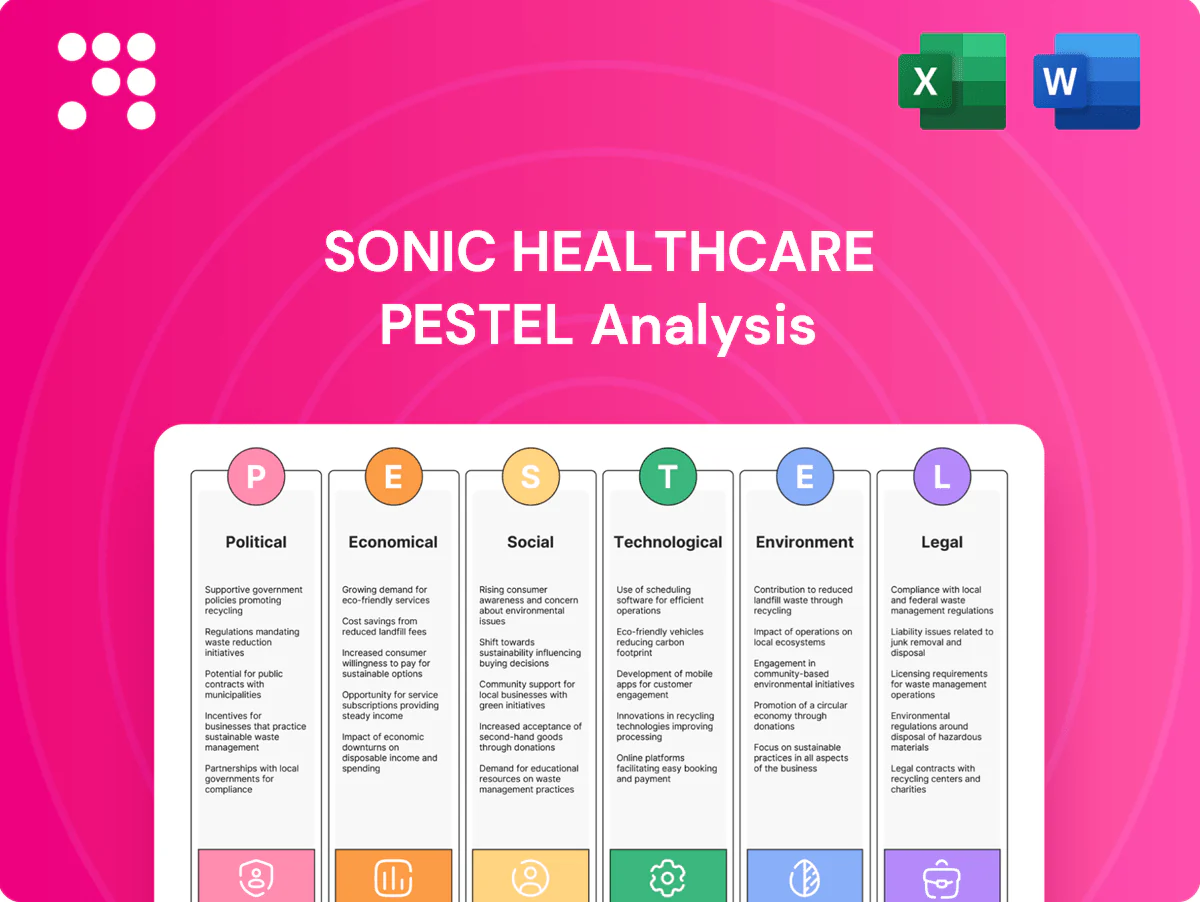
The preview shown here is the exact Sonic Healthcare PESTLE Analysis you’ll receive after purchase—fully formatted, comprehensive, and ready to use. This is the real file with complete political, economic, social, technological, legal, and environmental insights as displayed. No placeholders, no surprises—download the finished document immediately after checkout.

Product Information
Product Information
Shipping & Returns
Shipping & Returns
Description
Make Smarter Strategic Decisions with a Complete PESTEL View
Unlock how political, economic, social, technological, legal and environmental forces are reshaping Sonic Healthcare’s prospects with our concise PESTLE snapshot. These expert insights highlight regulatory risks, market opportunities, and tech-driven service shifts to inform investment and strategic decisions. Purchase the full PESTLE for the complete, editable analysis and immediate actionable intelligence.
Political factors
Healthcare reimbursement policies
Sonic’s revenues are tightly linked to government-set tariffs and fee schedules across Australia, the U.S., Europe and other regions; in FY2024 the group reported revenue of about AUD 11.5 billion, exposing it to tariff changes. Shifts in Medicare, Medicaid and national insurance rates can compress margins or, conversely, drive volume growth when access expands. Policy moves toward value-based care may reward outcome-linked diagnostics, increasing reimbursement for high-value tests. Continuous advocacy and payer engagement are essential to mitigate pricing risk.
Public health funding cycles
Budget priorities drive test utilization in hospitals and community settings, with government health budgets—Australia health spending ~10% of GDP—shaping demand for pathology and radiology. Election outcomes and fiscal constraints can cut screening program funding, altering volumes and reimbursement rates for providers like Sonic Healthcare (group revenue ~AUD 5.8bn in FY2024). Pandemic aftereffects keep surveillance testing and readiness funding elevated relative to pre‑2020 levels even as PCR volumes remain >70% below peak. Diversification across jurisdictions smooths revenue volatility from shifting public funding cycles.
Geopolitical supply chain stability
Geopolitical tensions can disrupt supply of reagents, consumables and imaging kit logistics, with freight cost spikes of up to 40% seen during 2022–24 that raised COGS and extended turnaround times. Export controls or sanctions have delayed critical analyzers and medical isotopes in multiple markets. Building multi-vendor sourcing and regional inventory buffers reduces exposure and preserves service continuity.
Cross-border operations and localization
Sonic Healthcare operates in around 10 countries, requiring tight alignment with local healthcare priorities and procurement processes to win public contracts and price-sensitive tenders; governments increasingly promote regionalized lab networks for resilience after COVID-19, creating both barriers and opportunities. Local partnerships and strong policymaker relationships improve contract success and influence diagnostic pathways and reimbursement decisions.
- operations: ~10 countries
- trend: post-COVID regionalization
- advantage: local partnerships aid public contracts
- policy: engagement shapes diagnostic pathways
Pandemic preparedness and biosecurity
Governments are institutionalizing surge testing and genomic surveillance, creating recurring procurement channels that favour accredited providers like Sonic Healthcare; adherence to national preparedness plans can unlock multi-year framework agreements and co-funded investments in high-complexity testing capacity, while visibility into demand cycles helps buffer revenue against post-surge normalization.
- Surge testing institutionalized
- Genomic surveillance prioritized
- Framework agreements possible
- Co-funding for complex labs
- Demand visibility reduces volatility
FY24 rev AUD 11.5bn; tariffs, freight +40%, PCR >70% down
Sonic’s FY2024 group revenue ~AUD 11.5bn across ~10 countries; exposure to government tariffs and Medicare/Medicaid shifts can quickly affect margins. Post‑COVID regionalization and institutionalized genomic surveillance create multi‑year contracts, while 2022–24 freight cost spikes (up to 40%) and PCR volumes >70% below peak highlight supply and volume risks.
| Metric | Value |
|---|---|
| FY2024 revenue | AUD 11.5bn |
| Operating markets | ~10 countries |
| Aus health spend | ~10% of GDP |
| Freight spike (2022–24) | up to 40% |
| PCR volumes vs peak | >70% below peak |
What is included in the product
Detailed Word Document
Explores how Political, Economic, Social, Technological, Environmental and Legal forces uniquely affect Sonic Healthcare, with data-backed trends and region-specific regulatory context to identify threats and opportunities. Designed for executives, consultants and investors, the analysis delivers actionable, forward-looking insights and ready-to-use content for strategy, scenario planning and funding materials.
Customizable Excel Spreadsheet
Clean, summarized Sonic Healthcare PESTLE analysis segmented by category for quick interpretation, easily dropped into presentations, shared across teams, and editable to add region- or business-line specific notes—ideal for aligning strategy and highlighting external risks in planning sessions.
Economic factors
Macroeconomic cycles and test volumes
Economic slowdowns typically reduce elective procedures and imaging referrals; OECD data showed elective surgeries fell up to 30% during the 2020 COVID shock, illustrating vulnerability of discretionary volumes. Primary care volumes are more resilient, with AIHW noting GP attendances returned to pre‑pandemic levels by 2022, supporting baseline pathology testing. Inflationary pressure can curb discretionary screening uptake, while counter‑cyclical public health spending has partially offset private demand weakness.
Input cost inflation
Input-cost inflation from reagents, labor, energy and freight squeezes margins in Sonic Healthcare’s fixed-tariff markets; Australia’s Wage Price Index rose 4.1% year to March 2024, lifting labor expense pressure.
Automation and procurement scale reduce per-test costs, while contract renegotiations and test-mix optimisation help recover margins.
Hedging strategies and long-term supplier agreements add stability against reagent and energy price volatility.
Labor market dynamics
Shortages of pathologists, radiologists and skilled lab technologists push up wage costs for providers like Sonic; Australia's health care and social assistance workforce numbered about 1.8 million in 2023 (ABS), tightening labour supply.
Training pipeline constraints and reliance on international recruitment affect staffing reliability and compliance timelines.
Adoption of productivity tools and AI can raise capacity per clinician, while targeted retention programs cut dependence on costly agency staff.
Currency fluctuations
Sonic, as a multinational lab services group, faces both translation and transaction FX risks as revenue and costs flow in AUD, USD, EUR and GBP; currency moves can compress margins when rates diverge. Local cost bases in each market provide natural hedges that reduce short-term volatility, while structured hedging programs and forward contracts are used to protect earnings visibility.
- FX exposure: AUD, USD, EUR, GBP
- Risks: translation and transaction
- Natural hedging: local costs
- Mitigation: structured hedging programs
M&A and consolidation landscape
Diagnostic markets continue consolidating, with global lab services projected to approach USD 288 billion by 2030 and platform players like Sonic leveraging scale for margin and capex efficiencies; valuation cycles and central bank policy (policy rates ~5.25–5.50% in 2024–25) materially influence deal pacing and financing costs. Integration synergies in logistics, IT and procurement drive 3–5% uplift in EBITDA accretion targets, while antitrust scrutiny in EU/US reshapes deal structures and geographic entry strategies.
- Consolidation: scale benefits for margins and capex
- Rates: policy rates ~5.25–5.50% impact financing
- Synergies: logistics/IT/procurement → 3–5% EBITDA uplift
- Regulation: antitrust dictates structure and entry
FY24 rev AUD 11.5bn; tariffs, freight +40%, PCR >70% down
Economic headwinds—input inflation (AUS Wage Price Index +4.1% to Mar 2024), higher policy rates (~5.25–5.50% in 2024–25) and elective-volume sensitivity (elective surgeries down ~30% in 2020)—pressure margins, while resilient GP volumes support baseline testing. Scale, automation and contracting restore 3–5% EBITDA through synergies; FX (AUD, USD, EUR, GBP) and labour tightness (AUS health workforce ~1.8M in 2023) remain key risks.
| Metric | Value |
|---|---|
| Wage Price Index (AUS) | +4.1% Mar 2024 |
| Policy rates | ~5.25–5.50% (2024–25) |
| Global lab market | USD 288bn by 2030 |
| AUS health workforce | ~1.8M (2023) |
Same Document Delivered
Sonic Healthcare PESTLE Analysis
The preview shown here is the exact Sonic Healthcare PESTLE Analysis you’ll receive after purchase—fully formatted, comprehensive, and ready to use. This is the real file with complete political, economic, social, technological, legal, and environmental insights as displayed. No placeholders, no surprises—download the finished document immediately after checkout.