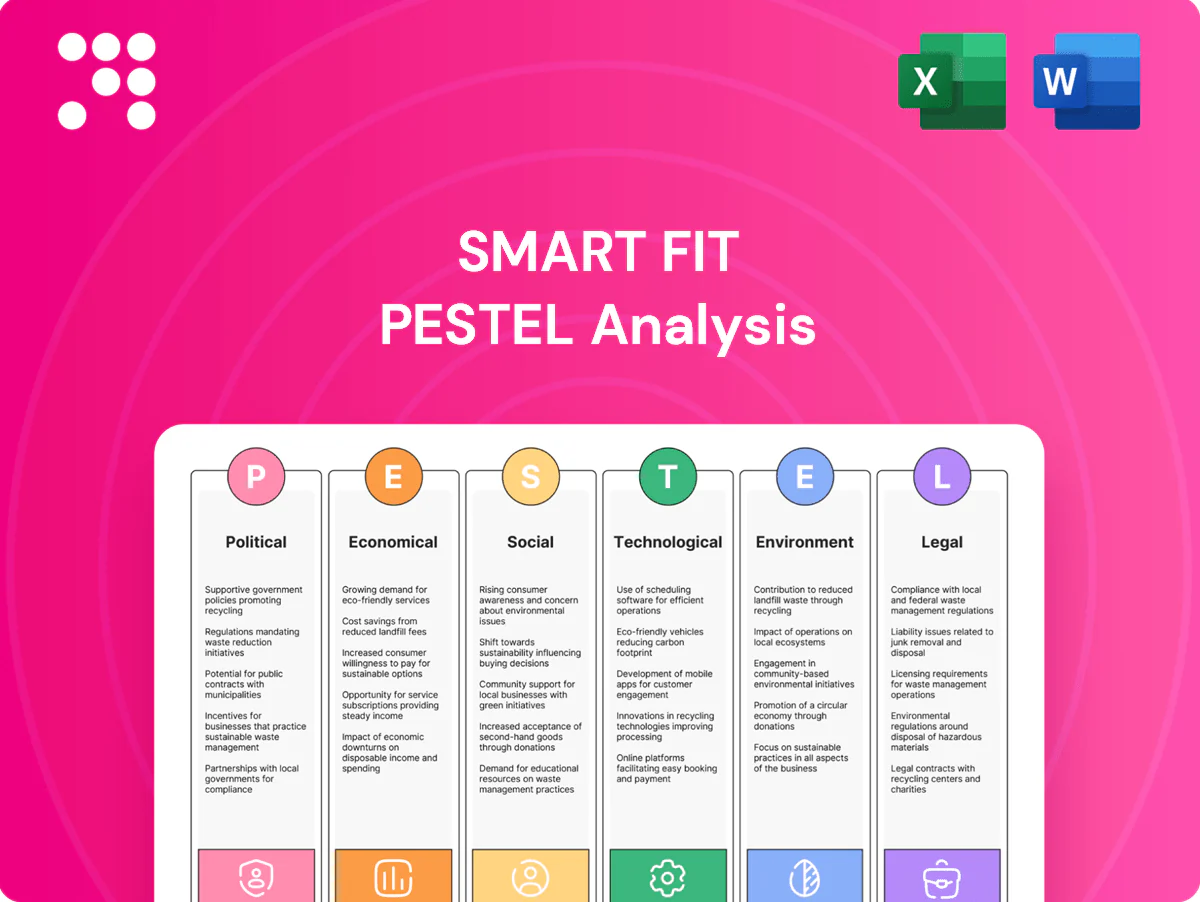
Smart Fit PESTLE Analysis

Make Smarter Strategic Decisions with a Complete PESTEL View
Discover how political shifts, economic trends, social behaviors, technological innovation, legal changes, and environmental pressures are reshaping Smart Fit’s strategy and growth prospects. Our concise PESTLE highlights key risks and opportunities to inform investment and operational decisions. Purchase the full analysis for the complete, editable report and actionable insights you can use immediately.
Political factors

Regulatory stability in LatAm
Smart Fit’s multi-country footprint—over 1,300 clubs and ~11.2 million members across 10+ LatAm markets (2024)—heightens exposure to policy shifts, subsidies and changing public health priorities. Stable governments facilitate capex on new clubs and long-term lease negotiations, supporting expansion. Political volatility can delay permits and push out growth pipelines. Proactive stakeholder engagement reduces location and timing risks.
Public health policy alignment
Governments increasingly promote preventive health—WHO reports 27.5% of adults are insufficiently active—creating policy tailwinds for gym chains like Smart Fit. Partnerships and tax incentives (employer wellness credits, reduced VAT) can lower customer costs and lift memberships. Sudden shifts in health funding or priorities could reduce subsidies and demand. Aligning programs with national campaigns strengthens legitimacy and uptake.

Municipal zoning and permits
Opening Smart Fit sites depends on local zoning, occupancy limits (commonly calculated at 7–15 sq ft per person) and parking rules (often 3–4 spaces per 1,000 sq ft), with municipal approvals typically adding 2–6 months and permit fees frequently ranging from $1,000–15,000 for commercial builds. Complex city processes raise pre-opening costs and delays; strong relationships with planners accelerate approvals and reduce review cycles. Standardized site packages cut design variance and rework, shortening site selection and permitting iterations.

Trade and import dynamics
Fitness equipment supply chains are import-reliant, and tariffs, FX-linked customs and port bottlenecks raise capex and delay club fit-outs; e.g., Shanghai–LA container spot rates fell from ~18,000 USD per FEU in 2021 to ~2,000 USD by 2023, highlighting volatile logistics costs that still spike with regional congestion in 2024.
- Diversify suppliers to cut single‑port risk
- Negotiate regional contracts to hedge FX and tariff shifts
- Consider local assembly to lower import duty exposure
Security and public safety
Crime and civil unrest in select urban markets depress member traffic and raise staff risk, forcing Smart Fit to increase security spend; the company reported expanding security budgets across high-risk cities in 2024, impacting margins in those locations. Government policing effectiveness shapes late-hour operations and club opening hours, with contingency plans and alternate-site clauses used to maintain service continuity and protect brand reputation.
- Impact: reduced footfall, higher absenteeism
- Cost: elevated security and insurance premiums
- Operations: restricted late-hour openings where policing is weak
- Mitigation: contingency plans, site selection, emergency protocols
1,300+ clubs and ~11.2M members magnify regulatory exposure; permits 2–6 months, security costs rise
Smart Fit’s 1,300+ clubs and ~11.2M members (2024) increase exposure to policy shifts, subsidies and cross‑border regulation. Permitting averages 2–6 months with fees of $1k–$15k, slowing rollouts; preventive‑health agendas (WHO: 27.5% inactive adults) create membership tailwinds. Crime-driven security spend rose in 2024, squeezing margins in high‑risk cities.
| Metric | Value |
|---|---|
| Clubs (2024) | 1,300+ |
| Members (2024) | ~11.2M |
| Permit time | 2–6 months |
| Permit fees | $1k–$15k |
What is included in the product
 Detailed Word Document
Explores how external macro-environmental factors uniquely affect Smart Fit across six dimensions: Political, Economic, Social, Technological, Environmental, and Legal. Each section is data-backed, region- and industry-specific, forward-looking, and formatted for executives to identify threats, opportunities, and inform strategic planning.

 Customizable Excel Spreadsheet
Condensed Smart Fit PESTLE summary that’s visually segmented for quick interpretation, easing meeting prep and decision-making by highlighting external risks and opportunities at a glance. Ideal for dropping into presentations, sharing across teams, or annotating with region-specific notes to support rapid alignment and strategic planning.
Economic factors

Disposable income sensitivity
Smart Fit's low-cost, high-volume model benefits when consumers trade down, evidenced by membership growth to roughly 5.5 million members by 2024 as price-conscious users shift from premium chains. Recessions boost price sensitivity and favor value gyms over premium rivals, but deep downturns still raise churn and cut ancillary spend (personal training, retail). Flexible pricing, promotions and pay-as-you-go offers have stabilized occupancy and revenue per club.
Inflation and cost pass-through
LatAm inflation, averaging about 7% in 2024 (IMF), raises rents, utilities, wages and equipment costs, pressuring Smart Fit margins. The chain must calibrate price increases to avoid churn, leveraging tiered pricing and promotions. Multi-year supplier contracts and efficiency gains (lower capex per new club) help protect margins. Lease indexation clauses can smooth cash‑flow volatility.

Currency fluctuations
Revenue is collected locally while a share of equipment purchases and some debt are USD/EUR-linked, so FX depreciation raises imported-equipment costs and foreign-denominated debt service; the US dollar accounted for about 58% of global reserves in 2024 (IMF COFER). Natural hedging through local-currency financing mitigates mismatch, and phased capex schedules smooth timing risk and reduce one-off FX exposure.

Labor market dynamics
Labor market dynamics affect Smart Fit as trainer availability and rising wage levels press on service quality and operating cost; global fitness industry revenue was about 100 billion USD in 2024 while ILO estimated global unemployment at 5.4% in 2024, tightening skilled hires.
- Trainer availability: limited skilled trainers raise costs and impact quality
- Gig staffing: flexible scheduling smooths peak utilization
- Training academies: boost productivity and retention
- Variable pay: aligns labor cost with utilization and demand
Market saturation and growth
Market saturation: fitness membership penetration remains under 10% in many LatAm cities, leaving runway; Smart Fit operates 1,000+ clubs across 10 countries with millions of members, while boutique studios and a 20–30% rise in at‑home fitness since 2020 force differentiation. Cluster openings raise revenue per sqm via operational leverage; data-driven site selection boosted new-club ROI by ~15% in recent rollouts.
- penetration: <10% in many LatAm cities
- scale: 1,000+ clubs, millions of members
- threats: boutique studios, at‑home growth +20–30%
- strategy: cluster openings, +15% ROI via data site selection
1,300+ clubs and ~11.2M members magnify regulatory exposure; permits 2–6 months, security costs rise
Smart Fit's low‑cost model grew to ~5.5M members by 2024 as price sensitivity rose; recessions boost membership but cut ancillary spend. LatAm inflation ~7% (2024 IMF) and USD-linked costs squeeze margins; flexible pricing, hedging and phased capex mitigate risk. Scale (1,000+ clubs) and data-driven site selection (+15% new-club ROI) sustain growth versus boutiques and at‑home trends.
| Metric | Value (year) |
|---|---|
| Members | 5.5M (2024) |
| Clubs | 1,000+ (2025) |
| LatAm inflation | ~7% (2024) |
| Industry rev | USD100B (2024) |
Preview Before You Purchase
Smart Fit PESTLE Analysis
The preview shown here is the exact Smart Fit PESTLE Analysis you’ll receive after purchase—fully formatted and ready to use. This is a real snapshot of the finished file, delivered exactly as displayed with complete political, economic, social, technological, legal, and environmental insights. No placeholders or teasers—download the same professional document immediately after payment.

Product Information
Product Information
Shipping & Returns
Shipping & Returns
Description
Make Smarter Strategic Decisions with a Complete PESTEL View
Discover how political shifts, economic trends, social behaviors, technological innovation, legal changes, and environmental pressures are reshaping Smart Fit’s strategy and growth prospects. Our concise PESTLE highlights key risks and opportunities to inform investment and operational decisions. Purchase the full analysis for the complete, editable report and actionable insights you can use immediately.
Political factors
Regulatory stability in LatAm
Smart Fit’s multi-country footprint—over 1,300 clubs and ~11.2 million members across 10+ LatAm markets (2024)—heightens exposure to policy shifts, subsidies and changing public health priorities. Stable governments facilitate capex on new clubs and long-term lease negotiations, supporting expansion. Political volatility can delay permits and push out growth pipelines. Proactive stakeholder engagement reduces location and timing risks.
Public health policy alignment
Governments increasingly promote preventive health—WHO reports 27.5% of adults are insufficiently active—creating policy tailwinds for gym chains like Smart Fit. Partnerships and tax incentives (employer wellness credits, reduced VAT) can lower customer costs and lift memberships. Sudden shifts in health funding or priorities could reduce subsidies and demand. Aligning programs with national campaigns strengthens legitimacy and uptake.
Municipal zoning and permits
Opening Smart Fit sites depends on local zoning, occupancy limits (commonly calculated at 7–15 sq ft per person) and parking rules (often 3–4 spaces per 1,000 sq ft), with municipal approvals typically adding 2–6 months and permit fees frequently ranging from $1,000–15,000 for commercial builds. Complex city processes raise pre-opening costs and delays; strong relationships with planners accelerate approvals and reduce review cycles. Standardized site packages cut design variance and rework, shortening site selection and permitting iterations.
Trade and import dynamics
Fitness equipment supply chains are import-reliant, and tariffs, FX-linked customs and port bottlenecks raise capex and delay club fit-outs; e.g., Shanghai–LA container spot rates fell from ~18,000 USD per FEU in 2021 to ~2,000 USD by 2023, highlighting volatile logistics costs that still spike with regional congestion in 2024.
- Diversify suppliers to cut single‑port risk
- Negotiate regional contracts to hedge FX and tariff shifts
- Consider local assembly to lower import duty exposure
Security and public safety
Crime and civil unrest in select urban markets depress member traffic and raise staff risk, forcing Smart Fit to increase security spend; the company reported expanding security budgets across high-risk cities in 2024, impacting margins in those locations. Government policing effectiveness shapes late-hour operations and club opening hours, with contingency plans and alternate-site clauses used to maintain service continuity and protect brand reputation.
- Impact: reduced footfall, higher absenteeism
- Cost: elevated security and insurance premiums
- Operations: restricted late-hour openings where policing is weak
- Mitigation: contingency plans, site selection, emergency protocols
1,300+ clubs and ~11.2M members magnify regulatory exposure; permits 2–6 months, security costs rise
Smart Fit’s 1,300+ clubs and ~11.2M members (2024) increase exposure to policy shifts, subsidies and cross‑border regulation. Permitting averages 2–6 months with fees of $1k–$15k, slowing rollouts; preventive‑health agendas (WHO: 27.5% inactive adults) create membership tailwinds. Crime-driven security spend rose in 2024, squeezing margins in high‑risk cities.
| Metric | Value |
|---|---|
| Clubs (2024) | 1,300+ |
| Members (2024) | ~11.2M |
| Permit time | 2–6 months |
| Permit fees | $1k–$15k |
What is included in the product
Detailed Word Document
Explores how external macro-environmental factors uniquely affect Smart Fit across six dimensions: Political, Economic, Social, Technological, Environmental, and Legal. Each section is data-backed, region- and industry-specific, forward-looking, and formatted for executives to identify threats, opportunities, and inform strategic planning.
Customizable Excel Spreadsheet
Condensed Smart Fit PESTLE summary that’s visually segmented for quick interpretation, easing meeting prep and decision-making by highlighting external risks and opportunities at a glance. Ideal for dropping into presentations, sharing across teams, or annotating with region-specific notes to support rapid alignment and strategic planning.
Economic factors
Disposable income sensitivity
Smart Fit's low-cost, high-volume model benefits when consumers trade down, evidenced by membership growth to roughly 5.5 million members by 2024 as price-conscious users shift from premium chains. Recessions boost price sensitivity and favor value gyms over premium rivals, but deep downturns still raise churn and cut ancillary spend (personal training, retail). Flexible pricing, promotions and pay-as-you-go offers have stabilized occupancy and revenue per club.
Inflation and cost pass-through
LatAm inflation, averaging about 7% in 2024 (IMF), raises rents, utilities, wages and equipment costs, pressuring Smart Fit margins. The chain must calibrate price increases to avoid churn, leveraging tiered pricing and promotions. Multi-year supplier contracts and efficiency gains (lower capex per new club) help protect margins. Lease indexation clauses can smooth cash‑flow volatility.
Currency fluctuations
Revenue is collected locally while a share of equipment purchases and some debt are USD/EUR-linked, so FX depreciation raises imported-equipment costs and foreign-denominated debt service; the US dollar accounted for about 58% of global reserves in 2024 (IMF COFER). Natural hedging through local-currency financing mitigates mismatch, and phased capex schedules smooth timing risk and reduce one-off FX exposure.
Labor market dynamics
Labor market dynamics affect Smart Fit as trainer availability and rising wage levels press on service quality and operating cost; global fitness industry revenue was about 100 billion USD in 2024 while ILO estimated global unemployment at 5.4% in 2024, tightening skilled hires.
- Trainer availability: limited skilled trainers raise costs and impact quality
- Gig staffing: flexible scheduling smooths peak utilization
- Training academies: boost productivity and retention
- Variable pay: aligns labor cost with utilization and demand
Market saturation and growth
Market saturation: fitness membership penetration remains under 10% in many LatAm cities, leaving runway; Smart Fit operates 1,000+ clubs across 10 countries with millions of members, while boutique studios and a 20–30% rise in at‑home fitness since 2020 force differentiation. Cluster openings raise revenue per sqm via operational leverage; data-driven site selection boosted new-club ROI by ~15% in recent rollouts.
- penetration: <10% in many LatAm cities
- scale: 1,000+ clubs, millions of members
- threats: boutique studios, at‑home growth +20–30%
- strategy: cluster openings, +15% ROI via data site selection
1,300+ clubs and ~11.2M members magnify regulatory exposure; permits 2–6 months, security costs rise
Smart Fit's low‑cost model grew to ~5.5M members by 2024 as price sensitivity rose; recessions boost membership but cut ancillary spend. LatAm inflation ~7% (2024 IMF) and USD-linked costs squeeze margins; flexible pricing, hedging and phased capex mitigate risk. Scale (1,000+ clubs) and data-driven site selection (+15% new-club ROI) sustain growth versus boutiques and at‑home trends.
| Metric | Value (year) |
|---|---|
| Members | 5.5M (2024) |
| Clubs | 1,000+ (2025) |
| LatAm inflation | ~7% (2024) |
| Industry rev | USD100B (2024) |
Preview Before You Purchase
Smart Fit PESTLE Analysis
The preview shown here is the exact Smart Fit PESTLE Analysis you’ll receive after purchase—fully formatted and ready to use. This is a real snapshot of the finished file, delivered exactly as displayed with complete political, economic, social, technological, legal, and environmental insights. No placeholders or teasers—download the same professional document immediately after payment.