Silvercorp PESTLE Analysis

Skip the Research. Get the Strategy.
Discover how political shifts, commodity cycles, and environmental regulations are shaping Silvercorp’s outlook in our concise PESTLE snapshot. This 3–5 sentence primer highlights key external risks and opportunities to inform investment or strategy decisions. For the full, editable PESTLE with data-driven recommendations, download the complete report now and act with confidence.
Political factors

Central–local mining policy alignment
Mining approvals, land use and safety oversight in China are split between the central Ministry of Natural Resources (established 2018) and provincial bureaus, so alignment or divergence can materially shift permit timing and output schedules.
For Silvercorp (operations in Henan and Guangdong) stable local government ties are vital for continuity; misalignment has delayed projects nationally by months in past regulatory cycles.
Policy shifts toward resource security (Beijing emphasis since 2021) could impose domestic supply obligations that reprioritize domestic buyers over exports.
Geopolitical tensions and foreign operator status
As a Canadian-listed miner founded in 2005 and listed on the TSX, Silvercorp operates primarily in China, concentrating over 90% of its assets there; thus Canada–China or US–China tensions can restrict capital access, audits and investor confidence. Heightened regulatory scrutiny of foreign entities has risen since 2018, so proactive compliance and local partnerships mitigate risk.

Industrial policy and critical metals strategy
China's industrial policy drives demand for silver, lead and zinc through infrastructure and electronics, with China consuming roughly half of global refined silver and over 40% of lead and zinc market volumes (2023–24 estimates). Preferential support for downstream users — tax breaks, subsidies — can compress domestic spreads and alter global pricing. Strategic stockpiling or timed releases by Beijing have historically increased volatility in base-precious metal spreads. Active engagement with Chinese industry associations offers early signals on policy shifts and procurement plans.

Infrastructure and regional development priorities
- Provincial plans guide mine-area infrastructure
- Improved infrastructure lowers OPEX and downtime
- Priority shifts can defer upgrades
- Engage local planning for mutual gains
Community relations and social license
Local political leaders in Silvercorp’s Chinese operating regions are highly responsive to community concerns about employment and environmental impacts, making social license a critical political factor; maintaining it reduces protest and permitting risk and helps continuity of operations. Transparent reporting and grievance mechanisms have proven effective in building trust, while community investment programs aligned with government development goals strengthen resilience to policy shifts.
- Local responsiveness: reduces permit/protest risk
- Transparency: reporting + grievance mechanisms = trust
- Community investment aligned with government goals = policy resilience
China regulators risk output for TSX miner with >90% China assets
China central and provincial mining regulators (Ministry of Natural Resources + provincial bureaus) materially affect permit timing and output schedules for Silvercorp, which holds >90% of assets in China.
Beijing policies since 2021 favor resource security and downstream users; China accounted for ~50% of refined silver demand and >40% of lead/zinc (2023–24 est.).
Canada–China tensions and rising foreign-entity scrutiny (post-2018) increase audit, capital and investor-risk for TSX-listed Silvercorp.
| Metric | Value |
|---|---|
| China share silver demand (2023–24) | ~50% |
| Lead & zinc China share (2023–24) | >40% |
| Silvercorp China assets | >90% |
| TSX listing | 2005 |
What is included in the product
 Detailed Word Document
Explores how Political, Economic, Social, Technological, Environmental and Legal forces uniquely impact Silvercorp’s mining operations and strategy, with data-driven subpoints, region-specific regulatory and market trends, and forward-looking insights to inform risk mitigation, investment decisions and scenario planning.

 Customizable Excel Spreadsheet
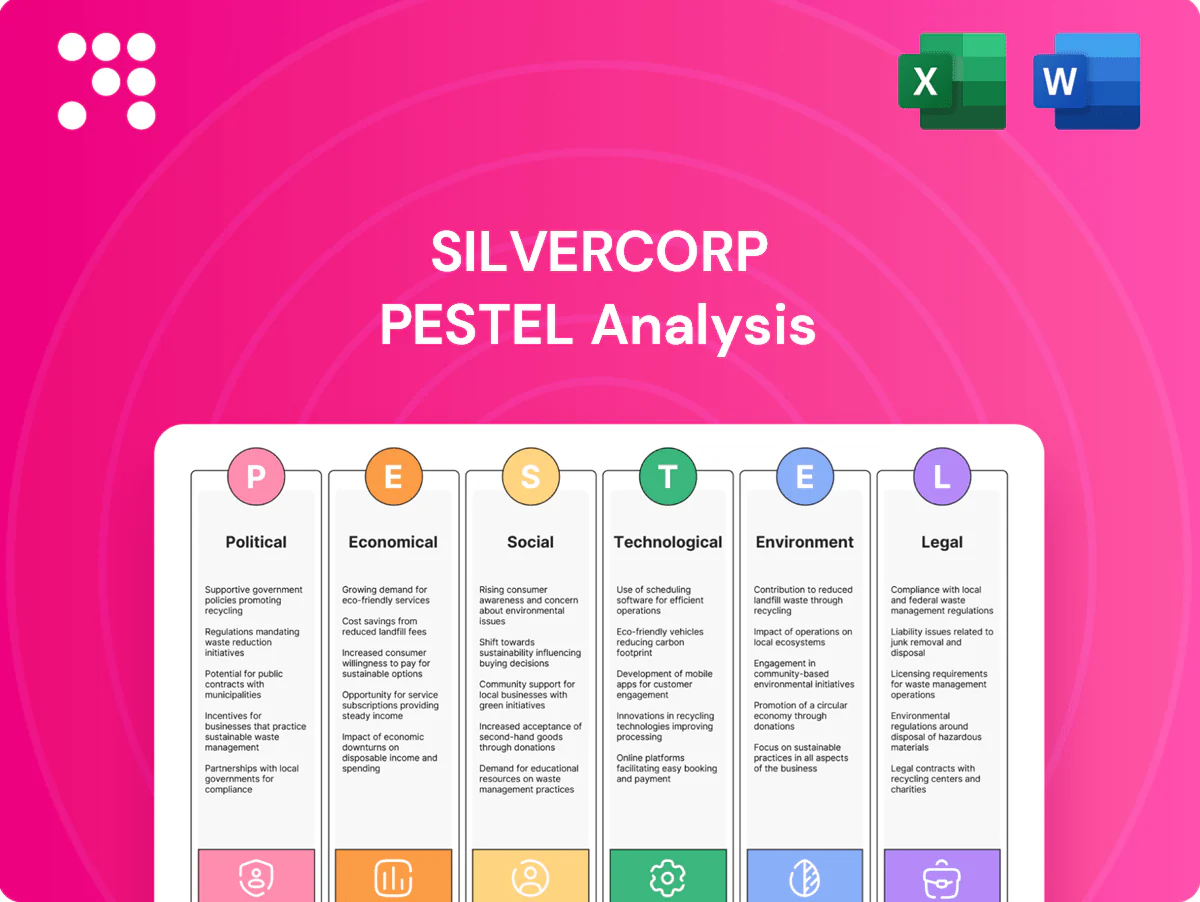
Concise, visually segmented Silvercorp PESTLE summary that eases stakeholder briefings and presentations, supports region-specific annotations, and is easily shared for quick alignment across teams.
Economic factors

Commodity price volatility
Silvercorp revenue is highly leveraged to silver with material exposure to lead and zinc by-products; global monetary cycles, industry demand and investor sentiment drive price swings that materially affect margins. Strategic hedging can stabilise cash flows while limiting upside during rallies. Flexible mine planning and throughput adjustment allow rapid response to shifting price regimes, protecting free cash flow and preserving optionality.
Domestic demand and smelter terms
Sales to Chinese customers depend on available smelter capacity and prevailing treatment charges, with tight smelter markets historically pushing TCs higher and compressing producer margins. Diversifying concentrate contracts across multiple smelters and product types strengthens negotiating leverage and price realization. Payment terms and counterparties’ credit quality directly affect Silvercorp’s working capital and cash-conversion cycle.

FX and cost inflation
Silvercorp's operating costs are largely RMB-denominated while reporting is in USD/CAD, so RMB moves (about 5% swing vs USD/CAD in 2024) materially affect translated costs and earnings. Energy, explosives, steel and labor inflation—energy ~10% and steel ~6% in 2024, wages ~4%—raise unit costs. Targeted procurement and energy-efficiency programs have offset pressures, cutting specific unit costs by up to ~8% in 2024.

Capital access and investment cycle
Cyclical metals markets drive equity and debt availability, with COMEX silver averaging about US$26/oz in 2024, tightening financing when prices fall. Strong balance sheets allow Silvercorp to invest counter‑cyclically in exploration and mine optimization, while government incentives or VAT rebates can lift project IRRs; disciplined capital allocation preserves returns through cycles.
- Price sensitivity: silver ~US$26/oz (2024)
- Balance-sheet optionality: enables counter-cyclical spend
- Policy boost: VAT/incentives improve IRRs
- Capital discipline: preserves long-term returns
Logistics and power reliability
Power tariffs in Silvercorp’s Chinese mine regions typically run around 0.5–0.8 RMB/kWh, directly raising processing costs and affecting uptime; regional curtailments (notably 2021–2022) have shown the risk of output disruption. Proximity to customers trims transport distance and risk, while on-site backup generation and demand-management systems (backup cover often 24–72 hours) boost resilience.
- Tariffs: 0.5–0.8 RMB/kWh
- Curtailment risk: historical disruptions 2021–22
- Backup: 24–72h generator cover
- Proximity: lowers transport cost and risk
China regulators risk output for TSX miner with >90% China assets
Silver price sensitivity (COMEX ~US$26/oz in 2024) and by‑product mixes drive margins; hedging and flexible mine plans protect cash flow but cap upside.
RMB swings (~±5% vs USD/CAD in 2024), energy & input inflation (energy ~10% in 2024) materially affect unit costs and translated earnings.
Smelter TCs, smelter capacity and power tariffs (0.5–0.8 RMB/kWh) influence realizations and working capital.
| Metric | 2024 Value |
|---|---|
| COMEX silver | ~US$26/oz |
| RMB move | ~±5% |
| Power tariff | 0.5–0.8 RMB/kWh |
Preview Before You Purchase
Silvercorp PESTLE Analysis
The preview shown here is the exact Silvercorp PESTLE Analysis document you’ll receive after purchase—fully formatted and ready to use. The layout, content, and structure visible are identical to the downloadable file. No placeholders, no teasers—this is the final, professionally structured report.

Original: $10.00
-65%$10.00
$3.50Product Information
Product Information
Shipping & Returns
Shipping & Returns
Description
Skip the Research. Get the Strategy.
Discover how political shifts, commodity cycles, and environmental regulations are shaping Silvercorp’s outlook in our concise PESTLE snapshot. This 3–5 sentence primer highlights key external risks and opportunities to inform investment or strategy decisions. For the full, editable PESTLE with data-driven recommendations, download the complete report now and act with confidence.
Political factors
Central–local mining policy alignment
Mining approvals, land use and safety oversight in China are split between the central Ministry of Natural Resources (established 2018) and provincial bureaus, so alignment or divergence can materially shift permit timing and output schedules.
For Silvercorp (operations in Henan and Guangdong) stable local government ties are vital for continuity; misalignment has delayed projects nationally by months in past regulatory cycles.
Policy shifts toward resource security (Beijing emphasis since 2021) could impose domestic supply obligations that reprioritize domestic buyers over exports.
Geopolitical tensions and foreign operator status
As a Canadian-listed miner founded in 2005 and listed on the TSX, Silvercorp operates primarily in China, concentrating over 90% of its assets there; thus Canada–China or US–China tensions can restrict capital access, audits and investor confidence. Heightened regulatory scrutiny of foreign entities has risen since 2018, so proactive compliance and local partnerships mitigate risk.
Industrial policy and critical metals strategy
China's industrial policy drives demand for silver, lead and zinc through infrastructure and electronics, with China consuming roughly half of global refined silver and over 40% of lead and zinc market volumes (2023–24 estimates). Preferential support for downstream users — tax breaks, subsidies — can compress domestic spreads and alter global pricing. Strategic stockpiling or timed releases by Beijing have historically increased volatility in base-precious metal spreads. Active engagement with Chinese industry associations offers early signals on policy shifts and procurement plans.
Infrastructure and regional development priorities
- Provincial plans guide mine-area infrastructure
- Improved infrastructure lowers OPEX and downtime
- Priority shifts can defer upgrades
- Engage local planning for mutual gains
Community relations and social license
Local political leaders in Silvercorp’s Chinese operating regions are highly responsive to community concerns about employment and environmental impacts, making social license a critical political factor; maintaining it reduces protest and permitting risk and helps continuity of operations. Transparent reporting and grievance mechanisms have proven effective in building trust, while community investment programs aligned with government development goals strengthen resilience to policy shifts.
- Local responsiveness: reduces permit/protest risk
- Transparency: reporting + grievance mechanisms = trust
- Community investment aligned with government goals = policy resilience
China regulators risk output for TSX miner with >90% China assets
China central and provincial mining regulators (Ministry of Natural Resources + provincial bureaus) materially affect permit timing and output schedules for Silvercorp, which holds >90% of assets in China.
Beijing policies since 2021 favor resource security and downstream users; China accounted for ~50% of refined silver demand and >40% of lead/zinc (2023–24 est.).
Canada–China tensions and rising foreign-entity scrutiny (post-2018) increase audit, capital and investor-risk for TSX-listed Silvercorp.
| Metric | Value |
|---|---|
| China share silver demand (2023–24) | ~50% |
| Lead & zinc China share (2023–24) | >40% |
| Silvercorp China assets | >90% |
| TSX listing | 2005 |
What is included in the product
Detailed Word Document
Explores how Political, Economic, Social, Technological, Environmental and Legal forces uniquely impact Silvercorp’s mining operations and strategy, with data-driven subpoints, region-specific regulatory and market trends, and forward-looking insights to inform risk mitigation, investment decisions and scenario planning.
Customizable Excel Spreadsheet
Concise, visually segmented Silvercorp PESTLE summary that eases stakeholder briefings and presentations, supports region-specific annotations, and is easily shared for quick alignment across teams.
Economic factors
Commodity price volatility
Silvercorp revenue is highly leveraged to silver with material exposure to lead and zinc by-products; global monetary cycles, industry demand and investor sentiment drive price swings that materially affect margins. Strategic hedging can stabilise cash flows while limiting upside during rallies. Flexible mine planning and throughput adjustment allow rapid response to shifting price regimes, protecting free cash flow and preserving optionality.
Domestic demand and smelter terms
Sales to Chinese customers depend on available smelter capacity and prevailing treatment charges, with tight smelter markets historically pushing TCs higher and compressing producer margins. Diversifying concentrate contracts across multiple smelters and product types strengthens negotiating leverage and price realization. Payment terms and counterparties’ credit quality directly affect Silvercorp’s working capital and cash-conversion cycle.
FX and cost inflation
Silvercorp's operating costs are largely RMB-denominated while reporting is in USD/CAD, so RMB moves (about 5% swing vs USD/CAD in 2024) materially affect translated costs and earnings. Energy, explosives, steel and labor inflation—energy ~10% and steel ~6% in 2024, wages ~4%—raise unit costs. Targeted procurement and energy-efficiency programs have offset pressures, cutting specific unit costs by up to ~8% in 2024.
Capital access and investment cycle
Cyclical metals markets drive equity and debt availability, with COMEX silver averaging about US$26/oz in 2024, tightening financing when prices fall. Strong balance sheets allow Silvercorp to invest counter‑cyclically in exploration and mine optimization, while government incentives or VAT rebates can lift project IRRs; disciplined capital allocation preserves returns through cycles.
- Price sensitivity: silver ~US$26/oz (2024)
- Balance-sheet optionality: enables counter-cyclical spend
- Policy boost: VAT/incentives improve IRRs
- Capital discipline: preserves long-term returns
Logistics and power reliability
Power tariffs in Silvercorp’s Chinese mine regions typically run around 0.5–0.8 RMB/kWh, directly raising processing costs and affecting uptime; regional curtailments (notably 2021–2022) have shown the risk of output disruption. Proximity to customers trims transport distance and risk, while on-site backup generation and demand-management systems (backup cover often 24–72 hours) boost resilience.
- Tariffs: 0.5–0.8 RMB/kWh
- Curtailment risk: historical disruptions 2021–22
- Backup: 24–72h generator cover
- Proximity: lowers transport cost and risk
China regulators risk output for TSX miner with >90% China assets
Silver price sensitivity (COMEX ~US$26/oz in 2024) and by‑product mixes drive margins; hedging and flexible mine plans protect cash flow but cap upside.
RMB swings (~±5% vs USD/CAD in 2024), energy & input inflation (energy ~10% in 2024) materially affect unit costs and translated earnings.
Smelter TCs, smelter capacity and power tariffs (0.5–0.8 RMB/kWh) influence realizations and working capital.
| Metric | 2024 Value |
|---|---|
| COMEX silver | ~US$26/oz |
| RMB move | ~±5% |
| Power tariff | 0.5–0.8 RMB/kWh |
Preview Before You Purchase
Silvercorp PESTLE Analysis
The preview shown here is the exact Silvercorp PESTLE Analysis document you’ll receive after purchase—fully formatted and ready to use. The layout, content, and structure visible are identical to the downloadable file. No placeholders, no teasers—this is the final, professionally structured report.