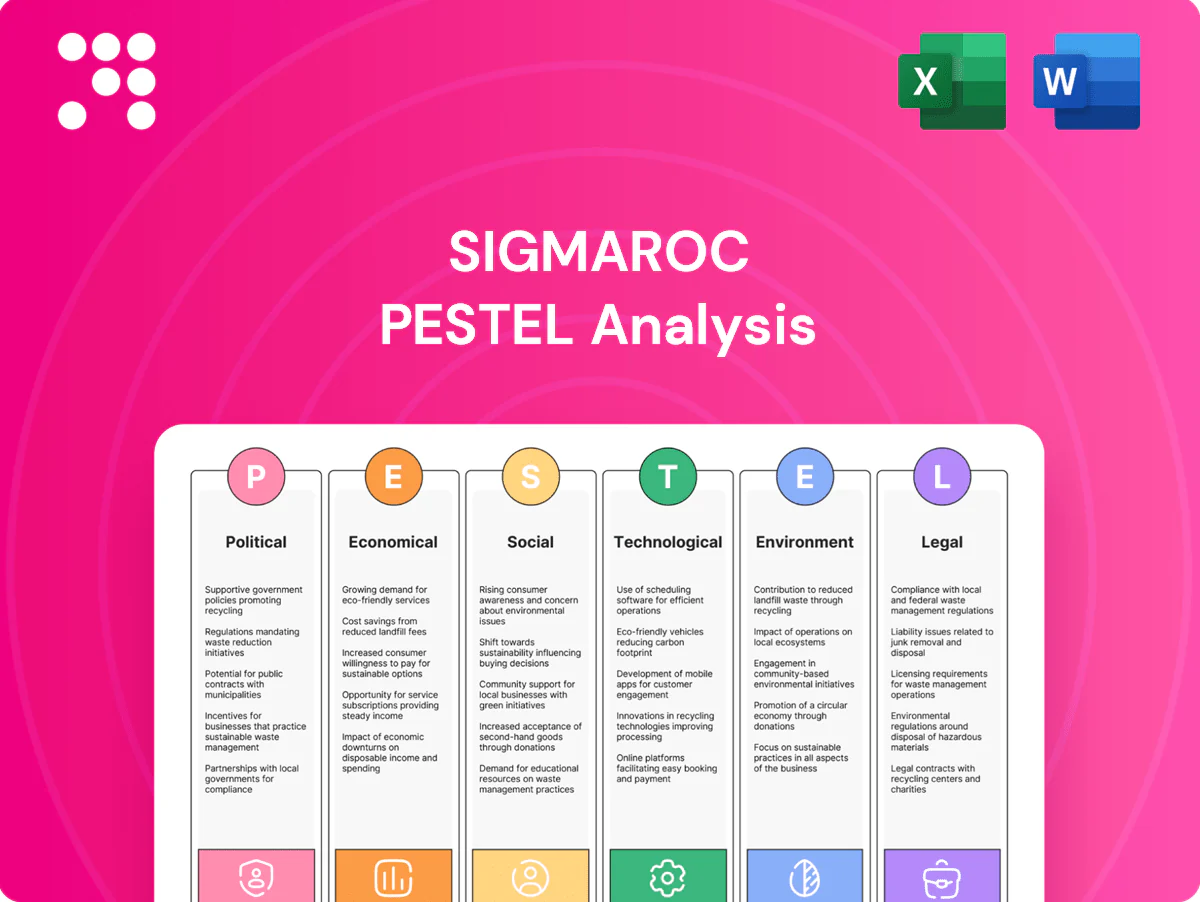
SigmaRoc PESTLE Analysis

Your Shortcut to Market Insight Starts Here
Gain a strategic edge with our PESTLE Analysis of SigmaRoc — uncover how political, economic, social, technological, legal and environmental forces shape its prospects. Ideal for investors and strategists, this ready-to-use report highlights risks and growth opportunities you can't miss. Purchase the full analysis now for instant, editable insights to inform decisions and forecasts.
Political factors

EU/UK infrastructure policy
EU/UK infrastructure policy—backed by the EU 2021–27 MFF of €1.074tn plus NextGenerationEU €750bn and the UK’s c.£600bn national pipeline—drives sustained demand for aggregates, cement and lime. Priority transport, energy-transition and housing projects feed SigmaRoc’s order book, while shifts in public budgets or electoral cycles can speed or stall volumes. Monitoring recovery funds and tender pipelines enables aligned capacity and capex planning.
Trade and cross-border frictions
Operating across Europe exposes SigmaRoc to post‑Brexit customs procedures and evolving UK–EU alignment, with CBAM reporting in effect since 1 Oct 2023 and full application from 2026 increasing administrative burden. UK customs declarations surged to roughly 76 million yearly post‑Brexit, raising transit risk and paperwork. Efficient customs brokerage, localized sourcing and 2–4 week strategic stockholding near borders mitigate delays and delivery disruption.

Regional permitting and licenses
Quarrying and kiln operations for SigmaRoc hinge on regional permits that can be politicized; UK major planning applications have a statutory determination target of 13 weeks, though complex mineral proposals commonly exceed this. Local authority timelines, consultation outcomes and zoning decisions directly affect expansion and continuity. Proactive community engagement speeds approvals, and a pipeline approach to permit renewals reduces shutdown risk.

Energy and industrial policy
National energy and industrial policy drives SigmaRoc input costs and incentives: UK net‑zero by 2050 and renewables supplying ~40% of UK electricity in 2023 shift fuel mix and capex toward electrification and low‑carbon heat. Subsidies and CfDs for low‑carbon fuels and CCUS materially improve project IRRs; exposure to windfall taxes and electricity market reform requires hedging and contract structures.
- Policy drivers: net‑zero targets, renewables ~40% (UK 2023)
- Support: CfDs/CCUS subsidies improve economics
- Risks: windfall tax, market reform → hedge needed
- Action: engage industry bodies for favorable frameworks
Geopolitical stability and procurement
War and sanctions since 2022 and the Russia‑Ukraine conflict have pushed EU gas reliance from ~40% pre‑2022 to ~9% of supply by 2024, tightening fuel and cementitious pricing while CBAM (operational 2023) reshapes import cost profiles; public procurement (~14% of EU GDP, ~€2tn/year) increasingly favors local content and low‑carbon materials, so EPD alignment raises bid win rates and diversified sourcing cuts geopolitical exposure.
- Gas reliance: ~40%→9% (2024)
- Public procurement: ~14% GDP ≈ €2tn/yr
- CBAM in force (2023)
- EPD alignment increases win probability
- Diversified sourcing reduces supply risk
EU/UK infrastructure spend boosts low-carbon demand; trade, energy risks force local supply
EU/UK infrastructure budgets (EU MFF €1.074tn; NextGenerationEU €750bn; UK pipeline ≈£600bn) sustain aggregate demand, while CBAM (operational 2023) and public procurement (~14% GDP ≈€2tn/yr) favour low‑carbon materials. Post‑Brexit customs (~76m UK declarations) and reduced EU gas exposure (≈40%→9% by 2024) raise input/cost risks requiring local sourcing and hedging. Permitting delays and energy policy (UK renewables ≈40% 2023) drive capex and community engagement needs.
| Metric | Value |
|---|---|
| EU MFF | €1.074tn (2021–27) |
| NextGenerationEU | €750bn |
| UK pipeline | ≈£600bn |
| Public procurement | ~14% GDP ≈€2tn/yr |
| UK customs | ~76m declarations |
| EU gas reliance | ≈40%→9% (2024) |
What is included in the product
 Detailed Word Document
Explores how Political, Economic, Social, Technological, Environmental and Legal forces specifically impact SigmaRoc’s operations and growth, with data-backed trends and region‑/industry‑specific examples to identify risks and opportunities. Delivered in clean, investor-ready format with forward-looking insights for strategy and scenario planning.

 Customizable Excel Spreadsheet
A concise, visually segmented SigmaRoc PESTLE summary that’s easy to drop into presentations, annotate for local context, and share across teams to streamline external risk discussions and strategic alignment.
Economic factors

Construction cycle sensitivity
SigmaRoc’s volumes are cyclical, tracking residential, commercial and infrastructure activity; UK mortgage rates averaged about 5–6% through 2024 with Bank Rate near 5.25% in mid‑2025, constraining housing starts. Fiscal consolidation in key markets has reduced public works pipelines, tempering demand for aggregates. SigmaRoc’s balanced end‑market mix helps buffer this volatility.
Energy and fuel cost inflation
Lime and cement are energy‑intensive, with fuel and power often representing 20–40% of operating costs; gas, electricity, petcoke and alternative fuels therefore directly drive margins. Price volatility has made hedging, index‑linked pricing and fuel switching essential to protect margins. Energy‑efficiency programmes can reduce fuel consumption by c.5–15%, while long‑term PPAs (typically 5–20 years) stabilise power costs.

Input logistics and transport
Aggregates are heavy, low-value freight—industry average revenue often under £10/tonne—so transport dominates SigmaRoc margins; road haul typically costs ~€0.06–0.12/tonne·km versus rail ~€0.03/tonne·km, making modal mix critical. Diesel averaged ~£1.65–1.75/L in 2024 and UK HGV driver gaps remained ~80,000–100,000, while tolls and access charges further raise delivered cost. Rail and short-sea options can economically extend catchments, and optimized routing with backhaul utilisation (saving 10–20% on haul costs) helps defend margins.

M&A integration economics
Value creation at SigmaRoc hinges on acquisition multiples, synergy capture and ROIC: European aggregates M&A trades around EV/EBITDA ~8x (2024), with realistic synergy-driven EBITDA uplift of 10–15% and procurement savings of 3–6%. Faster integration preserves deal NPV under ~8–10% discounting, while disciplined capital allocation targets net debt/EBITDA below ~3.0x to protect rating headroom.
- EV/EBITDA ~8x (2024)
- Synergy EBITDA uplift 10–15%
- Procurement savings 3–6%
- Discount rate 8–10% (NPV sensitivity)
- Net debt/EBITDA target <3.0x
Currency and market diversification
Multi‑country operations expose SigmaRoc to FX translation and transaction risks as cash flows and balance sheets are affected by currency moves; careful treasury management is required. Natural hedging through local costs and pricing reduces net exposure, while selective financial hedges (forwards/options) protect key cash flows. Geographic diversification smooths revenue volatility during localized economic downturns.
- FX translation/transaction risk
- Natural hedging via local costs/pricing
- Selective financial hedges for cash flows
- Market diversification lowers downturn impact
EU/UK infrastructure spend boosts low-carbon demand; trade, energy risks force local supply
SigmaRoc faces cyclical volumes with UK mortgage rates ~5–6% in 2024 and Bank Rate ~5.25% mid‑2025, constraining housing starts. Energy (20–40% of opex) and diesel (£1.65–1.75/L in 2024) drive margins; transport (~€0.06–0.12/tonne·km road) is critical. M&A trades ~EV/EBITDA 8x (2024) with net debt/EBITDA target <3.0x; FX hedging reduces translation risk.
| Metric | 2024/25 |
|---|---|
| UK mortgage/Bank Rate | 5–6% / 5.25% |
| Diesel | £1.65–1.75/L |
| Energy opex | 20–40% |
| EV/EBITDA | ~8x |
| Net debt/EBITDA | <3.0x |
Same Document Delivered
SigmaRoc PESTLE Analysis
The SigmaRoc PESTLE Analysis preview shown here is the exact document you’ll receive after purchase—fully formatted and ready to use. It contains the complete political, economic, social, technological, legal and environmental assessment. No placeholders or teasers; the file is final and downloadable immediately after payment.

Original: $10.00
-65%$10.00
$3.50Product Information
Product Information
Shipping & Returns
Shipping & Returns
Description
Your Shortcut to Market Insight Starts Here
Gain a strategic edge with our PESTLE Analysis of SigmaRoc — uncover how political, economic, social, technological, legal and environmental forces shape its prospects. Ideal for investors and strategists, this ready-to-use report highlights risks and growth opportunities you can't miss. Purchase the full analysis now for instant, editable insights to inform decisions and forecasts.
Political factors
EU/UK infrastructure policy
EU/UK infrastructure policy—backed by the EU 2021–27 MFF of €1.074tn plus NextGenerationEU €750bn and the UK’s c.£600bn national pipeline—drives sustained demand for aggregates, cement and lime. Priority transport, energy-transition and housing projects feed SigmaRoc’s order book, while shifts in public budgets or electoral cycles can speed or stall volumes. Monitoring recovery funds and tender pipelines enables aligned capacity and capex planning.
Trade and cross-border frictions
Operating across Europe exposes SigmaRoc to post‑Brexit customs procedures and evolving UK–EU alignment, with CBAM reporting in effect since 1 Oct 2023 and full application from 2026 increasing administrative burden. UK customs declarations surged to roughly 76 million yearly post‑Brexit, raising transit risk and paperwork. Efficient customs brokerage, localized sourcing and 2–4 week strategic stockholding near borders mitigate delays and delivery disruption.
Regional permitting and licenses
Quarrying and kiln operations for SigmaRoc hinge on regional permits that can be politicized; UK major planning applications have a statutory determination target of 13 weeks, though complex mineral proposals commonly exceed this. Local authority timelines, consultation outcomes and zoning decisions directly affect expansion and continuity. Proactive community engagement speeds approvals, and a pipeline approach to permit renewals reduces shutdown risk.
Energy and industrial policy
National energy and industrial policy drives SigmaRoc input costs and incentives: UK net‑zero by 2050 and renewables supplying ~40% of UK electricity in 2023 shift fuel mix and capex toward electrification and low‑carbon heat. Subsidies and CfDs for low‑carbon fuels and CCUS materially improve project IRRs; exposure to windfall taxes and electricity market reform requires hedging and contract structures.
- Policy drivers: net‑zero targets, renewables ~40% (UK 2023)
- Support: CfDs/CCUS subsidies improve economics
- Risks: windfall tax, market reform → hedge needed
- Action: engage industry bodies for favorable frameworks
Geopolitical stability and procurement
War and sanctions since 2022 and the Russia‑Ukraine conflict have pushed EU gas reliance from ~40% pre‑2022 to ~9% of supply by 2024, tightening fuel and cementitious pricing while CBAM (operational 2023) reshapes import cost profiles; public procurement (~14% of EU GDP, ~€2tn/year) increasingly favors local content and low‑carbon materials, so EPD alignment raises bid win rates and diversified sourcing cuts geopolitical exposure.
- Gas reliance: ~40%→9% (2024)
- Public procurement: ~14% GDP ≈ €2tn/yr
- CBAM in force (2023)
- EPD alignment increases win probability
- Diversified sourcing reduces supply risk
EU/UK infrastructure spend boosts low-carbon demand; trade, energy risks force local supply
EU/UK infrastructure budgets (EU MFF €1.074tn; NextGenerationEU €750bn; UK pipeline ≈£600bn) sustain aggregate demand, while CBAM (operational 2023) and public procurement (~14% GDP ≈€2tn/yr) favour low‑carbon materials. Post‑Brexit customs (~76m UK declarations) and reduced EU gas exposure (≈40%→9% by 2024) raise input/cost risks requiring local sourcing and hedging. Permitting delays and energy policy (UK renewables ≈40% 2023) drive capex and community engagement needs.
| Metric | Value |
|---|---|
| EU MFF | €1.074tn (2021–27) |
| NextGenerationEU | €750bn |
| UK pipeline | ≈£600bn |
| Public procurement | ~14% GDP ≈€2tn/yr |
| UK customs | ~76m declarations |
| EU gas reliance | ≈40%→9% (2024) |
What is included in the product
Detailed Word Document
Explores how Political, Economic, Social, Technological, Environmental and Legal forces specifically impact SigmaRoc’s operations and growth, with data-backed trends and region‑/industry‑specific examples to identify risks and opportunities. Delivered in clean, investor-ready format with forward-looking insights for strategy and scenario planning.
Customizable Excel Spreadsheet
A concise, visually segmented SigmaRoc PESTLE summary that’s easy to drop into presentations, annotate for local context, and share across teams to streamline external risk discussions and strategic alignment.
Economic factors
Construction cycle sensitivity
SigmaRoc’s volumes are cyclical, tracking residential, commercial and infrastructure activity; UK mortgage rates averaged about 5–6% through 2024 with Bank Rate near 5.25% in mid‑2025, constraining housing starts. Fiscal consolidation in key markets has reduced public works pipelines, tempering demand for aggregates. SigmaRoc’s balanced end‑market mix helps buffer this volatility.
Energy and fuel cost inflation
Lime and cement are energy‑intensive, with fuel and power often representing 20–40% of operating costs; gas, electricity, petcoke and alternative fuels therefore directly drive margins. Price volatility has made hedging, index‑linked pricing and fuel switching essential to protect margins. Energy‑efficiency programmes can reduce fuel consumption by c.5–15%, while long‑term PPAs (typically 5–20 years) stabilise power costs.
Input logistics and transport
Aggregates are heavy, low-value freight—industry average revenue often under £10/tonne—so transport dominates SigmaRoc margins; road haul typically costs ~€0.06–0.12/tonne·km versus rail ~€0.03/tonne·km, making modal mix critical. Diesel averaged ~£1.65–1.75/L in 2024 and UK HGV driver gaps remained ~80,000–100,000, while tolls and access charges further raise delivered cost. Rail and short-sea options can economically extend catchments, and optimized routing with backhaul utilisation (saving 10–20% on haul costs) helps defend margins.
M&A integration economics
Value creation at SigmaRoc hinges on acquisition multiples, synergy capture and ROIC: European aggregates M&A trades around EV/EBITDA ~8x (2024), with realistic synergy-driven EBITDA uplift of 10–15% and procurement savings of 3–6%. Faster integration preserves deal NPV under ~8–10% discounting, while disciplined capital allocation targets net debt/EBITDA below ~3.0x to protect rating headroom.
- EV/EBITDA ~8x (2024)
- Synergy EBITDA uplift 10–15%
- Procurement savings 3–6%
- Discount rate 8–10% (NPV sensitivity)
- Net debt/EBITDA target <3.0x
Currency and market diversification
Multi‑country operations expose SigmaRoc to FX translation and transaction risks as cash flows and balance sheets are affected by currency moves; careful treasury management is required. Natural hedging through local costs and pricing reduces net exposure, while selective financial hedges (forwards/options) protect key cash flows. Geographic diversification smooths revenue volatility during localized economic downturns.
- FX translation/transaction risk
- Natural hedging via local costs/pricing
- Selective financial hedges for cash flows
- Market diversification lowers downturn impact
EU/UK infrastructure spend boosts low-carbon demand; trade, energy risks force local supply
SigmaRoc faces cyclical volumes with UK mortgage rates ~5–6% in 2024 and Bank Rate ~5.25% mid‑2025, constraining housing starts. Energy (20–40% of opex) and diesel (£1.65–1.75/L in 2024) drive margins; transport (~€0.06–0.12/tonne·km road) is critical. M&A trades ~EV/EBITDA 8x (2024) with net debt/EBITDA target <3.0x; FX hedging reduces translation risk.
| Metric | 2024/25 |
|---|---|
| UK mortgage/Bank Rate | 5–6% / 5.25% |
| Diesel | £1.65–1.75/L |
| Energy opex | 20–40% |
| EV/EBITDA | ~8x |
| Net debt/EBITDA | <3.0x |
Same Document Delivered
SigmaRoc PESTLE Analysis
The SigmaRoc PESTLE Analysis preview shown here is the exact document you’ll receive after purchase—fully formatted and ready to use. It contains the complete political, economic, social, technological, legal and environmental assessment. No placeholders or teasers; the file is final and downloadable immediately after payment.