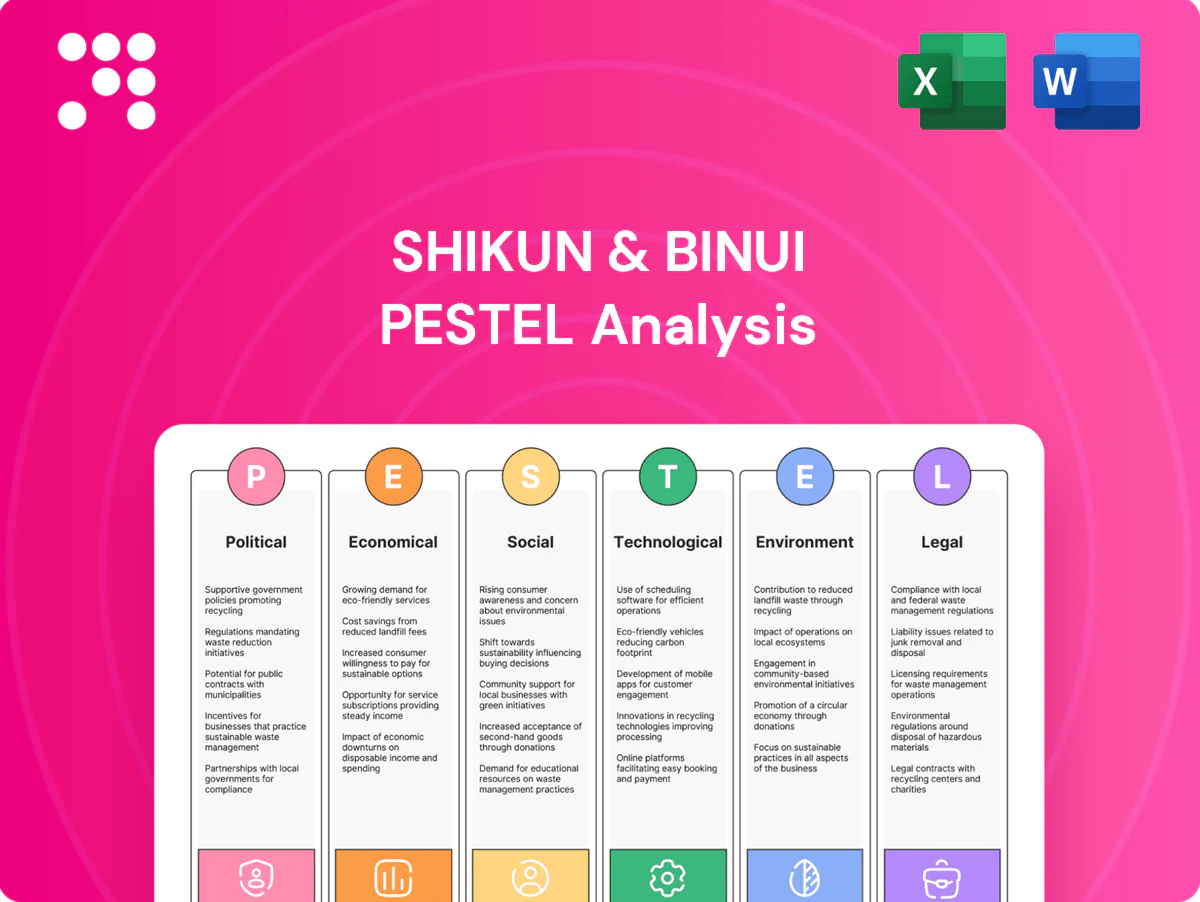
Shikun & Binui PESTLE Analysis

Plan Smarter. Present Sharper. Compete Stronger.
Unlock strategic clarity with our Shikun & Binui PESTLE Analysis—3–5 concise insights into the political, economic, social, technological, legal, and environmental forces shaping the company’s trajectory. Ideal for investors and strategists seeking a competitive edge. Purchase the full, editable report now to access the complete data-driven breakdown and actionable recommendations.
Political factors

Government infrastructure priorities
Public investment agendas and national infrastructure plans shape project pipelines and timelines, with global needs estimated at about $94 trillion for infrastructure to 2040 (Global Infrastructure Hub) and the EU Recovery and Resilience Facility allocating €723.8 billion to member states. Shifts in transport, housing and energy policy can accelerate or delay tenders, while alignment with connectivity and energy security priorities boosts win rates. Geographic diversification reduces exposure to single‑market policy swings.
Public–private partnership (PPP) frameworks
Public–private partnership laws, clear risk-sharing structures and availability payments determine project bankability; World Bank PPI data reported $76.6bn of PPP investment in 2023, highlighting capital flow to well-structured concessions. Clear concession rules and robust dispute mechanisms reduce bid uncertainty and lower financing spreads. Markets with mature PPP units (UK, Canada) offer steadier pipelines and bankable financing, while mid-life changes in concession norms can materially alter return profiles and refinancing risk.

Geopolitical and country risk
Operating across regions exposes Shikun & Binui to political instability, sanctions and conflict that can delay projects; permitting and land acquisition often face local opposition or administrative inertia, while currency controls and limits on capital repatriation can squeeze cash flows—robust risk screening, political-risk insurance and contingency liquidity are therefore critical for sustainable cross-border operations.

Municipal and regional governance
Decentralized municipal decision-making across Israel's 257 local authorities drives wide variance in permitting speed and procurement practices, directly affecting Shikun & Binui project timelines; local elections (held 31 Oct 2023) frequently pause or reprioritize capital works. Building sustained relationships with authorities and communities reduces delays and change orders, while variability in transparency raises bid risk and compliance costs.
- 257 local authorities — spatial variance in permitting
- 31 Oct 2023 — municipal elections can delay projects
- Stakeholder relations lower schedule and cost overruns
- Transparency variability increases bidding and compliance risk
Diplomatic and trade relations
Bilateral agreements such as the US–Israel FTA (1985) and the EU–Israel Association Agreement (1995) facilitate cross-border contracting, labor mobility, and equipment movement for Shikun & Binui.
Tariffs or import restrictions can raise procurement costs and delay schedules, particularly for heavy equipment and materials routed through Europe or the US markets.
Development finance from multilateral lenders (World Bank, EBRD) often follows geopolitical priorities, affecting project pipeline and financing access; monitoring trade policy optimizes sourcing and logistics.
- Cross-border contracting: US–Israel FTA 1985, EU Association 1995
- Risk: tariffs/import limits → higher costs, schedule delays
- Finance: World Bank/EBRD priorities shape project funding
- Action: continuous trade-policy monitoring to optimize sourcing
Infrastructure pipeline: $94T to 2040, €723.8bn RRF, $76.6bn PPP; 257 authorities add permitting risk
National infrastructure agendas (global need $94T to 2040) and EU RRF (€723.8bn) drive project pipelines and tender timing, while PPP markets (World Bank PPI PPP investment $76.6bn in 2023) determine bankability. Political instability, sanctions and local permitting variance across Israel's 257 authorities increase schedule and FX risk. Active stakeholder relations and political-risk insurance reduce delays and financing spreads.
| Factor | 2024/25 metric | Impact |
|---|---|---|
| Global need | $94T to 2040 | Pipeline scale |
| EU support | €723.8bn RRF | Member-state projects |
| PPP flows | $76.6bn (2023) | Bankability |
| Local variance | 257 authorities (IL) | Permitting risk |
What is included in the product
 Detailed Word Document
Explores how macro-environmental factors uniquely impact Shikun & Binui across Political, Economic, Social, Technological, Environmental and Legal dimensions, with data-driven subpoints and region-specific examples. Designed for executives and investors to identify risks, opportunities and inform strategic planning.

 Customizable Excel Spreadsheet
Shikun & Binui PESTLE Analysis delivers a clean, visually segmented summary that’s easy to drop into presentations or share across teams, with editable notes for region- or business-specific context and simple language to support planning discussions and client reports on external risks and market positioning.
Economic factors

Interest rates and financing costs
Rising policy and market rates (Bank of Israel policy ~4.75% end-2024; 10-year Israeli yield ~3.8% mid-2025) lift WACC for infrastructure to roughly 7–9%, compressing concession valuations. Higher borrowing costs reduce PPP affordability and weigh on real-estate demand. Refinancing risk on long-duration assets and backlog can erode margins; hedging and fixed-rate structures stabilize cash yields.
Construction input inflation
Volatility in steel, cement, asphalt and fuel has materially pressured margins for Shikun & Binui, with steel and cement prices swinging up to 30% during 2023–24 and Brent crude averaging about $86/bbl in 2024. Contract indexation and escalation clauses—now embedded in most public and BOT contracts—are key protections, typically covering 60–80% of input risk. Diversifying suppliers and regional sourcing reduces single‑source spike exposure. Efficient procurement, forward buying and inventory buffering preserve project economics.

Macroeconomic cycles and demand
GDP growth drives public budgets and private real-estate appetite; with global GDP near 3% in 2023–24 (IMF), tighter growth reduces municipal capital for housing and infra and cools developer demand.
Recessions commonly defer projects and compress bid prices, pressuring margins and working capital for Shikun & Binui.
Countercyclical work — essential infrastructure and utilities — shows resilience, and geographic plus sectoral diversification smooths revenue volatility.

Currency fluctuations
Multi-currency contracts expose Shikun & Binui to FX translation and transaction risks that can swing reported EBITDA; global FX turnover reached about 7.5 trillion USD daily per BIS 2022 and the ILS moved roughly 4% versus USD in 2024, illustrating tangible exposure. Mismatches between revenue and cost currencies erode margins unless natural hedges or derivatives are used; clear FX policies increase lender and investor confidence.
- FX translation risk: impacts reported earnings
- Transaction risk: mismatched revenue/cost erodes margins
- Mitigation: natural hedging, forwards/options
- Governance: transparent FX policy boosts creditor confidence
Labor market dynamics
- Skilled supply: 3.7% unemployment (Israel, 2024, OECD)
- Wage pressure: higher bidding wages in tight market
- Mitigation: training and retention programs
- Gap-filler: international specialist mobility
Infrastructure pipeline: $94T to 2040, €723.8bn RRF, $76.6bn PPP; 257 authorities add permitting risk
Rising BoI policy (4.75% end‑2024) and 10y yield (~3.8% mid‑2025) push infrastructure WACC to ~7–9%, compressing concession valuations and PPP affordability. Volatile inputs (steel/cement ±30% 2023–24; Brent ≈$86/bbl 2024) squeeze margins despite indexation. ILS moved ~4% vs USD (2024), creating FX risk; Israel unemployment 3.7% (2024) tightens skilled labor.
| Metric | Value |
|---|---|
| BoI policy | 4.75% |
| 10y yield | 3.8% |
| WACC infra | 7–9% |
| Brent 2024 | $86/bbl |
Full Version Awaits
Shikun & Binui PESTLE Analysis
The preview shown here is the exact Shikun & Binui PESTLE Analysis you’ll receive after purchase—fully formatted and ready to use. It includes the same structured political, economic, social, technological, legal and environmental assessments as the downloadable file. No placeholders or teasers; this is the final, ready-to-download document.

Product Information
Product Information
Shipping & Returns
Shipping & Returns
Description
Plan Smarter. Present Sharper. Compete Stronger.
Unlock strategic clarity with our Shikun & Binui PESTLE Analysis—3–5 concise insights into the political, economic, social, technological, legal, and environmental forces shaping the company’s trajectory. Ideal for investors and strategists seeking a competitive edge. Purchase the full, editable report now to access the complete data-driven breakdown and actionable recommendations.
Political factors
Government infrastructure priorities
Public investment agendas and national infrastructure plans shape project pipelines and timelines, with global needs estimated at about $94 trillion for infrastructure to 2040 (Global Infrastructure Hub) and the EU Recovery and Resilience Facility allocating €723.8 billion to member states. Shifts in transport, housing and energy policy can accelerate or delay tenders, while alignment with connectivity and energy security priorities boosts win rates. Geographic diversification reduces exposure to single‑market policy swings.
Public–private partnership (PPP) frameworks
Public–private partnership laws, clear risk-sharing structures and availability payments determine project bankability; World Bank PPI data reported $76.6bn of PPP investment in 2023, highlighting capital flow to well-structured concessions. Clear concession rules and robust dispute mechanisms reduce bid uncertainty and lower financing spreads. Markets with mature PPP units (UK, Canada) offer steadier pipelines and bankable financing, while mid-life changes in concession norms can materially alter return profiles and refinancing risk.
Geopolitical and country risk
Operating across regions exposes Shikun & Binui to political instability, sanctions and conflict that can delay projects; permitting and land acquisition often face local opposition or administrative inertia, while currency controls and limits on capital repatriation can squeeze cash flows—robust risk screening, political-risk insurance and contingency liquidity are therefore critical for sustainable cross-border operations.
Municipal and regional governance
Decentralized municipal decision-making across Israel's 257 local authorities drives wide variance in permitting speed and procurement practices, directly affecting Shikun & Binui project timelines; local elections (held 31 Oct 2023) frequently pause or reprioritize capital works. Building sustained relationships with authorities and communities reduces delays and change orders, while variability in transparency raises bid risk and compliance costs.
- 257 local authorities — spatial variance in permitting
- 31 Oct 2023 — municipal elections can delay projects
- Stakeholder relations lower schedule and cost overruns
- Transparency variability increases bidding and compliance risk
Diplomatic and trade relations
Bilateral agreements such as the US–Israel FTA (1985) and the EU–Israel Association Agreement (1995) facilitate cross-border contracting, labor mobility, and equipment movement for Shikun & Binui.
Tariffs or import restrictions can raise procurement costs and delay schedules, particularly for heavy equipment and materials routed through Europe or the US markets.
Development finance from multilateral lenders (World Bank, EBRD) often follows geopolitical priorities, affecting project pipeline and financing access; monitoring trade policy optimizes sourcing and logistics.
- Cross-border contracting: US–Israel FTA 1985, EU Association 1995
- Risk: tariffs/import limits → higher costs, schedule delays
- Finance: World Bank/EBRD priorities shape project funding
- Action: continuous trade-policy monitoring to optimize sourcing
Infrastructure pipeline: $94T to 2040, €723.8bn RRF, $76.6bn PPP; 257 authorities add permitting risk
National infrastructure agendas (global need $94T to 2040) and EU RRF (€723.8bn) drive project pipelines and tender timing, while PPP markets (World Bank PPI PPP investment $76.6bn in 2023) determine bankability. Political instability, sanctions and local permitting variance across Israel's 257 authorities increase schedule and FX risk. Active stakeholder relations and political-risk insurance reduce delays and financing spreads.
| Factor | 2024/25 metric | Impact |
|---|---|---|
| Global need | $94T to 2040 | Pipeline scale |
| EU support | €723.8bn RRF | Member-state projects |
| PPP flows | $76.6bn (2023) | Bankability |
| Local variance | 257 authorities (IL) | Permitting risk |
What is included in the product
Detailed Word Document
Explores how macro-environmental factors uniquely impact Shikun & Binui across Political, Economic, Social, Technological, Environmental and Legal dimensions, with data-driven subpoints and region-specific examples. Designed for executives and investors to identify risks, opportunities and inform strategic planning.
Customizable Excel Spreadsheet
Shikun & Binui PESTLE Analysis delivers a clean, visually segmented summary that’s easy to drop into presentations or share across teams, with editable notes for region- or business-specific context and simple language to support planning discussions and client reports on external risks and market positioning.
Economic factors
Interest rates and financing costs
Rising policy and market rates (Bank of Israel policy ~4.75% end-2024; 10-year Israeli yield ~3.8% mid-2025) lift WACC for infrastructure to roughly 7–9%, compressing concession valuations. Higher borrowing costs reduce PPP affordability and weigh on real-estate demand. Refinancing risk on long-duration assets and backlog can erode margins; hedging and fixed-rate structures stabilize cash yields.
Construction input inflation
Volatility in steel, cement, asphalt and fuel has materially pressured margins for Shikun & Binui, with steel and cement prices swinging up to 30% during 2023–24 and Brent crude averaging about $86/bbl in 2024. Contract indexation and escalation clauses—now embedded in most public and BOT contracts—are key protections, typically covering 60–80% of input risk. Diversifying suppliers and regional sourcing reduces single‑source spike exposure. Efficient procurement, forward buying and inventory buffering preserve project economics.
Macroeconomic cycles and demand
GDP growth drives public budgets and private real-estate appetite; with global GDP near 3% in 2023–24 (IMF), tighter growth reduces municipal capital for housing and infra and cools developer demand.
Recessions commonly defer projects and compress bid prices, pressuring margins and working capital for Shikun & Binui.
Countercyclical work — essential infrastructure and utilities — shows resilience, and geographic plus sectoral diversification smooths revenue volatility.
Currency fluctuations
Multi-currency contracts expose Shikun & Binui to FX translation and transaction risks that can swing reported EBITDA; global FX turnover reached about 7.5 trillion USD daily per BIS 2022 and the ILS moved roughly 4% versus USD in 2024, illustrating tangible exposure. Mismatches between revenue and cost currencies erode margins unless natural hedges or derivatives are used; clear FX policies increase lender and investor confidence.
- FX translation risk: impacts reported earnings
- Transaction risk: mismatched revenue/cost erodes margins
- Mitigation: natural hedging, forwards/options
- Governance: transparent FX policy boosts creditor confidence
Labor market dynamics
- Skilled supply: 3.7% unemployment (Israel, 2024, OECD)
- Wage pressure: higher bidding wages in tight market
- Mitigation: training and retention programs
- Gap-filler: international specialist mobility
Infrastructure pipeline: $94T to 2040, €723.8bn RRF, $76.6bn PPP; 257 authorities add permitting risk
Rising BoI policy (4.75% end‑2024) and 10y yield (~3.8% mid‑2025) push infrastructure WACC to ~7–9%, compressing concession valuations and PPP affordability. Volatile inputs (steel/cement ±30% 2023–24; Brent ≈$86/bbl 2024) squeeze margins despite indexation. ILS moved ~4% vs USD (2024), creating FX risk; Israel unemployment 3.7% (2024) tightens skilled labor.
| Metric | Value |
|---|---|
| BoI policy | 4.75% |
| 10y yield | 3.8% |
| WACC infra | 7–9% |
| Brent 2024 | $86/bbl |
Full Version Awaits
Shikun & Binui PESTLE Analysis
The preview shown here is the exact Shikun & Binui PESTLE Analysis you’ll receive after purchase—fully formatted and ready to use. It includes the same structured political, economic, social, technological, legal and environmental assessments as the downloadable file. No placeholders or teasers; this is the final, ready-to-download document.