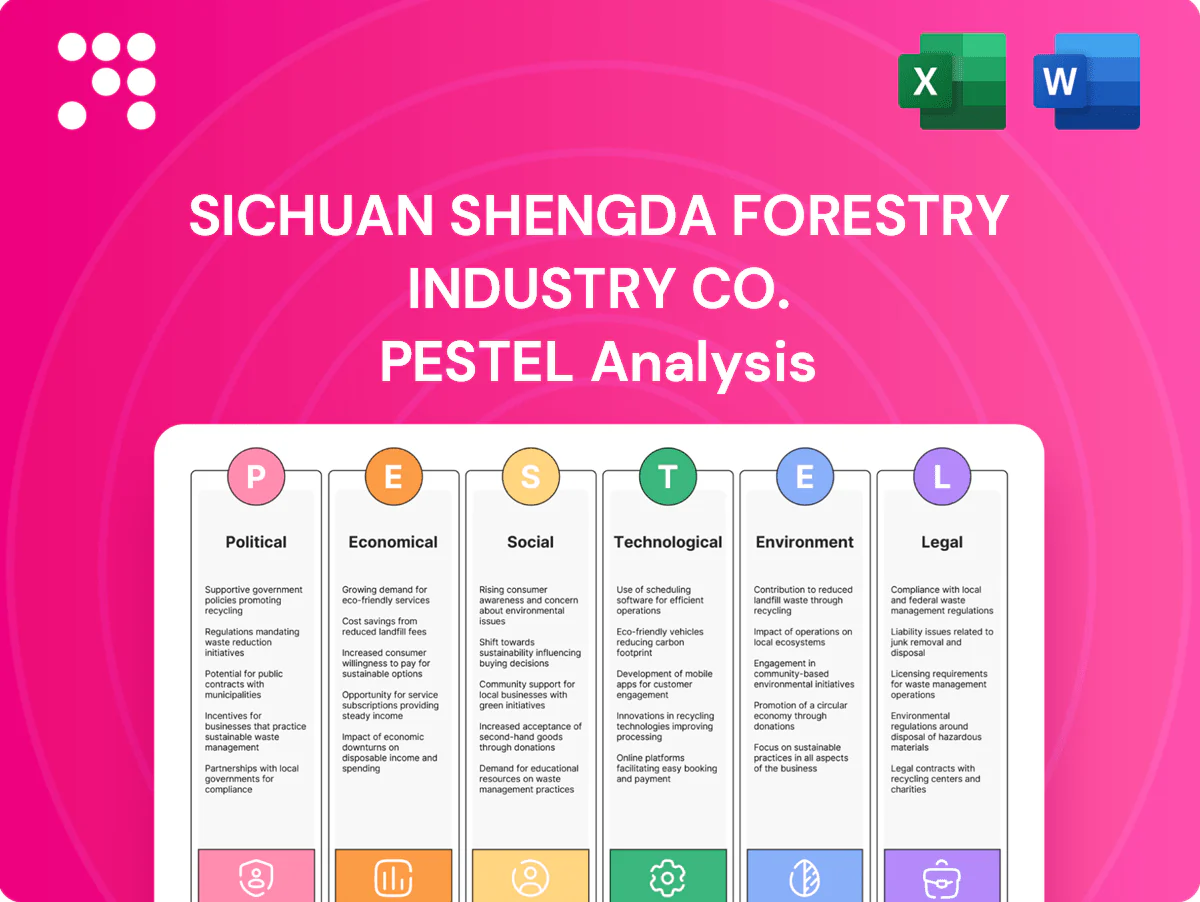
Sichuan Shengda Forestry Industry Co. PESTLE Analysis

Make Smarter Strategic Decisions with a Complete PESTEL View
Our concise PESTLE highlights how regulatory shifts, environmental policy, and market trends shape Sichuan Shengda Forestry Industry Co.'s prospects—ideal for investors and strategists seeking quick, actionable context. Purchase the full PESTLE for the complete, editable report and immediate insights.
Political factors

Forestry quotas and logging permits
China’s central and provincial authorities set annual harvest quotas and license regimes that determine available log volumes, directly shaping Shengda’s upstream sourcing plans in Sichuan and neighboring provinces. Shengda’s production scheduling and cost forecasts hinge on quota allocations and any tightening to meet national ecological targets could materially constrain raw material supply. Proactive, ongoing engagement with regulators and participation in quota consultations can stabilize access and improve planning certainty.
State support for green industries
State industrial policy backing carbon goals (peak by 2030, neutrality by 2060) favors wood substitution and engineered wood in construction, boosting demand for Shengda products. Subsidies, tax breaks and pilot programs—often covering capital expenses up to 20–30% in recent provincial schemes—can lower upgrade costs for presses and kilns. Aligning products with China’s green building standards (Three-Star/GB) can unlock incentives and market access. Policy continuity determines payback and ROI horizons for modernization.

Infrastructure and regional development
Western development initiatives have expanded Sichuan road and rail capacity, lowering log and finished-goods transport costs by an estimated 10–15% and widening access to coastal construction and furniture hubs; improved Sichuan logistics corridors—backed by roughly 1 trillion RMB in recent western infrastructure commitments—have raised dispatch reliability, though episodic public-works delays keep local bottlenecks and seasonally spike lead times.

Trade relations and export policies
In 2024 China wood product exports were about $22.6 billion, making export rebates and VAT policies central to Sichuan Shengda Forestry Industry Co.s competitiveness in veneer and panel markets. Geopolitical frictions have triggered countervailing duties and investigations in major markets. Diversifying destinations reduces policy-shock risk and close monitoring of customs and standards alignment is critical for cross-border sales.
- Export rebates/VAT impact margins
- Countervailing duties risk from geopolitical frictions
- Diversify destinations to lower policy shock
- Monitor customs/standards alignment
Rural revitalization and land-use governance
Rural revitalization policies and collective forest-rights programs in Sichuan increase access to concessions by incentivizing sustainable forestry, while secure tenure encourages long-cycle plantation investments and capital allocation to timber assets; changing land zoning or ecological redlines can curtail logging in ecologically sensitive counties, making local partnerships with collectives crucial to securing long-term supply.
- Tenure stability supports investment
- Ecological redlines restrict sensitive-area logging
- Collective partnerships secure supply
- Policies shift concession access incentives
Harvest quotas, carbon targets and trade risks reshape engineered-wood sourcing and capex economics
Central and provincial harvest quotas determine log supply and any tightening to meet carbon targets (peak 2030, neutrality 2060) could materially constrain Shengda’s sourcing. State policy favoring wood substitution and provincial subsidy pilots (up to 20–30%) support capex for engineered wood. Western infrastructure commitments (~1 trillion RMB) cut transport costs ~10–15%, while 2024 China wood exports of $22.6B make VAT/rebate and anti-dumping risks critical.
| Policy | Metric | Implication |
|---|---|---|
| Harvest quotas | Allocation-dependent | Raw material risk |
| Carbon targets | 2030/2060 | Demand for engineered wood |
| Infrastructure | ~1 trillion RMB | -10–15% transport cost |
| Trade | $22.6B (2024) | VAT/rebate & duty exposure |
What is included in the product
 Detailed Word Document
Explores how Political, Economic, Social, Technological, Environmental and Legal forces specifically shape Sichuan Shengda Forestry Industry Co., combining data-driven trends and regional policy context to identify risks, opportunities and strategic actions for executives, investors and advisors.

 Customizable Excel Spreadsheet
A concise, PESTLE-segmented summary of Sichuan Shengda Forestry Industry Co. that relieves meeting prep pain—clear, editable notes for quick sharing, risk discussion, and drop-in slides to align teams fast.
Economic factors

Construction and furniture demand cycles
Domestic real estate slowdowns — with real estate investment contracting about 10% in 2024 — have depressed structural timber and panel consumption, directly reducing demand for Shengda’s core product lines. Furniture manufacturing output, which fell modestly in 2024 alongside weaker consumer confidence and export demand, further transmits volatility to upstream suppliers. Shengda’s revenue is highly sensitive to these downstream cycles given heavy exposure to construction-grade timber and panels. A product mix shift toward renovation and interior fit-outs helps cushion volatility by accessing steadier replacement and retrofit spending.
Raw material and input cost volatility
Domestic log prices rose about 6% in 2024 while imported timber costs climbed ~8% and resin prices were up roughly 12%, with energy (coal/electricity) costs rising near 10%; RMB averaged about 7.2 per USD in 2024, affecting imported species and machinery costs. Long-term supply contracts and hedges now cover around 40% of purchases, stabilizing COGS. Ongoing process efficiency and 3–5% yield improvements help offset input inflation.

Credit conditions and capex financing
Interest rates and bank lending appetite—China 1‑year LPR 3.65% and 5‑year LPR 4.30% (2024–25) — materially affect timing of kiln, press and sawline upgrades at Sichuan Shengda. Tighter credit raises working‑capital costs for its inventory‑heavy wood processing and trading cycles. Government green finance channels can reduce funding costs for certified afforestation/energy‑efficiency projects. Maintaining strong cash conversion is vital in downturns.

Export market growth and competition
ASEAN (population ~676 million in 2024) and Belt and Road markets (149 countries as of 2024) present expanded demand for plywood and engineered wood, while low-cost producers in Southeast Asia and Russia exert downward pricing pressure; graded quality and FSC/PEFC certification support margin defense, and port-to-door logistics costs largely determine landed price competitiveness.
- ASEAN market scale: 676M people (2024)
- BRI coverage: 149 countries (2024)
- Pressure: low-cost SE Asia & Russia
- Defence: graded quality + FSC/PEFC; logistics set landed price
Labor availability and wages
Manufacturing hubs around Sichuan face rising wages and skilled operator shortages; China urban unit average annual wage reached 106,837 yuan in 2023 and manufacturing wages grew about 6.8%, pressuring margins for Sichuan Shengda. Automation can cut unit labor costs and stabilize quality (McKinsey estimates 20–30% cost reductions), while training boosts uptime and safety, helping offset wage inflation that demands pricing discipline and productivity gains.
- Wage pressure: 106,837 yuan (2023)
- Manufacturing wage growth: ~6.8% (2023)
- Automation ROI: 20–30% cost cut
- Training: improves uptime/safety
Harvest quotas, carbon targets and trade risks reshape engineered-wood sourcing and capex economics
Real estate investment fell ~10% in 2024, cutting construction-timber demand and pressuring Shengda’s revenues; renovation share partially cushions cyclicality. Input inflation: domestic logs +6%, imports +8%, resin +12%, energy +10% (2024); RMB ~7.2/USD. Financing costs (1y LPR 3.65%, 5y LPR 4.30%) and rising wages (urban avg 106,837 yuan 2023; mfg +6.8%) squeeze margins, while ASEAN/BRI markets expand export outlets.
| Metric | Value (year) |
|---|---|
| Real estate investment | -10% (2024) |
| Domestic log prices | +6% (2024) |
| Imported timber | +8% (2024) |
| Resin | +12% (2024) |
| Energy | +10% (2024) |
| RMB/USD | 7.2 (2024) |
| 1y / 5y LPR | 3.65% / 4.30% (2024–25) |
| ASEAN population | 676M (2024) |
| BRI countries | 149 (2024) |
| Urban avg wage | 106,837 yuan (2023) |
Preview the Actual Deliverable
Sichuan Shengda Forestry Industry Co. PESTLE Analysis
This preview of the Sichuan Shengda Forestry Industry Co. PESTLE Analysis is the exact document you’ll receive after purchase. It’s fully formatted, professionally structured, and ready to use with no placeholders or surprises. After checkout you’ll download this identical file instantly.

Original: $10.00
-65%$10.00
$3.50Product Information
Product Information
Shipping & Returns
Shipping & Returns
Description
Make Smarter Strategic Decisions with a Complete PESTEL View
Our concise PESTLE highlights how regulatory shifts, environmental policy, and market trends shape Sichuan Shengda Forestry Industry Co.'s prospects—ideal for investors and strategists seeking quick, actionable context. Purchase the full PESTLE for the complete, editable report and immediate insights.
Political factors
Forestry quotas and logging permits
China’s central and provincial authorities set annual harvest quotas and license regimes that determine available log volumes, directly shaping Shengda’s upstream sourcing plans in Sichuan and neighboring provinces. Shengda’s production scheduling and cost forecasts hinge on quota allocations and any tightening to meet national ecological targets could materially constrain raw material supply. Proactive, ongoing engagement with regulators and participation in quota consultations can stabilize access and improve planning certainty.
State support for green industries
State industrial policy backing carbon goals (peak by 2030, neutrality by 2060) favors wood substitution and engineered wood in construction, boosting demand for Shengda products. Subsidies, tax breaks and pilot programs—often covering capital expenses up to 20–30% in recent provincial schemes—can lower upgrade costs for presses and kilns. Aligning products with China’s green building standards (Three-Star/GB) can unlock incentives and market access. Policy continuity determines payback and ROI horizons for modernization.
Infrastructure and regional development
Western development initiatives have expanded Sichuan road and rail capacity, lowering log and finished-goods transport costs by an estimated 10–15% and widening access to coastal construction and furniture hubs; improved Sichuan logistics corridors—backed by roughly 1 trillion RMB in recent western infrastructure commitments—have raised dispatch reliability, though episodic public-works delays keep local bottlenecks and seasonally spike lead times.
Trade relations and export policies
In 2024 China wood product exports were about $22.6 billion, making export rebates and VAT policies central to Sichuan Shengda Forestry Industry Co.s competitiveness in veneer and panel markets. Geopolitical frictions have triggered countervailing duties and investigations in major markets. Diversifying destinations reduces policy-shock risk and close monitoring of customs and standards alignment is critical for cross-border sales.
- Export rebates/VAT impact margins
- Countervailing duties risk from geopolitical frictions
- Diversify destinations to lower policy shock
- Monitor customs/standards alignment
Rural revitalization and land-use governance
Rural revitalization policies and collective forest-rights programs in Sichuan increase access to concessions by incentivizing sustainable forestry, while secure tenure encourages long-cycle plantation investments and capital allocation to timber assets; changing land zoning or ecological redlines can curtail logging in ecologically sensitive counties, making local partnerships with collectives crucial to securing long-term supply.
- Tenure stability supports investment
- Ecological redlines restrict sensitive-area logging
- Collective partnerships secure supply
- Policies shift concession access incentives
Harvest quotas, carbon targets and trade risks reshape engineered-wood sourcing and capex economics
Central and provincial harvest quotas determine log supply and any tightening to meet carbon targets (peak 2030, neutrality 2060) could materially constrain Shengda’s sourcing. State policy favoring wood substitution and provincial subsidy pilots (up to 20–30%) support capex for engineered wood. Western infrastructure commitments (~1 trillion RMB) cut transport costs ~10–15%, while 2024 China wood exports of $22.6B make VAT/rebate and anti-dumping risks critical.
| Policy | Metric | Implication |
|---|---|---|
| Harvest quotas | Allocation-dependent | Raw material risk |
| Carbon targets | 2030/2060 | Demand for engineered wood |
| Infrastructure | ~1 trillion RMB | -10–15% transport cost |
| Trade | $22.6B (2024) | VAT/rebate & duty exposure |
What is included in the product
Detailed Word Document
Explores how Political, Economic, Social, Technological, Environmental and Legal forces specifically shape Sichuan Shengda Forestry Industry Co., combining data-driven trends and regional policy context to identify risks, opportunities and strategic actions for executives, investors and advisors.
Customizable Excel Spreadsheet
A concise, PESTLE-segmented summary of Sichuan Shengda Forestry Industry Co. that relieves meeting prep pain—clear, editable notes for quick sharing, risk discussion, and drop-in slides to align teams fast.
Economic factors
Construction and furniture demand cycles
Domestic real estate slowdowns — with real estate investment contracting about 10% in 2024 — have depressed structural timber and panel consumption, directly reducing demand for Shengda’s core product lines. Furniture manufacturing output, which fell modestly in 2024 alongside weaker consumer confidence and export demand, further transmits volatility to upstream suppliers. Shengda’s revenue is highly sensitive to these downstream cycles given heavy exposure to construction-grade timber and panels. A product mix shift toward renovation and interior fit-outs helps cushion volatility by accessing steadier replacement and retrofit spending.
Raw material and input cost volatility
Domestic log prices rose about 6% in 2024 while imported timber costs climbed ~8% and resin prices were up roughly 12%, with energy (coal/electricity) costs rising near 10%; RMB averaged about 7.2 per USD in 2024, affecting imported species and machinery costs. Long-term supply contracts and hedges now cover around 40% of purchases, stabilizing COGS. Ongoing process efficiency and 3–5% yield improvements help offset input inflation.
Credit conditions and capex financing
Interest rates and bank lending appetite—China 1‑year LPR 3.65% and 5‑year LPR 4.30% (2024–25) — materially affect timing of kiln, press and sawline upgrades at Sichuan Shengda. Tighter credit raises working‑capital costs for its inventory‑heavy wood processing and trading cycles. Government green finance channels can reduce funding costs for certified afforestation/energy‑efficiency projects. Maintaining strong cash conversion is vital in downturns.
Export market growth and competition
ASEAN (population ~676 million in 2024) and Belt and Road markets (149 countries as of 2024) present expanded demand for plywood and engineered wood, while low-cost producers in Southeast Asia and Russia exert downward pricing pressure; graded quality and FSC/PEFC certification support margin defense, and port-to-door logistics costs largely determine landed price competitiveness.
- ASEAN market scale: 676M people (2024)
- BRI coverage: 149 countries (2024)
- Pressure: low-cost SE Asia & Russia
- Defence: graded quality + FSC/PEFC; logistics set landed price
Labor availability and wages
Manufacturing hubs around Sichuan face rising wages and skilled operator shortages; China urban unit average annual wage reached 106,837 yuan in 2023 and manufacturing wages grew about 6.8%, pressuring margins for Sichuan Shengda. Automation can cut unit labor costs and stabilize quality (McKinsey estimates 20–30% cost reductions), while training boosts uptime and safety, helping offset wage inflation that demands pricing discipline and productivity gains.
- Wage pressure: 106,837 yuan (2023)
- Manufacturing wage growth: ~6.8% (2023)
- Automation ROI: 20–30% cost cut
- Training: improves uptime/safety
Harvest quotas, carbon targets and trade risks reshape engineered-wood sourcing and capex economics
Real estate investment fell ~10% in 2024, cutting construction-timber demand and pressuring Shengda’s revenues; renovation share partially cushions cyclicality. Input inflation: domestic logs +6%, imports +8%, resin +12%, energy +10% (2024); RMB ~7.2/USD. Financing costs (1y LPR 3.65%, 5y LPR 4.30%) and rising wages (urban avg 106,837 yuan 2023; mfg +6.8%) squeeze margins, while ASEAN/BRI markets expand export outlets.
| Metric | Value (year) |
|---|---|
| Real estate investment | -10% (2024) |
| Domestic log prices | +6% (2024) |
| Imported timber | +8% (2024) |
| Resin | +12% (2024) |
| Energy | +10% (2024) |
| RMB/USD | 7.2 (2024) |
| 1y / 5y LPR | 3.65% / 4.30% (2024–25) |
| ASEAN population | 676M (2024) |
| BRI countries | 149 (2024) |
| Urban avg wage | 106,837 yuan (2023) |
Preview the Actual Deliverable
Sichuan Shengda Forestry Industry Co. PESTLE Analysis
This preview of the Sichuan Shengda Forestry Industry Co. PESTLE Analysis is the exact document you’ll receive after purchase. It’s fully formatted, professionally structured, and ready to use with no placeholders or surprises. After checkout you’ll download this identical file instantly.