Samsung Fire & Marine PESTLE Analysis

Your Competitive Advantage Starts with This Report
Gain strategic advantage with our PESTLE analysis of Samsung Fire & Marine—uncover how political shifts, economic cycles, tech disruption and regulatory change shape its risk and growth profile. Ideal for investors and strategists; buy the full report for detailed, actionable insights. Download now for editable charts and clear recommendations.
Political factors

Regulatory direction of Korean insurance policy
South Korea’s Financial Services Commission and Financial Supervisory Service set solvency, conduct and product rules that directly affect pricing and capital, operating under a risk-based capital regime with a 100% minimum threshold. Recent shifts (2023–24) toward stronger consumer protection have tightened sales practices and commissions. Policy support for digital finance expands distribution but raises AML and IT compliance costs. Ongoing reviews through 2024–25 may change capital buffers and product incentives.
Geopolitical tensions on the Korean Peninsula
Heightened North Korea risk elevates market volatility and can disrupt trade and asset valuations; KOSPI volatility spiked over 30% during 2024 crisis episodes, while South Korea 10-year yields moved roughly 1 percentage point toward the 4% area during peak tensions. War-risk and specialty covers see periodic demand surges—reinsurance rates for geopolitical perils rose materially after 2022 and remain elevated. Operational contingency planning, robust reinsurance protections and higher investor risk premia raise capital costs for banks and insurers.

Government disaster preparedness and PPP schemes
Public–private catastrophe schemes reshape loss sharing and pricing for Samsung Fire & Marine, shifting premiums and reserve requirements as global insured natural catastrophe losses reached about US$120 billion in 2023 (Swiss Re). Subsidies or mandates can materially expand flood, wind and crop coverages, driving penetration while concentrating portfolio exposure. Active PPP participation increases market share but raises aggregation risk, making stable policy frameworks critical for reinsurance and retrocession planning.

Trade policy and overseas market access
Bilateral agreements and local licensing regimes materially shape Samsung Fire & Marine Insurance’s overseas expansion, affecting market entry timing, capital requirements and service scope; protectionist shifts in key markets raise compliance costs and may force narrower product mixes. Favorable treaties facilitate cross-border reinsurance and asset diversification, while political relationships influence approval speed and supervisory scrutiny of foreign investments.
- Licensing impact on entry
- Protectionism increases compliance cost
- Treaties enable reinsurance/diversification
- Political ties affect approvals
Healthcare, pensions, and social policy interplay
Shifts in national health insurance and retirement policy materially affect demand for Samsung Fire & Marine personal accident and long-term savings lines as South Korea’s over-65 population reached about 17.5% in 2023 (Statistics Korea) and national health spending was roughly 8.3% of GDP in 2022 (OECD).
Tax incentive changes or contribution caps alter product attractiveness and drive repricing, lapse risk, and product redesign; government cost-containment often increases demand for private supplemental coverage.
- Demographics: aging population 17.5% (2023)
- Health spend: ~8.3% of GDP (2022)
- Impacts: repricing, lapse risk, product redesign
Regulatory tightening, higher capital costs and nat-cat/reinsurance pressure amid KOSPI volatility
Regulatory tightening by the FSC/FSS (100% RBC min) and stronger consumer-protection rules (2023–24) raise compliance and capital costs for Samsung Fire & Marine. Geopolitical risk (North Korea) has driven KOSPI volatility >30% in 2024 and pushed 10y yields ~1ppt toward 4%, lifting war-risk demand and reinsurance rates. PPPs and public catastrophe schemes (global insured nat-cat ≈ US$120bn in 2023) alter pricing and aggregation risk. Cross-border treaties and protectionism determine overseas entry timing and capital requirements.
| Metric | Value (year) |
|---|---|
| Minimum RBC | 100% (regime) |
| Aging pop | 17.5% 65+ (2023) |
| Nat-cat insured losses | US$120bn (2023) |
| KOSPI vol spike | >30% (2024) |
What is included in the product
 Detailed Word Document
Explores how Political, Economic, Social, Technological, Environmental and Legal forces uniquely impact Samsung Fire & Marine, with data-backed subpoints, region-specific regulatory context and forward-looking insights to help executives, consultants and investors identify risks, opportunities and strategic responses.

 Customizable Excel Spreadsheet
A clean, summarized PESTLE of Samsung Fire & Marine, visually segmented by category and easily dropped into presentations or shared across teams; editable for region- or line-specific notes to streamline external risk discussions and market-positioning planning.
Economic factors

Interest rate cycle and investment yields
Rising rates (Bank of Korea policy rate peaked at 3.50% in 2023) lift reinvestment yields and improve insurers’ interest margin but depress bond prices and IFRS equity; under IFRS 17 (effective 2023) duration management and asset–liability matching are pivotal. Prolonged low-rate scenarios compress profitability and push risk-taking, while rate volatility directly pressures solvency ratios and dividend capacity.
GDP growth, employment, and insurance demand
Stronger GDP growth in South Korea (about 2.0% in 2024) and falling unemployment (~2.8%) typically boost auto, property and commercial lines, lifting industry premiums (Korean non-life premiums rose ~3.5% y/y in 2024). Economic slowdowns compress premium growth, raise lapse and credit risk. Corporate investment cycles reallocate commercial cover demand, and cyclical sensitivity requires dynamic underwriting and tight expense control.

Inflation and claims severity
Parts, medical and labor inflation have driven auto and casualty claim severities higher, with medical care inflation in many markets outpacing headline CPI in 2024. Adequate pricing, indexing and tight claims leakage controls are essential to protect loss ratios. Social inflation continues to push bodily injury severities up. Reinsurance pricing and reserve levels required frequent recalibration at 2024 renewals, with market rate hardening.

FX and global market volatility
Won fluctuations materially affect the value of Samsung Fire & Marine’s foreign assets, reinsurance treaty payouts, and statutory capital ratios, while 2024 global equity and credit market volatility strained investment returns and solvency metrics across the insurance sector. Hedging programs lower FX and market exposure but increase cost and basis risk. Diversification across currencies and asset classes remains a primary risk-management lever.
- FX exposure: impacts asset values and capital
- Market volatility: lowers investment yield, pressures solvency
- Hedging: mitigates risk, adds cost/basis risk
- Diversification: multi-currency, multi-asset mitigation
Credit cycle and counterparty risk
Economic stress raises defaults among SMEs and households, hurting premium collection and surety; South Korea household debt hovered near 106% of GDP in 2024, increasing vulnerability to lapses and claims stress. Reinsurer credit quality gains importance as downgrades rose in 2023–24, tightening capacity. Counterparty limits and collateralization protect capital, while tight underwriting and fraud controls reduce adverse selection.
- Household debt ~106% GDP (2024)
- Rising reinsurer downgrades (2023–24)
- Use of counterparty limits and collateral
- Enhanced underwriting & fraud controls
Regulatory tightening, higher capital costs and nat-cat/reinsurance pressure amid KOSPI volatility
Higher rates (BOK peak 3.50% 2023) boost reinvestment yields but raise duration risk under IFRS 17; 2024 yield volatility squeezed solvency. Korean GDP ~2.0% (2024) and unemployment ~2.8% lifted non-life premiums ~3.5% y/y. Household debt ~106% GDP (2024) elevates lapse/default risk; FX swings and reinsurance downgrades tightened capital management.
| Metric | 2024 |
|---|---|
| BOK rate peak | 3.50% |
| GDP growth | ~2.0% |
| Unemployment | ~2.8% |
| Household debt | ~106% GDP |
| Non-life premium growth | ~3.5% y/y |
Preview Before You Purchase
Samsung Fire & Marine PESTLE Analysis
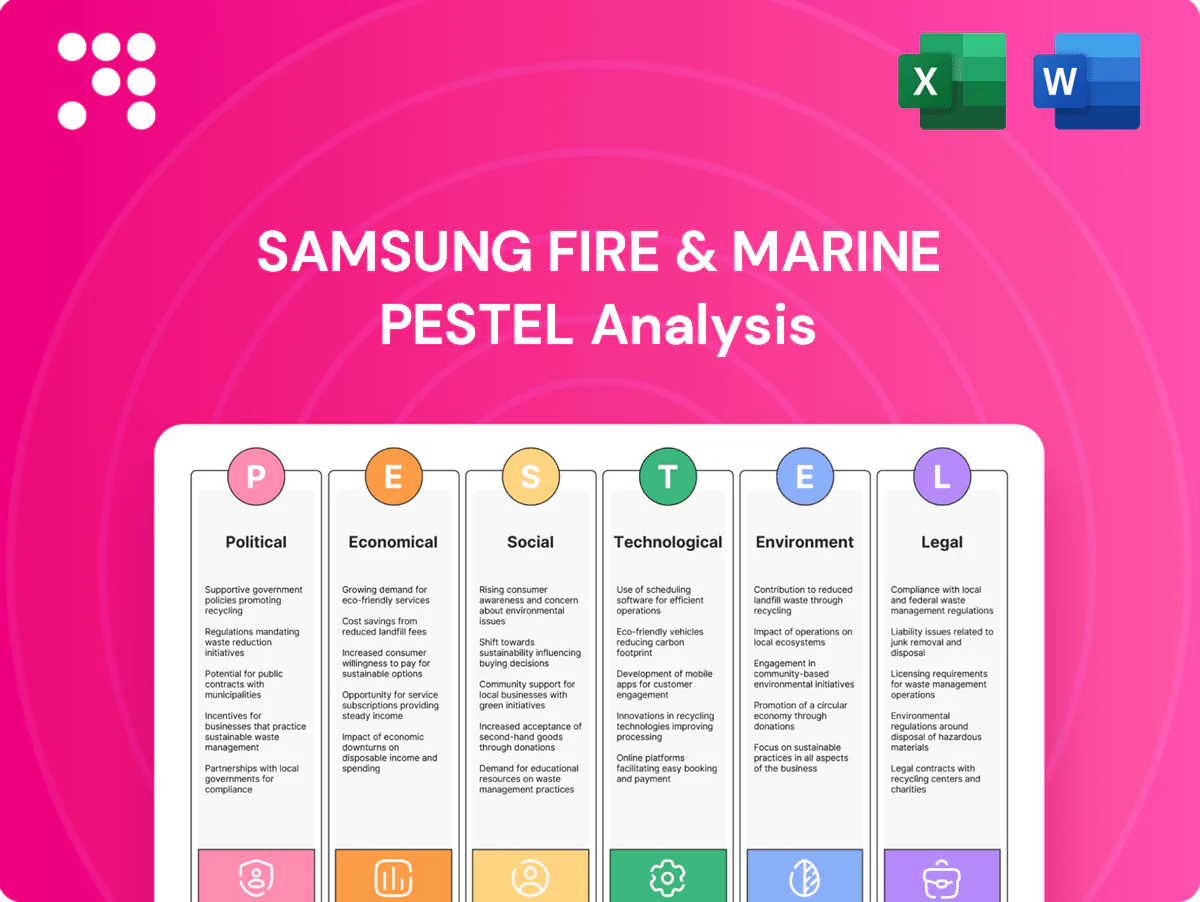
The preview shown here is the exact Samsung Fire & Marine PESTLE Analysis you’ll receive after purchase—fully formatted and ready to use. This is a real screenshot of the product you’re buying, delivered exactly as shown with no placeholders or surprises. The layout, content, and structure visible here are exactly what you’ll be able to download immediately after buying.

Product Information
Product Information
Shipping & Returns
Shipping & Returns
Description
Your Competitive Advantage Starts with This Report
Gain strategic advantage with our PESTLE analysis of Samsung Fire & Marine—uncover how political shifts, economic cycles, tech disruption and regulatory change shape its risk and growth profile. Ideal for investors and strategists; buy the full report for detailed, actionable insights. Download now for editable charts and clear recommendations.
Political factors
Regulatory direction of Korean insurance policy
South Korea’s Financial Services Commission and Financial Supervisory Service set solvency, conduct and product rules that directly affect pricing and capital, operating under a risk-based capital regime with a 100% minimum threshold. Recent shifts (2023–24) toward stronger consumer protection have tightened sales practices and commissions. Policy support for digital finance expands distribution but raises AML and IT compliance costs. Ongoing reviews through 2024–25 may change capital buffers and product incentives.
Geopolitical tensions on the Korean Peninsula
Heightened North Korea risk elevates market volatility and can disrupt trade and asset valuations; KOSPI volatility spiked over 30% during 2024 crisis episodes, while South Korea 10-year yields moved roughly 1 percentage point toward the 4% area during peak tensions. War-risk and specialty covers see periodic demand surges—reinsurance rates for geopolitical perils rose materially after 2022 and remain elevated. Operational contingency planning, robust reinsurance protections and higher investor risk premia raise capital costs for banks and insurers.
Government disaster preparedness and PPP schemes
Public–private catastrophe schemes reshape loss sharing and pricing for Samsung Fire & Marine, shifting premiums and reserve requirements as global insured natural catastrophe losses reached about US$120 billion in 2023 (Swiss Re). Subsidies or mandates can materially expand flood, wind and crop coverages, driving penetration while concentrating portfolio exposure. Active PPP participation increases market share but raises aggregation risk, making stable policy frameworks critical for reinsurance and retrocession planning.
Trade policy and overseas market access
Bilateral agreements and local licensing regimes materially shape Samsung Fire & Marine Insurance’s overseas expansion, affecting market entry timing, capital requirements and service scope; protectionist shifts in key markets raise compliance costs and may force narrower product mixes. Favorable treaties facilitate cross-border reinsurance and asset diversification, while political relationships influence approval speed and supervisory scrutiny of foreign investments.
- Licensing impact on entry
- Protectionism increases compliance cost
- Treaties enable reinsurance/diversification
- Political ties affect approvals
Healthcare, pensions, and social policy interplay
Shifts in national health insurance and retirement policy materially affect demand for Samsung Fire & Marine personal accident and long-term savings lines as South Korea’s over-65 population reached about 17.5% in 2023 (Statistics Korea) and national health spending was roughly 8.3% of GDP in 2022 (OECD).
Tax incentive changes or contribution caps alter product attractiveness and drive repricing, lapse risk, and product redesign; government cost-containment often increases demand for private supplemental coverage.
- Demographics: aging population 17.5% (2023)
- Health spend: ~8.3% of GDP (2022)
- Impacts: repricing, lapse risk, product redesign
Regulatory tightening, higher capital costs and nat-cat/reinsurance pressure amid KOSPI volatility
Regulatory tightening by the FSC/FSS (100% RBC min) and stronger consumer-protection rules (2023–24) raise compliance and capital costs for Samsung Fire & Marine. Geopolitical risk (North Korea) has driven KOSPI volatility >30% in 2024 and pushed 10y yields ~1ppt toward 4%, lifting war-risk demand and reinsurance rates. PPPs and public catastrophe schemes (global insured nat-cat ≈ US$120bn in 2023) alter pricing and aggregation risk. Cross-border treaties and protectionism determine overseas entry timing and capital requirements.
| Metric | Value (year) |
|---|---|
| Minimum RBC | 100% (regime) |
| Aging pop | 17.5% 65+ (2023) |
| Nat-cat insured losses | US$120bn (2023) |
| KOSPI vol spike | >30% (2024) |
What is included in the product
Detailed Word Document
Explores how Political, Economic, Social, Technological, Environmental and Legal forces uniquely impact Samsung Fire & Marine, with data-backed subpoints, region-specific regulatory context and forward-looking insights to help executives, consultants and investors identify risks, opportunities and strategic responses.
Customizable Excel Spreadsheet
A clean, summarized PESTLE of Samsung Fire & Marine, visually segmented by category and easily dropped into presentations or shared across teams; editable for region- or line-specific notes to streamline external risk discussions and market-positioning planning.
Economic factors
Interest rate cycle and investment yields
Rising rates (Bank of Korea policy rate peaked at 3.50% in 2023) lift reinvestment yields and improve insurers’ interest margin but depress bond prices and IFRS equity; under IFRS 17 (effective 2023) duration management and asset–liability matching are pivotal. Prolonged low-rate scenarios compress profitability and push risk-taking, while rate volatility directly pressures solvency ratios and dividend capacity.
GDP growth, employment, and insurance demand
Stronger GDP growth in South Korea (about 2.0% in 2024) and falling unemployment (~2.8%) typically boost auto, property and commercial lines, lifting industry premiums (Korean non-life premiums rose ~3.5% y/y in 2024). Economic slowdowns compress premium growth, raise lapse and credit risk. Corporate investment cycles reallocate commercial cover demand, and cyclical sensitivity requires dynamic underwriting and tight expense control.
Inflation and claims severity
Parts, medical and labor inflation have driven auto and casualty claim severities higher, with medical care inflation in many markets outpacing headline CPI in 2024. Adequate pricing, indexing and tight claims leakage controls are essential to protect loss ratios. Social inflation continues to push bodily injury severities up. Reinsurance pricing and reserve levels required frequent recalibration at 2024 renewals, with market rate hardening.
FX and global market volatility
Won fluctuations materially affect the value of Samsung Fire & Marine’s foreign assets, reinsurance treaty payouts, and statutory capital ratios, while 2024 global equity and credit market volatility strained investment returns and solvency metrics across the insurance sector. Hedging programs lower FX and market exposure but increase cost and basis risk. Diversification across currencies and asset classes remains a primary risk-management lever.
- FX exposure: impacts asset values and capital
- Market volatility: lowers investment yield, pressures solvency
- Hedging: mitigates risk, adds cost/basis risk
- Diversification: multi-currency, multi-asset mitigation
Credit cycle and counterparty risk
Economic stress raises defaults among SMEs and households, hurting premium collection and surety; South Korea household debt hovered near 106% of GDP in 2024, increasing vulnerability to lapses and claims stress. Reinsurer credit quality gains importance as downgrades rose in 2023–24, tightening capacity. Counterparty limits and collateralization protect capital, while tight underwriting and fraud controls reduce adverse selection.
- Household debt ~106% GDP (2024)
- Rising reinsurer downgrades (2023–24)
- Use of counterparty limits and collateral
- Enhanced underwriting & fraud controls
Regulatory tightening, higher capital costs and nat-cat/reinsurance pressure amid KOSPI volatility
Higher rates (BOK peak 3.50% 2023) boost reinvestment yields but raise duration risk under IFRS 17; 2024 yield volatility squeezed solvency. Korean GDP ~2.0% (2024) and unemployment ~2.8% lifted non-life premiums ~3.5% y/y. Household debt ~106% GDP (2024) elevates lapse/default risk; FX swings and reinsurance downgrades tightened capital management.
| Metric | 2024 |
|---|---|
| BOK rate peak | 3.50% |
| GDP growth | ~2.0% |
| Unemployment | ~2.8% |
| Household debt | ~106% GDP |
| Non-life premium growth | ~3.5% y/y |
Preview Before You Purchase
Samsung Fire & Marine PESTLE Analysis
The preview shown here is the exact Samsung Fire & Marine PESTLE Analysis you’ll receive after purchase—fully formatted and ready to use. This is a real screenshot of the product you’re buying, delivered exactly as shown with no placeholders or surprises. The layout, content, and structure visible here are exactly what you’ll be able to download immediately after buying.