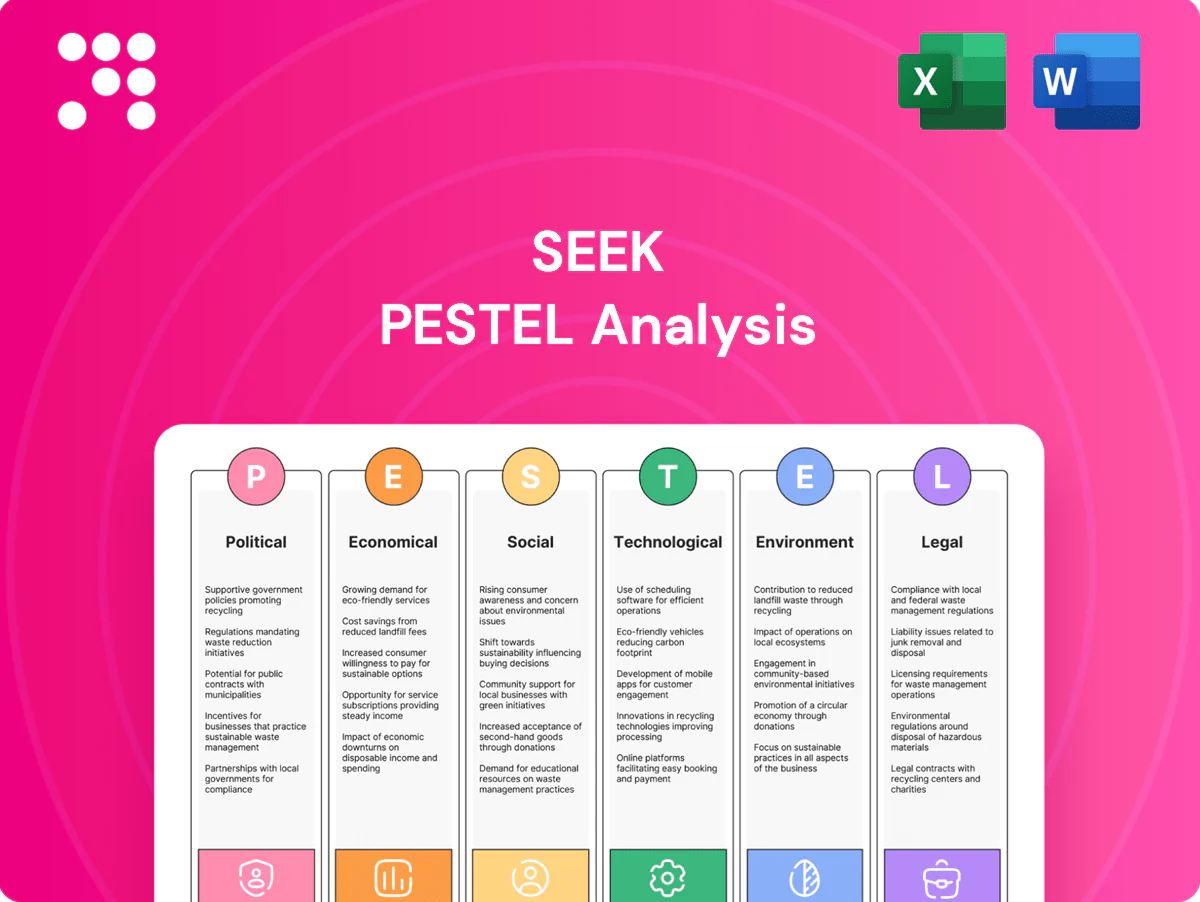
SEEK PESTLE Analysis

Your Competitive Advantage Starts with This Report
Unlock how political, economic, social, technological, legal, and environmental forces are shaping SEEK’s trajectory with our concise PESTLE analysis. Ideal for investors, strategists, and consultants, it highlights risks and growth levers you can act on now. Purchase the full report for the complete, editable breakdown and immediate strategic value.
Political factors

Regulatory shifts in labor and employment policy
Changes to hiring subsidies, minimum wages and labor-market reform materially shift employer demand for SEEK postings; public apprenticeship and retraining programs have historically driven spikes in platform activity while public-sector hiring freezes reduce listings. SEEK must track multi-country policy trajectories and labor-policy calendars to recalibrate pricing, product bundles and sales focus in markets where regulatory change is imminent.
Digital platform and marketplace oversight
Governments are tightening rules on digital platforms, algorithms and advertising transparency, notably the EU Digital Services Act affecting some 450 million EU users since full application in 2024. New obligations on content authenticity and scam prevention will increase compliance costs and can raise barriers to entry for smaller rivals. Proactive compliance can enhance brand trust with regulators and users.

Immigration and skilled visa policies
Relaxed visa quotas increase candidate pools and employer postings in shortage areas, while tighter border or skills-recognition rules intensify local competition and reduce cross-border placements. Policy variability across APAC affects SEEK’s regional mix, with Australia’s 2023–24 permanent migration ceiling set at 195,000. Tools highlighting sponsorship and eligibility become more valuable to employers and candidates.

Geopolitical and trade tensions
Government digital procurement and partnerships
Public-sector digitization creates strong demand for job portals and retraining platforms as governments modernize hiring and upskilling processes; EU public procurement alone represents about 14% of EU GDP, signaling large addressable volume. Winning tenders boosts credibility and scale, but accessibility and data-security standards (eg GDPR, ISO 27001) are strict. Procurement cycles commonly run 6–18 months, requiring sustained public affairs and bid teams.
- Opportunity: large addressable market — EU procurement ~14% of GDP
- Barrier: stringent accessibility and data-security compliance
- Requirement: long sales cycles (6–18 months) -> dedicated public affairs
Policy shifts, migration cap and platform rules raise hiring costs as FDI drops ~20%
Policy shifts in wages, hiring subsidies and training programs drive SEEK volume and pricing; Australia set a 2023–24 migration ceiling of 195,000, altering talent supply. Digital-platform rules (EU DSA, full 2024) and data-localization in 80+ countries raise compliance costs and fragment stacks. Regional instability cut FDI ~20% to $1.3T in 2023, reducing hiring and client budgets.
| Factor | Impact | Key stat |
|---|---|---|
| Migration policy | Talent supply | 195,000 (AUS 23–24) |
| Platform regulation | Compliance cost | EU DSA applied 2024 |
| Macro instability | Hiring demand | FDI −20% (~$1.3T 2023) |
What is included in the product
 Detailed Word Document
Explores how external macro-environmental factors uniquely affect SEEK across six dimensions—Political, Economic, Social, Technological, Environmental, and Legal—delivering data-backed, region- and industry-specific insights; designed for executives, consultants, and entrepreneurs, it includes forward-looking scenarios and actionable implications in clean format, ready for business plans, pitch decks, or investor discussions.

 Customizable Excel Spreadsheet
A concise, visually segmented SEEK PESTLE summary that can be dropped into presentations or shared across teams, enabling quick alignment and focused discussion of external risks and market positioning.
Economic factors

Hiring cycle sensitivity to GDP and unemployment
Job ad volumes closely follow business confidence and GDP: Australia recorded GDP growth of about 2.1% year to June 2024 while unemployment was 3.7% in June 2024, correlating with softer paid listings despite higher job-seeker traffic when unemployment rises. Recoveries lift demand for SEEKs premium products and talent-search tools, so pricing models should flex with macro conditions to protect revenue and match demand.
SME health and credit conditions
SMEs, which constitute about 99% of firms and roughly 60% of employment in OECD economies (OECD), are core advertisers for SEEK; ECB 2024 bank lending surveys reported net tightening of credit for SMEs, which curbs hiring ad spend. Stimulus or tax incentives historically lift job postings; tiered packages and deferred billing retain SMEs in downturns, while sales efficiency is critical in rate-tight cycles.

Wage inflation and skills shortages
Skill scarcity is driving employers to pay more for talent attraction and employer branding, as Australia recorded wage growth around 4.4% year-on-year in 2024 and unemployment hovered near 3.8%, tightening candidate supply. Rising wages compress budgets for non-critical hires, pushing firms to prioritise core roles. SEEK can monetise pay-trend insights as pay data becomes valuable, while superior matching efficiency differentiates SEEK in tight labour markets.

Currency fluctuations across operating regions
Multi-currency exposure materially affects reported revenues and costs, with AUD averaging about US$0.66 in 2024, shifting translation for ASX-exposed firms; local pricing power in markets like Brazil and SE Asia can offset FX headwinds. A disciplined hedging program smooths earnings volatility, while investment pacing into new markets is often slowed or accelerated based on FX trends.
- FX exposure: AUD ~US$0.66 (2024)
- Pricing offset: local tariffs/subscriptions
- Hedging: reduces quarter-to-quarter volatility
- Investment pacing: aligned to FX stability
Advertising and marketing spend cycles
Recruitment advertising competes within broader ad budgets, and in 2024 over two-thirds of global ad spend flowed to digital channels, pushing employers in slowdowns to consolidate toward high-ROI channels and measurable formats. Demonstrable conversion metrics protect market share for job platforms; cross-selling talent search and employer-branding products can stabilize ARPU by deepening customer spend.
- Macro: digital > two-thirds of ad spend (2024)
- Behavior: employers shift to high-ROI channels in downturns
- Product: conversion metrics and cross-sell stabilize ARPU
Policy shifts, migration cap and platform rules raise hiring costs as FDI drops ~20%
Australia GDP ~2.1% y/y (Jun 2024) with unemployment ~3.7–3.8% drives job-ad sensitivity; recoveries lift premium product demand. SMEs (~99% firms, ~60% employment) face net credit tightening (ECB 2024), constraining ad spend. Wage growth ~4.4% tightens labour supply and budgets; AUD ~US$0.66 and digital >66% ad share shape pricing, FX and channel mix.
| Metric | 2024 |
|---|---|
| GDP growth (AUS) | 2.1% y/y |
| Unemployment (AUS) | 3.7–3.8% |
| Wage growth (AUS) | 4.4% y/y |
| AUD/USD | ~0.66 |
| Digital ad share | >66% |
| SME share | ~99% firms / ~60% employment |
| SME credit | Net tightening (ECB 2024) |
What You See Is What You Get
SEEK PESTLE Analysis
The preview shown here is the exact SEEK PESTLE Analysis document you’ll receive after purchase—fully formatted and ready to use. The layout, content, and structure visible are identical to the downloadable file. No placeholders or teasers—this is the final, professional report you’ll own immediately after checkout.

Original: $10.00
-65%$10.00
$3.50Product Information
Product Information
Shipping & Returns
Shipping & Returns
Description
Your Competitive Advantage Starts with This Report
Unlock how political, economic, social, technological, legal, and environmental forces are shaping SEEK’s trajectory with our concise PESTLE analysis. Ideal for investors, strategists, and consultants, it highlights risks and growth levers you can act on now. Purchase the full report for the complete, editable breakdown and immediate strategic value.
Political factors
Regulatory shifts in labor and employment policy
Changes to hiring subsidies, minimum wages and labor-market reform materially shift employer demand for SEEK postings; public apprenticeship and retraining programs have historically driven spikes in platform activity while public-sector hiring freezes reduce listings. SEEK must track multi-country policy trajectories and labor-policy calendars to recalibrate pricing, product bundles and sales focus in markets where regulatory change is imminent.
Digital platform and marketplace oversight
Governments are tightening rules on digital platforms, algorithms and advertising transparency, notably the EU Digital Services Act affecting some 450 million EU users since full application in 2024. New obligations on content authenticity and scam prevention will increase compliance costs and can raise barriers to entry for smaller rivals. Proactive compliance can enhance brand trust with regulators and users.
Immigration and skilled visa policies
Relaxed visa quotas increase candidate pools and employer postings in shortage areas, while tighter border or skills-recognition rules intensify local competition and reduce cross-border placements. Policy variability across APAC affects SEEK’s regional mix, with Australia’s 2023–24 permanent migration ceiling set at 195,000. Tools highlighting sponsorship and eligibility become more valuable to employers and candidates.
Geopolitical and trade tensions
Government digital procurement and partnerships
Public-sector digitization creates strong demand for job portals and retraining platforms as governments modernize hiring and upskilling processes; EU public procurement alone represents about 14% of EU GDP, signaling large addressable volume. Winning tenders boosts credibility and scale, but accessibility and data-security standards (eg GDPR, ISO 27001) are strict. Procurement cycles commonly run 6–18 months, requiring sustained public affairs and bid teams.
- Opportunity: large addressable market — EU procurement ~14% of GDP
- Barrier: stringent accessibility and data-security compliance
- Requirement: long sales cycles (6–18 months) -> dedicated public affairs
Policy shifts, migration cap and platform rules raise hiring costs as FDI drops ~20%
Policy shifts in wages, hiring subsidies and training programs drive SEEK volume and pricing; Australia set a 2023–24 migration ceiling of 195,000, altering talent supply. Digital-platform rules (EU DSA, full 2024) and data-localization in 80+ countries raise compliance costs and fragment stacks. Regional instability cut FDI ~20% to $1.3T in 2023, reducing hiring and client budgets.
| Factor | Impact | Key stat |
|---|---|---|
| Migration policy | Talent supply | 195,000 (AUS 23–24) |
| Platform regulation | Compliance cost | EU DSA applied 2024 |
| Macro instability | Hiring demand | FDI −20% (~$1.3T 2023) |
What is included in the product
Detailed Word Document
Explores how external macro-environmental factors uniquely affect SEEK across six dimensions—Political, Economic, Social, Technological, Environmental, and Legal—delivering data-backed, region- and industry-specific insights; designed for executives, consultants, and entrepreneurs, it includes forward-looking scenarios and actionable implications in clean format, ready for business plans, pitch decks, or investor discussions.
Customizable Excel Spreadsheet
A concise, visually segmented SEEK PESTLE summary that can be dropped into presentations or shared across teams, enabling quick alignment and focused discussion of external risks and market positioning.
Economic factors
Hiring cycle sensitivity to GDP and unemployment
Job ad volumes closely follow business confidence and GDP: Australia recorded GDP growth of about 2.1% year to June 2024 while unemployment was 3.7% in June 2024, correlating with softer paid listings despite higher job-seeker traffic when unemployment rises. Recoveries lift demand for SEEKs premium products and talent-search tools, so pricing models should flex with macro conditions to protect revenue and match demand.
SME health and credit conditions
SMEs, which constitute about 99% of firms and roughly 60% of employment in OECD economies (OECD), are core advertisers for SEEK; ECB 2024 bank lending surveys reported net tightening of credit for SMEs, which curbs hiring ad spend. Stimulus or tax incentives historically lift job postings; tiered packages and deferred billing retain SMEs in downturns, while sales efficiency is critical in rate-tight cycles.
Wage inflation and skills shortages
Skill scarcity is driving employers to pay more for talent attraction and employer branding, as Australia recorded wage growth around 4.4% year-on-year in 2024 and unemployment hovered near 3.8%, tightening candidate supply. Rising wages compress budgets for non-critical hires, pushing firms to prioritise core roles. SEEK can monetise pay-trend insights as pay data becomes valuable, while superior matching efficiency differentiates SEEK in tight labour markets.
Currency fluctuations across operating regions
Multi-currency exposure materially affects reported revenues and costs, with AUD averaging about US$0.66 in 2024, shifting translation for ASX-exposed firms; local pricing power in markets like Brazil and SE Asia can offset FX headwinds. A disciplined hedging program smooths earnings volatility, while investment pacing into new markets is often slowed or accelerated based on FX trends.
- FX exposure: AUD ~US$0.66 (2024)
- Pricing offset: local tariffs/subscriptions
- Hedging: reduces quarter-to-quarter volatility
- Investment pacing: aligned to FX stability
Advertising and marketing spend cycles
Recruitment advertising competes within broader ad budgets, and in 2024 over two-thirds of global ad spend flowed to digital channels, pushing employers in slowdowns to consolidate toward high-ROI channels and measurable formats. Demonstrable conversion metrics protect market share for job platforms; cross-selling talent search and employer-branding products can stabilize ARPU by deepening customer spend.
- Macro: digital > two-thirds of ad spend (2024)
- Behavior: employers shift to high-ROI channels in downturns
- Product: conversion metrics and cross-sell stabilize ARPU
Policy shifts, migration cap and platform rules raise hiring costs as FDI drops ~20%
Australia GDP ~2.1% y/y (Jun 2024) with unemployment ~3.7–3.8% drives job-ad sensitivity; recoveries lift premium product demand. SMEs (~99% firms, ~60% employment) face net credit tightening (ECB 2024), constraining ad spend. Wage growth ~4.4% tightens labour supply and budgets; AUD ~US$0.66 and digital >66% ad share shape pricing, FX and channel mix.
| Metric | 2024 |
|---|---|
| GDP growth (AUS) | 2.1% y/y |
| Unemployment (AUS) | 3.7–3.8% |
| Wage growth (AUS) | 4.4% y/y |
| AUD/USD | ~0.66 |
| Digital ad share | >66% |
| SME share | ~99% firms / ~60% employment |
| SME credit | Net tightening (ECB 2024) |
What You See Is What You Get
SEEK PESTLE Analysis
The preview shown here is the exact SEEK PESTLE Analysis document you’ll receive after purchase—fully formatted and ready to use. The layout, content, and structure visible are identical to the downloadable file. No placeholders or teasers—this is the final, professional report you’ll own immediately after checkout.











