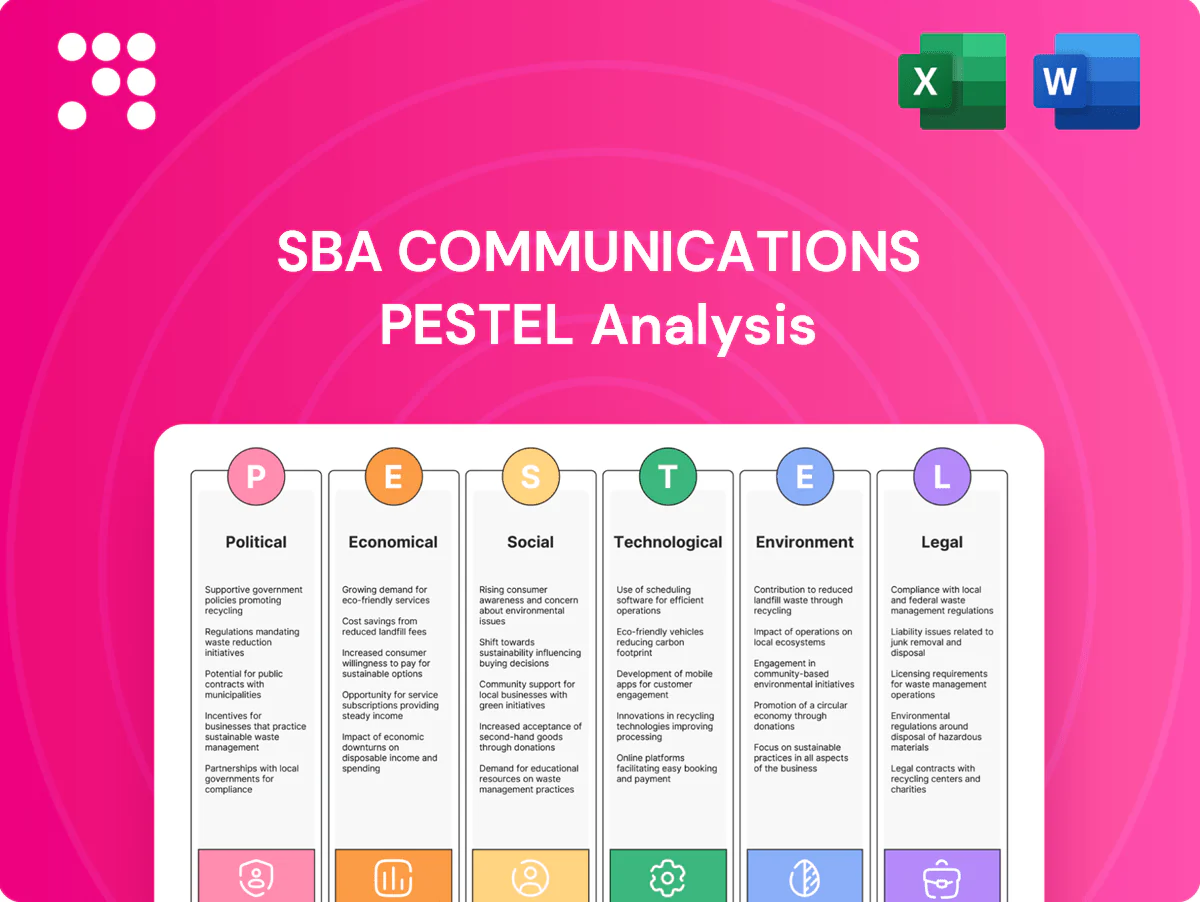
SBA Communications PESTLE Analysis

Plan Smarter. Present Sharper. Compete Stronger.
Unlock strategic clarity with our PESTLE Analysis of SBA Communications—three to five sentence snapshot revealing how political, economic, social, technological, legal, and environmental forces shape its trajectory. Ideal for investors and strategists, this ready-to-use report highlights key risks and opportunities. Purchase the full analysis to access comprehensive, actionable insights and customizable charts to inform your next decision.
Political factors

Spectrum policy and auctions
National spectrum allocation directs carrier investment and thus tower leasing demand; major auctions like the US C-band ($80.9B, 2020) and Auction 110 3.45 GHz (~$22.5B, 2023) have historically triggered accelerated radio deployments and colocation. Favorable auction outcomes correlate with higher carrier capex (Verizon 2024 capex ~18B) while delays or fragmented bands slow build-outs. SBA must monitor multi-country spectrum roadmaps to position inventory ahead of carrier spend.
Municipal siting and permitting
Local governments control zoning, setbacks and aesthetic rules that can expedite or block tower approvals; SBA operates roughly 43,000 sites (2024) so permitting speed materially affects revenue. Streamlined permits (3–4 months vs 9–12 months) accelerate cashflows while restrictive ordinances raise costs. 2024 BEAD funding $42.45B increases political pressure for coverage, and SBA’s community engagement and siting expertise mitigate local resistance.

Cross-border political risk
SBA Communications faces cross-border political risk in Latin America where election cycles and infrastructure nationalism—notably in Argentina and Venezuela with persistent currency controls—can restrict import approvals and capital repatriation, squeezing cash flows. Stable regimes enable long-term tower leases while instability pushes required discount rates higher; geographic diversification and FX/insurance hedges mitigate volatility.

Public safety and resilience priorities
Governments prioritize reliable communications for emergencies, driving requirements for site hardening and backup power and raising resilience standards that favor macro towers over small cells. The Bipartisan Infrastructure Law allocates about 65 billion dollars for broadband, which can catalyze rural tower builds and new site economics. Mandates may raise capex but deepen SBA Communications' long-term entrenchment; aligning projects with public safety objectives can secure political and funding support.
- Public safety mandates → higher resiliency capex
- 65 billion dollars (IIJA) → rural coverage catalyst
- Hardening/backup power → favors macro towers
- Alignment with public safety → access to funding/support
Trade and infrastructure incentives
Incentives for broadband expansion (IIJA included ~65 billion USD for broadband and the BEAD program at 42.45 billion USD) and CHIPS Act support for domestic equipment (≈52 billion USD) can materially lower SBA Communications deployment costs; tariffs (e.g., Section 301) raising equipment prices by up to ~25% increase capex and lead times; alignment with 5G/6G policy boosts tower utilization and SBA can access grants and partnership funding to accelerate builds.
- BEAD: 42.45B
- IIJA broadband: ~65B
- CHIPS: ~52B
- Tariffs: up to 25% equipment cost impact
- Opportunity: grant/partner acceleration
Spectrum auctions, funding and permitting reshape tower capex; tariffs and LatAm risk hit returns
Spectrum auctions (C-band $80.9B 2020; 3.45 GHz ~$22.5B 2023) drive carrier capex (Verizon 2024 capex ~$18B) and tower demand; zoning/permitting speed affects SBA’s ~43,000 sites and revenue timing. BEAD $42.45B, IIJA ~65B and CHIPS ~$52B lower deployment costs while tariffs (up to 25%) raise capex; LatAm political volatility increases FX and repatriation risk.
| Factor | Key data | Impact |
|---|---|---|
| Spectrum auctions | $80.9B; $22.5B | ↑carrier capex, colocation |
| Permitting | 43,000 sites | Revenue timing |
| Funding & tariffs | BEAD $42.45B; IIJA $65B; CHIPS $52B; tariffs ≤25% | Lower grants vs ↑capex |
| LatAm risk | Currency controls | ↑discount rates |
What is included in the product
 Detailed Word Document
Explores how macro-environmental factors uniquely affect SBA Communications across Political, Economic, Social, Technological, Environmental, and Legal dimensions, with data-backed trends and region-specific examples; designed for executives, investors, and consultants to identify threats, opportunities, and forward-looking scenarios that inform strategic planning and funding decisions.

 Customizable Excel Spreadsheet
A concise SBA Communications PESTLE summary that distills regulatory, technological, economic and environmental risks into an easily shareable, editable brief—ideal for quick alignment in meetings, slide decks or client reports to speed decision-making and reduce research overhead.
Economic factors

Carrier capex cycles
Wireless operators’ capex cycles—notably the 5G buildouts from 2020–2024—directly drive new leases and amendments, boosting colocation; capex pauses compress leasing activity. Multi-year master leases (commonly 10–15 years) smooth cashflow volatility, and SBA’s diversified tenant mix, including all major U.S. carriers, buffers revenue when a single carrier pulls back.
Interest rates and capital structure
Tower assets are long-duration cash flows highly sensitive to discount rates and funding costs; with the federal funds rate near 5.25–5.50% (July 2025) higher rates compress valuations and raise refinancing costs. SBA mitigates via fixed-rate debt ladders and REIT structure requiring ~90% distribution of taxable income. Lower rates would reopen accretive build-to-suit projects and M&A.

Inflation and lease escalators
Contracts often include fixed or CPI-linked escalators; US CPI rose 3.4% in 2024, supporting organic rent growth when resets occur. Inflation also lifts operating and build costs, potentially compressing spreads unless active spread management and tenant mix optimization preserve margins. SBA’s long-term tower leases and multi-year contracts provide pricing visibility and predictable cash flows.

Currency and emerging-market exposure
FX swings materially affect SBA Communications reported revenue and reported leverage; in 2024 roughly 30% of net lease revenue was international, creating translation effects that can move adjusted EBITDA and net-debt/EBITDA ratios by several percentage points quarter-to-quarter.
Local-currency leases versus predominantly USD debt create currency-mismatch risk; SBA uses natural hedges through mixed cash flows and derivatives (cross-currency swaps and forwards) to reduce volatility, while country mix drives both growth potential and risk-adjusted returns.
- ~30% international revenue (2024)
- USD-denominated debt concentration
- Use of cross-currency swaps/forwards
- Country mix = growth vs currency risk
Industry consolidation
Industry consolidation drives site churn as merged carriers de-duplicate towers, but large post-merger capex often follows; major US carriers spent over $15 billion each on wireless capex in 2024, supporting rebuilds and densification that benefit tower owners like SBA, which operated roughly 33,000 sites in 2024.
- De-duplication risk
- Post-merger reinvestment
- Contract protections/termination fees cushion revenue
- SBA can backfill with regional or new entrants
Spectrum auctions, funding and permitting reshape tower capex; tariffs and LatAm risk hit returns
Wireless capex cycles (5G 2020–24) drive leases; capex pauses reduce activity. Higher rates (fed funds 5.25–5.50% Jul 2025) compress valuations and raise refinancing costs; SBA mitigates via fixed-rate debt and REIT payouts. CPI 3.4% (2024) supports escalators but raises build costs. ~30% international revenue (2024) creates FX translation risk.
| Metric | Value |
|---|---|
| Fed funds (Jul 2025) | 5.25–5.50% |
| CPI (2024) | 3.4% |
| Intl revenue (2024) | ~30% |
| Sites (2024) | ~33,000 |
| Major carrier capex (2024) | >$15B each |
Same Document Delivered
SBA Communications PESTLE Analysis
The preview shown here is the exact SBA Communications PESTLE Analysis you’ll receive after purchase—fully formatted and ready to use. This professional, final document covers political, economic, social, technological, legal, and environmental factors affecting SBA Communications. No placeholders or teasers—what you see is what you’ll download immediately after checkout. Use it for due diligence, strategy, or investor presentations.

Original: $10.00
-65%$10.00
$3.50Product Information
Product Information
Shipping & Returns
Shipping & Returns
Description
Plan Smarter. Present Sharper. Compete Stronger.
Unlock strategic clarity with our PESTLE Analysis of SBA Communications—three to five sentence snapshot revealing how political, economic, social, technological, legal, and environmental forces shape its trajectory. Ideal for investors and strategists, this ready-to-use report highlights key risks and opportunities. Purchase the full analysis to access comprehensive, actionable insights and customizable charts to inform your next decision.
Political factors
Spectrum policy and auctions
National spectrum allocation directs carrier investment and thus tower leasing demand; major auctions like the US C-band ($80.9B, 2020) and Auction 110 3.45 GHz (~$22.5B, 2023) have historically triggered accelerated radio deployments and colocation. Favorable auction outcomes correlate with higher carrier capex (Verizon 2024 capex ~18B) while delays or fragmented bands slow build-outs. SBA must monitor multi-country spectrum roadmaps to position inventory ahead of carrier spend.
Municipal siting and permitting
Local governments control zoning, setbacks and aesthetic rules that can expedite or block tower approvals; SBA operates roughly 43,000 sites (2024) so permitting speed materially affects revenue. Streamlined permits (3–4 months vs 9–12 months) accelerate cashflows while restrictive ordinances raise costs. 2024 BEAD funding $42.45B increases political pressure for coverage, and SBA’s community engagement and siting expertise mitigate local resistance.
Cross-border political risk
SBA Communications faces cross-border political risk in Latin America where election cycles and infrastructure nationalism—notably in Argentina and Venezuela with persistent currency controls—can restrict import approvals and capital repatriation, squeezing cash flows. Stable regimes enable long-term tower leases while instability pushes required discount rates higher; geographic diversification and FX/insurance hedges mitigate volatility.
Public safety and resilience priorities
Governments prioritize reliable communications for emergencies, driving requirements for site hardening and backup power and raising resilience standards that favor macro towers over small cells. The Bipartisan Infrastructure Law allocates about 65 billion dollars for broadband, which can catalyze rural tower builds and new site economics. Mandates may raise capex but deepen SBA Communications' long-term entrenchment; aligning projects with public safety objectives can secure political and funding support.
- Public safety mandates → higher resiliency capex
- 65 billion dollars (IIJA) → rural coverage catalyst
- Hardening/backup power → favors macro towers
- Alignment with public safety → access to funding/support
Trade and infrastructure incentives
Incentives for broadband expansion (IIJA included ~65 billion USD for broadband and the BEAD program at 42.45 billion USD) and CHIPS Act support for domestic equipment (≈52 billion USD) can materially lower SBA Communications deployment costs; tariffs (e.g., Section 301) raising equipment prices by up to ~25% increase capex and lead times; alignment with 5G/6G policy boosts tower utilization and SBA can access grants and partnership funding to accelerate builds.
- BEAD: 42.45B
- IIJA broadband: ~65B
- CHIPS: ~52B
- Tariffs: up to 25% equipment cost impact
- Opportunity: grant/partner acceleration
Spectrum auctions, funding and permitting reshape tower capex; tariffs and LatAm risk hit returns
Spectrum auctions (C-band $80.9B 2020; 3.45 GHz ~$22.5B 2023) drive carrier capex (Verizon 2024 capex ~$18B) and tower demand; zoning/permitting speed affects SBA’s ~43,000 sites and revenue timing. BEAD $42.45B, IIJA ~65B and CHIPS ~$52B lower deployment costs while tariffs (up to 25%) raise capex; LatAm political volatility increases FX and repatriation risk.
| Factor | Key data | Impact |
|---|---|---|
| Spectrum auctions | $80.9B; $22.5B | ↑carrier capex, colocation |
| Permitting | 43,000 sites | Revenue timing |
| Funding & tariffs | BEAD $42.45B; IIJA $65B; CHIPS $52B; tariffs ≤25% | Lower grants vs ↑capex |
| LatAm risk | Currency controls | ↑discount rates |
What is included in the product
Detailed Word Document
Explores how macro-environmental factors uniquely affect SBA Communications across Political, Economic, Social, Technological, Environmental, and Legal dimensions, with data-backed trends and region-specific examples; designed for executives, investors, and consultants to identify threats, opportunities, and forward-looking scenarios that inform strategic planning and funding decisions.
Customizable Excel Spreadsheet
A concise SBA Communications PESTLE summary that distills regulatory, technological, economic and environmental risks into an easily shareable, editable brief—ideal for quick alignment in meetings, slide decks or client reports to speed decision-making and reduce research overhead.
Economic factors
Carrier capex cycles
Wireless operators’ capex cycles—notably the 5G buildouts from 2020–2024—directly drive new leases and amendments, boosting colocation; capex pauses compress leasing activity. Multi-year master leases (commonly 10–15 years) smooth cashflow volatility, and SBA’s diversified tenant mix, including all major U.S. carriers, buffers revenue when a single carrier pulls back.
Interest rates and capital structure
Tower assets are long-duration cash flows highly sensitive to discount rates and funding costs; with the federal funds rate near 5.25–5.50% (July 2025) higher rates compress valuations and raise refinancing costs. SBA mitigates via fixed-rate debt ladders and REIT structure requiring ~90% distribution of taxable income. Lower rates would reopen accretive build-to-suit projects and M&A.
Inflation and lease escalators
Contracts often include fixed or CPI-linked escalators; US CPI rose 3.4% in 2024, supporting organic rent growth when resets occur. Inflation also lifts operating and build costs, potentially compressing spreads unless active spread management and tenant mix optimization preserve margins. SBA’s long-term tower leases and multi-year contracts provide pricing visibility and predictable cash flows.
Currency and emerging-market exposure
FX swings materially affect SBA Communications reported revenue and reported leverage; in 2024 roughly 30% of net lease revenue was international, creating translation effects that can move adjusted EBITDA and net-debt/EBITDA ratios by several percentage points quarter-to-quarter.
Local-currency leases versus predominantly USD debt create currency-mismatch risk; SBA uses natural hedges through mixed cash flows and derivatives (cross-currency swaps and forwards) to reduce volatility, while country mix drives both growth potential and risk-adjusted returns.
- ~30% international revenue (2024)
- USD-denominated debt concentration
- Use of cross-currency swaps/forwards
- Country mix = growth vs currency risk
Industry consolidation
Industry consolidation drives site churn as merged carriers de-duplicate towers, but large post-merger capex often follows; major US carriers spent over $15 billion each on wireless capex in 2024, supporting rebuilds and densification that benefit tower owners like SBA, which operated roughly 33,000 sites in 2024.
- De-duplication risk
- Post-merger reinvestment
- Contract protections/termination fees cushion revenue
- SBA can backfill with regional or new entrants
Spectrum auctions, funding and permitting reshape tower capex; tariffs and LatAm risk hit returns
Wireless capex cycles (5G 2020–24) drive leases; capex pauses reduce activity. Higher rates (fed funds 5.25–5.50% Jul 2025) compress valuations and raise refinancing costs; SBA mitigates via fixed-rate debt and REIT payouts. CPI 3.4% (2024) supports escalators but raises build costs. ~30% international revenue (2024) creates FX translation risk.
| Metric | Value |
|---|---|
| Fed funds (Jul 2025) | 5.25–5.50% |
| CPI (2024) | 3.4% |
| Intl revenue (2024) | ~30% |
| Sites (2024) | ~33,000 |
| Major carrier capex (2024) | >$15B each |
Same Document Delivered
SBA Communications PESTLE Analysis
The preview shown here is the exact SBA Communications PESTLE Analysis you’ll receive after purchase—fully formatted and ready to use. This professional, final document covers political, economic, social, technological, legal, and environmental factors affecting SBA Communications. No placeholders or teasers—what you see is what you’ll download immediately after checkout. Use it for due diligence, strategy, or investor presentations.